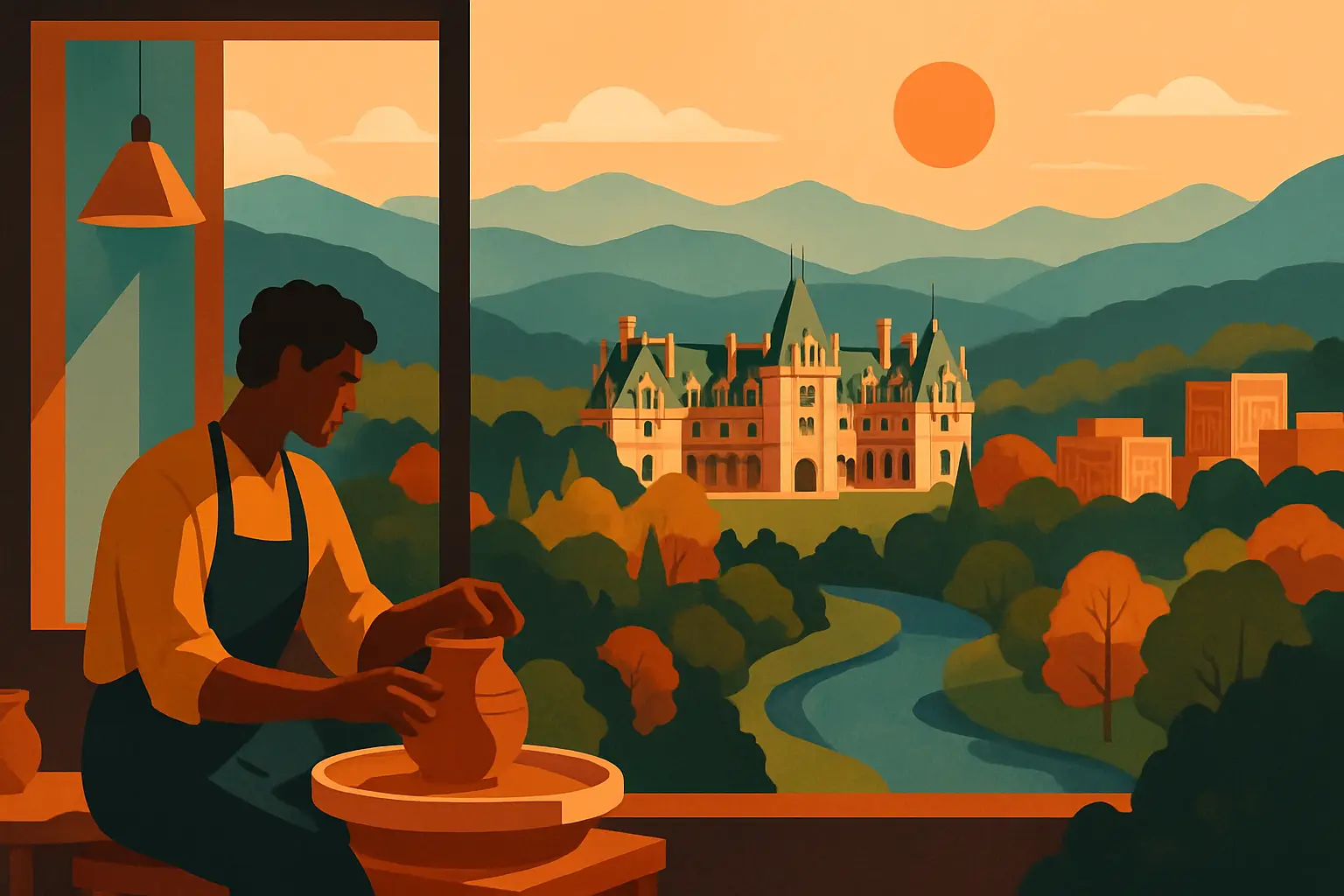
Asheville is a year-round destination, but September occupies a specific sweet spot most guides miss. The summer humidity breaks — highs drop from the mid-80s to the mid-70s, and evenings in the mountains turn crisp. The peak fall foliage, which draws enormous crowds in mid-to-late October, hasn't started. Restaurants booked two weeks out in July often have same-week availability.
The summer festival season extends into early September: the Lexington Avenue Arts and Fun Festival (LAAFF) typically falls mid-month, turning Lexington Avenue into a block party with local bands and vendors. The Western North Carolina Farmers Market peaks with fall produce.
For foliage watchers who want color without the I-40 parking-lot traffic: the Blue Ridge Parkway sees first color at its highest elevations (above 5,000 feet) by late September — Mount Mitchell State Park and the area near Craggy Gardens show it first. September visitors catch the preview without the weekend backups.
The River Arts District (RAD) runs along Depot Street and the French Broad River for roughly two miles south of downtown Asheville. What makes it different from most 'arts districts' is the word 'working' — these are not galleries that happen to display art. These are operating studios where potters throw clay, painters are mid-canvas, glassblowers work their furnaces, and printmakers pull runs on antique presses. You can walk in off the street and watch.
The buildings are former industrial structures: the River Arts District grew in the 1990s and 2000s as artists claimed cheap space in old rail freight depots, textile mills, and icehouses along the French Broad. The Wedge Building at 125 Roberts Street holds a cluster of fine-art studios and the Wedge Brewing Company taproom, a longtime neighborhood anchor. The Cotton Mill Studios at 122 Riverside Drive converted a 1905 cotton mill into 30 individual studios — ceramics, jewelry, fiber arts, printmaking — all open to the public during studio hours.
Ben Owen III, whose family has been making traditional North Carolina pottery for four generations (his grandfather taught at Penland School of Crafts), keeps a studio in the RAD. Watching him work a wheel is a connection to a craft tradition that runs 400 years deep in the NC Piedmont.
The RAD Brew Trail links nine breweries within the district — Wedge, New Belgium's Asheville outpost, Burial Beer Co. — making it possible to tour studios in the morning and walk to taprooms in the afternoon without moving your car.
RAD Studio hours: most open Tuesday–Saturday, 10 a.m.–5 p.m.; the RAD Studios map (free, downloadable) lists all 200+ by building and medium
Wedge Building: 125 Roberts St — studio cluster plus Wedge Brewing taproom
Cotton Mill Studios: 122 Riverside Dr — 30 working studios in an 1895 textile mill; printmakers, jewelers, ceramicists
New Belgium Brewing: 21 Craven St — the Asheville outpost of the Fort Collins-founded brewery, with river views and a large outdoor patio
Get short, interactive stories that make each place easier to remember while you travel.
Downtown Asheville is geographically small — Pack Square Park at its center, Lexington Avenue running north, Biltmore Avenue running south, Battery Park to the west — and navigable on foot. The architecture is the first thing to notice: downtown Asheville survived the Great Depression economically devastated, which meant developers couldn't afford to tear buildings down and rebuild. The result is one of the best-preserved Art Deco and Beaux-Arts downtowns in the American South. The S&W Building (1929, 56 Patton Ave) has a terra-cotta facade with geometric ornamentation that stops people mid-sidewalk. The Flatiron Building at 20 Battery Park Avenue predates the more famous New York structure by six years.
The food scene is the subject of genuine national conversation. Chef Katie Button's Cúrate (11 Spain St) serves modern Spanish tapas — specifically the food of Extremadura, where she trained — with an ingredient sourcing discipline that has earned consistent James Beard recognition. The bar at Cúrate alone is worth the trip. Chai Pani (22 Battery Park Ave), a James Beard Award winner for Outstanding Restaurant in 2022, serves Indian street food — dahi puri, bhel puri, kathi rolls — in a counter-service format that remains one of the most specific and delicious restaurant experiences in the South. Biscuit Head (multiple locations) is the regional answer to anyone who thinks biscuits are simple: cat-head biscuits the size of a fist, served with rotating seasonal gravies and a jam bar.
Lexington Avenue is the street that shows Asheville's independent streak — no national chains, murals on nearly every building, a head shop next to a letterpress studio next to a ramen counter. The Malaprop's Bookstore & Cafe (55 Haywood St) is the kind of independent bookstore that reminds you why physical bookstores still matter, with a staff curation and events calendar that punches hard.
George Vanderbilt began construction on Biltmore House in 1889, at age 25, on an inheritance from his grandfather Cornelius Vanderbilt's railroad fortune. He hired architect Richard Morris Hunt — who also designed the Met's Fifth Avenue facade — and landscape designer [Frederick Law Olmsted](/us/blog/who-was-frederick-olmsted-central-park), who had just finished Central Park. Construction required a private railroad to haul Indiana limestone into the mountains. When Biltmore opened on Christmas Eve 1895, it was the largest private residence in the United States. It still is.
The numbers: 250 rooms, 35 bedrooms, 43 bathrooms, a bowling alley, an indoor swimming pool, and a pipe organ in the Banquet Hall. The 8,000 remaining acres (the original estate was 125,000 before Vanderbilt donated land to Pisgah National Forest) include managed forests, a 1,800-acre working farm, and trails connecting to the Blue Ridge Parkway.
The Winery, in the estate's former Dairy Barn, is included in the estate ticket. Biltmore produces more wine than any East Coast winery — 150,000+ cases annually. The four-acre Walled Garden, designed by Olmsted with Italian Renaissance proportions, peaks again in early fall.
For accommodation: Biltmore's Inn on Biltmore Estate ($400–$700/night) allows 8 a.m. early entry — an hour before general admission opens. The practical alternative is staying downtown (15 minutes by car) and arriving at the 9 a.m. opening.
West Asheville, separated from downtown by the I-240 overpass, has developed its own identity — less polished, more residential, with a walkable commercial strip on Haywood Road that fills gaps downtown prices out. Sunny Point Cafe (626 Haywood Rd) is the institution: weekend brunch waits run 45 minutes, the biscuits are architectural, and the outdoor patio operates year-round. Burial Beer Co. maintains its original taproom at 40 Collier Ave — a small-batch release program that has drawn national craft beer attention. West End Bakery (757 Haywood Rd) is the neighborhood's coffee anchor.
North Asheville, heading up Merrimon Avenue, is where Vanderbilt-era summer cottage architecture is densest — Queen Anne and Arts and Crafts homes on shaded lots. The Grove Park Inn (290 Macon Ave) is a 1913 resort hotel built from 180-ton boulders quarried from Sunset Mountain, with two massive fireplaces in the Great Hall that burn 12-foot logs. F. Scott Fitzgerald stayed here in 1935 and 1936 while Zelda was treated at Highland Hospital nearby; the hotel's bar is named for him.
Black Mountain (15 minutes east on I-40) is a small town that punches culturally beyond its size because of Black Mountain College, the experimental arts school that operated from 1933 to 1957 and trained Josef and Anni Albers, Buckminster Fuller, John Cage, and Robert Rauschenberg. The Black Mountain College Museum + Arts Center is in downtown Asheville at 56 Broadway — the former campus on Lake Eden now hosts music festivals each fall. The town itself has a dense strip of independent galleries.
Hot Springs (45 minutes northwest on US-25) sits at the point where the Appalachian Trail passes through a town center — one of the few places on the 2,190-mile trail where you step off into a restaurant. The Hot Springs Resort and Spa has natural mineral hot spring tubs along the Spring Creek riverbank; book a private outdoor tub for two hours.
The Blue Ridge Parkway passes directly through Asheville. The 469-mile scenic highway has no commercial development or traffic signals; the speed limit is 45 mph by design. The stretch north to Craggy Gardens (Milepost 364, about 18 miles) ends at a trailhead where a 45-minute walk through heath balds opens to 360-degree views. In late September, the balds catch first color before the valleys below.
Is Asheville overhyped? The counterargument to the hype is that Asheville's density of independently owned restaurants, working artists, and genuine cultural institutions per square mile is difficult to find in any American city its size. The hype draws crowds; the crowds don't negate the underlying quality. What has changed: downtown hotel prices have risen sharply since 2022, and some blocks on Lexington Avenue that were artist-run businesses are now gift shops. But West Asheville, the River Arts District, and the food scene remain the real thing.
What happened after Hurricane Helene (2024)? Asheville and the surrounding region took severe flood damage from Hurricane Helene in September 2024. Recovery has been substantial: most downtown businesses have reopened, the River Arts District is largely operational again (several studios were destroyed by flooding and rebuilt), and the French Broad River greenway has been repaired. As of 2026, Asheville is open and functioning — visiting supports a community that invested heavily in rebuilding. A handful of RAD buildings closest to the river remain under reconstruction.
How long should I spend? Two full days gets you the River Arts District, downtown food and architecture, and one evening. Three days adds Biltmore and a day trip to Black Mountain or Hot Springs. Four days allows a full Blue Ridge Parkway loop and a second pass through neighborhoods you rushed on the first day.
Where should I stay? Downtown gives the most walkability — Hotel Arras (7 Patton Ave) and Cambria Hotel Asheville Downtown (15 Page Ave) are well-positioned. For a quieter alternative, several bed and breakfasts operate in the North Asheville historic neighborhoods at lower price points than downtown hotels. Avoid the chain hotels clustered around the I-26 interchange unless you are primarily driving to the Biltmore.