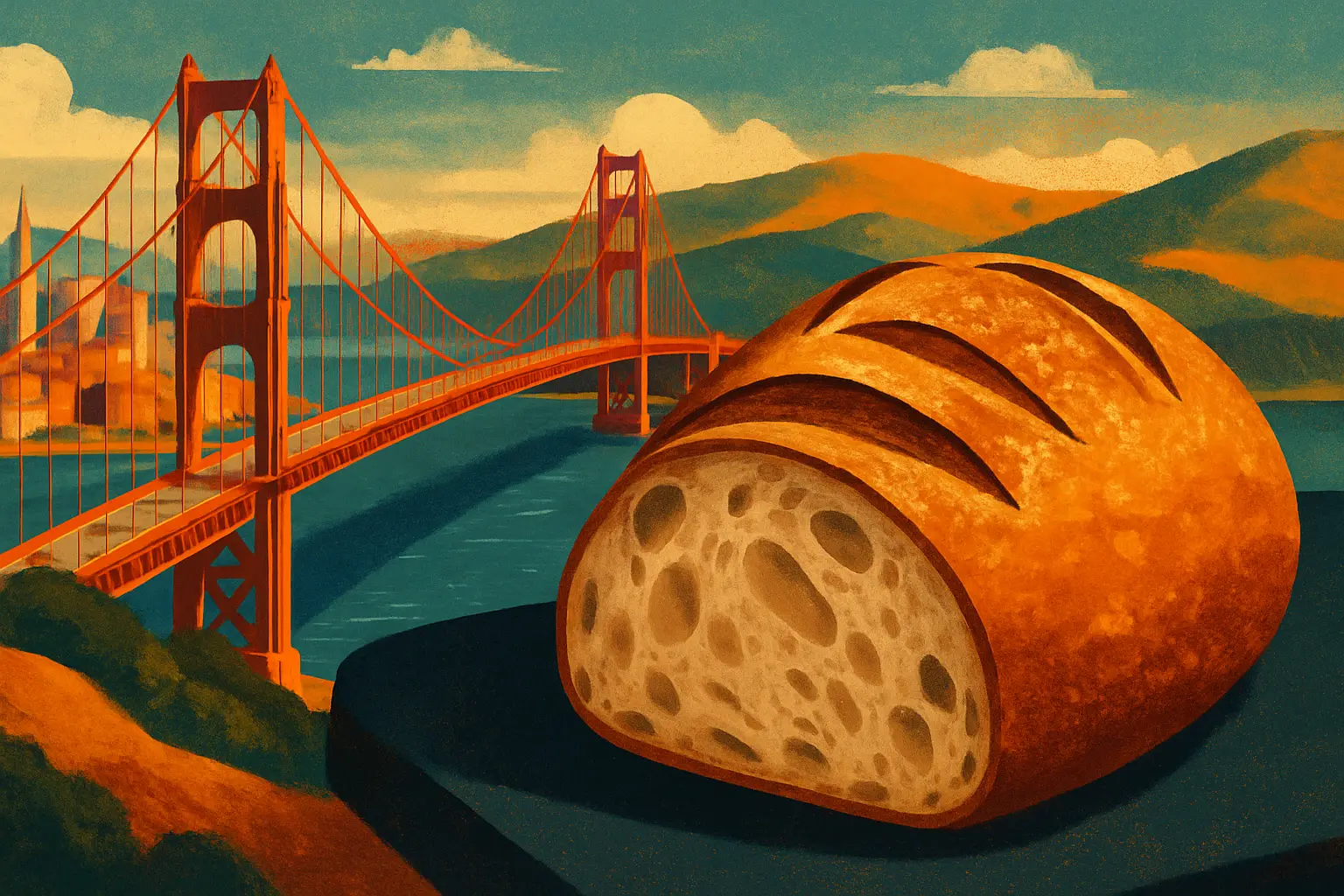
1. The 1849 Origin: How a Gold Rush Baker Started a Tradition That Never Stopped
Isidore Boudin arrived in San Francisco in 1849, one year into the California Gold Rush, and opened a small bakery on the corner of Dupont and Washington Streets (now Grant Avenue in Chinatown). The timing was deliberate: thousands of newly arrived miners needed to eat, and the city had very few working ovens. What Boudin did differently was capture and cultivate the wild yeast floating in the Bay Area air, mixing it with flour and water to create a living starter that would leaven bread indefinitely without the commercial yeast that hadn't yet become widely available.
That original starter culture — called the 'mother dough' — has been kept alive and refreshed daily in the 177 years since. The bakery changed hands within the Boudin family, grew into a significant San Francisco institution, and survived the 1906 earthquake and fire. According to the Boudin family record, Louise Boudin carried the mother dough out of the burning city in a wooden bucket during the chaos of April 18, 1906, protecting it as everything around the neighborhood collapsed. The bakery reopened a few months after the fire, using the same culture that survives to this day.
Boudin Bakery is one of the oldest continuously operating businesses in California. Most Gold Rush-era enterprises folded within a decade. Boudin is still baking on the same block of San Francisco history, with the same starter, 175 years later — which is the kind of continuity most American food traditions can only approximate.
2. The Science: Why San Francisco Sourdough Tastes Different Anywhere Else
The distinctive tang of San Francisco sourdough comes primarily from a bacterium called Fructilactobacillus sanfranciscensis (formerly Lactobacillus sanfranciscensis, renamed in 2020) — a microorganism first isolated from SF sourdough starters in the 1970s and named specifically for the city. It appears in high concentrations in the Bay Area's wild yeast populations and is the primary driver of the acetic acid — vinegar-type sharpness — that defines the flavor profile.
The local climate amplifies this effect in ways that cannot be fully replicated elsewhere. San Francisco's fog keeps daytime summer temperatures between 55 and 65°F for much of the year — dramatically cooler than virtually any other American city. Cold temperatures slow fermentation, and slower fermentation produces more acetic acid (which is sharper and more assertive) relative to lactic acid (which is milder and slightly sweet). The combination of the right bacteria and the right temperature creates the sour profile that distinguishes an SF loaf from sourdough made with the same starter in Dallas or Chicago.
This is why bakers who move SF sourdough starters to other cities report that the flavor gradually shifts over months: the local microbial population of a new city colonizes the starter and begins to change its character. The starter's genetics change; the climate changes; the bread changes. A true San Francisco sourdough is bound to this specific geography in a way that most foods are not. It is one of the few American foods where the concept of terroir — the idea that place directly shapes flavor — applies in a scientifically verifiable sense.
3. Boudin Bakery at Fisherman's Wharf: Museum, Mother Dough, and a Bread Bear
The main Boudin Bakery and Café is at 160 Jefferson Street, the eastern end of Fisherman's Wharf near Pier 43 1/2. The building is hard to miss — it has a large glass wall facing the sidewalk along Jefferson Street where the entire bread-shaping and baking operation is visible from the street, free of charge. Bakers work from approximately 5 a.m. to noon, rolling, scoring, and loading roughly 3,000 loaves a day into stone-deck ovens. A morning visit during the working window is worth planning around.
The Boudin Museum occupies the second floor ($5–$7 admission) and covers the full arc of the bakery's history: the Gold Rush founding, the 1906 earthquake documentation, the family ownership lineage, and the science behind the fermentation. It is small — you can cover it in 30 minutes — but the photographs of 1906 San Francisco and the preserved equipment from the early 20th century are genuine.
The restaurant attached to the bakery serves sourdough bread bowls filled with clam chowder, which is the quintessential Fisherman's Wharf experience and, unlike many tourist-area food choices, is genuinely worth having once. The bread bowl itself is a boule hollowed out and toasted, which concentrates the sour crust — the last few bites of bread soaked in chowder are frequently the best bites of the meal. Boudin also sells shaped sourdough novelties — a bread crab, a bread bear, bread alligators — that are primarily for tourists and primarily for Instagram. They taste fine. The serious bread is in the plain round loaves.
4. Tartine Bakery: The Bread That Changed American Home Baking
Tartine Bakery opened at 600 Guerrero Street in the Mission District in 2002, founded by Chad Robertson and Elisabeth Prueitt. Robertson had trained at a farm bakery in the Auvergne region of France and spent years refining a specific approach to sourdough: a very wet dough, a long slow fermentation, and a bake that produces a thick, crackling, deeply caramelized crust with an open, irregular crumb inside. The resulting loaf looks nothing like a standard sourdough; it looks like bread that was made with serious intention.
In 2010, Robertson published Tartine Bread — a cookbook that detailed his method with unusual specificity, including the precise water temperatures, timing windows, and visual cues he uses to judge fermentation. The book sold hundreds of thousands of copies and directly precipitated the home sourdough movement that would accelerate to pandemic proportions by 2020. If you know someone who bakes sourdough at home, there is a reasonable chance their method traces back to this book.
The daily country bread loaves available at the bakery on Guerrero Street are not particularly sour — Robertson's method produces a milder, more lactic profile than Boudin's assertive tang. What makes the Tartine loaf different is the crust: thick, shattering, deeply golden-brown with an interior that has more open air pockets and more complex wheat flavor than almost anything else available in the city. A loaf runs $20–$22. It is not cheap. It earns the price.
Note that Tartine also operates Tartine Manufactory at 595 Alabama Street in the Dogpatch neighborhood, open daily with a broader menu and shorter bread queues — a better option if you want to eat there rather than take a loaf home.
5. Four More SF Sourdough Bakeries Worth Knowing
San Francisco's bread scene extends well beyond Boudin and Tartine. These four bakeries each represent a distinct approach worth seeking out.
•**Acme Bread Company (Ferry Building Marketplace, One Ferry Building)** — Founded in Berkeley in 1983 by Steve Sullivan, a former Chez Panisse busboy who became obsessed with French boulangerie. Acme was one of the first American bakeries to take artisan sourdough seriously before it was fashionable. The Ferry Building stall is the most convenient SF location; the levain baguette and the pain de mie are both exceptional. Open Tuesday through Sunday from 8 a.m.
•**The Mill (736 Divisadero Street, NoPa)** — Co-owned by Josey Baker (yes, his real name), who focuses on whole-grain and heritage wheat loaves fermented with a rye starter. Became famous for thick-cut 'four-dollar toast' — country bread sliced thick, griddled, and served with toppings. The loaves themselves are nuttier and more complex than most sourdoughs because of the whole-grain component. The café opens at 7 a.m. daily; bread is usually available until late afternoon.
•**Arizmendi Bakery (1268 Valencia Street, Mission District; and 1331 9th Avenue, Inner Sunset)** — Worker-owned cooperative bakeries operating since 1997, modeled on the Mondragon cooperatives of the Basque Country. The seeded sourdough — a large batard loaded with sesame, poppy, and fennel seeds — is one of the most distinctive loaves in the city. Prices are lower than Tartine; quality is consistently high. Both locations open at 7 a.m., closed Mondays and Tuesdays.
•**Rize Up Bakery (2278 Market Street, Castro; and Ferry Building)** — Founded by Azikiwee Anderson, a Black baker whose naturally leavened breads have a following that extends well beyond the Castro. The Pullman (a square-sided sandwich loaf with a substantial sourdough tang) is unusual in the SF bread scene and worth seeking out. Shorter lines than Tartine and a more casual environment — you can usually walk up and buy a loaf without waiting.
6. What Separates Great SF Sourdough From a Mediocre Loaf
The San Francisco name on a loaf does not guarantee anything. These are the four dimensions that separate a genuinely excellent SF sourdough from bread that's merely sour.
Crust integrity. A great sourdough crust is thick — at least a few millimeters — and shatters when you cut it, sending crumbs across the counter. A thin, soft, flexible crust indicates under-baking or a dough that wasn't fermented long enough to build proper structure. The crust should crackle audibly when you press it gently with a fingertip.
The crumb (the interior). Open, irregular holes indicate a properly fermented, high-hydration dough. A tight, uniform crumb — like sandwich bread — indicates a dough that either didn't ferment long enough or had too little water to develop proper gluten structure. The holes should vary in size, and the interior color should be creamy rather than stark white.
The tang level. Real SF sourdough should have a noticeable sour note — this is not optional. But the sourness should accompany wheat flavor, not mask it. If the bread tastes primarily of vinegar with no underlying grain complexity, the fermentation was too long or the starter was too acidic.
Freshness. Sourdough is best within 6 hours of baking and still good the following day if stored cut-side down on a cutting board (not in a plastic bag, which softens the crust). By day three, the crumb tightens and the tang flattens. Most SF bakeries sell day-old loaves at a discount — Arizmendi and The Mill both do this regularly.
7. FAQ: Prices, Hours, and Getting the Real Thing Home
How much does a loaf cost? Expect $14–$22 for a full loaf at the bakeries on this list. Tartine and Rize Up are at the higher end ($20–$22); Arizmendi is at the lower end ($8–$12). Boudin's supermarket-style round loaves run $10–$15. The price gap reflects ingredient costs, fermentation time, and labor — a loaf that spent 24 hours fermenting costs more to make than one that spent four.
Is the Boudin on Fisherman's Wharf worth visiting if I also want to eat? Yes for the sourdough bread bowl experience and the observation window. Less so if you want to buy a loaf to eat at home — the bread bowls are the format where Boudin's sourdough shines, and the Wharf environment is genuinely enjoyable if you aren't in a hurry. For a plain loaf, Acme at the Ferry Building is a better choice in the same waterfront zone.
Can I take sourdough home on a plane? Sourdough travels better than most bakery items because the acidity inhibits mold. A fresh loaf will stay good for two to three days at room temperature. If your flight is longer or you want to extend the shelf life: let the loaf cool completely, wrap it tightly in plastic, freeze it, and pack it frozen in your checked luggage. It will thaw during the flight. Reheat at 400°F for 12–15 minutes and the crust revives significantly.
Why does the SF sourdough I had last year taste different this year? Living starters evolve. Even Boudin's mother dough, refreshed daily for 175 years, responds to seasonal shifts in ambient temperature and humidity. Summer bakes tend to be milder and slightly less sour because warmer temperatures speed fermentation and favor lactic acid production; winter bakes are often tangier. This variability is a feature, not a defect — it is what distinguishes living bread from engineered bread.