1. The 1921 Flood That Made the River Walk Necessary
The San Antonio River Walk exists because fifty people died.
On the night of September 9–10, 1921, a slow-moving storm dropped more than 20 inches of rain on the Edwards Plateau northwest of the city and sent a wall of water down the San Antonio River basin. By the time floodwaters peaked through downtown, the river had risen 12 feet above flood stage. Basements filled in minutes. Bridges were swept away. The flood killed 50 people in San Antonio and caused millions of dollars in damage.
Within weeks, city engineers were arguing over the solution. The dominant proposal: line the river's downtown bend in concrete and either convert it into a covered storm drain or box it under a road. Several city blocks would gain a new street. The riverbed would disappear entirely.
A handful of civic voices pushed back. What San Antonio had, they argued, was not a flood-control problem but an asset that happened to flood. The horseshoe-shaped bend of the river through downtown — already called the Great Bend — ran through some of the city's oldest commercial blocks and sat 20 feet below street level in a natural amphitheater of cypress trees and limestone walls. Covering it would destroy the one feature that made downtown San Antonio genuinely distinctive.
The city built bypass channels around the Great Bend to divert floodwaters — the system that still functions today — and the question of what to do with the old channel settled into an eight-year debate.
2. Robert Hugman's 1929 Proposal: Venice Meets New Orleans in Texas
In 1929, a San Antonio architect named Robert H.H. Hugman submitted a proposal to the city that reframed the problem entirely.
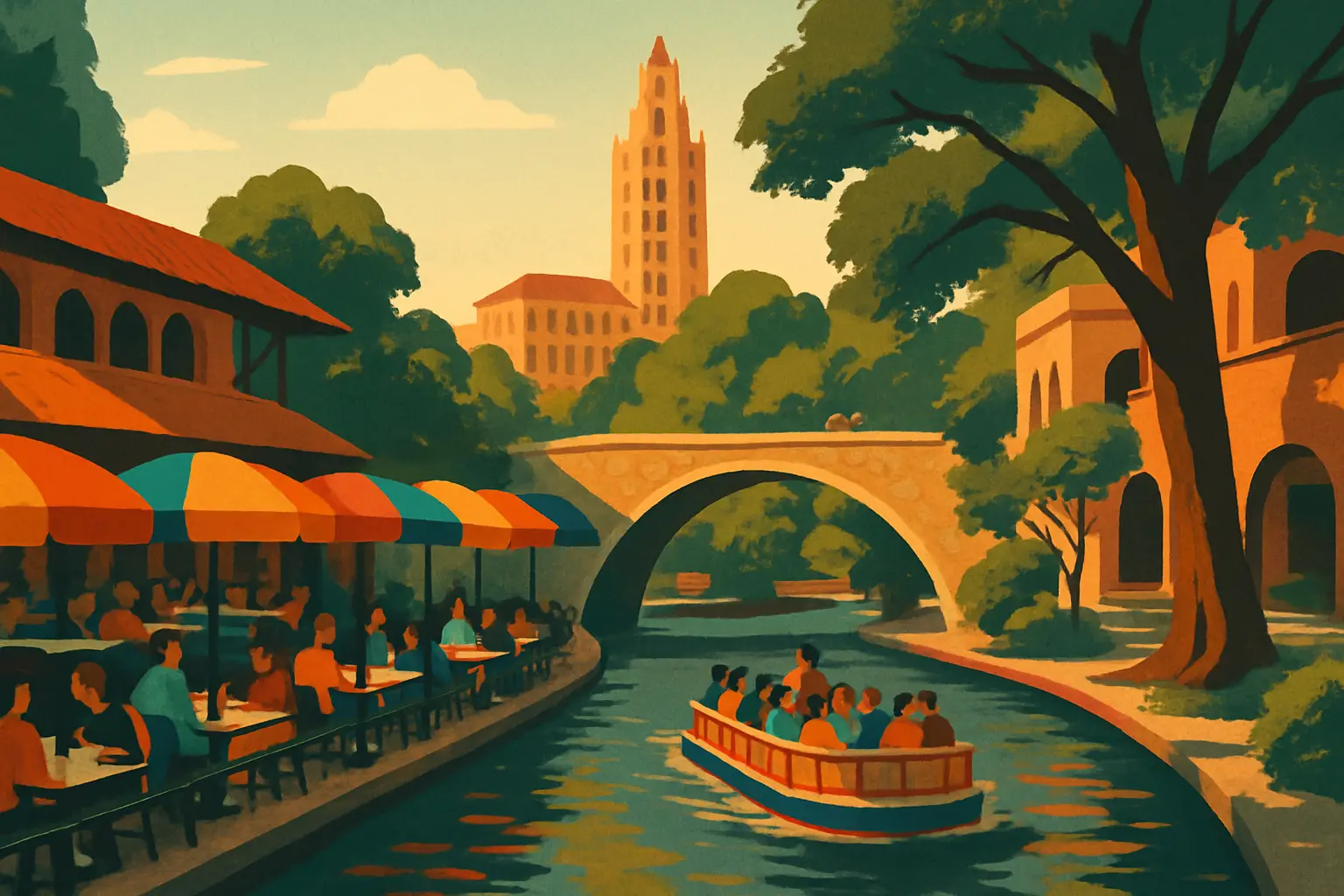
Hugman had grown up in San Antonio and studied architecture in New Orleans, where he was influenced by the French Quarter's arcaded walkways and by canal cities in Europe. His proposal — which he titled 'The Shops of Aragon and Romula' — imagined the Great Bend's waterway as a Spanish colonial pedestrian district: flagstone walkways at river level, small shops and restaurants built into the cypress-shaded banks, stone footbridges connecting the two sides at intervals, open-air staircases rising to street level, and terraced gardens where the walls of the channel met the water.
The proposal was beautiful and specific and had no immediate funding source. Hugman spent the rest of the 1930s lobbying the city commission. The critical intervention came through the Works Progress Administration — the New Deal employment program that funded public construction nationwide. San Antonio applied for WPA funding, and in 1939, construction began. The city contributed matching funds; the WPA provided labor and materials.
Hugman served as supervising architect. His design produced 21 stone footbridges, 31 stairways, 17,000 feet of flagstone walks, and hundreds of cypress and oak trees transplanted into the channel. The project was completed in 1941. In a bitter footnote, Hugman was fired from the project in 1940 over a contract dispute before the opening. He was not invited to the opening ceremony. The Paseo del Río — the River Walk — opened without him.
Hugman died in 1980, having spent his later years advocating for the preservation of the system he designed.
3. HemisFair 1968: When the River Walk Became a Tourism Economy
The River Walk that Hugman built was appreciated locally but not a major tourist draw through the 1950s. The transformation came in 1968, when San Antonio hosted HemisFair '68 — a World's Fair themed around 'The Confluence of Civilizations in the Americas.'
The fairgrounds occupied 92 acres immediately southeast of the Great Bend. The city extended the River Walk channel to connect to the fair entrance, added new stairways and lighting, and built two major hotels directly on the river: the Hilton Palacio del Rio — famously constructed in 90 days using prefabricated room modules craned into a steel frame — and La Mansión del Rio. The convention center was designed with River Walk access at its lower level.
The fair's signature structure, the Tower of the Americas, remains the tallest observation tower in Texas and still operates a rotating restaurant near its summit. The Institute of Texan Cultures, built for HemisFair, is now part of the University of Texas at San Antonio. The fairgrounds became HemisFair Park.
The 1968 infrastructure created the economic model — hotels connected directly to the waterway, convention attendees dining at river-level restaurants — that has defined the neighborhood ever since. San Antonio's tourism economy is now second only to Dallas in Texas, and the River Walk is its anchor.
4. The Museum Reach: North to the Pearl
When the city extended the River Walk northward in 2009, adding 1.3 miles called the Museum Reach, it connected the Great Bend to a stretch of the city that most tourist itineraries had never included.
The Museum Reach passes the San Antonio Museum of Art (200 W Jones Ave), housed since 1981 in the former Lone Star Brewery — a 1904 industrial complex with water tanks converted to sky-lit galleries that now hold one of the largest Latin American art collections in the United States. The river path runs directly alongside the brewery's brick foundation.
At the northern end of the Museum Reach is the Pearl: 22 acres of the former Pearl Brewing Company campus (founded 1883, closed 2001), redeveloped into restaurants, boutiques, a hotel, and the Culinary Institute of America San Antonio campus. The Pearl's anchor is Hotel Emma, opened in 2015 inside the restored 1894 brewhouse building — the hotel's lobby occupies the former brew kettle room, with original copper equipment retained as architectural features. It appears regularly on national lists of the best boutique hotels in the United States.
The walk from the Great Bend to the Pearl along the Museum Reach takes about 20–25 minutes on flat paved path. It is significantly less crowded than the main tourist loop and opens up the part of San Antonio that visitors most consistently say they wished they'd found sooner.
5. The Mission Reach: 8 Miles to the Spanish Missions
The Mission Reach is the 8-mile southern extension of the River Walk, completed in 2013, and it is both the least-visited and most historically significant part of the system.
The trail runs south from the Great Bend through parks and natural riverbank habitat to Mission Espada, the southernmost of San Antonio's Spanish colonial missions. Along the route, it connects four missions that are part of San Antonio Missions National Historical Park — collectively designated a UNESCO World Heritage Site in 2015, the only such site in Texas.
The missions, north to south:
- Mission Concepción (807 Mission Rd) — the best-preserved 18th-century church in the United States; the original geometric frescoes on the facade are still faintly visible in certain angles of light.
- Mission San José (6701 San José Dr) — the largest, with the baroque 'Rosa's Window' carved into the south sacristy wall, one of the finest examples of Spanish colonial stonework in North America.
- Mission San Juan (9101 Graf Rd) — smaller and quieter, with a significant agricultural history that supplied many of the surrounding missions.
- Mission Espada (10040 Espada Rd) — the most remote; its acequia (irrigation ditch) system, still partially operational, is among the oldest functioning irrigation works in the United States.
All four missions are free to visit. The Mission Reach trail is primarily a cycling and walking path; bike rentals are available near the Great Bend. A round trip by bike to Mission Concepción, the nearest, takes about 60–90 minutes.
6. Where to Eat: Specific Picks on the River Walk and Nearby
The main tourist loop has several dozen restaurants. Most are priced for tourist volume rather than local quality. These are the exceptions.
•Boudro's Texas Bistro — 421 E Commerce St (on the River Walk): the tableside guacamole made with roasted jalapeño and fresh citrus has been on the menu since 1990 and is the best version in downtown San Antonio. Gulf seafood and blackened prime rib anchor the menu. Make a reservation — it fills quickly on weekends.
•The Esquire Tavern — 155 E Commerce St: On the River Walk since 1933, one of the oldest bars in Texas. Claimed to have the longest bar in Texas at 100 feet. Cocktails are the reason to come.
•Ostra — 212 W Crockett St (inside the Mokara Hotel): the most upscale restaurant on the main loop, with a Gulf Coast-focused menu and a good oyster program. Less noisy than most River Walk options.
•La Gloria — 100 E Grayson St (Pearl): regional Mexican street food by Chef Johnny Hernandez. Tlayudas, memelas, and tacos al vapor are the best versions in the city. A 25-minute walk north from the Great Bend via the Museum Reach.
•Cured — 234 E Grayson St (Pearl): house-cured charcuterie, Gulf fish, and seasonal vegetable cooking in a renovated industrial space. One of the best restaurants in San Antonio regardless of neighborhood.
7. Is the River Walk Worth Visiting? (FAQ)
How long should I plan for? The main tourist loop takes 45–60 minutes to walk without stopping. Add 35 minutes for a Go Rio boat tour, 60–90 minutes if you stop at restaurants. Factoring in the Museum Reach walk to the Pearl and back, a full River Walk day is 5–6 hours. Pairing it with the Alamo — a 5-minute walk from the loop — adds 60–90 minutes.
How hot is it in August? Honest answer: very. San Antonio temperatures in August regularly exceed 100°F. The River Walk's channel is about 20 feet below street level, offering some shade and a river breeze, but the sun is strong from 10 a.m. onward. Plan outdoor activity before 10 a.m. or after 6 p.m. and build in midday time at air-conditioned restaurants or museums. October through April is considerably more pleasant.
Is it safe? The main tourist loop and Museum Reach are well-lit, heavily trafficked, and staffed during operating hours. The Mission Reach is well-maintained but more isolated — better to go by bike, or with company, and stick to the northern sections (near Mission Concepción) if exploring solo after dark.
How do I get there? San Antonio International Airport (SAT) is about 8 miles from downtown — 15–20 minutes by rideshare with no traffic. Direct flights serve New York, Los Angeles, Chicago, Denver, and most major US hubs. Once downtown, the River Walk and Alamo are walkable; a car or rideshare is useful for the Mission Reach and the Spanish missions farther south.
What about the Alamo? The Alamo (300 Alamo Plaza) is a 5-minute walk from the River Walk's main loop, up a staircase and across Alamo Street. Admission is free, hours run 9 a.m.–5:30 p.m. daily (extended in summer). The chapel is smaller than most visitors expect — the 1836 battle took place over 13 days across the full 3-acre compound, most of which has been built over — but the exhibition inside the Long Barrack museum is detailed and worth the 45-minute commitment.