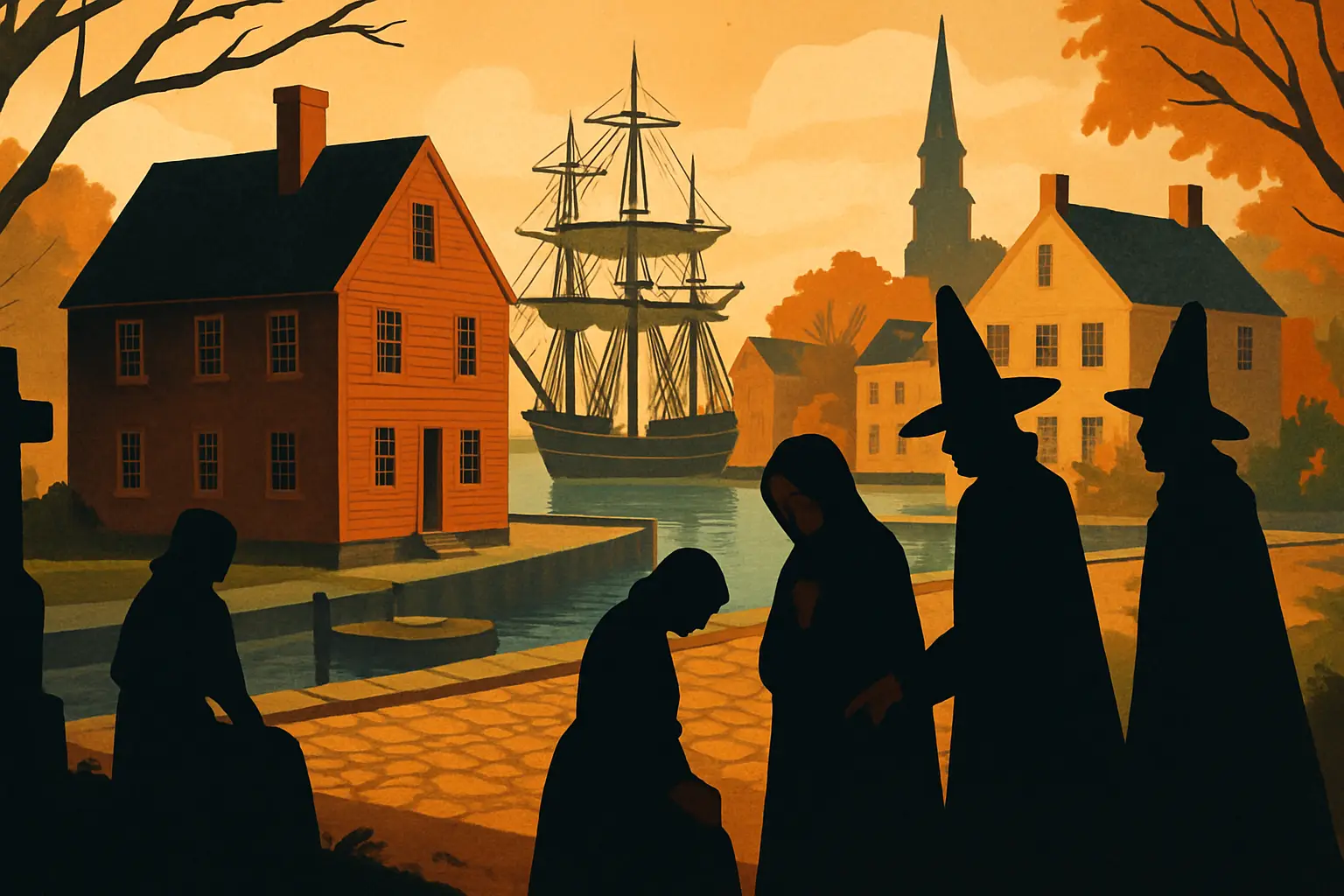
The Salem witch crisis began in January 1692 in Salem Village — a separate settlement from Salem Town (the harbor city most visitors explore) that is now the town of Danvers, about six miles north. Betty Parris, age 9, and her cousin Abigail Williams, age 11, began having fits: convulsions, trance-like states, strange vocalizations that no physical diagnosis could explain. A doctor's verdict of witchcraft followed quickly. Three local women were accused: Tituba, an enslaved woman from Barbados who worked in Reverend Samuel Parris's household; Sarah Good, a homeless beggar; and Sarah Osborne, an elderly woman who had stopped attending church.
What happened next was explosive. By the time Governor William Phips dissolved the Court of Oyer and Terminer in October 1692, the crisis had consumed an entire colony. Nineteen people were executed by hanging at Proctor's Ledge — a rocky outcropping on the edge of Salem that was only confirmed archaeologically as the actual execution site in 2016, overturning the long-held belief that Gallows Hill was the location. Giles Corey, an 80-year-old farmer, was pressed to death under heavy stones over two days after he refused to enter a plea — reportedly telling the sheriff to add more weight with his dying breaths. More than 200 people were accused and imprisoned. At least five died in jail awaiting trial.
The legal engine driving the executions was spectral evidence: testimony that the accused person's spirit or specter had appeared to the accuser in a dream or vision. Under Massachusetts law at the time, this was admissible in court. The accused had no effective defense against it — you cannot disprove what someone claims to have seen in a dream. The Salem trials became the founding American case study in the danger of evidence that cannot be confronted or cross-examined.
The pattern of accusations was not random, and historians have spent decades mapping it. Several overlapping dynamics were at work.
Salem Village versus Salem Town economics. Salem Village was a farming community economically subordinate to Salem Town, the prosperous merchant port. Many of the accused had ties to the Town's merchant class, which Village farmers resented. Reverend Samuel Parris, whose household produced the first accusers, was deep in a salary dispute with the Village congregation. Several key accusers came from the Putnam family, the Village's dominant farming dynasty, and their accusations frequently targeted people aligned with the rival Porter merchant faction.
Women with independent property. An unusual number of accused women had no male heirs and owned property outright — a legally anomalous situation in 17th-century Massachusetts. Bridget Bishop, the first person executed, had been twice widowed, ran a tavern independently, and had faced informal witchcraft accusations twice before. She was a known irritant to neighbors who had interests in her land.
Tituba's strategic confession. After initially denying the accusations, Tituba reversed course and confessed elaborately: a mysterious man who came to her in the night, a book she signed, a flying stick, other witches in the colony. The confession saved her life — the court did not execute confessed witches, on the theory that confession opened the door to redemption. Tituba named names, and the crisis escalated. She was eventually sold to cover her jail fees and disappears from the historical record. Her confession gave the trials their narrative framework and their momentum.
Get short, interactive stories that make each place easier to remember while you travel.
Governor Phips dissolved the Court of Oyer and Terminer in October 1692 after his own wife was named as a suspect — a development that apparently clarified for him that the accusations had become untethered from reality. The prisoners remaining in jail were released. Some had been imprisoned for months.
The accountability was uneven and slow. Judge Samuel Sewall — one of nine magistrates who presided over the Court — made a public apology in 1697 at Boston's Old South Meeting House, standing in silence while his pastor read his statement of guilt aloud to the congregation. No other judge matched his courage. Ann Putnam Jr., the most prolific accuser with 62 names to her account, apologized publicly in 1706, stating she had acted 'through a great delusion of Satan' and had been 'a sad instrument for accusing several persons of a grievous crime, whereby their lives were taken away from them.'
Massachusetts passed a bill of reversal in 1711 that cleared some of the convicted, but the list was incomplete for centuries. The colony fully exonerated all 19 executed victims only in 1957. The last five names on that list weren't officially cleared until 2001.
The legal legacy is concrete. Legal scholars trace a direct line from the Salem proceedings to the Confrontation Clause of the Sixth Amendment — the constitutional guarantee that defendants can confront and cross-examine witnesses against them. Spectral evidence is the archetype of testimony that cannot be cross-examined, and Salem is the reason American law eventually ruled it inadmissible. The trials are taught in law schools as the original case study in evidence standards and due process, not just as a historical curiosity.
Salem has many sites branded 'witch trial' adjacent, but three have direct historical connections worth understanding before you visit.
The Salem Witch Trials Memorial on Charter Street is described in the Quick Tips — it's the most affecting site in the city and is frequently passed by tourists rushing to the museum. The adjacent Charter Street Cemetery, one of the oldest burying grounds in New England (dating to 1637), contains the grave of Judge John Hathorne — the most aggressive of the trial magistrates, a man who showed no doubt or remorse during the proceedings. Hathorne is also the great-great-grandfather of Nathaniel Hawthorne, who added the 'w' to his surname in part to distance himself from the association. Walking through this cemetery with that context feels different than walking through without it.
The Salem Witch Museum at Washington Square North is the most visited site in the city. It's a 45-minute dramatized walkthrough that reconstructs the accusations and trials using life-size dioramas and narration. Accessible and thorough, though its theatrical format is not to every visitor's taste. Most useful for visitors arriving with little prior knowledge, or for explaining the history to children.
The Witch House at 310½ Essex Street is the only surviving structure in Salem with a documented physical connection to the trials: it was the home of Judge Jonathan Corwin, one of the magistrates who conducted the preliminary examinations of the accused in his own house before sending them to trial. The house dates to approximately 1675 and was privately occupied until 1945, when Salem acquired it. Interior tours run daily. The staff explains the house's context without theatrical embellishment, which makes it a good counterweight to the Witch Museum.
A fourth site worth the effort: Proctor's Ledge Memorial, off Proctor Street in Salem's Gallows Hill neighborhood, was opened in 2017 after archaeologists confirmed it as the actual 1692 execution site. It's small, quiet, and frequently missed by tourists who don't know it exists. The walk from Charter Street takes about 25 minutes on foot, or 5 minutes by rideshare.
The witch trials are Salem's most famous chapter, but they happened at the very beginning of the city's history. The following 150 years produced a story equally remarkable: Salem became one of the most prosperous cities on the continent.
In the late 18th century, Salem merchants pioneered the India Trade — direct commerce with Sumatra, Java, and the Indian subcontinent at a time when most American merchants still worked Atlantic routes. Elias Hasket Derby, operating out of Derby Wharf at the end of Derby Street, became the first confirmed American millionaire through this trade. His ships returned with pepper, silk, chinaware, and spices that Salem resold to the rest of the country at premium prices. By 1790, Salem was the sixth-largest city in America and per capita one of its wealthiest.
The Peabody Essex Museum on Essex Street is the direct heir to this era. Founded in 1799 by Salem's East India Marine Society (which required members to have crossed the equator or traveled beyond Cape Horn), it contains the world's largest collection of maritime art and Asian export art — Chinese porcelain, Japanese screens, Indonesian textiles — alongside a complete Qing Dynasty merchant's house that was dismantled in Anhui Province, shipped to Salem, and reassembled inside the museum. The PEM is genuinely world-class. Allow at least two hours; the full collection rewards a half-day.
Chestnut Street, two blocks from the Essex Street pedestrian mall, is regularly cited by architectural historians as the finest Federal-style residential streetscape in America. The houses date to the 1800–1820 period, when Salem's trade wealth was converting into real estate. Samuel McIntire, the Salem-born architect and woodcarver, designed many of them. Walking Chestnut Street after visiting Charter Street Cemetery puts Salem's full arc — Puritan settlement, witch crisis, mercantile empire, architectural legacy — into coherent order.
Salem is 28 miles northeast of Boston, directly served by the MBTA Commuter Rail's Newburyport/Rockport Line from North Station. The train takes 28–30 minutes and runs multiple times per hour during peak hours. This is the best way to visit: October parking is genuinely punishing, with remote lots, shuttle buses, and 2+ hour waits on peak weekends. The train deposits you half a mile from the Heritage Trail starting point on Washington Street.
By car from Boston: take I-93 North to Route 128 North, then follow Route 107 East into Salem. Parking is available at the structure at 241 Essex Street and lots near Pickering Wharf, but both fill before 10 a.m. on October weekends. For a fall visit, the train is not just convenient — it's genuinely the better experience.
Salem rewards visitors in every season. October is the obvious draw, and the Haunted Happenings festival creates a genuine atmosphere — the city leans into it with theatrical walking tours, ghost hunts, and special museum programming. September offers the same programming at a fraction of the crowd. January and February are quieter than any other New England city of comparable interest: the PEM has no lines, the cemetery has a quality of stillness appropriate to what it contains, and Chestnut Street in winter light is something the October crowds never see.
MBTA train from Boston North Station: 28–30 min, runs every 30–60 min on weekdays
By car: I-93 N to Route 128 N to Route 107 E, approximately 45 min without traffic
October weekends: plan for the train or remote parking with shuttle; street parking is gone by 9 a.m.
September is the sweet spot: Haunted Happenings begins mid-month, crowds still manageable
Is the Witch House where the trials happened? No. The actual courthouse no longer exists. The Witch House at 310½ Essex Street was the private home of Judge Jonathan Corwin — he conducted preliminary examinations of the accused there, but the formal trials took place at a courthouse that was subsequently demolished. The Witch House is the only surviving structure with a documented physical connection to any trial participant.
What is the difference between Salem and Salem Village? The witch crisis began in Salem Village, which is now the separate town of Danvers, about six miles north. The formal trials and executions happened in Salem Town — the harbor city visitors explore today. The two are frequently confused in popular accounts. The Rebecca Nurse Homestead, where the accused victim Rebecca Nurse lived, is in Danvers, not Salem.
Was Nathaniel Hawthorne from Salem? Yes. Hawthorne was born at 27 Union Street in Salem in 1804. His great-great-grandfather was Judge John Hathorne, whose grave is in the Charter Street Cemetery. Hawthorne added the 'w' to his surname specifically to create distance from that association. His novel *The House of the Seven Gables* is set in a version of Salem; the actual house it references stands at 115 Derby Street, a short walk from Pickering Wharf.
Is Salem worth visiting outside October? Strongly yes. The Peabody Essex Museum is world-class and operates year-round with no seasonal degradation. The historic sites are unhurried, the restaurants and coffee shops serve a real year-round population, and winter Salem has a atmospheric quality that the Halloween crowds never experience. Many repeat visitors consider October their least favorite month to come back.