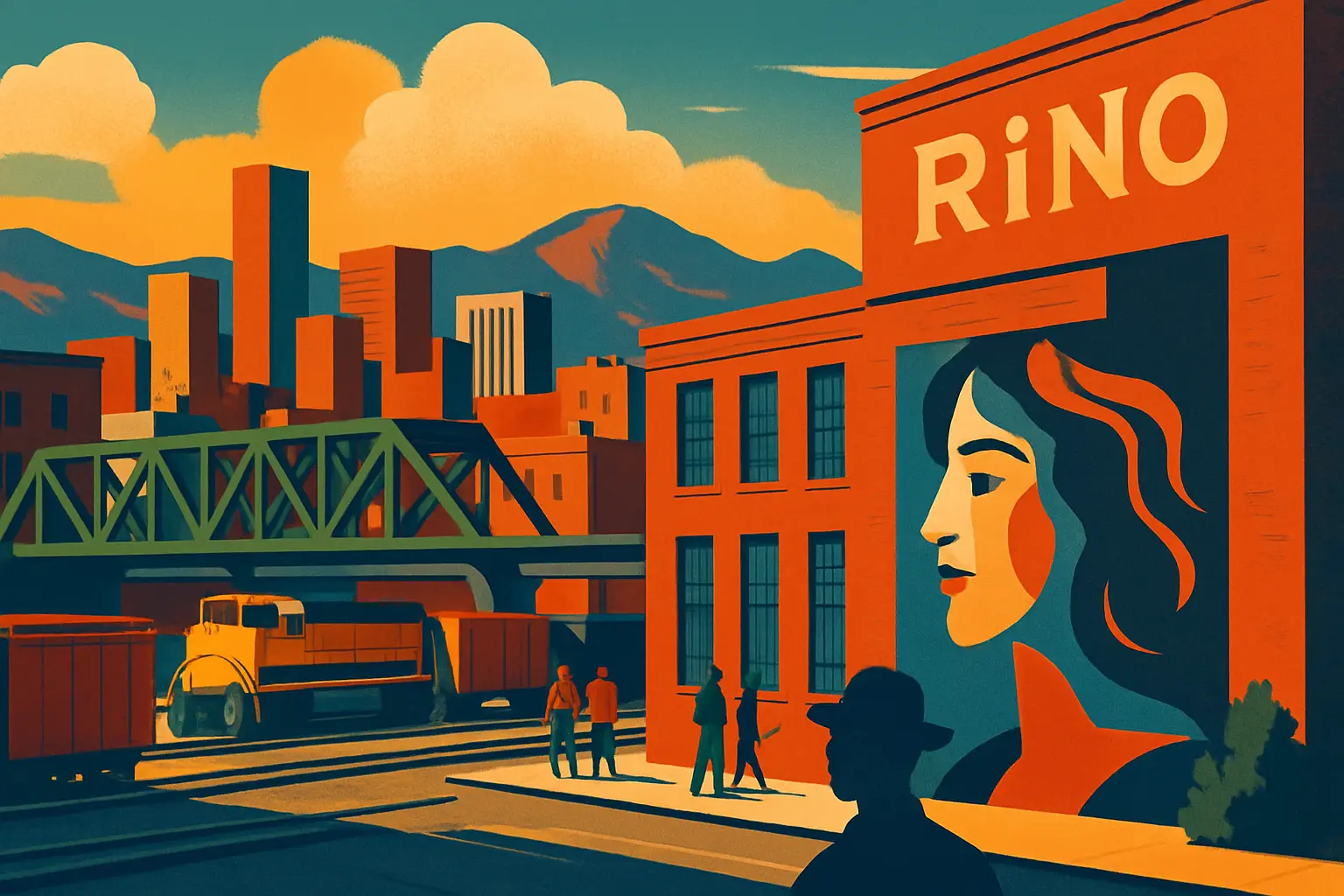
RiNo's boundaries run roughly from Brighton Boulevard on the east to the South Platte River on the west, between I-70 and 40th Avenue — a zone that spent most of the 20th century as Denver's industrial back yard. The Denver & Rio Grande Western Railroad operated switching yards and freight facilities through this corridor. Meat packing plants, ironworks, and cold storage warehouses occupied the blocks that Brighton, Larimer, Blake, and Walnut Streets now divide into galleries and restaurants.
Artists noticed around 2003, when warehouse rents in this stretch ran a fraction of what downtown lofts cost. Studios opened along Larimer Street. The River North Art District was formally organized as a nonprofit in 2005, and the mural program that now defines the neighborhood launched that same year. By 2015 the transformation was visible on every block. By 2020 the Source Hotel, Denver Central Market, and Safta had made RiNo a destination rather than a discovery.
The industrial bones remain. Most buildings are still the original concrete-and-steel warehouses — high ceilings, loading docks, freight doors widened into entryways. The neighborhood's visual identity comes from what was painted on top of that infrastructure, not from anything torn down and rebuilt.
More than 100 murals cover RiNo's warehouse exteriors, parking structures, and blank commercial facades — one of the highest concentrations of commissioned outdoor art in the Mountain West. The works range from monumental abstract compositions across entire building facades to detailed figurative portraits of Denver workers and families. Quality varies because there is no single curatorial body: property owners, individual artists, and gallery partners coordinate with the RiNo Art District on their own terms, producing a genuinely diverse mix rather than a branded aesthetic.
The most reliable concentration runs between Blake Street, Larimer Street, and 27th to 34th avenues. Walk this grid slowly — murals wrap corners, appear on surfaces you'd miss from a moving car, and use the industrial architecture as part of the composition. The I-70 underpass along Brighton Boulevard functions as an ongoing outdoor gallery where murals are regularly refreshed by local artists; what's there today will differ from what's there in six months.
The Source Hotel's south exterior wall at 3330 Brighton Boulevard carries one of the district's most-photographed commissions: a full-building-height abstract work best viewed from the west side of Brighton at a distance, where the scale against the original brick foundry facade becomes clear.
Get short, interactive stories that make each place easier to remember while you travel.
Great Divide Brewing Company opened at 2201 Arapahoe Street in 1994, when this part of Denver had no name and no district organization. The original taproom — a low-slung building tucked among freight warehouses — became a gathering point for the artists, fabricators, and early neighborhood adopters who were beginning to occupy the surrounding blocks before any developer had noticed them. Great Divide's presence in RiNo predates every gallery, restaurant, and hotel in the district by years.
The brewery's Yeti Imperial Stout, first brewed in 2003, now ranks among the most recognized imperial stouts in American craft beer: 10.5% ABV, built on roasted malts with Centennial hops and a long chocolate finish. It appears in barrel-aged variants, coffee editions, and seasonal releases — most available only at the Barrel Bar & Tap Room at 1812 35th Street, the larger northern taproom the brewery opened to accommodate specialty releases. Both locations are dog-friendly and have outdoor seating.
Ratio Beerworks at 2920 Larimer Street is RiNo's other essential brewery: Belgian-influenced ales in a converted warehouse with a wraparound patio on the south side. The patio fills on warm evenings — arrive before 5 p.m. to claim a table without waiting.
Denver Central Market opened in 2016 at 2669 Larimer Street inside a reclaimed printing facility built in the early 1900s. The building's concrete floors and industrial ceiling stayed intact; vendors moved into permanent stalls around a shared seating area, creating a food hall that functions like a genuine neighborhood market rather than a performative culinary experience.
Rosenberg's Bagels & Delicatessen anchors the market with New York-style water bagels made in-house and a deli counter that does lox, whitefish, and proper cream cheese correctly. Blue Sparrow Coffee operates from within the same building with house-roasted beans. Culture Meat & Cheese runs the charcuterie counter and cuts to order. A produce stall and a wine shop complete the market's functional range — enough to cover an entire day's eating from a single building.
The covered outdoor patio along the south side on Larimer Street is one of RiNo's most pleasant people-watching spots from April through October. Weekday mornings are calm; weekend brunch hours fill every table and queue all three counter services simultaneously.
RiNo's restaurant scene has grown dense enough that most destinations now require reservations on weekends.
**Safta** — 3330 Brighton Blvd (Source Hotel Market Hall). Chef Alon Shaya's Israeli-American kitchen: wood-fired whole cauliflower, house-made hummus with rotating toppings, lamb shoulder, and pita pulled straight from a stone oven. One of the best restaurants in Denver. Dinner reservations book 1–2 weeks out; bar seats and the Market Hall counter are more accessible as walk-ins.
**Zeppelin Station** — 3501 Wazee St. A multi-vendor food market with international street food stalls in a converted warehouse space. More casual than Denver Central Market, open later on weekends, and significantly livelier on Friday and Saturday nights. A good option for a quick lunch or a late-night snack after the breweries.
**The Original** — 3524 Larimer St. An all-day diner that has operated through multiple cycles of RiNo's transformation. Good for a straightforward breakfast before walking the mural blocks — no wait before 9 a.m. on weekdays, reliably busy after 10.
The Source Hotel at 3330 Brighton Boulevard opened in 2017 inside a metal foundry built in 1880 — one of the oldest surviving industrial buildings in the RiNo corridor. The foundry's original steel frame and exposed brick are legible throughout the interior. The 100-room hotel stacks above the Source Hotel Market Hall, a ground-floor collection of vendors and restaurants anchored by Safta.
The roof deck — open to hotel guests and, most evenings, to diners with rooftop bar reservations — has views across the railroad yards and downtown Denver skyline that are notably open compared to rooftop bars in the more built-up central neighborhoods. The perspective makes RiNo's geography legible in a way the street level does not: you can read the freight corridor, the shift from warehouses to new apartment towers, and the South Platte River marking the western edge.
The northern section of RiNo along Brighton Boulevard between 33rd and 40th avenues has seen significant new residential development since 2020. The character there is newer and more residential than the core mural district, though Great Divide's Barrel Bar at 35th Street anchors it as a destination worth the extra blocks.
How do I get to RiNo from downtown Denver? The RTD 44 bus along Larimer Street connects from Union Station to RiNo's core in about 10 minutes for $3.25. Rideshares from Union Station run $10–14 for the same trip. Walking from Union Station northeast along Wewatta Street to Blake Street takes about 15 minutes on a flat grid. The RTD light rail does not serve RiNo directly. Bike-share and scooter rentals work well on the neighborhood's flat streets.
Is RiNo walkable? Yes, with planning. The core between Denver Central Market, the main mural blocks, and the breweries spans about half a mile. Zeppelin Station and the Source Hotel sit at the northern end — budget a 15-minute walk from the southern cluster. Plan a single route to avoid doubling back.
When is the best time to visit? September and October offer ideal conditions — temperatures in the mid-60s to low-70s Fahrenheit, clear skies, and lighter crowds than the summer peak. The RiNo Art Walk on the first Friday of each month is the highest-energy version of the neighborhood at any time of year. Avoid driving on Art Walk Fridays: parking in the core blocks becomes effectively impossible by 6 p.m. For a deeper look at Denver's historic downtown — LoDo, Union Station, Larimer Square, and Coors Field — the LoDo neighborhood guide covers that district 10 blocks southwest.