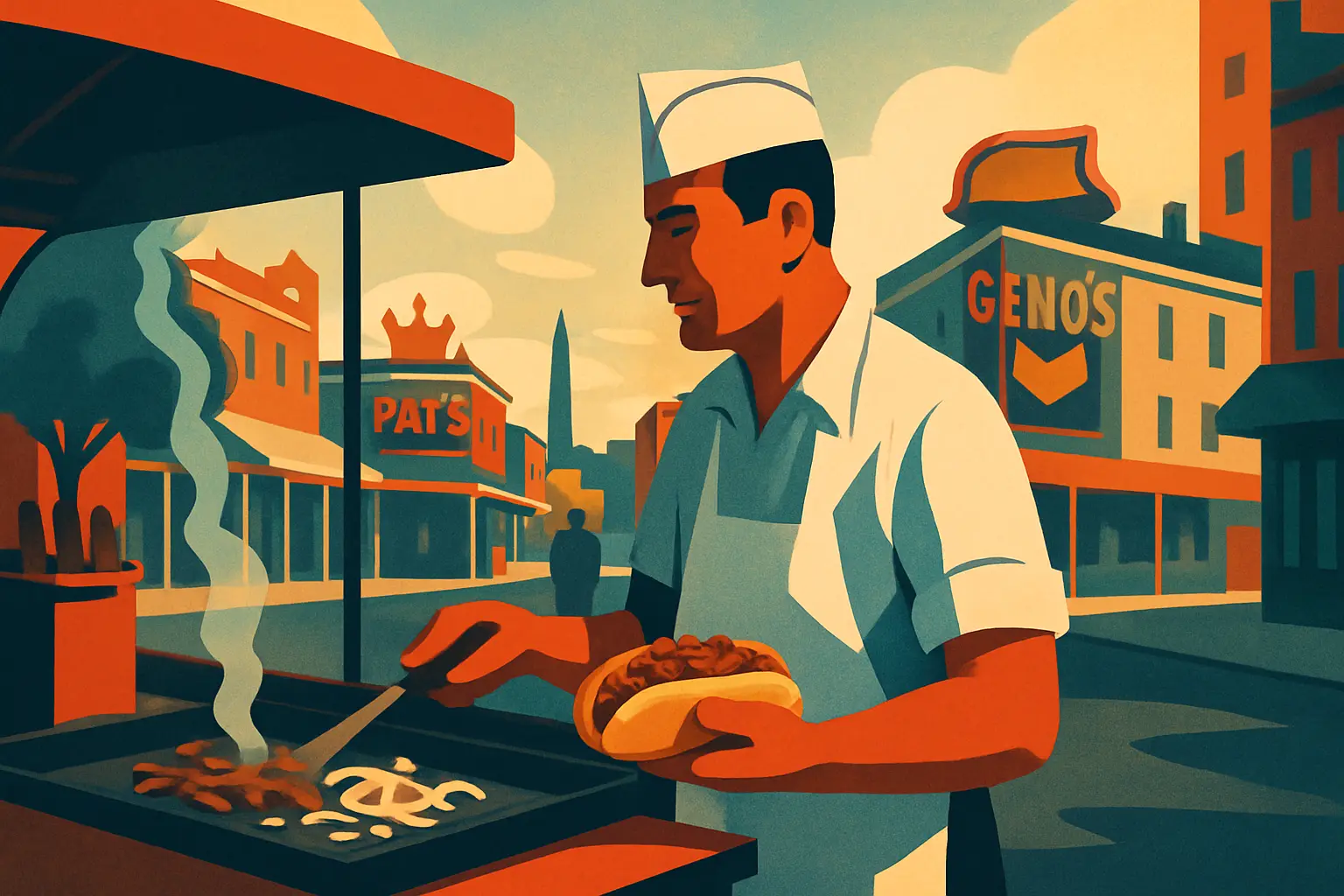
Pat Olivieri was running a hot dog stand at the corner of 9th Street and Passyunk Avenue in South Philadelphia when, around 1930, he decided to cook something different for his own lunch. He bought some beef from a nearby butcher, sliced it thin, fried it on his griddle with onions, and put it in an Italian roll. A cab driver waiting at the stand noticed what he was making and asked for one instead of a hot dog. Pat obliged. The driver liked it, told other drivers, and within days the corner had a new reputation.
This is the version the Olivieri family has told for three generations, and it has the plausibility of specificity: a hungry cook, a cab driver, a griddle with leftover beef. The South Philadelphia neighborhood around 9th Street was the heart of the city's Italian-American community, and the butchers and bakers who supplied that community were all within a few blocks. The Amoroso family had been baking rolls on the same street since the early 20th century.
The hot dog stand became Pat's King of Steaks, formalized at its current location at 1237 E Passyunk Avenue. Pat Olivieri died in 1974. The restaurant is still operated by his family, still at the same corner, still open 24 hours a day, every day of the year.
The original cheesesteak had no cheese. Pat Olivieri's early versions were steak and onions in a roll — period. Cheese came later, and which cheese is 'correct' has been generating arguments ever since.
Provolone was the first cheese added to the sandwich, consistent with the Italian-American culinary tradition of South Philadelphia. Provolone was what the neighborhood's Italian grocers and delis stocked, and it melted reasonably well on the hot meat. Sharp provolone has a distinct, slightly tangy flavor that many people consider the ideal match for ribeye.
Cheez Whiz entered the picture sometime in the 1950s — it couldn't have been earlier, because Kraft didn't introduce Whiz until 1952. The story most often told is that a manager at Pat's suggested adding it, and customers liked the way it emulsified smoothly across the meat without pooling or breaking the way provolone can. By the time Pat's became a tourist destination in the 1970s and 1980s, Whiz was its signature choice, which is why visitors often assume Whiz is the original or most authentic option. What it is, more precisely, is the most popular option at the specific stands that became famous.
American cheese melts cleanly and is mild enough not to compete with the meat. It's the compromise choice. What do locals actually prefer? In South Philly Italian-American households, provolone is generally the answer. At John's Roast Pork and Dalessandro's — two spots with strong local followings — provolone is the default. At Pat's and Geno's, Whiz dominates by sheer volume.
Get short, interactive stories that make each place easier to remember while you travel.
'Wit' means with fried onions. 'Witout' means without. This is the entirety of the system.
At Pat's and Geno's, the ordering protocol requires you to state your cheese first, then your onion preference: 'whiz wit,' 'provolone witout,' 'American wit.' This developed from the practical reality of a fast-moving window serving hundreds of customers during peak hours — a two-word order is faster than 'I'll have the cheesesteak with Cheez Whiz and onions, please.'
In 2006, Geno's Steaks posted a sign at its ordering window: 'This Is AMERICA: WHEN ORDERING PLEASE SPEAK ENGLISH.' The sign, put up by owner Joey Vento during the national debate about immigration and official English legislation, drew national media attention. Philadelphia's Commission on Human Relations initially ruled the sign violated city anti-discrimination ordinance; a federal appeals court later ruled it was protected speech. The sign stayed up until Vento's death in 2011. His son Geno Vento now runs the restaurant.
The incident is a piece of the cheesesteak's cultural history that most tourist guides skip. The wit/witout ordering system, divorced from that controversy, is simply useful to know: it signals to the person at the window that you've done your homework.
Pat's King of Steaks (1237 E Passyunk Ave) opened in its current form in 1940, establishing the corner as the cheesesteak's founding site. Geno's Steaks (1219 S 9th St) opened directly across the intersection in 1966, founded by Joey Vento — who, by some accounts, was deliberately placing himself at the same corner as the Olivieri family.
The result is what locals call 'Cheesesteak Corner': two 24-hour counter-service stands facing each other across a wedge-shaped intersection, both lit with neon signs, both surrounded at peak hours by people debating which is better. Both serve on Amoroso rolls with the same cuts of beef. The differences in seasoning, meat thickness, and Whiz consistency are real but subtle.
The honest local assessment is that both are good and neither is the city's best. They are the most famous because they were the first and because they share the same corner, not because the sandwich is categorically superior to what a dozen other Philadelphia shops produce. Going to Pat's and Geno's is worth doing once for the atmosphere — the hour, the neon, the outdoor seating in summer, the cab drivers at 3 a.m. It is a specific experience. But if the objective is the best cheesesteak in Philadelphia, the walk to John's Roast Pork is worth taking.
Pat's King of Steaks — 1237 E Passyunk Ave; open 24/7, year-round; order at the window, eat at the outdoor tables
Geno's Steaks — 1219 S 9th St; open 24/7, year-round; directly across the street from Pat's
The intersection sits at the southern end of the 9th Street Italian Market corridor — arrive before 5 p.m. to walk the market on the same trip
John's Roast Pork at 14 E Snyder Avenue is the most decorated cheesesteak spot in Philadelphia that most visitors have never heard of. It won the James Beard Foundation's America's Classics award in 2006 — the same category that recognized Prince's Hot Chicken in Nashville. The shop opens at 6:45 a.m., serves weekdays only, and sells out most days before 4 p.m. The cheesesteak uses thin-sliced ribeye with sharp provolone on an Amoroso roll. The pork sandwich — slow-roasted pork with broccoli rabe and sharp provolone — is widely considered even better than the cheesesteak. Going for both is not unreasonable.
Dalessandro's at 600 Wendover Street in Roxborough has no tourist profile and a long line of locals on any given lunch hour. The meat is cut thinner than at most spots, which means better caramelization on the griddle and more surface area for cheese contact. It is the answer most longtime Philadelphians give when asked where they go when they want a cheesesteak without the tourist theater.
Jim's Steaks at 400 South Street occupies a 1940s-era building in the South Street commercial corridor and is open late enough (midnight most nights) to serve the post-show crowd. Consistent quality, reliable hours.
Tony Luke's at 39 Oregon Ave, near Pat's and Geno's in South Philly, has its own loyal following for both the cheesesteak and the roast pork sandwich.
John's Roast Pork — 14 E Snyder Ave; Mon–Fri 6:45 a.m. until sold out; cash preferred
Dalessandro's — 600 Wendover St, Roxborough; Mon–Sat 10 a.m.–10 p.m.; expect a wait at lunch
Jim's Steaks — 400 South St; Mon–Thu 10 a.m.–midnight, Fri–Sat 10 a.m.–3 a.m., Sun noon–10 p.m.
The Amoroso's Baking Company has been supplying South Philadelphia's sandwich shops since the early 20th century. The roll they produce for cheesesteaks — a 10-inch seeded hoagie — has specific characteristics that are hard to replicate with a generic sub roll: a crust firm enough to hold the meat juices without becoming immediately soggy, an interior soft enough to compress without crumbling, and a shape that keeps the filling from spilling forward when you bite in.
Most serious cheesesteak shops in Philadelphia use Amoroso rolls. The shops that don't — or that substitute a French roll, ciabatta, or Kaiser bun — produce something that may be good on its own terms but is not a Philadelphia cheesesteak in the strictest sense. The bread is structural: the whole sandwich depends on it holding together from counter to first bite.
Amoroso's operates a bakery and distribution center in Philadelphia and supplies restaurants through the mid-Atlantic region. Outside that distribution radius, the roll is hard to source, which is one concrete reason why cheesesteaks made in other cities rarely taste like the ones in Philadelphia: it's not just the nostalgia talking.
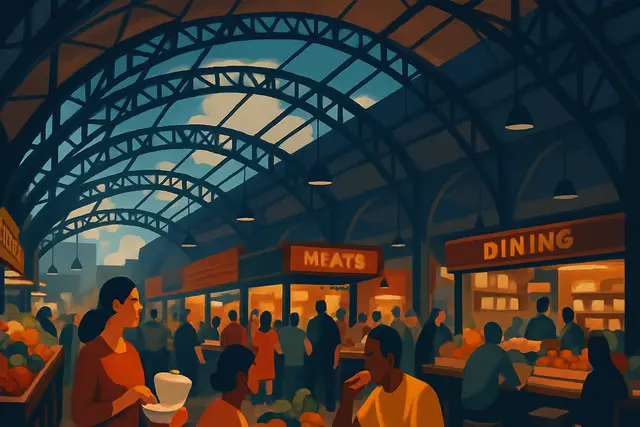
Pat's King of Steaks sits at the far southern end of the 9th Street Italian Market — the oldest and largest continuously operating outdoor market in the United States. The market runs along 9th Street from Washington Avenue to Wharton Street, a stretch of stalls and storefronts that Italian immigrants established beginning in the 1880s.
For more than a century, the market was the food supply for South Philadelphia's Italian-American community. Fish mongers, cheese shops, produce vendors, butchers, and bakeries clustered along the same blocks where their families had settled. The neighborhood's culinary character — the long-cooking red sauce tradition, the sharp provolone, the pork roasts, the broccoli rabe — traces directly to the regional cuisines of Sicily, Calabria, Campania, and Abruzzo that immigrant families brought with them.
The market is still operating. Sarcone's Bakery at 758 S 9th Street bakes the Italian bread that has been in its display window for generations. Fante's Kitchen Shop at 1006 S 9th Street has sold Italian cooking equipment since 1906.
The cheesesteak didn't come from nowhere. It came from a neighborhood with specific ingredients, specific techniques, and a specific relationship between street food and community. Walking the Italian Market before eating at Pat's gives the sandwich the context it was built inside. For more on Philadelphia's neighborhoods, the Fishtown neighborhood guide covers the city's creative quarter north of the market, where a newer restaurant scene has concentrated.
9th Street Italian Market — from Washington Ave to Wharton St; most stalls open Tue–Sat 9 a.m.–5 p.m.; most active Tuesday through Saturday mornings
Sarcone's Bakery — 758 S 9th St; Tue–Sat 7 a.m. until sold out
Fante's Kitchen Shop — 1006 S 9th St; Mon–Sat 9 a.m.–5 p.m.; browsing is free and the imported pasta molds are worth the trip
Does a cheesesteak actually taste different in Philadelphia? Yes, materially. The Amoroso roll is the most concrete reason. The griddle technique, locally sourced meat, and each shop's specific cheese-to-meat ratio matter too. A cheesesteak made on a French roll with shredded steak from a bag and Whiz from a warmer is a different food.
What's actually on a traditional cheesesteak? Shaved or thinly sliced ribeye, fried onions if ordered 'wit,' and one cheese. No peppers, no mushrooms, no jalapeños unless specifically requested. Bell peppers on a cheesesteak is a regional modification from outside Philadelphia. At most Philadelphia shops, adding anything beyond the three standard ingredients requires an explicit ask.
Is Geno's better than Pat's? Locals don't particularly care. The rivalry is a marketing phenomenon both shops have benefited from for 60 years. The cheesesteaks are similar in quality. If you're going to one, go to both — they're 30 feet apart.
Can you get a good cheesesteak in Center City without going to South Philly? Yes. Sonny's Famous Steaks at 228 Market Street is a reliable Center City option. Campo's at 214 Market Street has outdoor seating and solid sandwiches. Neither is John's Roast Pork, but both are within walking distance of the Liberty Bell and Independence Hall if you're visiting Center City and don't want to make a separate trip south.