1. A Neighborhood Shaped by History, Transformed by a Trail
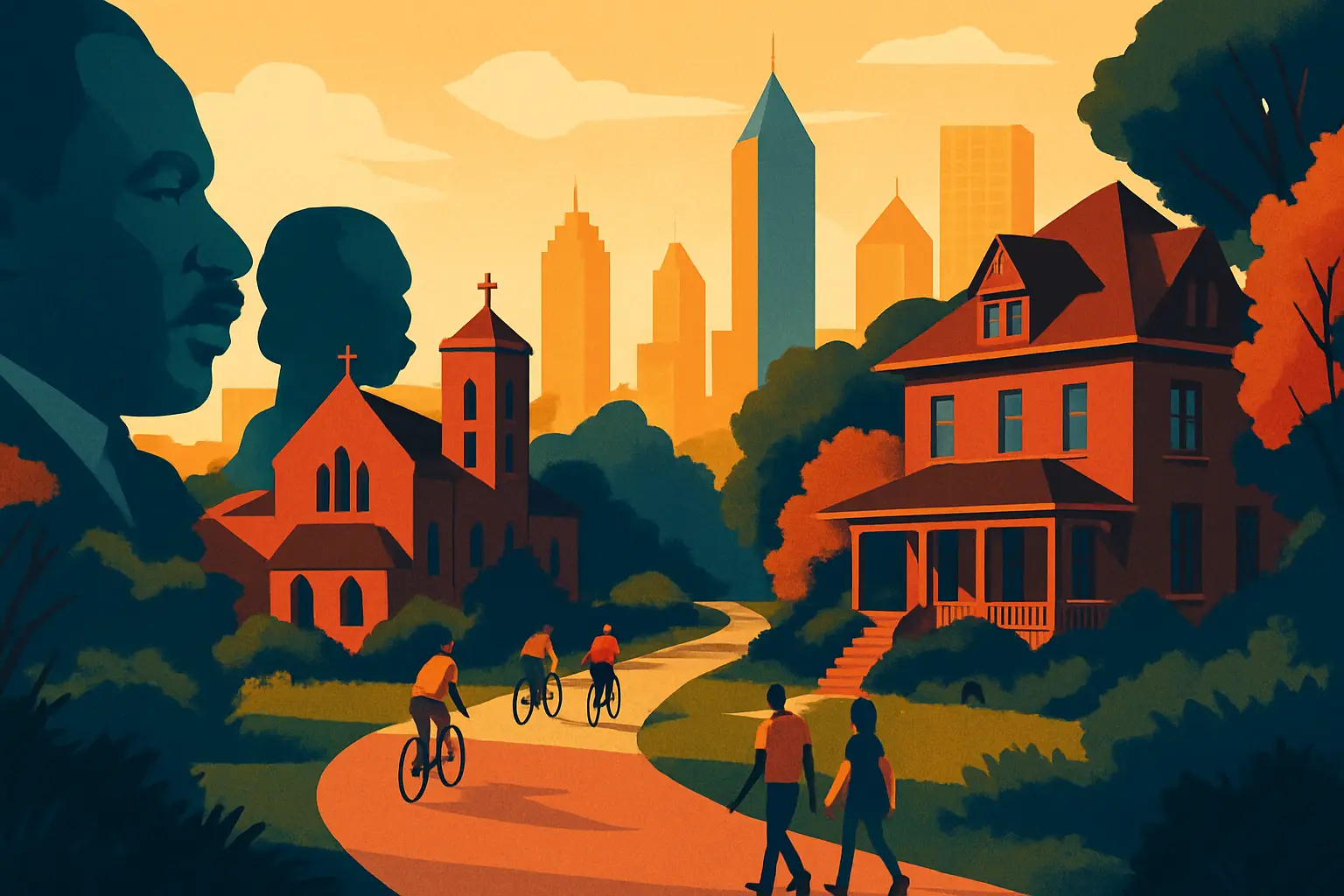
Old Fourth Ward takes its name from Atlanta's original five ward system. By the early 20th century, it had become the center of Black professional life in the South — a concentrated stretch of Auburn Avenue anchored by Black-owned banks, insurance companies, churches, and civil rights organizations at a time when legal segregation made such a corridor both necessary and remarkable.
The neighborhood declined after desegregation reduced the economic necessity of Black-only commercial corridors, and sections fell to disinvestment through the 1980s and 1990s. Its revival came from an unusual source: infrastructure. The Atlanta BeltLine, a 22-mile loop of multi-use trails built on former railroad corridors, opened its Eastside Trail segment in 2012, threading directly through Old Fourth Ward. The trail linked the neighborhood to Inman Park, Ponce City Market, and eventually to the Virginia-Highland and Reynoldstown neighborhoods. Property values along the BeltLine's Eastside Trail rose faster than almost anywhere else in the city. Restaurants, breweries, and boutique hotels followed. The neighborhood's story since then is the familiar tension of urban revival: renewed investment alongside displacement pressures for long-term residents.
2. Sweet Auburn: The Street That Built a Movement
Auburn Avenue NE runs through Old Fourth Ward's southern section and was once called the richest street in Black America. Fortune magazine coined the phrase in 1956, referring to the concentration of Black-owned businesses, professional offices, and institutions that made Auburn Avenue the commercial capital of Black Atlanta from the 1920s onward.
The street's anchor is the Martin Luther King Jr. National Historical Park, a 35-acre federally managed site that contains three separate sites of historical weight. 501 Auburn Ave NE is the Victorian house where King was born on January 15, 1929, and where he lived until age 12. Ebenezer Baptist Church at 407 Auburn Ave NE is where King's grandfather founded the congregation in 1886, where his father served as pastor for decades, and where King himself preached his first sermon as a teenager. King later served as co-pastor alongside his father. The King Center, which is located just east, houses the tombs of Martin Luther King Jr. and Coretta Scott King in a reflecting pool open to the public.
Along Auburn Avenue, several other buildings survive from the neighborhood's commercial peak: the Herndon Building (1924), built by Atlanta Life Insurance Company founder Alonzo Herndon, and the Citizens Trust Bank Building, founded in 1921 as one of the first Black-owned banks in Georgia and still operating. The architecture of the block is unusually intact for a neighborhood that saw severe disinvestment — walk the full length of the street between Jackson and Boulevard to understand what Sweet Auburn looked like in its prime.
3. Historic Fourth Ward Park and the BeltLine's Eastside Trail
Historic Fourth Ward Park opened in 2011 on a site that had previously been a stormwater retention basin — essentially a flooding problem that sat vacant for years. The 17-acre park resolved the flooding issue by converting the retention area into a 2-acre lake, then built outward with a skate park, a splash pad, an outdoor amphitheater, athletic fields, and walking paths that connect directly to the BeltLine's Eastside Trail.
The park is the easiest entry point to the BeltLine Eastside Trail, the trail segment that draws the most foot traffic of any stretch in the full 22-mile BeltLine loop. From the park, the trail heads north past rotating outdoor murals — a collection that changes annually and includes works by both local Atlanta artists and internationally known muralists — before reaching Ponce City Market. Heading south, it passes through Inman Park and eventually connects to the Westside Trail and Grant Park sections of the loop.
The murals along the Eastside Trail are one of Atlanta's most underrated outdoor experiences. The city has invested in commissioning large-format works on retaining walls, rail underpasses, and the sides of buildings that face the trail — dozens of them between PCM and Irwin Street alone. No admission, no barriers, just outdoor art at scale.
•Historic Fourth Ward Park: 680 Dallas St NE; open daily, free; skate park is one of the best outdoor rinks in Atlanta
•BeltLine Eastside Trail: trailhead at Ponce City Market; runs south approximately 2 miles to the Inman Park connection point
•E-scooters and Lime bikes dock along the trail at several points — a fast way to cover the full Eastside stretch in one pass
4. Ponce City Market: The Sears Building That Became Atlanta's Anchor
Ponce City Market (675 Ponce De Leon Ave NE) occupies the former Sears, Roebuck & Co. distribution center, a 2.1 million-square-foot red brick building constructed in 1926. For decades it was one of the largest buildings in the Southeast — Sears used it as its Atlanta retail store and regional warehouse until 1987, when the company vacated. The building sat partially empty for years; the City of Atlanta used portions of it for municipal offices.
The redevelopment, completed in phases from 2014 to 2019, preserved the building's industrial bones — exposed brick, steel columns, original freight elevators — while converting it into a mixed-use complex with residential apartments on the upper floors, a large food hall and retail market on the ground level, and an unusual rooftop entertainment deck.
The Central Food Hall is the largest and most consistent food destination in Old Fourth Ward. Stalls include Little Tart Bakeshop (exceptional croissants and pastries), H&F Bread Co. (from Holeman & Finch, Atlanta's storied gastropub), The Cockentrice (charcuterie and offal-focused), and rotating seasonal vendors. The hall connects to a full-service restaurant level and a rooftop with skyline views, a mini-golf course, and carnival-style attractions.
The BeltLine's Eastside Trail runs directly behind the building, making PCM the most convenient trail access point for visitors.
5. Edgewood Avenue, Krog Street Market, and Where to Eat
Edgewood Avenue is the neighborhood's primary dining and nightlife corridor, running east-west through the heart of Old Fourth Ward. The density of restaurants and bars along Edgewood between Boulevard and Randolph is higher than any comparable stretch in Atlanta.
Krog Street Market (99 Krog St NE), just south of Edgewood where it meets the BeltLine, is a covered market with approximately 20 food stalls, restaurants, and small retail shops in a converted 1920s industrial warehouse. The stalls change faster than most markets — count on rotating concepts, with the most consistent anchors being its dumplings counter, wood-fired pizza, and rotating brunch stalls on weekends.
Venkman's (740 Ralph McGill Blvd NE), in a former soda bottling factory, operates as both a sit-down restaurant with upscale comfort food (biscuits, oysters, fried chicken) and a live music venue. The combination works better than it sounds — the room is designed to absorb both at once.
Highland Bakery (655 Highland Ave NE) has been one of Atlanta's most consistently good breakfast spots for over a decade. Expect waits on weekend mornings; the egg sandwiches and French toast are the orders.
Sister Louisa's Church of the Living Room & Ping Pong Emporium (466 Edgewood Ave SE) is exactly what the name suggests — a dive bar decorated entirely in religious camp imagery and thrift-store finds, with ping pong tables in the back room. It is one of Atlanta's genuinely distinctive bars, beloved and untouched by any gentrification aesthetic impulse whatsoever.
•Krog Street Market: 99 Krog St NE; open daily from 10 a.m.; food stalls generally close by 9–10 p.m.
•Venkman's: 740 Ralph McGill Blvd NE; dinner Tue–Sun, live music several nights per week
•Sister Louisa's Church: 466 Edgewood Ave SE; opens at 4 p.m. weekdays, noon on weekends
6. Old Fourth Ward After the World Cup
Atlanta served as one of the eleven US host cities for the 2026 FIFA World Cup, with matches played at Mercedes-Benz Stadium (home of Atlanta United and the Atlanta Falcons), located about two miles southwest of Old Fourth Ward. The tournament brought the city's largest sustained influx of international visitors in its history — and in the months since, interest in Atlanta as a destination has measurably increased.
Old Fourth Ward sits in an ideal position relative to where those visitors landed. It is close enough to downtown and the stadium area to be convenient, distinct enough to feel like a real neighborhood rather than a tourist corridor, and developed enough to absorb visitors without being overwhelmed by them. The neighborhood's mix of history (Auburn Avenue), trail life (the BeltLine), and a genuine food scene (Ponce City Market, Edgewood Avenue) gives it something that Atlanta's downtown lacks: a reason to linger.
For travelers now discovering Atlanta because of the World Cup, or planning a first visit in late 2026 and beyond, Old Fourth Ward is the strongest single argument for the city.
7. How to Get There and When to Go
How do I get to Old Fourth Ward from downtown Atlanta? No MARTA rail stop serves Old Fourth Ward directly. From downtown, the closest option is the King Memorial station (Blue/Green line) on Auburn Avenue — a 10-minute walk to the MLK National Historical Park. From Midtown, the North Avenue station (Red/Gold line) puts you a 15-minute walk east along Ponce de Leon Ave to Ponce City Market. Rideshare is the most practical option if you are carrying anything or planning to cover multiple spots.
When is the best time to visit? Weekdays are quieter. Weekends see heavy BeltLine and PCM traffic by mid-morning. For the MLK Historical Site, timed-entry birth home tours book out; reserve online before you arrive. August is hot and humid (mid-90s Fahrenheit most days) — plan for earlier mornings and air-conditioned breaks at PCM or Krog Street Market.
Can I walk the BeltLine to other neighborhoods? Yes — the Eastside Trail connects Old Fourth Ward to Inman Park (south, about 1.5 miles) and to the Ponce de Leon corridor (north toward Virginia-Highland). The full BeltLine loop is 22 miles; most visitors cover 2–4 miles on the Eastside stretch. For more on the Southern civil rights movement that Auburn Avenue helped define, see our guide to Birmingham's civil rights history.
8. Is Old Fourth Ward Safe to Visit?
Old Fourth Ward is one of the most-visited neighborhoods in Atlanta by tourists and locals alike, and the areas most visitors frequent — Auburn Avenue, the BeltLine Eastside Trail, Ponce City Market, and the Edgewood Avenue corridor — are well-trafficked and generally safe during the day and evening hours.
Like most urban neighborhoods, conditions vary by block and by time. The section of Auburn Avenue immediately east of the MLK National Historical Park (past Boulevard) is less developed and sees less foot traffic. The BeltLine trail itself is well-lit and monitored, with security posted at PCM's access points. The standard advice for any city applies: stay on the main corridors at night, be aware of surroundings, and avoid empty side streets after dark.
The neighborhood has changed significantly in the last decade. Most visitors who know Atlanta only from news coverage are pleasantly surprised by how active, well-maintained, and welcoming Old Fourth Ward feels on the ground.