On May 24, 1976, British wine merchant Steven Spurrier organized a blind tasting in Paris. French judges compared California wines against the top wines of Burgundy and Bordeaux with labels concealed. Spurrier expected the French wines to win handily — the exercise was designed to celebrate California's progress, not to embarrass the French establishment.
George Taber, the only journalist Spurrier had invited, reported the results in Time magazine on June 7, 1976. A 1973 Cabernet Sauvignon from Stag's Leap Wine Cellars — a Napa winery that had been open for just three years, on a Silverado Trail site that had been growing Cabernet since 1961 — outscored Mouton Rothschild, Haut-Brion, and Montrose. A 1973 Chardonnay from Chateau Montelena in Calistoga beat Meursault and the finest whites of Burgundy. The French judges were furious. One asked for her ballots back. Follow-up tastings in 1978 and at Napa's COPIA center in 2006 confirmed the original results.
Both wineries still welcome visitors. Stag's Leap Wine Cellars is at 5766 Silverado Trail — the FAY Vineyard that produced the Paris-winning 1973 Cabernet still supplies fruit, and the winery's tasting experiences trace that specific history. Chateau Montelena (1429 Tubbs Lane, Calistoga) stands in a 19th-century stone chateau at the northern valley end. The winemaker who made the Paris-winning Chardonnay — Croatian-born Mike Grgich — left Montelena in 1977 and founded Grgich Hills Estate at 1829 St. Helena Highway in Rutherford, which still operates under family ownership. All three require advance reservations.
The standard driving route is 60–75 miles and takes 1.5 to 2 hours depending on traffic. Take US-101 North across the Golden Gate Bridge, then follow Highway 37 East through Novato toward Vallejo. At Sears Point, take Highway 121 North into the southern Carneros region of Napa, which connects to Highway 29 North in the city of Napa — the main artery running the full length of the valley. The Golden Gate bridge toll is currently $9.50 for passenger vehicles, paid electronically.
Traffic out of San Francisco is manageable before 9 a.m. on weekdays and before 8 a.m. on weekends. Leaving after 9:30 a.m. on a Saturday in October — peak harvest season — means arriving in Napa after noon and fighting traffic all the way back.
A non-driving alternative exists. Golden Gate Ferry runs from the Ferry Building on the Embarcadero to Vallejo (about 75 minutes); from Vallejo Transit Center, Napa VINE Transit Route 11 connects to the city of Napa. The full one-way trip takes roughly 2.5 hours on a limited schedule — it works for a city-of-Napa visit rather than a full valley winery day.
One thing worth knowing: the city of Napa and Napa Valley are not the same. The city of Napa at the valley's southern end is a mid-sized city with its own downtown, restaurants, and walkable tasting rooms. The famous winery country runs north from there — 35 miles up Highway 29 through Yountville, Oakville, Rutherford, St. Helena, and ending at Calistoga near the valley's northern end.
Harvest in Napa is not a single event — it's a rolling, varietal-by-varietal process. Pinot Noir and Chardonnay in the cooler Carneros AVA come in first, usually late August or early September. Merlot and Zinfandel from warmer mid-valley sites harvest through September. Cabernet Sauvignon — the grape Napa is most famous for — comes in last, October through November at higher-elevation sites like Howell Mountain and Spring Mountain.
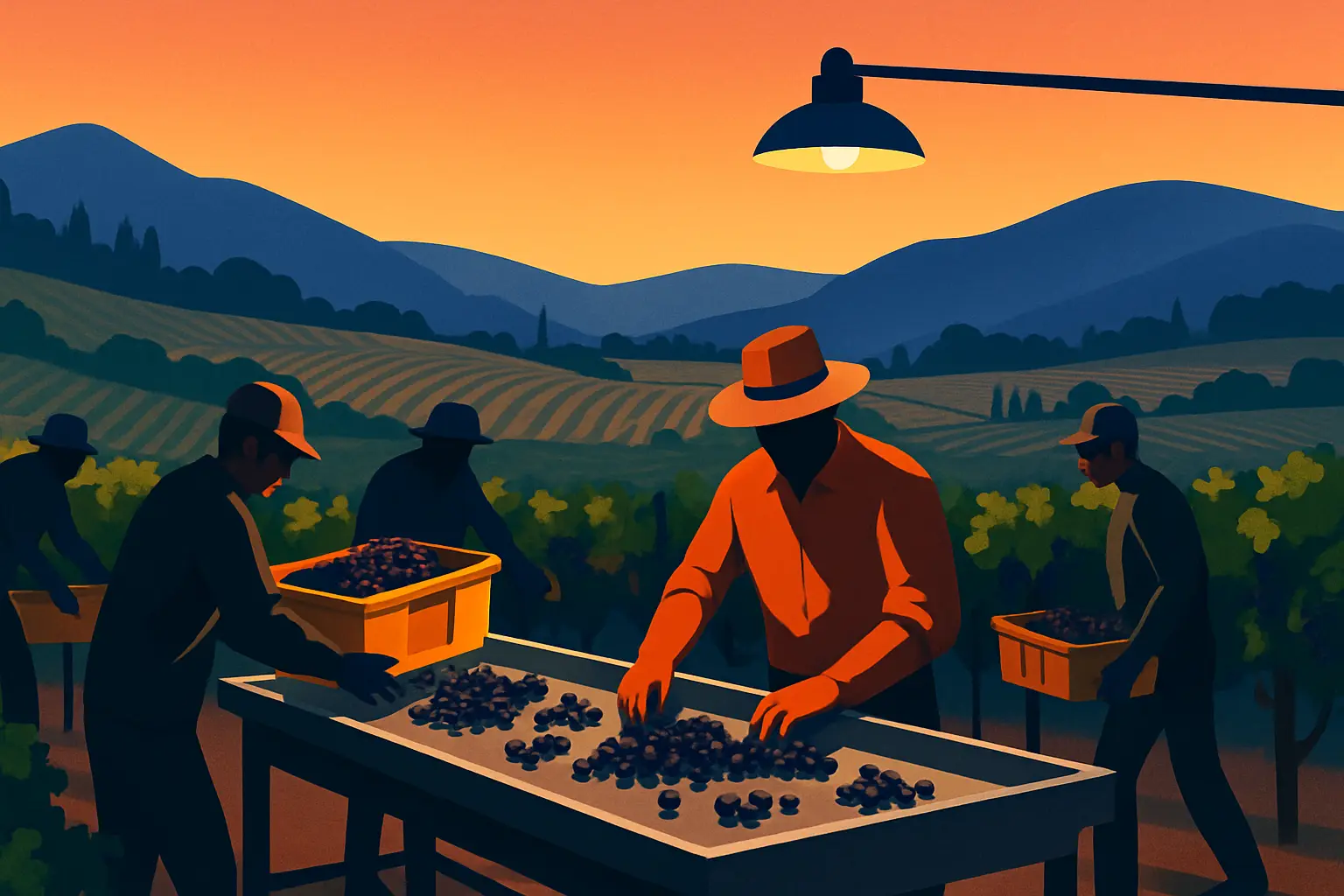
A late September morning at a Cabernet-focused winery in Oakville or Rutherford might find harvest crews finishing a night-shift pick, with fruit being sorted on vibrating sorting tables before going into fermentation tanks. The smell is unlike finished wine — yeast and grape skin, something slightly sweet and fermented, alive. Some wineries schedule dedicated harvest experiences where visitors can observe or hand-sort alongside the crew, priced as premium add-ons ($150–$300 per person) that book months out.
Even without a formal harvest experience, visiting in September gives you a working winery rather than a quiet one. Staff are moving fast. Parking lots have refrigerated trucks. Fermentation tanks are full and warm. The contrast with a January visit — dormant vines, empty cellar, quiet tasting room — is profound. For a first-time Napa day trip, September is the most interesting window of the year.
Highway 29 runs up the valley's western side through the main commercial corridor. This is the tourist road: the Napa Valley Wine Train, Beringer's Rhine House, Robert Mondavi Winery, the town of St. Helena with its restaurants and boutiques. Between noon and 4 p.m. on a Saturday in October, the 6-mile stretch through St. Helena can take 45 minutes to drive. Come early or plan to be off Highway 29 before 12:30 p.m. on weekends.
The Silverado Trail runs parallel on the eastern side, about a mile from Highway 29. It's a two-lane road with less traffic, better mountain views toward the Vaca Range, and a different set of wineries. Stag's Leap Wine Cellars, Darioush (a Persian-influenced estate at 4240 Silverado Trail with dramatically columned architecture modeled on Persepolis), Clos Du Val (1572 Silverado Trail, one of the 1972-founded estates that helped establish the valley's reputation), and Hall Wines (401 St. Helena Hwy, with large-scale contemporary sculptures installed throughout the grounds) are all Silverado Trail addresses.
The two roads are connected by east-west cross routes — Oakville Grade, Rutherford Road, Zinfandel Lane — so you can easily move between them. A day that works: drive north on Highway 29 in the morning, cross through Rutherford or Oakville to pick up the Silverado Trail for an afternoon winery, and return south on the Trail toward Napa city, bypassing the afternoon Highway 29 backup entirely.
Beringer Vineyards — 2000 Main St, St. Helena. Napa's oldest continuously operating winery, founded in 1876 by brothers Jacob and Frederick Beringer. The Rhine House, a 17-room Victorian mansion built by Frederick in 1884, still functions as the main visitor building. Beringer remained open through Prohibition by converting production to sacramental and medicinal wine — the limestone caves hand-dug by Chinese laborers in the 1870s are part of the standard cave tour. Walk-in tasting is available at the Wine Bar; the cave tour requires a reservation.
Inglenook — 1991 St. Helena Hwy, Rutherford. The 1879 stone chateau was built by Finnish fur trader Gustave Niebaum and became the benchmark Napa estate of the late 19th century. After decades of corporate ownership that diluted the brand, Francis Ford Coppola purchased the property in 1995 and has spent the decades since restoring the estate's ambitions. The flagship Rubicon Cabernet blend from estate fruit is the winery's center of gravity. The property's scale — stone chateau, working winery, museum of Napa history — makes it one of the most substantive single stops in the valley. Reservations required.
Domaine Carneros — 1240 Duhig Rd, Napa. A sparkling wine specialist in the cool Carneros AVA at the valley's southern end — the closest major winery to the Highway 37 junction, which makes it the logical first or last stop. Owned by Champagne Taittinger, and the production method (traditional methode champenoise) is the same used in Champagne. The views from the terrace over the Carneros vineyard and San Pablo Bay are among the best in the valley. Walk-ins occasionally possible; reservations preferred.
Castello di Amorosa — 4045 St. Helena Hwy, Calistoga. A genuine 13th-century-style Tuscan castle built over 14 years by Dario Sattui, opened in 2007. The structure includes a great hall, a moat, a drawbridge, a chapel, and 107 rooms, all constructed with hand-hewn stone and reclaimed European brick. The wines are Italian-varietal focused — Sangiovese, Barbera, Pinot Grigio — rather than Napa's standard Cabernet program. This one earns a visit for the architecture and spectacle specifically; no reservations required for self-guided entry.
French Laundry (6640 Washington St, Yountville) requires reservations made exactly two months in advance at 8 a.m. on the day bookings open, at $450–$550 per person before wine. Booking this on a same-day trip from San Francisco means planning the restaurant first and the trip around it, not the other way.
Oxbow Public Market (610 First St, Napa) is the realistic alternative for day visitors. Opened in 2010 in a former industrial building in downtown Napa, it anchors a walkable stretch of the city's riverfront. Hog Island Oyster runs a counter with a full oyster program, 9 a.m. to 5 p.m. Fatted Calf Charcuterie operates a retail counter with house-cured meats and pates. Ca' Momi Osteria serves Neapolitan pizza and pasta. All walk-in, no reservations. From Oxbow, it's a 10-minute walk to several downtown Napa tasting rooms on Main Street and First Street that operate without the valley's advance-booking requirements.
Bouchon Bakery (6528 Washington St, Yountville) is Thomas Keller's walk-in bakery attached to his Bouchon Bistro. Macarons, croissants, and bread baked in-house, open from 7 a.m. A coffee and pastry here before your first winery is the right way to use Yountville without a months-out reservation.
Gott's Roadside (933 Main St, St. Helena) is a vintage-style drive-in serving burgers, fish tacos, and a well-regarded ahi tuna melt. Walk-in only; lines get long on weekend afternoons, but it's one of the few affordable quick-service spots on the Highway 29 corridor.
How much does a Napa tasting day actually cost? Tasting fees at most mid-tier Napa wineries run $45–$80 per person for a standard pour; estate seated experiences run $100–$200 per person. Budget $200–$400 for a day covering two wineries, lunch at Oxbow Market, and the Golden Gate toll and fuel. Napa is not a value destination — the valley's economics are built around high-end Cabernet, and the tasting fee structure reflects that.
Do I need a designated driver? Yes. California DUI enforcement is active throughout the valley, especially on Highway 29 and the Silverado Trail on weekends. Two wineries with multiple pours at each adds up faster than expected, particularly in September heat. Many visitors designate a driver within their group — wineries almost always offer non-alcoholic alternatives for drivers. Napa Valley Wine Train (1275 McKinstry St, Napa) handles transport and wine stops in a single 36-mile excursion; 3-hour trips start at $175 per person and require advance booking.
What do most day trippers get wrong? The two most common mistakes are trying to visit four or five wineries (three tastings in September heat is effectively impaired by 2 p.m.) and skipping the city of Napa entirely for the more glamorous valley corridor. Two wineries per day is the experienced visitor standard. Napa city — Oxbow Market, downtown tasting rooms, the riverfront — is worth 90 minutes of the day and requires no reservations.
Is there a good time to visit that isn't harvest season? April and May are bud break — the vines leaf out in vivid green against the valley's brown winter hills, and the weather is mild without summer heat. Tasting room staff have time to talk when the volume is lower. Reservation requirements loosen and tasting fees sometimes drop. The tradeoff is no crush activity and a landscape that's still waking up. For first-time visitors, September wins for sheer spectacle; for second-time visitors who want depth, April is often better.