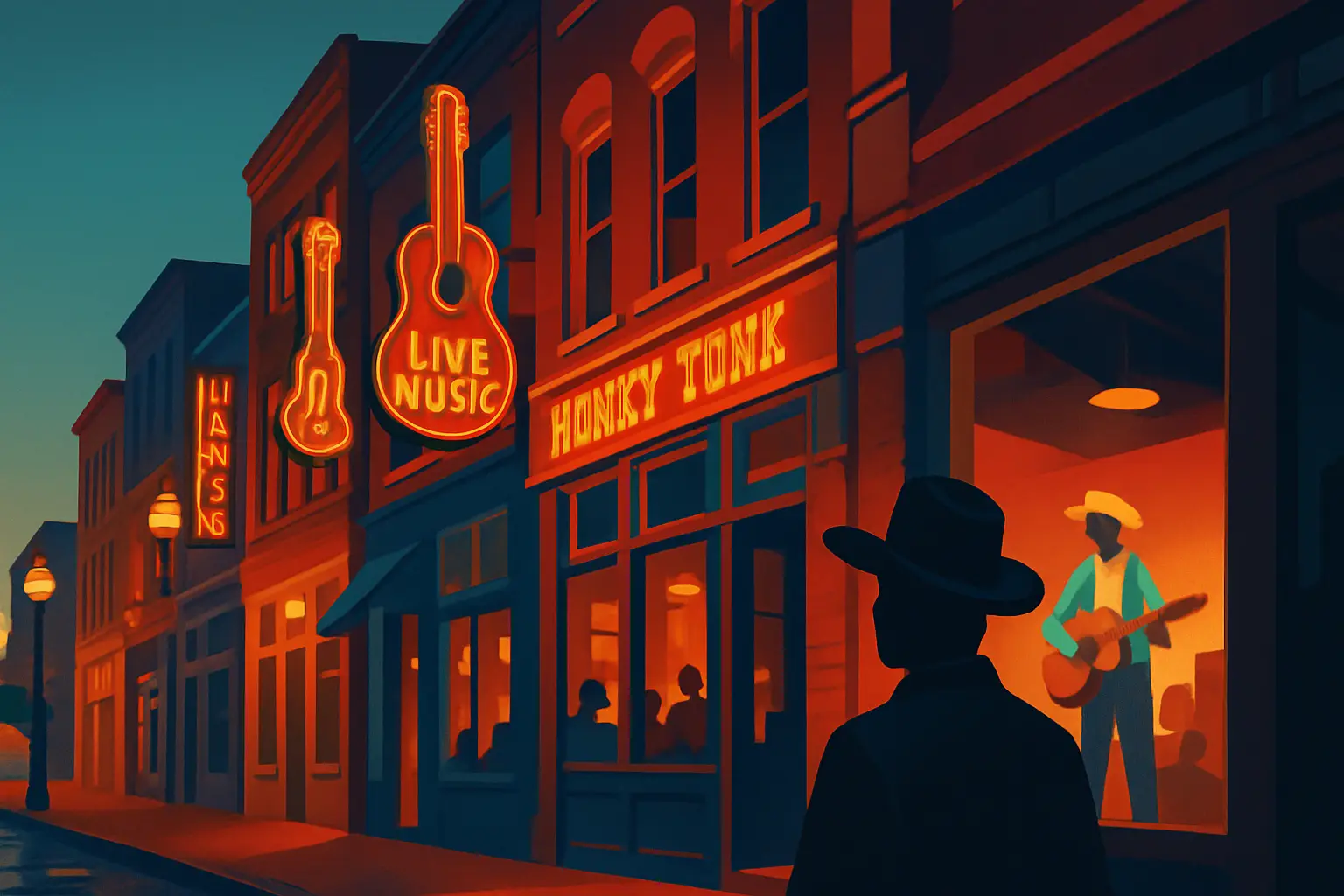
Lower Broadway — also called the Honky Tonk Highway — spans four blocks running east from 1st Avenue South toward 5th Avenue South, with Bridgestone Arena (home of the Nashville Predators, opened 1996) anchoring the western end and the Cumberland River visible from the eastern edge. This configuration was not always the city's prime real estate.
In the 1980s and early 1990s, Broadway was underfunded, declining, and largely ignored by the music industry that had moved its operations elsewhere when the Grand Ole Opry relocated to its current home in Opryland in 1974. What remained were pawn shops, western wear stores, and a handful of bars — including Tootsie's and Robert's — that kept the honky-tonk tradition alive through the lean years without any guarantee it would pay off.
Bridgestone Arena's opening in 1996 began the turnaround. The 2010s brought the second wave: celebrity-branded entertainment complexes stacking six and seven stories above the old storefronts, the bachelorette-party economy that made Nashville one of the most-visited cities in the American South, and international attention that now fills Broadway on Tuesday afternoons. The current strip runs all of that simultaneously: the original 1960s bars operating as they always have, and the new multi-floor venues running sound systems and booking calendars at full volume beside them. They coexist because Broadway is big enough and because the business model — no cover, buy drinks — works regardless of era.
Tootsie's Orchid Lounge (422 Broadway) is the most historically significant bar on the strip, and its significance is almost entirely due to its location relative to a door it cannot be seen from.
Hattie Louise 'Tootsie' Bess bought the bar — then called Mom's — in 1960. The name came by accident: she hired painters to freshen the building and told them to use whatever color they had on hand. They painted it purple. She renamed it Tootsie's Orchid Lounge. The exterior is still purple.
The Ryman Auditorium, the Mother Church of Country Music, sits one block north at 116 5th Avenue North. The Ryman was home to the Grand Ole Opry from 1943 to 1974. Its stage door opens onto a back alley that connects directly to the rear of the Broadway storefronts — and to Tootsie's back entrance. During the Opry's Ryman years, performers on Saturday night broadcasts would slip out the stage door during commercial breaks, walk the alley, have a drink at Tootsie's, and be back before their next number. The alley was the unofficial greenroom for an entire era of American country music.
Willie Nelson got his first Nashville songwriting deal after Tootsie heard him perform here. During a period when he was broke and not yet known as a recording artist, he lived in the room above the bar. Kris Kristofferson swept floors and helped settle bar tabs. Roger Miller was a regular. The roster of mid-career artists who used Tootsie's as their after-hours living room during the Ryman years reads like a Hall of Fame ballot.
The Opry moved out of the Ryman in 1974. The back-alley pipeline between the two venues ended. But Tootsie's stayed open, kept booking live music, and kept the lights on through the years when most businesses left Broadway. It is now a three-story venue. The original purple exterior is unchanged and unmistakable from the street.
Get short, interactive stories that make each place easier to remember while you travel.
Robert's Western World (416B Broadway) is the counterweight to Broadway's celebrity excess and the bar most likely to be recommended by someone who actually lives in Nashville.
Its current owner and house band leader, Jesse Lee Jones — a Brazilian-born musician whose group the Brazilbillies plays traditional honky-tonk and Ernest Tubb-era country — bought the venue from its original owner and has operated it with a stated philosophy: no gimmicks, no theme-park aesthetics, no cover charge, live music from noon daily.
The Recession Special was introduced in 2008 when the financial crisis was at its worst. The menu item — a fried bologna sandwich with six thin-cut slices griddled on the flat-top until the edges curl, a bag of chips, a Moon Pie, and a PBR — has stayed on the menu at roughly $6 ever since. On a strip where a single beer runs $10–14, this combination is both a genuine deal and a deliberate statement about what kind of bar Robert's intends to be.
The Brazilbillies play afternoon sets that can be heard from the street. Weekday afternoons at Robert's — near-empty room, traditional country from a committed house band, fried bologna at the bar, no tourists performing the tourism version of Nashville — are one of the most honest experiences the city offers. It is not a preserved version of the past; it is an active choice to be something specific in a strip that has largely stopped making choices.
The 2010s brought a structural change to Lower Broadway: the celebrity-branded, multi-story entertainment complex, which operates on different economics than the traditional two-floor honky-tonk.
Luke Bryan's 32 Bridge Food + Drink (301 Broadway) runs six levels and eight bars, with rooftop views of the Cumberland River and a programming calendar that extends beyond country into pop and rock. Kid Rock's Big Ass Honky Tonk and Rock N' Roll Steakhouse (221 Broadway) holds close to 2,000 people across five floors and functions as much as a dinner venue as an entertainment one. Jelly Roll's Goodnight Nashville occupies the highest rooftop bar position on Broadway — a meaningful distinction on a street where every successive owner has tried to build higher.
The predictable criticisms of these venues are not entirely wrong: they are loud, expensive by design, and built for throughput rather than intimacy. But the best of them are also genuinely good. The sound systems are professional-grade. The rooftop views — Cumberland River in the foreground, the pedestrian bridge lit at night, the skyline behind — are legitimately spectacular and not available anywhere else at this price of entry (which is usually still free).
The honest answer is that both kinds of Broadway coexist because both are doing what they set out to do. The multi-story complexes draw visitors who want a festival experience without a festival ticket. The old-guard venues draw visitors who want to understand what the strip was before the celebrities arrived. The distance between Tootsie's and Luke Bryan's 32 Bridge is about 150 feet.
Most celebrity venues open at 10 a.m. to noon and run until 2 or 3 a.m., 365 days a year
Rooftop bars on the upper floors often require separate elevator access — ask at the host stand
Crowds peak between 9 p.m. and 1 a.m. on Friday and Saturday; Sunday mornings are the strip's quietest window
The Ryman Auditorium (116 5th Ave N) is a ten-minute walk from Broadway and is the single most historically significant music venue in the United States. It is not optional.
Built in 1892 as the Union Gospel Tabernacle by riverboat captain Tom Ryman — who converted to Christianity after attending a revival by Reverend Sam Jones and wanted to build the minister a permanent meeting place — the Ryman was never designed as a music hall. Its wooden pews, arched gothic windows, and semi-circular revival-meeting layout produce acoustics that are exceptional by accident. Musicians from every genre describe the room as one of the best-sounding venues they have ever played.
The Grand Ole Opry broadcast live from the Ryman from 1943 to 1974, which is how the building became the Mother Church of Country Music. Hank Williams performed here. Patsy Cline. Johnny Cash. Elvis Presley (twice, in 1954 — his second appearance went poorly enough that the Opry manager told him to go back to driving trucks). Every major figure in country music's formative decades passed through this room.
After the Opry moved to its new home in Opryland in 1974, the Ryman nearly fell to demolition. A sustained preservation effort saved it. Today it hosts concerts year-round — the acoustics attract musicians far outside country music — and daily self-guided tours walk visitors through the stage and the seating history. Buying a ticket to see a show at the Ryman is one of the most reliable 'worth it' investments Nashville offers.
Is it safe? Lower Broadway is busy, well-policed, and safe for standard visitors. The strip operates under significant law enforcement presence on weekend nights, and the density of people and active storefronts means it functions as a typical high-traffic entertainment district rather than an area that requires caution beyond normal urban awareness. Keep an eye on your belongings in dense crowds.
When is the best time to visit in 2026? Labor Day weekend (September 4–7, 2026) is one of Nashville's biggest travel weekends — hotels fill early and Broadway gets louder than usual. If visiting then, arrive by Friday afternoon for the most manageable crowds. The shoulder-season window from mid-September through October is when the weather improves and the bachelorette traffic eases; that's the locals' preferred season for Lower Broadway.
How do I get there? From hotels in the Gulch, SoBro, or East Nashville, Broadway is accessible on foot or by a short ride-share. Driving to Broadway and parking is reliably frustrating — garages near the strip charge peak event rates and traffic on Saturday nights moves slowly. Ride-share drop-off at 1st Avenue or 5th Avenue puts you at either end of the strip within walking distance of everything.
What else is near Broadway? The Johnny Cash Museum (119 3rd Ave S) is a two-minute walk and one of the best music museums in the country — focused, curated, and built around real artifacts. The Country Music Hall of Fame (222 Rep. John Lewis Way S) is the comprehensive institution, covering the genre's full arc from its roots through the present. Both are worth an afternoon separate from the bar-hopping itinerary.
For the side of Nashville that exists outside the tourist infrastructure, see our East Nashville neighborhood guide — the neighborhood across the Cumberland River where the city's working musicians actually live.