The Hot Springs Reservation was established by Congress in 1832, forty years before Yellowstone became the world's first designated national park. Washington moved not to protect wilderness but to protect water: the thermal springs emerging from the Ouachita Mountains at 143°F had drawn visitors for centuries, and competing land claims in the 1820s threatened to divide the springs among private owners. Congress resolved the dispute the way it would eventually resolve others — it took the land and declared it federal territory.
This made Hot Springs the conceptual ancestor of the entire National Park system: the first instance of the federal government setting aside land of exceptional value on behalf of the public. The park became an official National Park in 1921. It now covers 5,550 acres of Ouachita Mountain forest wrapped around the city of Hot Springs, which has a population of about 39,000.
The Quapaw people called this valley 'the valley of the vapors.' They recognized the springs as neutral ground — a place where tribal groups could meet and the healing waters belonged to everyone. That idea, that land of exceptional value should be held in common, is the foundation of American conservation. It started here, in Arkansas, in 1832, with a dispute over who owned hot water.
The eight bathhouses lining the east side of Central Avenue were built between 1892 and 1923, each in its own architectural language. Walking the row from south to north is a compressed tour through thirty years of American ideas about public health, leisure, and institutional architecture.
The Fordyce Bathhouse (1915, Renaissance Revival) is now the park visitor center and free to enter. The Buckstaff Bathhouse (1912) has operated continuously since opening — it is the only one that never closed for renovation or conversion and still offers the traditional bathhouse experience. The Quapaw Baths & Spa (1922) reopened as a modern spa using the original thermal water supply from the mountain behind it. The Superior Bathhouse (1916) was converted into Arkansas's first brewery on federal land — Superior Bathhouse Brewery — and brews every beer with Hot Springs thermal spring water. The Hale Bathhouse now operates as a boutique hotel and spa. The Lamar, Ozark, and Maurice bathhouses serve as a gift shop, cultural center, and are in various stages of restoration.
The architectural contrast between buildings is deliberate — each owner wanted to signal their bathhouse as distinct from its neighbors. The result is a streetscape that looks unlike any other block in the South: eight monumental buildings in a row, none matching, all from the same era.
Get short, interactive stories that make each place easier to remember while you travel.
The Fordyce was the most expensive bathhouse on the row when it opened in 1915 — $100,000 in construction costs, which translates to roughly $3 million today. Its reputation was built on amenities that had no equivalent in the region: stained-glass ceilings over the main bathing pools, ceramic tile floors in geometric patterns across three floors, a rooftop sun parlor, a gymnasium fitted with the era's therapeutic equipment, and a bowling alley in the basement. The bowling alley still exists, intact, and is the room that most visitors photograph.
The building closed as a bathhouse in 1962 and was restored and reopened as the park visitor center in 1989. Everything inside is preserved — the tile work, the stained-glass domes, the porcelain tubs in the men's and women's bathing halls. An orientation film about Hot Springs National Park runs every half hour in the first-floor theater. Self-guided tour materials are available throughout, and park rangers run guided tours on a first-come, first-served basis beginning at 10 a.m.
The building spans four levels including the basement. The second-floor men's bathing hall, with its stained-glass ceiling still illuminated, and the basement bowling alley are the two stops that justify the full walk. Entry is free.
Hot Springs in the 1920s and 1930s operated on an unspoken agreement: the local government tolerated illegal gambling, the guests — whoever they were — spent money and tipped generously, and no one brought their violence from Chicago or New York into Arkansas. Law enforcement later referred to the city as 'open territory' — a neutral zone where gang rivalries were suspended by mutual consent. The thermal baths, the horse racing at Oaklawn Park, and the city's deliberate indifference to Prohibition made it exactly what organized crime wanted in a vacation.
Al Capone came annually for over a decade beginning in the early 1920s. He typically rented the entire fourth floor of the Arlington Hotel (239 Central Ave, still in operation) and occupied Room 443 himself. That room contained a closet connecting to an escape passage — now sealed — that allowed Capone to leave the building without using the lobby. He received thermal bath treatments at the bathhouses, in part because he had syphilis and believed the mineral water helped. He placed bets at Oaklawn Park (2705 Central Ave), still one of the premier horse racing venues in the South, and ate at the Ohio Club (336 Central Ave), Arkansas's oldest bar, open since 1905.
Lucky Luciano was arrested along Bathhouse Row on April 1, 1936, on orders from New York prosecutor Thomas Dewey. Hot Springs police released Luciano on a $5,000 bond before federal extradition could be arranged. The standoff between the city's local power structure and federal authority lasted weeks. The Gangster Museum of America (510 Central Ave) covers all of this with artifacts, documentary footage, and interviews with relatives of Capone and Luciano.
The water flowing through the Bathhouse Row system is local rainwater that infiltrated the Ouachita Mountain rock roughly 4,000 years ago. It descends deep enough to be heated by geothermal processes to 143°F and returns to the surface through forty-seven spring outlets. Before entering the bathhouses, it is mixed with cooler water to bring it down to a usable temperature — the pools in modern spas run between 100°F and 104°F.
The Quapaw Baths & Spa (413 Central Ave) is the most accessible for visitors seeking an actual thermal bath. The 1922 building was restored and reopened as a full-service spa. Thermal pool access starts around $35–$45; individual pools vary in temperature. The experience is less clinical than the original bathhouse model — towels and lockers are included, the pools are tiled, and private bath rooms are available for an additional fee. Book in advance, especially for weekends.
The Buckstaff Bathhouse (509 Central Ave) offers the traditional experience closest to the original 1912 format. An attendant walks you through the bath sequence — thermal soak, vapor cabinet, needle shower. Walk-ins are accepted. The two experiences are genuinely different: Quapaw is a spa, Buckstaff is a time capsule.
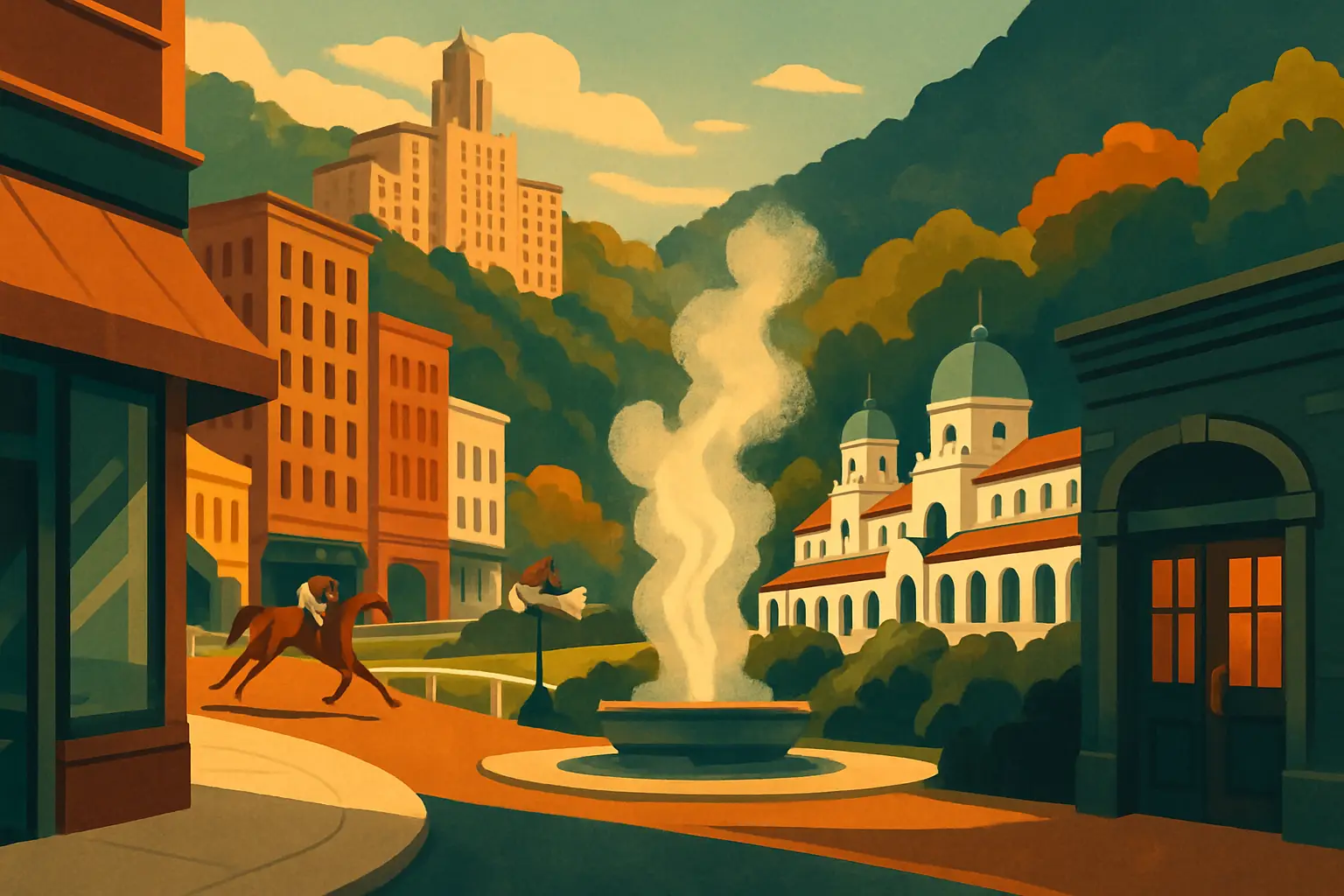
Behind Bathhouse Row, a half-mile brick walkway called the Grand Promenade runs between the backs of the bathhouses and the forested hillside where the actual spring outlets are visible. Several springs are uncapped here — on cool mornings, the steam rising from the 143°F water is visible from the walkway. The Promenade is the place in Hot Springs where the whole thing makes literal sense: there is a mountain behind the city, water heated in its rock is emerging from the ground, and people have been walking this path to look at it for two centuries.
From the Grand Promenade, multiple mountain trails enter the forested section of the park. The West Mountain Summit Trail (1.4 miles round-trip) reaches a viewpoint over downtown. The Sunset Trail is a 10-mile loop through the Ouachita forest for more committed hikers. Both start from the Promenade or from trailhead parking on Whittington Avenue.
Superior Bathhouse Brewery (329 Central Ave) holds a claim few breweries in the world can make: it is the only brewery operating on federal land inside a National Park. All beers are brewed with Hot Springs thermal spring water, which influences mineral balance and flavor. The taproom fills what was once the 1916 bathhouse's main hall. The patio along Central Avenue is the right place to end an afternoon after the Promenade walk.
From Little Rock: Hot Springs is 52 miles southwest via US-270 W — typically 55 to 60 minutes by car. It works as a day trip from Little Rock but rewards an overnight, especially if Oaklawn Park racing or an evening at the Ohio Club is part of the plan. The nearest commercial airport with regular service is Bill & Hillary Clinton National Airport (LIT) in Little Rock.
From Memphis: 165 miles west via I-40 and US-270, approximately 2.5 hours. Hot Springs sits naturally on a Memphis-to-Dallas driving route, and the detour off I-40 is worth it. Memphis's Beale Street and Hot Springs share a timeline — both hit their cultural peaks in the same Jazz Age decade when the rules were looser everywhere.
From Dallas: 335 miles northeast via I-30 and US-70, approximately 4.5 hours. Longer but doable as an overnight.
Day structure: Start at the Fordyce Bathhouse when it opens (9 a.m.). Walk Bathhouse Row south to north. Lunch at the Ohio Club. Grand Promenade in the early afternoon. Quapaw or Buckstaff for a bath if booked in advance. Gangster Museum before dinner. Dinner and drinks at Superior Bathhouse Brewery or back at the Ohio Club. If Oaklawn Park racing is active (January through April), it replaces the afternoon entirely.
Best time to visit: October into early November is the peak. The Ouachita Mountains produce genuine fall foliage — the forest surrounding Hot Springs turns from mid-October onward, and the Grand Promenade walk through the park is particularly good during leaf color. Temperatures drop to a range that makes thermal baths feel like the right idea. Summer is hot and humid; the park trails are less pleasant in July and August.
September is a useful shoulder month — fewer visitors than summer, still warm enough for evening patio time at Superior Bathhouse Brewery, and the bathhouses are less crowded on weekday mornings.
Oaklawn Park (January–April) changes the calculus for spring visits — racing season makes the city feel the way it must have felt when Capone was here. If horse racing at a historic Southern track sounds appealing, that is the reason to visit in winter or early spring.
What to budget: The Fordyce Bathhouse is free. The Gangster Museum runs about $15. A thermal bath at Quapaw starts at $35. Oaklawn Park admission is under $10; track betting is whatever you want to spend. The Ohio Club and Superior Bathhouse Brewery are standard bar prices. A realistic day budget — museum, bath, meals, drinks — is $80 to $120 per person without counting a hotel.
What to skip: Hot Springs has accumulated some tourist-trap additions over the years. The wax museum and the Ripley's Believe It or Not outpost on Central Avenue are not the reason to come. The National Park, the bathhouses, the gangster history, and the mountain trails are.