1. What Beale Street Actually Is — and Why It Matters
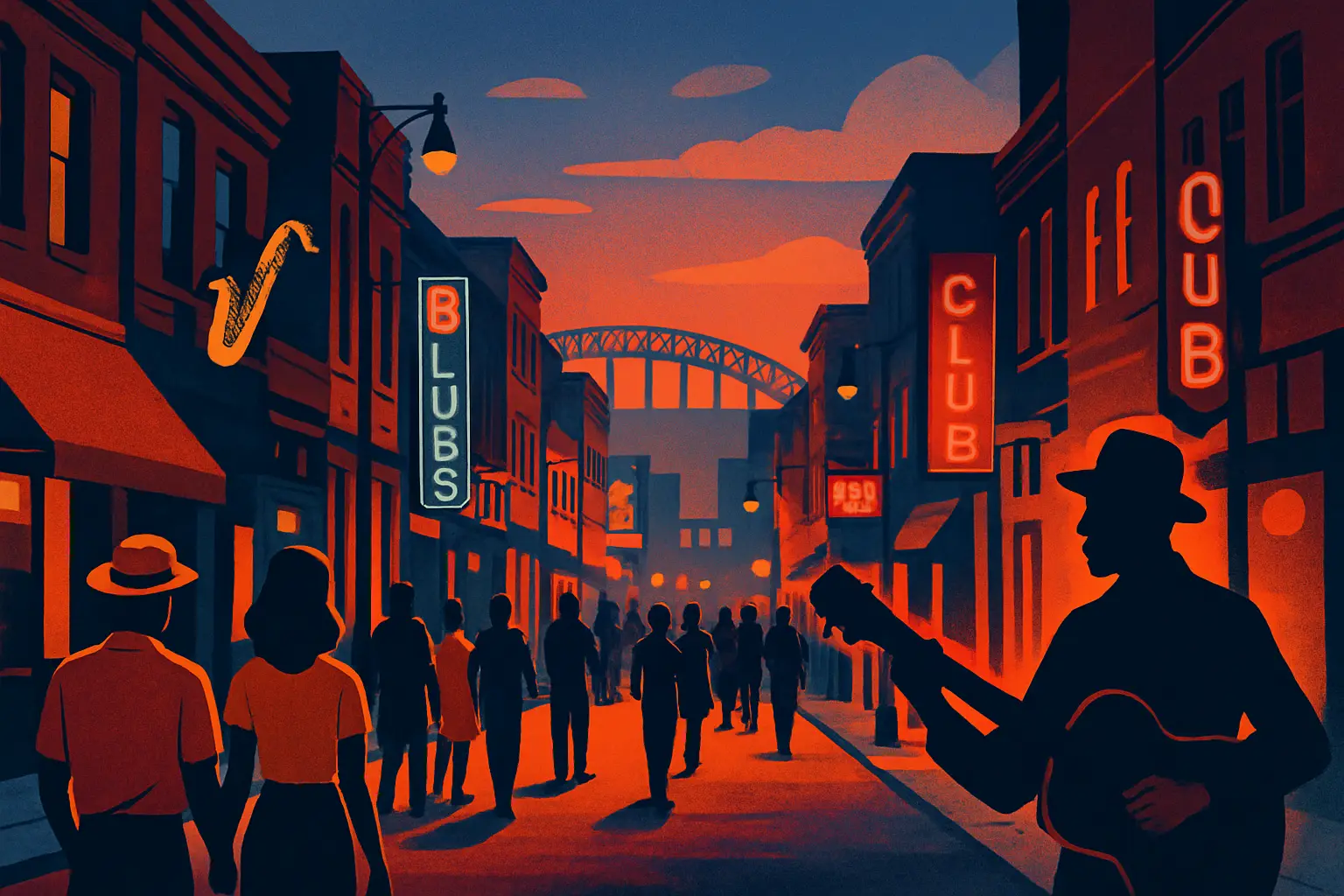
Beale Street was laid out in 1841 by a developer named Robertson Topp, who named it after a forgotten military figure. For its first few decades it was an unremarkable commercial corridor. What changed Beale Street's trajectory was the movement of African Americans into the surrounding neighborhood after the Civil War — particularly after the 1878 yellow fever epidemic killed approximately 5,000 Memphis residents and drove much of the white population out of the city. African Americans who had built immunity through earlier exposure remained, and in the aftermath they established businesses, churches, and institutions along and around Beale Street that made it the economic and cultural hub of the largest Black community in the mid-South.
By the early twentieth century, Beale Street had Black-owned banks, insurance companies, law offices, pharmacies, and theaters — all serving a community that was legally excluded from mainstream Memphis commercial life. This economic density is why the musicians came. Venue owners could pay, audiences were there, and a musical culture that had been building since Reconstruction had concentrated into something genuinely new. Handy arrived in 1909. The rest followed.
2. W.C. Handy and the Birth of Published Blues
William Christopher Handy was born in Florence, Alabama in 1873, the son of a minister who considered secular music sinful. He played cornet and led dance bands across the South before arriving in Memphis in 1909 to direct a Black dance orchestra. Handy had heard the blues — the raw, improvised string music of rural African Americans — for years before he began transcribing and publishing it in sheet music form.
In 1912, he published 'Memphis Blues,' originally written as a campaign song for Memphis political boss E.H. Crump. It was the first blues composition to appear in published sheet music form. Two years later he published 'St. Louis Blues,' which became one of the most recorded songs in American history. Handy's contribution wasn't inventing the blues — he was clear that he was documenting music that already existed in oral tradition. What he did was give the genre a commercial form that could be printed, distributed, and performed by orchestras, accelerating its spread across the country by decades.
Handy's office was at 392 Beale Street. The building is gone, but the park at Beale and Hernando — with his bronze likeness — marks the territory where he worked.
3. The Golden Age: Beale Street in the 1920s and 1930s
Beale Street's peak era ran roughly from the early 1920s through 1940. The Palace Theater at 324 Beale Street seated 2,200 and brought in national touring acts — Louis Armstrong performed there, as did Ma Rainey and Bessie Smith. The clubs along both sides of the street provided employment for musicians ranging from nationally recognized names to entirely regional players working the circuit.
Memphis Minnie — Lizzie Douglas, born in Louisiana in 1897 — was among the most technically accomplished blues guitarists of either gender in the era and recorded prolifically out of Memphis. Albert King arrived from Mississippi in the 1940s and built his regional reputation on Beale Street before his national breakthrough. B.B. King himself came north from Indianola, Mississippi in 1947, played Beale Street, secured a spot on WDIA (the first radio station in the country to program exclusively for Black audiences), and became a local celebrity before his wider career took off. His name is now on the biggest club on the street.
4. The Decline and the Long Resurrection
Beale Street's decline began in the late 1950s and accelerated through the 1960s. Urban renewal projects demolished the surrounding Black residential neighborhoods. Highway construction severed the community's street connections. Desegregation, paradoxically, pulled Black consumers toward previously unavailable mainstream commercial spaces, reducing foot traffic in the Beale corridor. By the early 1970s most businesses had closed. The city acquired the properties through eminent domain in 1977, planning redevelopment. Most of the remaining historic buildings were demolished.
What was left stood empty. A. Schwab at 163 Beale stayed open through the entire period — nearly alone on a street of boarded windows and vacant lots.
Serious redevelopment began in the late 1980s. A public-private partnership restored the historic district, created a pedestrian entertainment zone, and attracted bars and live music venues. The result — an open-container entertainment district that draws hundreds of thousands of visitors annually — is not the street W.C. Handy knew. Too much was demolished for that. But the history is real, the music is still playing, and the bones of what made the street matter have outlasted the decades of neglect.
5. Where to Hear Live Blues on Beale Street Today
Live music runs on Beale Street seven nights a week. These are the venues worth prioritizing.
•**B.B. King's Blues Club** (143 Beale St.) — The flagship. A house band plays two sets nightly; touring acts supplement on weekends. The sound system is the best on the strip. B.B. King performed here regularly before his death in 2015. The Memphis location is more serious about the music than the chain's other outposts.
•**Rum Boogie Café** (182 Beale St.) — Long-running blues club with walls lined with signed guitars donated by Stevie Ray Vaughan, Jerry Lee Lewis, Eric Clapton, and others. Live blues nightly. The fried catfish is good. The crowd skews older than the bar-crawl venues next door, which is usually a sign the music is the actual draw.
•**Silky O'Sullivan's** (183 Beale St.) — Famous for dueling pianos, a sprawling outdoor patio, and its resident goats — a genuine Memphis institution since the 1980s. Less focused on traditional blues, but the courtyard on a summer evening is hard to argue with.
6. Memphis Beyond Beale Street: MLK, Stax, and Sun Studio
Beale Street is the entry point, not the whole story.
The National Civil Rights Museum (450 Mulberry St.) is built around the Lorraine Motel, where Martin Luther King Jr. was assassinated on April 4, 1968. The museum preserves Room 306 and the balcony where he was shot, extends through the adjacent building where the shooter fired from, and chronicles the Civil Rights Movement from Montgomery through the Memphis sanitation workers' strike that brought King to the city. It is one of the most carefully designed historical museums in the United States. Budget three hours minimum.
Stax Museum of American Soul Music (926 E. McLemore Ave.) sits on the original site of Stax Records, which produced Otis Redding, Isaac Hayes, Sam & Dave, and Booker T. & the MGs between 1957 and 1975. The studio was demolished in 1989, but a recreation was built on the same foundation. The museum holds the actual recording console and instruments from the original sessions.
Sun Studio (706 Union Ave.) is the room where Sam Phillips recorded Elvis Presley, Johnny Cash, Jerry Lee Lewis, Roy Orbison, and Howlin' Wolf in the early 1950s. The space is roughly 800 square feet and still operates as a working recording studio at night. Daytime tours walk through original equipment in its original positions.
7. Is Beale Street Worth Visiting? Practical Questions Answered
Is it just a tourist bar strip? Partly. The open-container entertainment district brings bachelor parties and souvenir shoppers on weekend nights — that's real. But the historical depth underneath is also real: the W.C. Handy Museum (352 Beale St.), A. Schwab, the park with Handy's statue, and the live blues in the clubs every night are all genuine. Showing up with context makes the difference between a bar crawl and something worth remembering.
Is it safe? Beale Street during active evening hours is a well-lit, well-patrolled entertainment zone. Memphis has a significant overall crime rate, but the specific stretch of Beale Street while venues are open is safe in the same way a busy entertainment district anywhere is. Standard city awareness applies: stay in the lit corridor, don't leave valuables visible in a parked car.
Best time to visit? Weekday evenings in summer — live music is running, crowds are manageable, and the heat has dropped. The Beale Street Music Festival in early May brings major national acts to Tom Lee Park on the riverfront. Sunday afternoons offer the best combination of authentic audiences and reduced cover charges.
How do I get between Beale Street, Sun Studio, and Stax? Neither Sun Studio (midtown, on Union Ave.) nor the Stax Museum (South Memphis, McLemore Ave.) is within walking distance of Beale. Rideshare is the practical choice. Budget a full day if you want all three — Beale Street, the National Civil Rights Museum (a 15-minute walk from Beale), and one of Sun Studio or Stax.