1. Two Cities, One New Orleans: Why the Garden District Exists
Most American neighborhoods have a history, but few have a founding rivalry as legible as the Garden District's. When the Louisiana Purchase transferred New Orleans to the United States in 1803, the city was already a century old, French- and Spanish-speaking, culturally Creole, and economically controlled by families who had been there for generations. American merchants and planters arriving in the years after the purchase were outsiders, and the Creoles weren't especially interested in making them comfortable.
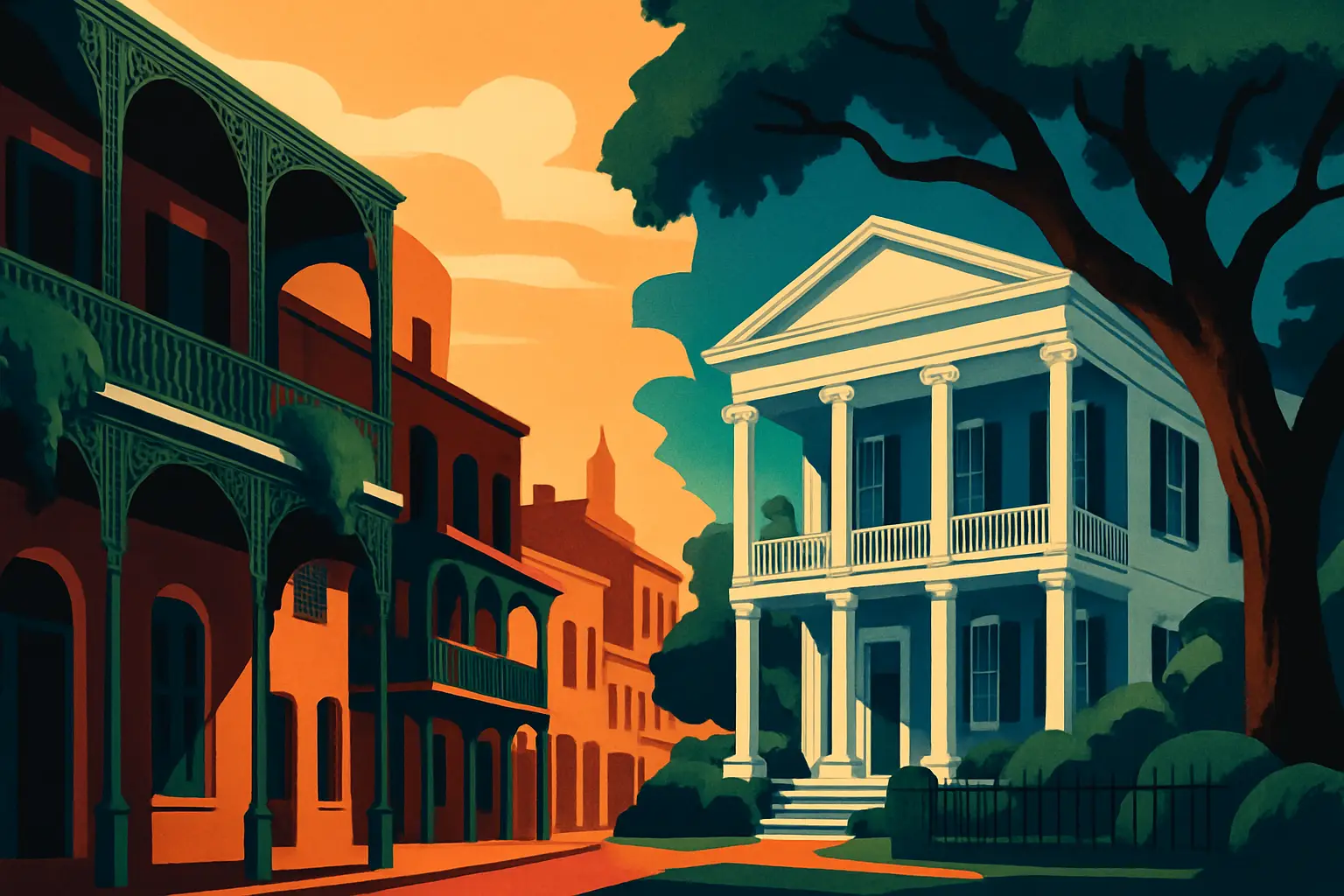
The solution was to move upriver — above Canal Street, which functioned as the effective boundary between the old Creole city and the American sector. American businessmen began purchasing land on former plantation tracts in what was then Jefferson Parish, laying out streets and building houses in a style that deliberately rejected the French Quarter's dense, courtyard-oriented form. Where the Quarter's buildings pressed against the street and enclosed private space inside, the American upriver houses were set back on wide lots, surrounded by gardens, visible from the street as statements of prosperity. In 1833 this area was incorporated as the City of Lafayette, New Orleans's first suburb and its most persistent architectural argument.
For nearly two decades, Lafayette operated as an independent municipality with its own government. It was wealthier per capita than New Orleans proper. When it was finally annexed into the city in 1852, the consolidation was partly financial necessity — yellow fever epidemics were bankrupting both — but the neighborhoods they produced remained culturally and architecturally distinct. The French Quarter tells one founding story. The Garden District tells another.
2. The St. Charles Avenue Streetcar: Arriving the Right Way
The St. Charles Avenue streetcar (Line 12) is the most useful piece of transit infrastructure in New Orleans for visitors, and it happens to be one of the oldest continuously operating streetcar lines in the world. Service began in 1835, making it older than the state of Texas and roughly contemporary with the first railroads in the United States. The current rolling stock — wooden-bench green cars from the 1920s — has been in service for over a century.
The practical case for taking the streetcar to the Garden District over an Uber or taxi: the line runs along the landscaped median of St. Charles Avenue, directly beneath one of the most intact canopies of live oaks in any American city. The oaks are ancient — some were planted in the mid-1800s — and their canopy forms a nearly continuous tunnel over the median. Driving or riding on the street itself is faster but misses the vantage point the streetcar provides from the center of the boulevard, looking outward at both sides of the avenue simultaneously.
Board at Canal Street and pay $1.25 in exact change or use a Jazzy Pass for the RTA. The ride to Washington Avenue takes roughly 20 minutes. The ride to Jackson Avenue, which puts you at the northern edge of the mansion district, is about 18 minutes. Most visitors benefit from alighting at Jackson Avenue to walk the residential blocks south toward Washington, then continuing west to the cemetery and Commander's Palace before ending on Magazine Street.
3. What the Mansions Are Actually Saying
The Garden District's residential architecture runs primarily to Greek Revival and Italianate styles, both of which were expressions of mid-19th-century American prosperity and both of which were chosen, in part, because they were nothing like the French Creole townhouse style of the Quarter. The Greek Revival form — columns, symmetrical facades, wide porticos — was the dominant architectural language of elite American construction from the 1820s through the Civil War. To build Greek Revival in New Orleans was to signal membership in mainstream American culture, not local Creole tradition.
Several specific houses are worth knowing before you walk the blocks:
1239 First Street — the Brevard-Clapp House (1857): This is Anne Rice's former home, a three-story Italianate mansion that Rice purchased in 1989 and sold in 2004 for $2.4 million. Rice used the house as a setting in her Mayfair Witches series, and during the years she lived there she was sufficiently embedded in the neighborhood that fans would congregate outside during the Halloween season. The house has a characteristic broad porch running the width of the facade and a garden visible through the cast-iron fence.
1448 Fourth Street — Colonel Short's Villa (1859): Built for Colonel Robert Henry Short of Kentucky, this house is known primarily for its cast-iron cornstalk fence — one of only two in New Orleans (the other is on Royal Street in the Quarter). The fence pattern is a continuous design of cornstalks and morning glories, commissioned by Short's wife reportedly because she was homesick for Iowa and wanted corn visible from the street. The fence is original to the house.
1134 First Street — the Payne-Strachan House (1849): One of the oldest surviving houses in the district, and the place where Jefferson Davis, the Confederate president, died on December 6, 1889. Davis was visiting his friend Judge Charles Fenner when he fell ill, and he died in an upstairs bedroom. He was 81. A plaque marks the building. The house is privately occupied and not open for tours, but the exterior is representative of the earlier Greek Revival wave that predates the more elaborate Italianate construction of the 1850s and 1860s.
The best blocks for an unguided walk are along Prytania Street between First and Fourth streets, and along Coliseum Street in the same range. Both have high concentrations of intact antebellum houses and mature gardens behind iron fences.
4. Lafayette Cemetery No. 1: Seven Thousand Burials Above Ground
New Orleans buries its dead above ground. The standard explanation is the water table — the city sits below sea level, and in the 1800s a coffin buried in the earth would sometimes float back to the surface during heavy rain. But the above-ground tomb tradition in New Orleans also has French and Spanish precedents that predate the flooding problem; the visible tombs of the Garden District are part inheritance and part practical adaptation.
Lafayette Cemetery No. 1 on Washington Avenue was established in 1833, the same year as the City of Lafayette itself, and is the oldest cemetery in what was then the American sector. It holds an estimated 7,000 burials in a city block of roughly 1.5 acres — a density made possible by the reuse of tomb vaults. Under traditional New Orleans funerary custom, the extreme heat accelerates decomposition to the point where a vault can typically be reopened after a year and a day, and the remains interred deeper to make room for a new occupant. Large family vaults in the cemetery hold dozens of individuals across generations.
The first decades of Lafayette Cemetery's operation coincided with New Orleans's worst epidemic period. The yellow fever epidemic of 1853 killed approximately 7,849 people in New Orleans — roughly one-eighth of the city's population at the time — in a single summer. Many of the dead in Lafayette Cemetery's oldest vaults are yellow fever victims. Entire tomb rows were filled in a matter of months during that summer. The Irish and German immigrant communities who had settled in the lower Garden District in the 1840s were disproportionately affected; they appear frequently in the cemetery's burial records.
Among the notable figures interred here is Judge John Howard Ferguson, who presided over the 1892 case *Plessy v. Ferguson* at the local level before it was appealed to the Supreme Court. The Supreme Court's 1896 ruling — which upheld Louisiana's Separate Car Act and established the 'separate but equal' doctrine that would govern American segregation law until *Brown v. Board of Education* in 1954 — bore his name. Ferguson's tomb is in the cemetery's older northern section. The cemetery is also the inspiration for the fictional St. Elizabeth's Cemetery in Anne Rice's *Interview with the Vampire*, which was filmed partially in New Orleans.
Lafayette Cemetery is open Monday through Saturday, 7 a.m. to 3 p.m. Admission is free. The Save Our Cemeteries nonprofit organization offers guided tours that depart from the Washington Avenue gate; reservations are recommended in season.
5. Commander's Palace and the Restaurant That Built Modern Louisiana Cooking
Commander's Palace at 1403 Washington Avenue is the most influential restaurant in Louisiana culinary history, and its influence is specific enough to document. The turquoise Victorian building — built in 1880 by Emile Commander as an upscale saloon and restaurant serving the Garden District's wealthy residents — has operated continuously for nearly 150 years. In that time it has functioned as the primary training institution for the chefs who defined what Louisiana cuisine became in the late 20th century.
Paul Prudhomme worked as Commander's executive chef from 1975 to 1980. Prudhomme left to open K-Paul's Louisiana Kitchen in the French Quarter in 1979, and from that platform he introduced Cajun cuisine to a national audience in the 1980s — the blackened redfish, the dirty rice, the cast-iron technique that became a national food craze. He is widely considered the most important American chef of the 20th century's second half.
The chef who replaced Prudhomme at Commander's was Emeril Lagasse, who held the executive chef position from 1982 to 1990 before leaving to open Emeril's in the Warehouse District. Lagasse became a national television personality in the 1990s and 2000s; Commander's Palace was where he learned the kitchen.
The Brennan family has owned Commander's Palace since 1974 and continues to operate it. The signature dishes that define the restaurant are largely unchanged from the Prudhomme era: the turtle soup (a thick sherry-laced soup served with a small pitcher of additional sherry to add at the table), the shrimp and tasso Henican (shrimp with Cajun cured ham and pickled okra), and the bread pudding soufflé — a twice-baked bread pudding finished as a soufflé, served tableside with whiskey cream sauce, which is functionally the restaurant's signature dessert. None of these are new. They are consistently excellent.
For travelers staying in the French Quarter: Commander's Palace is about 20 minutes by streetcar. The restaurant is walkable from Lafayette Cemetery — turn right out of the Washington Avenue gate, walk one block west.
6. Magazine Street: Six Miles of Shops, Coffee, and Neighborhood Transitions
Magazine Street runs roughly parallel to the Mississippi River for six miles, from Canal Street in the Central Business District through the Garden District and into Uptown. The stretch that runs through and adjacent to the Garden District — roughly from Jackson Avenue through the Seventh Ward — is what most visitors mean when they say Magazine Street, and it functions as the neighborhood's commercial spine.
The architectural key to understanding Magazine Street is that it was historically the line between the wealthy Garden District blocks to the river side and the working-class Irish Channel to the lake side. The contrast produced a street that served both populations: dry goods, hardware, and basic services for workers alongside the finer shops and restaurants serving the mansion district. In the decades since, the working-class businesses have been replaced by antique dealers, galleries, vintage clothing stores, and independent restaurants, but the street retains a density and variety that more deliberately curated shopping districts don't have.
For food and coffee: Stein's Market & Deli (2207 Magazine Street) is a New York-style Jewish deli run by Dan Stein, open since 2007, with a genuinely exceptional sandwich menu and a wine list that punches well above its deli format. Surrey's Café (1418 Magazine Street, near the Garden District's core) is the standard recommendation for brunch — the line on weekends is real, and the kitchen's Banana Foster French toast is the honest reason. La Petite Grocery (4238 Magazine Street) is the most accomplished table in the immediate neighborhood: a converted corner grocery from 1916, now a New American restaurant with a strong Louisiana seafood focus.
For shopping: the blocks between Nashville Avenue and Napoleon Avenue have the highest concentration of antique dealers, with several established shops that have been operating for twenty or thirty years alongside newer galleries. The transition from antiques to vintage clothing to coffee shops moves roughly from Uptown toward the CBD, so walking in either direction along the street produces a different sequence of stores.
7. FAQ: Visiting the Garden District
Is the Garden District safe? The core mansion blocks and the areas immediately around Commander's Palace and Lafayette Cemetery are among the safest areas of New Orleans for pedestrian visitors. Magazine Street is active and commercially busy. The Garden District is considerably more low-key than the French Quarter in terms of both tourist density and the nightlife economy, which makes it quieter but also means less foot traffic on residential streets at night.
How long does a Garden District visit take? A focused visit — streetcar ride, one-hour walk of the mansion blocks, 45 minutes at the cemetery, lunch at Commander's Palace — takes about four to five hours. Adding Magazine Street shopping and a coffee stop extends it to a full day. Many visitors do the Garden District as a half-day combined with an afternoon in the French Quarter or Marigny.
When is the best time to visit? October through April is the pleasant window. New Orleans from June through September is genuinely hot and humid — August in particular regularly reaches heat indices above 105°F with afternoon humidity that makes prolonged outdoor walking uncomfortable. If you're visiting in summer, the practical approach is to do outdoor walking before 10 a.m. (the cemetery is open at 7 a.m.) and shift to air-conditioned restaurants or museums during midday.
How does the Garden District relate to the French Quarter? They're telling opposite stories. The French Quarter is the Creole city — French and Spanish influences, narrow lots, courtyards, the dense urban grain of the original settlement. The Garden District is the American response — wide lots, Greek Revival mansions, gardens designed to be seen from the street. Together they describe the cultural negotiation that defined New Orleans after 1803. The Treme, just north of the French Quarter, adds a third layer: the free Black and Creole of color community that predated both.
Can you go inside the mansions? Most Garden District houses are private residences and are not open for tours on a regular schedule. The exception is the Spring Fiesta in April, when several private homes open for ticketed tours — the Spring Fiesta Association has organized these tours annually since 1937. Lafayette Cemetery is always free and open. Commander's Palace requires a reservation but is a restaurant, not a museum; getting a table is the access. Garden District walking tours (several operators depart from the corner of Prytania and First streets) typically cover architecture and family histories without requiring interior access.