Fremont's self-declared status as the Center of the Universe is enshrined in a green sign at the corner of N 35th St and Evanston Ave N. The neighborhood adopted the title in the 1990s as a declaration of independence from the kind of development reshaping the rest of Seattle during the first tech boom. It was a joke, but it was also a mission statement.
The neighborhood sits on the north shore of the Lake Washington Ship Canal, about 3 miles north of downtown. The Ship Canal runs east-west through Seattle, connecting Lake Washington to Puget Sound, and Fremont's position on its north bank gives it water access, a series of drawbridges, and a geography that creates a clear edge without isolating it. The Fremont Bridge, built in 1917, crosses the canal to connect the neighborhood to Queen Anne to the south. It opens on average 35 times per day during peak boating season — April through October — and watching a bridge lift while a sailboat passes underneath is one of those slow, specific pleasures that defines the waterfront.
The counterculture identity is real and earned. When South Lake Union was being remade into an Amazon campus in the 2000s, Fremont had already spent a decade becoming itself. The artists, the Google employees (Google has a major campus on the neighborhood's southern edge, along the Ship Canal), the brewery founders, and the Sunday Market vendors coexist with the Lenin statue and the Troll under the bridge in a way no other Seattle neighborhood has managed. The result is a neighborhood that has strong opinions about itself and can back them up with specifics.
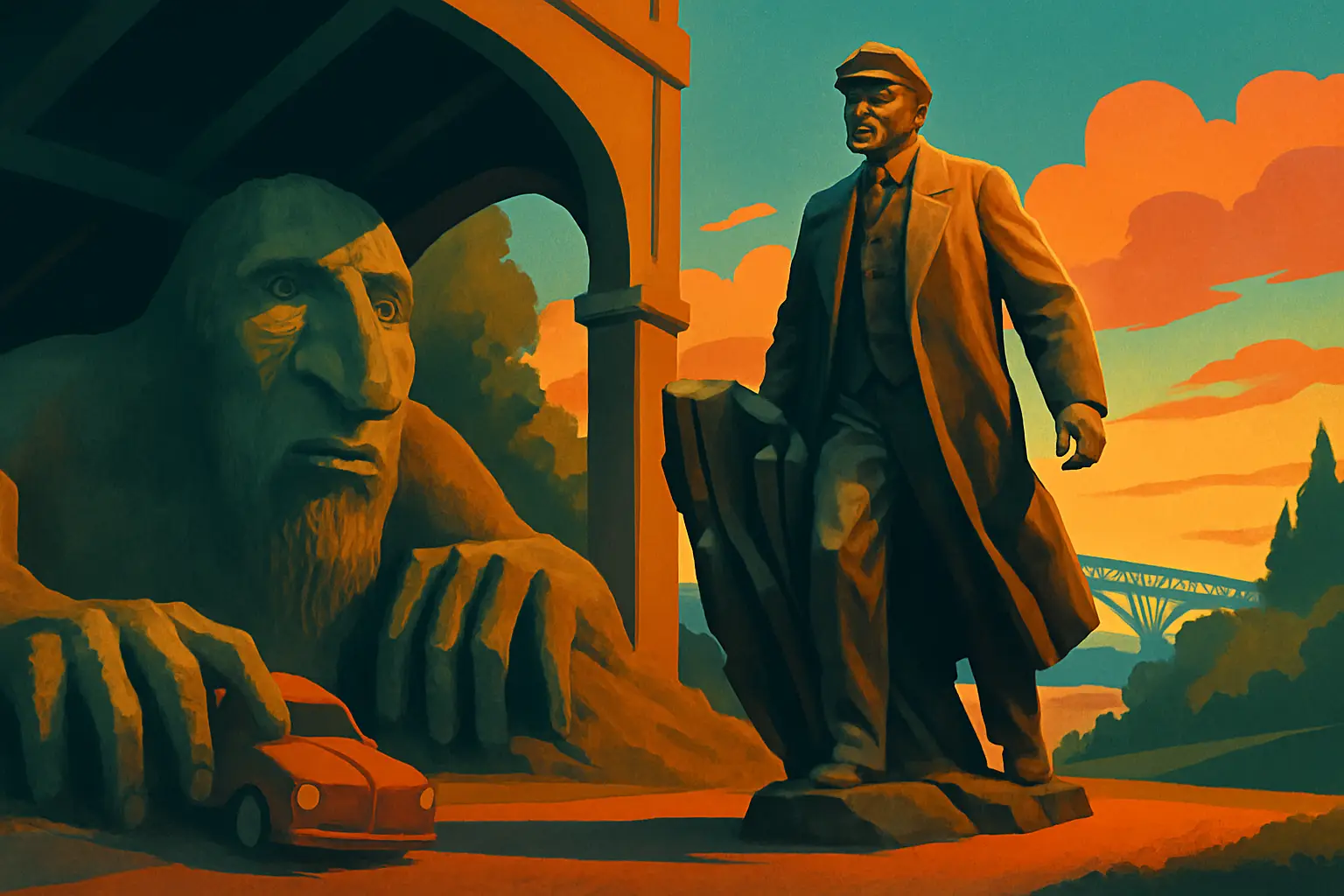
The Fremont Troll was born from a public art competition in 1990. The city had a problem: the underside of the Aurora Bridge (officially the George Washington Memorial Bridge) at N 36th St was becoming a site for illegal dumping. The Fremont Arts Council ran a competition for an installation that would activate the space. Four artists — Steve Badanes, Will Martin, Donna Walter, and Ross Whitehead — won with a proposal for a giant concrete troll.
The troll is 18 feet tall, weighs roughly two tons, and is made from ferroconcrete: a steel rebar armature covered in layers of poured concrete. It crouches directly against the north support of the Aurora Bridge, its left hand gripping a full-size Volkswagen Beetle. The car was real — it was embedded into the sculpture during construction in 1990, and its body is still visible inside the troll's fist. The troll's right eye is a hubcap. Its left eye is a mosaic of mirror glass.
The site has no fence, no admission, and no hours — you walk up from N 36th St, pass under the bridge ramp, and the troll is just there. It is the most visited public art installation in Seattle, and visiting at dusk, when the bridge casts its shadow across the concrete, is the right time. The address is simply: N 36th St at Aurora Ave N, under the Aurora Bridge.
Location: N 36th St at Aurora Ave N, under the north bridge support — look for the sidewalk leading under the ramp
Active day and night; the site is lit after dark and visited regularly by locals and tourists alike
The VW Bug in its fist is real — embedded in the concrete at construction in 1990, with the ID plate removed over the decades
Get short, interactive stories that make each place easier to remember while you travel.
The Lenin Statue stands at the corner of N 36th St and Fremont Place N, on a small triangular plaza near the neighborhood's main commercial strip. It is 16 feet tall, weighs 7 tons, and was created by sculptor Emil Venkov in what was then Czechoslovakia in 1988 — official Soviet public art, erected in the town of Poprad in what is now Slovakia.
After the Soviet collapse in 1989, the Poprad government removed the statue and left it on its side. An American teacher named Lewis Carpenter discovered it in 1993 while teaching in Slovakia, arranged to have it shipped to the United States, and had it stored in Bellevue while he sought a permanent home. He died in a car accident before finding one. His family put the statue up for sale; the Fremont neighborhood purchased it — or rather, leased it. The statue is technically still owned by the Carpenter family and has been listed for sale at various prices. Fremont keeps it because no one else has bought it, and because it has been so identified with the neighborhood for three decades that removing it is now its own controversy. It remains for sale at approximately $150,000.
A block west, at the corner of N 35th St and Fremont Ave N, a 53-foot decommissioned Nike missile is mounted horizontally to the side of a commercial building. The Fremont Rocket was found at an army surplus store in the early 1990s, purchased by the neighborhood, restored, and bolted to the building. The two landmarks — Lenin and the rocket — are within a one-block walk of each other along Fremont Ave N, creating the most concentrated stretch of deadpan public art in the Pacific Northwest.
Theo Chocolate at 3400 Phinney Ave N is the first organic, fair-trade, bean-to-bar chocolate factory in the United States — meaning it processes cacao from raw bean to finished bar in a single facility in Seattle, rather than importing pre-made chocolate mass from overseas. It was founded in 2006 and has been on the eastern edge of Fremont ever since.
On roasting days, the cacao beans produce a warm, buttery smell that carries two or three blocks in every direction. Walking the Burke-Gilman Trail on the right afternoon, you can smell Theo before you see the building.
Factory tours (Thursday through Sunday, approximately $15, book in advance) walk through the full production floor — roasters, winnowers, melangers, tempering machines — and end with a tasting flight of single-origin and blended chocolates. The on-site retail shop is open daily and sells the full bar range plus seasonal and limited-edition bars that do not appear at grocery retailers.
The organic and fair-trade claims are substantive: Theo holds Direct Trade certification and works with named farm cooperatives in Uganda, Madagascar, and Peru, publishing its supply chain partners publicly. The factory is also the largest single employer in the immediate Fremont neighborhood, with around 100 full-time employees on production and in the café.
The Burke-Gilman Trail is a 27-mile multi-use path running from Bothell in the northeast to the Ballard neighborhood on the west side of Seattle, tracing the north shore of Lake Union and the Lake Washington Ship Canal through Fremont's waterfront. The section through Fremont — from roughly the Fremont Bridge east toward Gas Works Park in Wallingford, about 1.5 miles — is flat, paved, and runs directly alongside the canal.
The trail offers close views of the Ship Canal's daily boat traffic and, on the clearest days between August and October, the Olympic Mountains to the west. The Google campus along the canal south of Fremont Ave N is accessible from the trail through a public connection that passes the campus's signature piece of public art: two full-size apatosaurus topiaries trimmed from living ivy — a mother and a juvenile — that stand near the junction of the trail and N 34th St. They are not marked; you simply encounter them while walking.
The Fremont Bridge goes up for boat traffic roughly 35 times per day during boating season. From the south side of the bridge, on the trail, you can watch the bridge lift and the boats pass through from a few feet away — the mechanics of the bridge are visible from the walkway, and the ships that pass under range from small sailboats to large research vessels from the University of Washington.
Gas Works Park, 10 minutes east on the trail in Wallingford, is a 19-acre park built on the site of the former Seattle Gas Light Company plant. The industrial gas equipment was left in place and incorporated into the park design. The hilltop has one of the best unobstructed views of the Seattle skyline across Lake Union, and the park is where the city's July 4th fireworks are launched.
Fremont Brewing opened in 2009 at 1050 N 34th St and has become one of Seattle's most celebrated independent craft breweries. The outdoor Urban Beer Garden occupies the full sidewalk along N 34th St, with covered seating that makes it functional year-round. The flagship lineup includes the Universale Pale Ale, the Interurban IPA, and seasonal releases tied to the Pacific Northwest hop harvest — Fremont is in close proximity to the Yakima Valley, which produces the majority of the US hop supply, and the brewery uses this proximity deliberately in its seasonal calendar.
The beer garden does not serve food, but allows outside food and has no minimum order — it functions as a public gathering space as much as a commercial one. Dogs are welcome in the outdoor area.
One block east, the Fremont Sunday Market sets up on N 34th St near Fremont Ave N every Sunday from May through October. The market runs 150–200 vendors at peak season: artisan jewelry and ceramics, vintage furniture, estate sale goods, and produce from regional farms in the Skagit and Yakima valleys. Entry is free.
The combination of the Sunday Market and Fremont Brewing's beer garden is the neighborhood's most reliable ritual. The pattern locals use: browse the market from 10am to noon, pick up whatever stands out (the vintage goods move fast), walk to Fremont Brewing at 11am when it opens, spend the afternoon in the garden, walk the Burke-Gilman Trail back. For a comparison with Seattle's other neighborhood identity, our Capitol Hill guide covers the city's political and nightlife hub, two miles to the east.
How do I get to Fremont from downtown Seattle? Seattle Transit Route 40 runs from downtown via Westlake and terminates near N 34th St and Fremont Ave N, roughly 20 minutes from the Downtown Seattle Transit Tunnel. Route 62 runs from Capitol Hill and the University District. Both run every 15–20 minutes on weekdays. Biking the Westlake Ave N cycle track from South Lake Union takes about 15 minutes and connects directly to the Ship Canal waterfront trail.
Is Fremont safe? Yes. The commercial strip on Fremont Ave N and N 35th St, the Sunday Market area, the troll site, and the waterfront trail are all active and well-traveled during the day and into the evening. The area under the Aurora Bridge where the troll is located is publicly maintained; standard city-after-dark awareness applies late at night.
What is the best time of year to visit? Late August through September is Fremont's optimal window — Seattle's driest and warmest stretch, the Sunday Market at full capacity, and the outdoor beer garden packed. The Fremont Solstice Parade in June is worth building a trip around: the annual parade down Fremont Ave N has included naked cyclists in body paint as an unofficial tradition since the early 1990s, alongside giant puppets, elaborate floats, and live bands. It draws tens of thousands of spectators each year and is one of the most genuinely strange public events in the country.
What else is nearby? Ballard is 10 minutes west along N 36th St — it has its own Saturday farmers' market and a Scandinavian heritage that surfaces in its architecture and food. Wallingford is 5 minutes east along N 45th St with Gas Works Park on the waterfront. The University District is 10 minutes northeast, with the Burke-Gilman Trail connecting both ways.