1. James Moore Named It After Denver — Not Washington D.C.
Capitol Hill's name has nothing to do with the U.S. Capitol. It comes from Denver's Capitol Hill neighborhood, where Seattle real estate developer James A. Moore had spent years building his career before moving north around 1900. Moore purchased land on the ridge immediately east of downtown Seattle, hired the Olmsted Brothers landscape firm — the sons of Frederick Law Olmsted, who designed Central Park — to lay out the street grid and design its signature park, and began marketing lots to Seattle's wealthy class. For a few decades, the hillside mansions along 16th Avenue East were the city's most prestigious addresses.
That changed steadily through the 20th century. By the 1940s, the mansions had been converted to boarding houses. By the 1970s, Capitol Hill was Seattle's bohemian district — Victorian buildings, lower rents, proximity to downtown, and the cultural openness that tends to fill a neighborhood once the wealthy have already moved on. The LGBTQ+ community established the Broadway corridor as its commercial center during this decade and has never left.
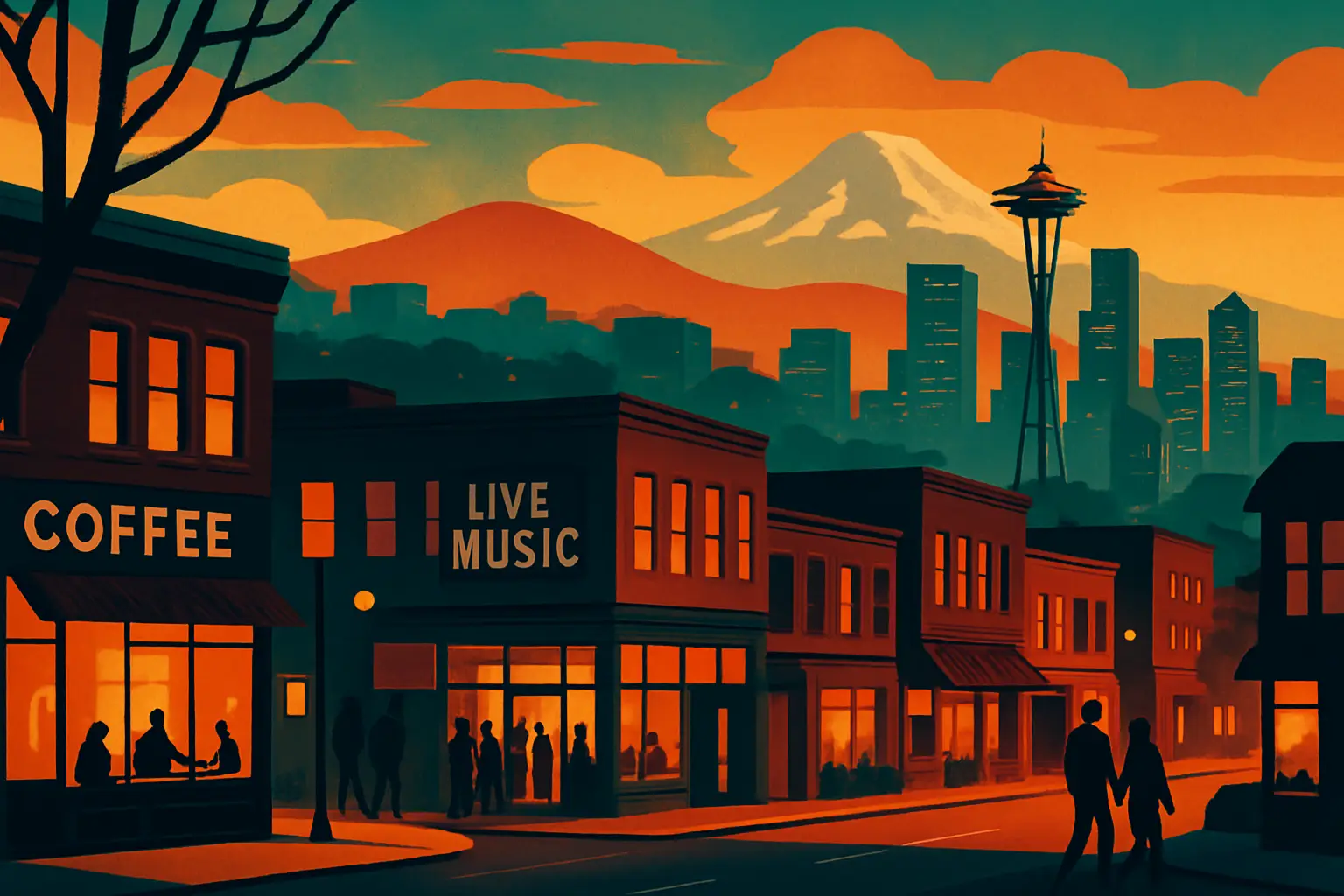
Today Capitol Hill is the most walkable neighborhood in a city that generally isn't. You can walk from the northern end at Volunteer Park to the southern anchor at Cal Anderson Park in about 18 minutes. Within that walk, you'll pass more independent restaurants, bars, and coffee shops per block than anywhere else in the Pacific Northwest.
2. The Pike-Pine Corridor: Where Seattle's Grunge Scene Was Born
The stretch of Pike and Pine streets between Broadway and 12th Avenue was the geographic center of Seattle's early grunge scene. Before Nirvana, Mudhoney, Soundgarden, and Pearl Jam became nationally known in 1991, they were playing bars in this corridor for $5 a head. The physical infrastructure of that era is largely gone — venues folded, rents climbed, buildings were redeveloped — but two addresses anchor the history on the same block.
Neumos (925 E Pike St) has operated under various names in the same building since the late 1990s. Today it's a 650-capacity venue hosting national touring acts in the $20–$35 range, with a smaller room called Barboza in the basement for emerging artists. It's the best mid-size music venue in Seattle — good sight lines, reasonable bar prices, and sound system that doesn't work against the room.
The Comet Tavern (922 E Pike St), directly across the street, has been open since 1927. Cash only. No kitchen. Closes at 2 a.m. The photographs on the back wall include musicians from the 1980s and 1990s who used this bar the way musicians use practice rooms — to argue, decompress, and overhear ideas. In 2026, it is the most unchanged corner of Pike-Pine.
The daytime corridor runs differently: Victrola Coffee, the Melrose Market (a 1920s auto-row building at 1501 Melrose Ave converted to an indoor food and retail hall), and a density of record shops, bookstores, and independent retail that keeps the neighborhood commercially self-contained even during the day.
3. Cal Anderson Park: Seattle's Town Square
Cal Anderson Park (1635 11th Ave) occupies 7.5 acres between Pike and Republican streets — small as urban parks go, enormous as neighborhood anchors go. It's named after Cal Anderson, who served in the Washington State Legislature from 1987 until his death in 1995. He was the first openly gay member of the Washington State Legislature, and he died of AIDS-related complications at 47.
The park's twin reflecting pools anchor the center, with a large fountain at the north end drawing crowds on warm evenings. The surrounding grass handles an improbably wide range of human activity simultaneously — families, dog walkers, pickup soccer games, people reading on blankets — in a space that never feels overbuilt or managed to the point of sterility.
The park carries a more recent history, too. In June 2020, following the Seattle Police Department's withdrawal from the nearby East Precinct during protests, Cal Anderson Park became the center of what was called the Capitol Hill Autonomous Zone (CHAZ, later CHOP). For roughly three weeks, the area was self-organized by demonstrators. The park was fully restored and reopened by late 2020; today the reflecting pools and ballfields look identical to before.
The Rainbow Crosswalk at Broadway and Pike — painted in 2015 and repainted annually by the city — marks the center of the LGBTQ+ commercial corridor. Seattle Pride's main parade route runs along Broadway each June. Several of the neighborhood's long-running bars, including Purr and Neighbours, have operated continuously for decades and remain anchors of the community.
4. Volunteer Park: 48 Acres at the Top of the Hill
Volunteer Park sits at the northern end of Capitol Hill, accessed from 15th Avenue East, and is the reason the Olmsted Brothers got involved in this neighborhood at all. James Moore hired them in 1904 to design the park system; the brothers worked with the natural topography of the ridge rather than leveling it, a characteristic of every Olmsted-influenced design.
The park contains three things worth specific visits.
The Volunteer Park Water Tower — a 75-foot brick structure built in 1906 — can be climbed via an interior staircase for free. The top provides a 360-degree view: the Olympic Mountains to the west, Mount Rainier to the south, the Cascade Range to the east, and downtown Seattle with Elliott Bay behind it. On a clear August morning this is the best free viewpoint in the city.
The Black Sun sculpture by Isamu Noguchi (1969) sits on the park's south lawn — a circular carved granite ring positioned so that looking through it from the east frames the Space Needle precisely in the center. The framing is intentional and has been photographed millions of times. It's worth finding the exact alignment point.
The Seattle Asian Art Museum (1400 E Prospect St), housed in a 1933 art deco building that predates the Space Needle by 29 years, holds Chinese, Japanese, Korean, and South Asian decorative arts from the Seattle Art Museum's collection. Admission is $19.99; the building itself is worth the visit for the WPA-era interior detailing alone.
•Water Tower: free, open daily 6 a.m.–10 p.m., accessible via 15th Ave E entrance
•Black Sun: south lawn, free — the alignment with the Space Needle works from directly east of the ring
•Seattle Asian Art Museum: $19.99 admission, closed Tuesdays; the 1933 art deco facade is photographed almost as often as the collection
5. Where to Eat on Capitol Hill
Capitol Hill has more independent restaurants per block than any Seattle neighborhood, and the range spans from the cheapest meal in the city to some of its most technically precise cooking.
Tacos Chukis (1023 E Pike St) is the $2.95 starting point: counter service, al pastor and carnitas made the way a neighborhood taqueria makes them when it's accountable to regulars. The line moves fast. Order three tacos and a horchata and pay under $15 for what is genuinely the best value meal in walking distance.
Glo's (1621 E Olive Way) is the neighborhood diner — open since 1987, famous for weekend waits that start forming before 8 a.m. Cash-preferred, straightforward diner food, and consistently one of the best breakfasts in Seattle. The cinnamon roll French toast is ordered by approximately half the room on any given morning.
Sitka & Spruce (1531 Melrose Ave, inside Melrose Market) is the James Beard-associated destination — Pacific Northwest ingredients, open kitchen, a menu that shifts based on what's in from the farms. The scallop crudo and whatever is roasted that evening are usually the moves. It's a mid-range dinner that regularly outperforms more expensive restaurants in the city.
Spinasse (1531 14th Ave) handles the upper tier: Northern Italian handmade pasta in a 40-seat room. The tajarin — thin egg-yolk pasta finished with butter and seasonal accompaniment — is the reason to make a reservation. Reservations book weeks in advance; calling in the morning for same-day cancellations works more often than you'd expect.
6. Getting Here, Best Time, and What to Know
How do I get to Capitol Hill from downtown Seattle? The Link Light Rail Capitol Hill Station (559 Broadway E) is one stop from Westlake Station in downtown and four stops from Pioneer Square. The ride takes approximately four minutes. The station exits directly onto Broadway at Pike — the geographic center of the neighborhood. From SeaTac Airport, the direct Light Rail ride to Capitol Hill takes roughly 40 minutes with no transfer.
Is Capitol Hill safe? The Pike-Pine corridor and the areas around Cal Anderson Park and Volunteer Park are densely populated and safe during daylight and evening hours. Broadway between Pike and Roy is high-traffic throughout the day. Standard urban awareness applies late at night near the bars on Pike Street. For most daytime visitors it is a straightforward urban neighborhood.
What is the Capitol Hill Block Party? The Capitol Hill Block Party is an annual music festival held across multiple outdoor stages and venues in the Pike-Pine corridor, typically the last weekend of July. It's been running since 1994 and consistently books a mix of established and emerging acts across rock, hip-hop, and electronic genres. It's one of the largest annual music events in the Pacific Northwest.
How does Capitol Hill connect to other Seattle neighborhoods? First Hill (the hospital district) borders Capitol Hill to the west — a 10-minute walk from Broadway leads to the Frye Art Museum, which charges no admission and holds a strong collection of 19th-century realist paintings. Pike Place Market is one Light Rail stop away (downtown Westlake) plus a 5-minute walk downhill — our guide covers the market's history and what's actually worth your time there.