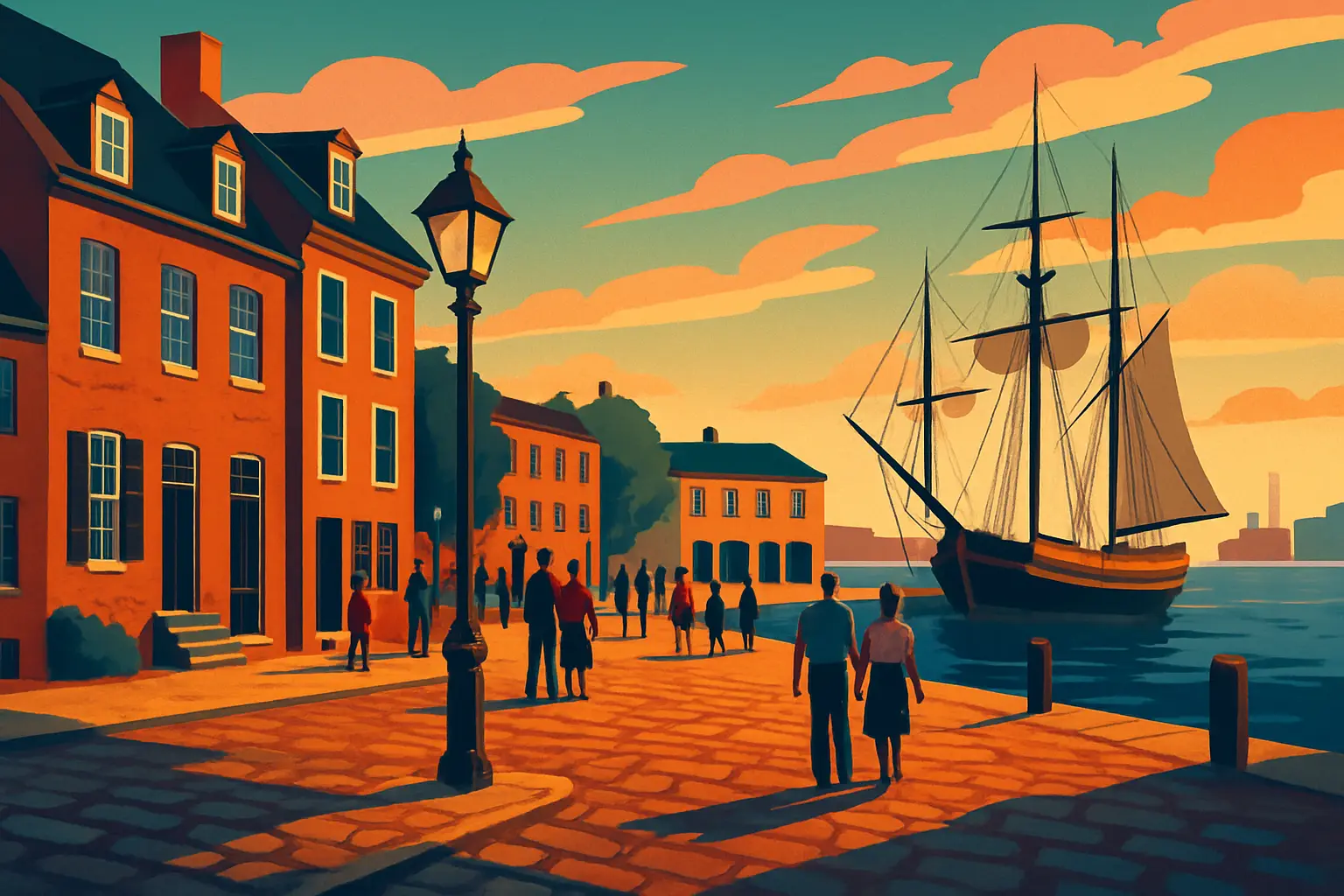
In 1726, an English Quaker shipbuilder named William Fell purchased a tract of land on the eastern side of Baltimore's harbor — a shallow, sandy point that the emerging port city considered a backwater. Fell recognized what the main harbor planners had missed: the point had deeper water access, which meant larger vessels could dock and load cargo without running aground. He platted a town, laid out streets, and built shipyards. His son Edward Fell continued the work after his death, and by 1763, Fells Point had its own town charter, predating the formal incorporation of Baltimore City.
By the late 18th century, Fells Point had become one of the most productive shipbuilding centers in North America. From 1790 to 1840, the yards at Fells Point built roughly 10 percent of all ships constructed in the United States — an extraordinary concentration of skilled shipwrights, sailmakers, ropemakers, and ironworkers in a neighborhood of only a few square blocks. Among the vessels that came out of Fells Point were two of the first ships commissioned for the new United States Navy: the USS Constellation and the USS Enterprise.
The ships Fells Point was most famous for were the Baltimore Clippers — fast, narrow-hulled schooners with deeply raked masts designed for speed over cargo capacity. They became the preferred vessel for merchants who needed to outrun pirates, and later for the U.S. government when it needed to outrun the British.
When the United States declared war on Britain in June 1812, the U.S. Navy had roughly 17 warships. Britain's Royal Navy had over 600. The strategic imbalance was obvious, so Congress authorized letters of marque — legal licenses allowing private shipowners to attack British merchant and naval vessels and keep the captured cargo as profit. Fells Point, with its concentration of fast ships, experienced captains, and yards capable of outfitting a vessel quickly, became the center of American privateering almost immediately.
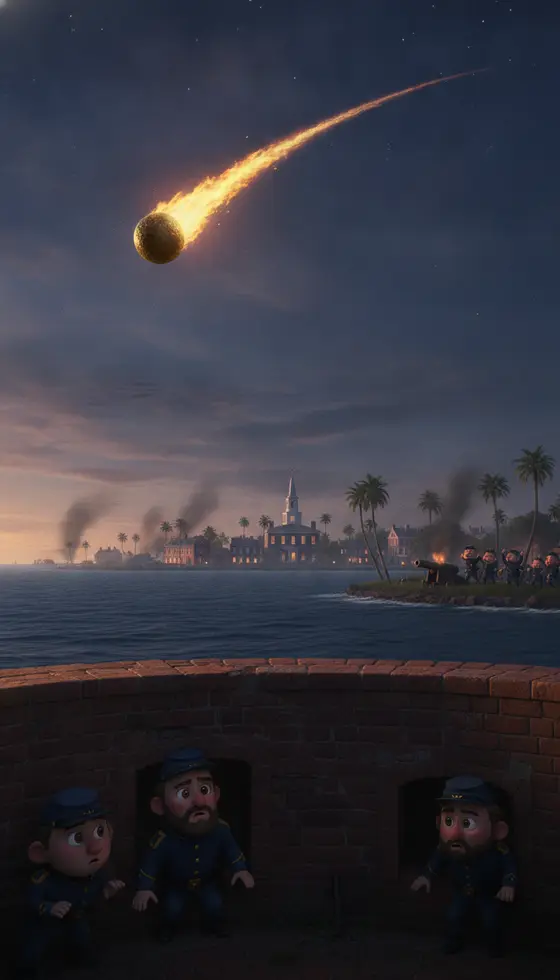
Over the course of the war, American privateers captured more than 500 British ships. The majority of the vessels involved had been built at Fells Point, crewed by Baltimore sailors, and outfitted from Fells Point's warehouses and ropewalks. The British naval command was so destabilized by the losses that London newspapers called for the destruction of Baltimore specifically — which led to the bombardment of Fort McHenry in September 1814 that Francis Scott Key witnessed from a British ship and turned into the lyrics of what became the national anthem.
One often-overlooked fact: historians estimate that 20 percent of the War of 1812 privateers were African American — free Black sailors and some enslaved men who earned wages working the Fells Point yards and ships. The neighborhood's maritime workforce was more racially mixed than most of the American cities of its era, which directly shaped the experience of a young man named Frederick Douglass who arrived in these yards twenty years later.
Get short, interactive stories that make each place easier to remember while you travel.
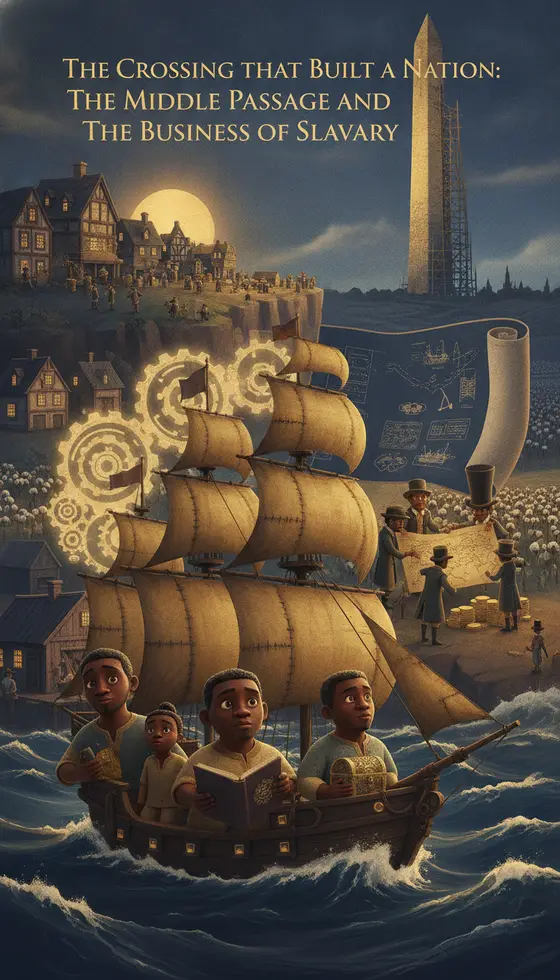
Frederick Douglass first came to Fells Point as a boy, enslaved and sent to serve the family of Hugh Auld in Baltimore. Sophia Auld, Hugh's wife, began teaching Douglass to read — until her husband forbade it, explaining that a literate enslaved person was a dangerous one. Sophia Auld stopped the lessons. Douglass, by his own account in his 1845 *Narrative*, kept going on his own: he made temporary teachers of the white boys he met on the streets of Fells Point, trading bread for reading lessons.
As a teenager, Douglass was assigned to work in the Fells Point shipyards — the same yards that had built the Baltimore Clippers and the privateer fleet. He worked as a caulker, sealing the seams between the planks of ship hulls to make them watertight. It was skilled, dangerous labor. By 1838, Douglass had a plan. He borrowed the sailor's protection papers of a free Black sailor he knew, dressed in a sailor's uniform, and boarded a train to Wilmington, Delaware. From there he took a steamboat to Philadelphia and a train to New York. The entire journey took less than 24 hours.
The Frederick Douglass-Isaac Myers Maritime Museum at 1417 Thames St now occupies a restored section of the original shipyard site. Isaac Myers was a Black Baltimore shipwright who organized a worker-owned shipbuilding cooperative in Fells Point in 1866 after white dockworkers violently drove Black workers out of the yards. The museum covers both men's stories and is one of the most specific and least-visited historical sites in Baltimore.
Frederick Douglass-Isaac Myers Maritime Museum: 1417 Thames St — open Tue–Sat, admission under $10
A sculpture of Douglass stands at 1467 Philpot St, a short walk from where the Auld house stood
Douglass returned to Baltimore multiple times after freedom — the city shaped his early intellectual life more than almost any other place
Eleanora Fagan — who would become Billie Holiday — was born in Philadelphia in 1915 but grew up in Baltimore, in the blocks just above Fells Point proper known as Upper Fells Point. Her mother, Sadie Fagan, moved the family to 217 South Durham Street, the address where Holiday spent her early childhood in the 1920s. The neighborhood was then a dense working-class community of Black Baltimoreans, Irish immigrants, and Eastern European families who had arrived in the wave of immigration that ended with the 1924 Immigration Act.
Holiday left Baltimore as a teenager for Harlem, where she began singing in clubs and was discovered by producer John Hammond in 1933 — the same year Prohibition ended. She went on to record more than 350 songs and became one of the defining voices of American jazz and blues. Her 1939 recording of 'Strange Fruit,' a protest against lynching that no major label would touch, was recorded for the independent Commodore label and remains one of the most politically significant songs in American popular music.
The block of South Durham Street has been designated the Billie Holiday Project — there are murals and a plaque at the house. It is not a museum; it is still a residential block. The correct way to experience it is on foot, walking the few blocks between the plaque and the waterfront, which covers the distance between where Holiday grew up and where the neighborhood's economic life happened.
The building at 1626 Thames Street has operated as a tavern since 1775 — which means it predates the United States by one year. It is, by that measure, the oldest continuously operating saloon in America, having served drinks before, during, and after Prohibition (the claim to Prohibition-era continuity is technically through a back-door arrangement, but no other bar in Maryland makes a stronger claim to unbroken operation).
The Poe connection is not a marketing invention. On October 3, 1849, Edgar Allan Poe was found unconscious on East Lombard Street in Baltimore — he had disappeared for days after leaving Richmond, Virginia. He was brought to Washington University Hospital in a state of delirium, ranting incoherently, wearing clothes that were not his own. He died four days later, on October 7, 1849, without regaining enough lucidity to explain where he had been or what had happened. The cause of death was never officially determined.
The Horse You Came In On Saloon is the leading candidate for Poe's last stop, based on historical records of the bars in operation on the blocks near where he was found. The bar staff refer to the ghost that haunts the building as 'Edgar' — bartenders over the years have reported cash registers opening on their own and chandeliers swinging without explanation. Whether you believe in the ghost or not, leaving a glass of whiskey out at closing time is the kind of specific ritual that only a genuine historic building accumulates.
Thames Street Oyster House (1728 Thames St) is the neighborhood's most consistent seafood option — local oysters from the Chesapeake Bay, lump crab cakes made with Maryland blue crab and very little filler, and a raw bar that operates until close. Reservations recommended Thursday through Saturday. For more on the crab culture that supplies these kitchens, see our Chesapeake blue crab guide.
Ale Mary's (1939 Fleet St) is Fells Point's neighborhood bar in the truest sense — it has been operating on Fleet Street since the early 2000s and is where locals go on a weekday night. Full kitchen, good wings, extensive local beer selection, and a back patio that is one of the better places to be in Baltimore on a warm September evening.
LP Steamers (1100 E Fort Ave, a short drive or Water Taxi ride) is the place Baltimoreans send visitors for steamed crabs — Old Bay-seasoned hard shells, brown paper on the tables, wooden mallets, and no wrong way to do it. It is technically just outside Fells Point in Locust Point, but it is 10 minutes away and represents the Maryland eating ritual at its least self-conscious.
The Daily Grind (1720 Thames St) has served coffee on Thames Street since 1985 and is one of those neighborhood institutions that survived gentrification by being too locally loved to displace. Opens at 7 a.m.; the corner window seat looks directly onto the water.
Is Fells Point safe? Fells Point is one of Baltimore's most actively policed and commercially active neighborhoods, with a residential population, constant foot traffic, and waterfront visibility that keeps the main streets well-occupied at most hours. Thames Street, Broadway, and the blocks immediately around the main square are consistently busy. Like any city neighborhood, situational awareness matters on quieter side streets after midnight — but the core of Fells Point is among Baltimore's most approachable areas for visitors.
What is within walking distance of Fells Point? The Inner Harbor is about a 15-minute walk west along the waterfront promenade — the National Aquarium (501 E Pratt St), the Maryland Science Center, and the USS Constellation (the original ship, permanently docked at Pier 1) are all clustered there. The Little Italy neighborhood is a 5-minute walk north on President Street, with a strip of Italian-American restaurants along Stiles Street that has operated in roughly the same form since the mid-20th century.
How do I get from Fells Point to Fort McHenry? The Water Taxi runs a seasonal route to Fort McHenry from the Fells Point dock — check current schedules on the Water Taxi website. The fort where Francis Scott Key watched the 1814 bombardment is fully preserved as a National Monument, and the walk along the ramparts gives a view of the harbor mouth that makes the geography of the battle immediately legible. It is one of the few places in American cities where you can stand inside an event and see the exact terrain it happened on.
Late August and September is the local's answer. Baltimore summers are genuinely hot and humid — the Inner Harbor amplifies heat in July and early August, and the brick streets of Fells Point radiate it. By late August the temperatures drop into the low 80s Fahrenheit and the humidity eases. The neighborhood is still fully in summer mode (all restaurants open, Water Taxi running full schedules, outdoor patios busy) but the tourist peak from July Fourth through mid-August has passed.
Labor Day weekend (September 5–7, 2026) is an excellent target: flights and hotels from major Northeast cities are cheaper than peak summer, the weather is nearly perfect, and the Chesapeake Bay crab season is at its height — meaning the blue crabs being steamed in September are among the largest and fullest of the year.
October brings the Fells Point Fun Festival, one of Baltimore's most popular street festivals, on the first full weekend of the month — typically attracting over 100,000 visitors over two days. If your visit overlaps, book accommodation several months in advance and expect the neighborhood to be extremely crowded. If your visit does not overlap, that first October weekend is a useful target to plan around rather than into.