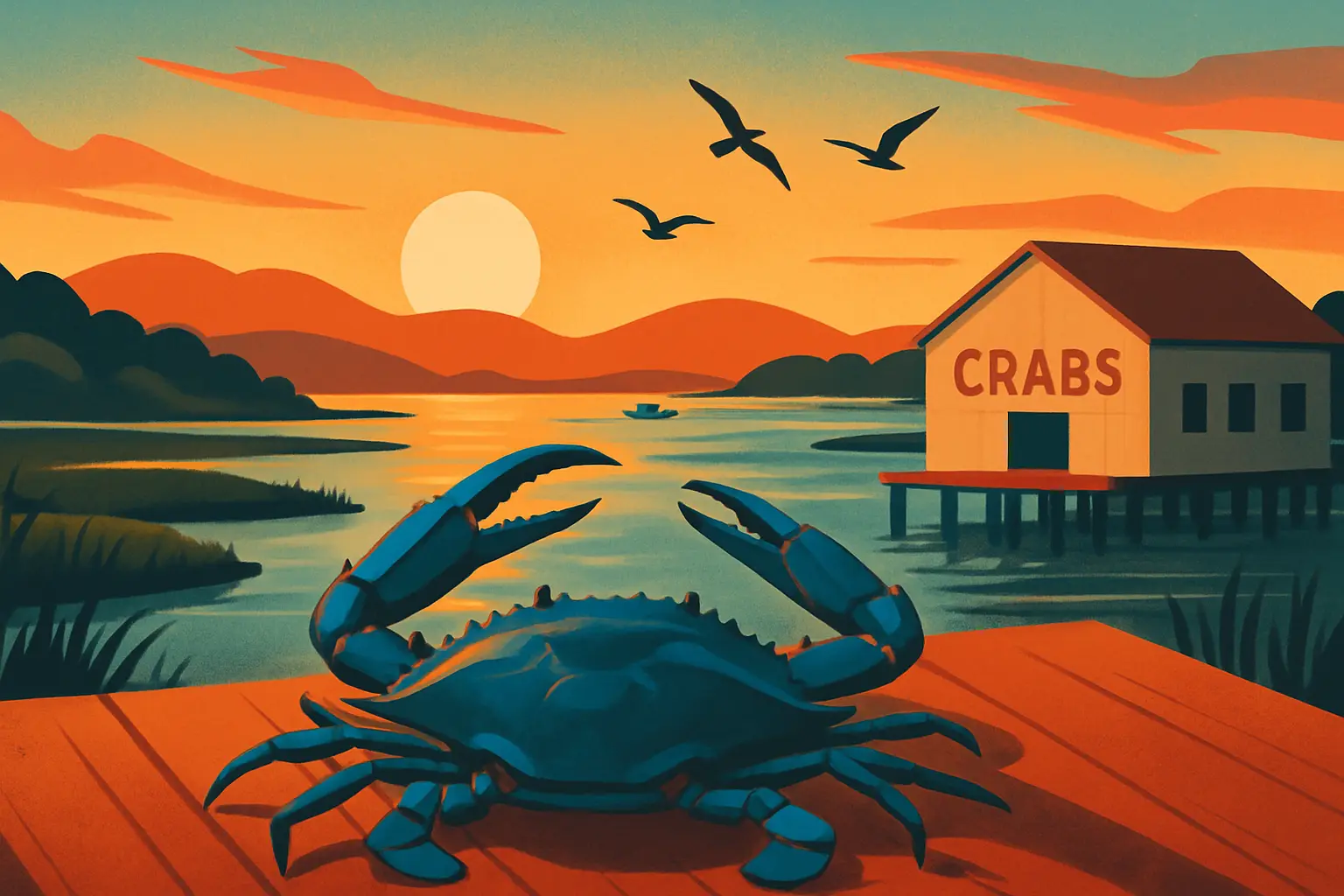
1. Why August Is the Best Month for Chesapeake Blue Crabs
Maryland's recreational blue crab season runs from April 1 through December 15, but August is when the math is most in the eater's favor. Blue crabs molt in spring — shedding their shells to grow — and then spend the summer feeding aggressively and rebuilding dense, heavy hard-shells. By August, the crabs that survived molting are at their heaviest and most flavorful. Watermen are pulling pots daily, supply is at its annual peak, and dock prices are at their annual low — which means the crabs in the steamer are the freshest, heaviest, and least expensive they'll be all year.
The logic runs opposite to Maine lobster season. For lobsters, the soft-shell period after molting is prized for its sweeter, more yielding meat. For Maryland blue crabs, the hard-shell is what crab house culture is built around: the shell holds the steam, the crab holds its shape, and the picking ritual — mallets, knives, paper-covered tables — only works when there's enough structure to crack. Soft-shell crabs are a different product entirely: eaten whole, fried or sauteed, with no picking involved. August hard crabs are a multi-hour, communal, sleeves-up experience.
One seasonal caveat: pregnant females called sponge crabs or berried crabs — identifiable by an orange egg mass visible on the belly — are illegal to harvest in Maryland all year. Responsible watermen return them to the water. If one arrives at your table, something went wrong in the supply chain.
2. Old Bay: A Refugee's Recipe That Became a Regional Identity
The seasoning that defines a Maryland steamed crab was created by a man who almost didn't make it out of Nazi Germany. Gustav Brunn was a German-Jewish spice merchant detained at Camp Buchenwald after Kristallnacht in 1938. His family paid 10,000 marks to a lawyer to secure his release, and Brunn arrived in Baltimore in the late 1930s with his knowledge of spice blending and almost nothing else. He established the Baltimore Spice Company and in 1939 launched a seafood seasoning he originally called 'Delicious Brand Shrimp and Crab Seasoning.'
The blend contains up to 18 spices — the exact formula remains proprietary — but the dominant notes are celery salt, paprika, mustard, red pepper, and bay leaf, with undertones of cloves, allspice, ginger, and cardamom. He named it Old Bay after the Old Bay Line, a steamship service that ran between Baltimore and Norfolk along the Chesapeake. The name tied the product directly to the water and the watermen who worked it.
McCormick & Company acquired Old Bay in 1990. Today it appears on potato chips, Bloody Mary rims, popcorn, and cocktail salt across the Mid-Atlantic. At a crab house it's applied to crabs in layers during steaming — seasoning is added between each layer of live crabs in the pot before the lid goes on — and provided at the table alongside vinegar. J.O. Spice, made in Baltimore since 1945, is a parallel regional blend used at many Baltimore crab houses and described as saltier and deeper red than Old Bay. The two are not interchangeable, but serve the same purpose.
3. Jimmy, Sook, and Peeler: The Language of Blue Crabs
Maryland crab culture has its own vocabulary. Knowing it before you order tells the person behind the counter you've done this before.
Jimmy — a male blue crab, identified by the narrow, pointed apron on the underside of the shell. Marylanders note that it resembles the Washington Monument, a comparison made without irony. Jimmies are typically larger than females and carry more body meat, making them the default order at most crab houses. Large Jimmies in peak August condition can yield a full cup of meat or more to an experienced picker.
Sook — an adult female crab. The apron is wide and dome-shaped, resembling the Capitol building — another comparison Marylanders use unironically. Sooks are smaller on average and yield less body meat. Sooks that have mated carry stored sperm internally and can produce multiple batches of eggs from a single mating.
Sponge crab (also: berried crab) — a female carrying a visible orange egg mass on the belly. Harvesting them is illegal in Maryland year-round; responsible watermen and crab houses release them to protect future population. A sponge crab at your table is a regulation violation somewhere in the supply chain.
Peeler — a crab on the verge of molting, identifiable to experienced watermen by a reddish line visible on the edge of the back flipper. Peelers are held in shallow-water floats until they shed, then sold immediately as soft-shell crabs. The soft-shell window is brief: a crab that isn't pulled from the float within hours of molting begins hardening again and is no longer marketable as soft-shell.
4. How a Maryland Crab House Works — and What to Order
The format at a traditional Maryland crab house is standardized enough that you can walk into almost any one in the state and understand the setup within a minute.
Tables are covered with brown paper or newspaper, sometimes with a plastic sheet underneath. Wooden mallets and metal picking knives — or standard butter knives at more casual houses — are on the table. Crabs arrive on a metal tray or in a paper-lined cardboard box, hot from the steamer, drenched in red-orange seasoning, piled by the dozen. There are no plates. Shells go in a pile on the table or into a bucket. There is beer, almost always by the pitcher.
The ordering decision comes down to size and quantity. Sizes run small, medium, large, extra-large, and jumbo — measured point-to-point across the shell. In August, most regulars order large or extra-large Jimmies. The price difference between large and extra-large is real, but the yield difference is larger: an extra-large crab has significantly more body meat, especially in August when crabs are at peak weight. Half-dozens are common for casual lunches; a full dozen per person is standard for a serious crab feast.
On the vinegar question: most houses provide extra seasoning alongside white vinegar for dipping. Many Marylanders dip each piece of extracted meat in vinegar before eating it — the acidity cuts the richness and is considered correct form by a vocal majority. Others use drawn butter. Combining both is possible but is noted at most crab house tables as at least mildly unconventional.
5. How to Pick a Steamed Blue Crab: Step by Step
Picking a steamed blue crab is a skill. Most first-timers take 8 to 12 minutes per crab and leave more meat in the shell than they'd like. Experienced pickers break one down in under two minutes. The technique is learnable — once you understand the anatomy, efficiency follows quickly.
Step 1 — Detach the claws and legs. Grip each claw at the joint and twist downward; most will pop off cleanly. Pull the walking legs off in groups. Set claws aside — they require a mallet.
Step 2 — Flip belly-side up and lift the apron. The apron is the triangular or dome-shaped flap on the underside. Insert a thumb under its edge and pull upward until it tears free at the base.
Step 3 — Remove the top shell. Insert your thumb into the gap where the apron was attached, grip the top shell from the front with your other hand, and pull back firmly. The top shell comes off with some resistance. Inside, the tomalley (hepatopancreas) and any roe may be visible — both are edible and considered a bonus by experienced pickers.
Step 4 — Scrape the gills. The spongy, gray finger-like projections on both sides of the body are gills, called 'dead man's fingers.' They are not toxic but are unpleasant to eat. Scrape them off with your thumb or knife.
Step 5 — Snap the body in half. Pull the crab apart laterally at the midline. The swim fin attachment points on the outer back edges are where the largest pieces of body meat sit.
Step 6 — Extract the meat. Work the picking knife from the back edge forward through each compartment. The largest single piece — jumbo lump — comes from the swim fin muscles. Work methodically; what looks empty often has a solid piece of backfin meat inside.
Step 7 — Crack the claws. One firm mallet strike on the flat back of the claw usually works. The knuckle section (the smaller jointed segment) contains a solid cylinder of meat worth the extra effort to extract.
6. L.P. Steamers and the Baltimore Crab House Tradition
L.P. Steamers at 1100 E Fort Ave in Locust Point — a formerly industrial neighborhood on Baltimore's South Baltimore peninsula — opened in 1994 and has become one of the most consistently cited crab houses in the city. The setup is classic Baltimore: communal wooden tables covered with paper, mallets and picking knives, pitchers of National Bohemian (Natty Boh, Baltimore's local lager), and a roof deck that looks out over the Inner Harbor and the working port. Crabs are steamed with J.O. and Old Bay applied in layers, arriving hot and heavily seasoned.
L.P. Steamers doesn't take reservations for weekend walk-ins. On summer Saturdays, a line forms outside before noon and the kitchen runs out of extra-large Jimmies by mid-afternoon. Arrive by noon or accept the possibility of dropping a size category and a longer wait. Pricing in August runs toward its seasonal low — the same crabs will cost noticeably more in October as supply tightens.
Nick's Fish House at 2600 Insulator Drive in Port Covington has a large outdoor deck on the Middle Branch of the Patapsco River — less neighborhood-specific than L.P. Steamers but more space, and a solid summer crab lineup. Thames Street Oyster House at 1728 Thames Street in Fells Point offers a restaurant-style experience with table service and steamed crabs available in season, for visitors who want the crab but prefer a proper dining room to the paper-table format.
7. Eastern Shore Crab Houses: Harris at Kent Narrows and Cantler's in Annapolis
The Eastern Shore experience of eating blue crabs differs from Baltimore in one essential way: you are eating at the water the crabs came from. Harris Crab House at 433 Kent Narrow Way North in Grasonville sits on the Kent Narrows waterway between Kent Island and the mainland Eastern Shore, about four miles east of the Bay Bridge. The Harris family has been in the seafood business since 1947; the restaurant opened in 1981. Dockside tables let you watch watermen bringing in catch. Ducks and swans work the dock below the deck. The pace is slower than a Baltimore crab house, the setting is more open, and transit time from Bay to steamer is short.
Harris is on the Maryland Crab and Oyster Trail, a state designation for producers and restaurants with direct seafood sourcing. It's a natural stop on the most common day-trip route from Baltimore or DC: take US-50 east across the Bay Bridge, exit at Kent Narrows, eat crabs, and return before the westbound backup develops on Sunday evenings.
Cantler's Riverside Inn at 458 Forest Beach Road in Annapolis is the other benchmark. Opened in 1974, Cantler's sits at the end of a winding two-lane road on Mill Creek, with tables cantilevered over the water. No frills — paper on the tables, plastic chairs on the dock, pitchers of beer, crabs by the dozen. It requires a deliberate detour and has limited parking, which is part of why it remains a local-feeling institution despite being consistently named by serious food writers as the single best traditional Maryland crab house experience in the state.
8. FAQ: When to Go, What It Costs, and Getting There from DC
What does a dozen steamed crabs cost in August? Pricing moves with dock prices and varies by house. As of August 2026, expect roughly $50–$75 per dozen for large Jimmies at a quality Baltimore or Eastern Shore crab house. Extra-large and jumbo run $70–$100 depending on the week. August prices are at or near their annual low due to peak supply — the same crabs can cost 30 to 50 percent more in October as watermen's hauls decline. Half-dozen orders are available at most houses and are appropriate for a casual lunch.
Can you eat steamed Maryland blue crabs in Washington, DC? Yes, but the experience is different. The DC Fish Market at 1100 Maine Ave SW — a working waterfront fish market on the Anacostia River — sells live crabs and steamed crabs by the dozen in season, and several DC restaurants serve them. But the full Maryland crab house experience — paper tables, communal setting, direct waterfront — requires driving. Annapolis is 35 miles from DC via US-50; Kent Narrows is 55 miles. Both are under an hour without traffic.
How early should I arrive at a crab house on a Saturday? At L.P. Steamers in Baltimore, arriving by noon is the target for the best crab selection. At Harris and Cantler's, 11:30 a.m. is reasonable. By 1 p.m. on summer Saturdays, the best crabs at all three are often committed to earlier orders or sold out at the top sizes. Plan your Bay Bridge return before 3 p.m. on Sundays to avoid the worst westbound traffic.
Is picking crabs something a first-timer can do? Yes — with realistic expectations about pace. Expect your first several crabs to take 8 to 12 minutes each and to leave meat in the shell. Ask the person next to you to show you their technique; Marylanders at crab houses are consistently willing to demonstrate. The skill compounds: by crab number eight, most first-timers have cut their time in half. A dozen crabs worked through at a reasonable pace takes 45 minutes to an hour and a half — that is the intended duration of the meal.