The name 'Deep Ellum' is a phonetic record of how Black Dallasites pronounced 'Deep Elm' — referring to the stretch of Elm Street that ran east from downtown into what was then a predominantly Black and working-class neighborhood. The 'deep' referred to the further-east sections of the street, away from the white commercial center, where Jim Crow laws allowed a parallel economy to develop: barbershops, pharmacies, theaters, pool halls, and after dark, music.
In the 1910s and 1920s, Deep Ellum was one of the few places in Dallas where Black and white audiences could occupy the same space, albeit uneasily. The commercial draw of the music scene made it economically rational for white venue owners to tolerate integrated audiences, which was unusual for the Jim Crow South. The street attracted musicians from across East Texas and beyond.
Blind Lemon Jefferson, born in Couchman, Texas in 1897, became the neighborhood's most famous regular performer and one of the most influential early blues musicians in American history. He performed in Deep Ellum throughout the 1920s, often on street corners along Central Track (now Malcolm X Boulevard), before recording for Paramount Records and selling more blues records than any other artist of his era. He died in 1929 in Chicago, likely from exposure during a winter storm, at approximately 36 years old.
Huddie Ledbetter — Lead Belly — also played Deep Ellum regularly, as did a rotating cast of Texas blues and gospel performers who passed through Dallas on the way to or from recording sessions. Central Track, the north-south street bisecting the entertainment district, had so many musicians, gamblers, and hustlers working its sidewalks that locals said you could find anything you needed on that block: 'If you ain't got a dime, go to Deep Ellum' became something of a neighborhood motto.
Deep Ellum's decline unfolded over decades and had several overlapping causes.
The opening of Central Expressway in 1949 — one of the first freeways in Texas — cut directly through the neighborhood, severing Central Track (renamed Good-Latimer Expressway in this stretch) and isolating Deep Ellum from the rest of east Dallas. Freeway construction in American cities during the postwar era disproportionately affected Black neighborhoods, and Deep Ellum was no exception. Businesses that had anchored the district for thirty years found themselves cut off from foot traffic.
Desegregation, counterintuitively, accelerated the decline: as legal barriers to Black Dallasites shopping and dining in previously white-only establishments fell during the 1960s, the economic logic of a separate Black commercial district weakened. Businesses that had been forced by law to operate in Deep Ellum found the option to relocate to higher-traffic areas.
By the 1970s and early 1980s, the neighborhood was effectively abandoned commercial real estate. Buildings sat empty. The historic clubs and theaters went dark. It was not a dangerous neighborhood so much as a blank one — physically intact but economically hollow, its 1920s brick warehouses and commercial buildings standing empty.
Get short, interactive stories that make each place easier to remember while you travel.
Deep Ellum's second life began the same way many American arts districts are born: cheap rent attracted artists who couldn't afford to operate anywhere else.
In the late 1980s, gallery owners and musicians began moving into the vacant warehouses. The rents were low enough to support small-capacity music venues, artist studios, and the kind of independent bars that can't survive in high-rent districts. The venue Trees opened in 1991 at 2709 Elm Street, a 1,000-capacity space in a former warehouse that became one of the most important independent concert venues in Texas. Club Dada established itself on the same block. By the early 1990s, Deep Ellum had a critical mass of live music — alternative rock, metal, punk, and electronic — that put it on the national touring circuit.
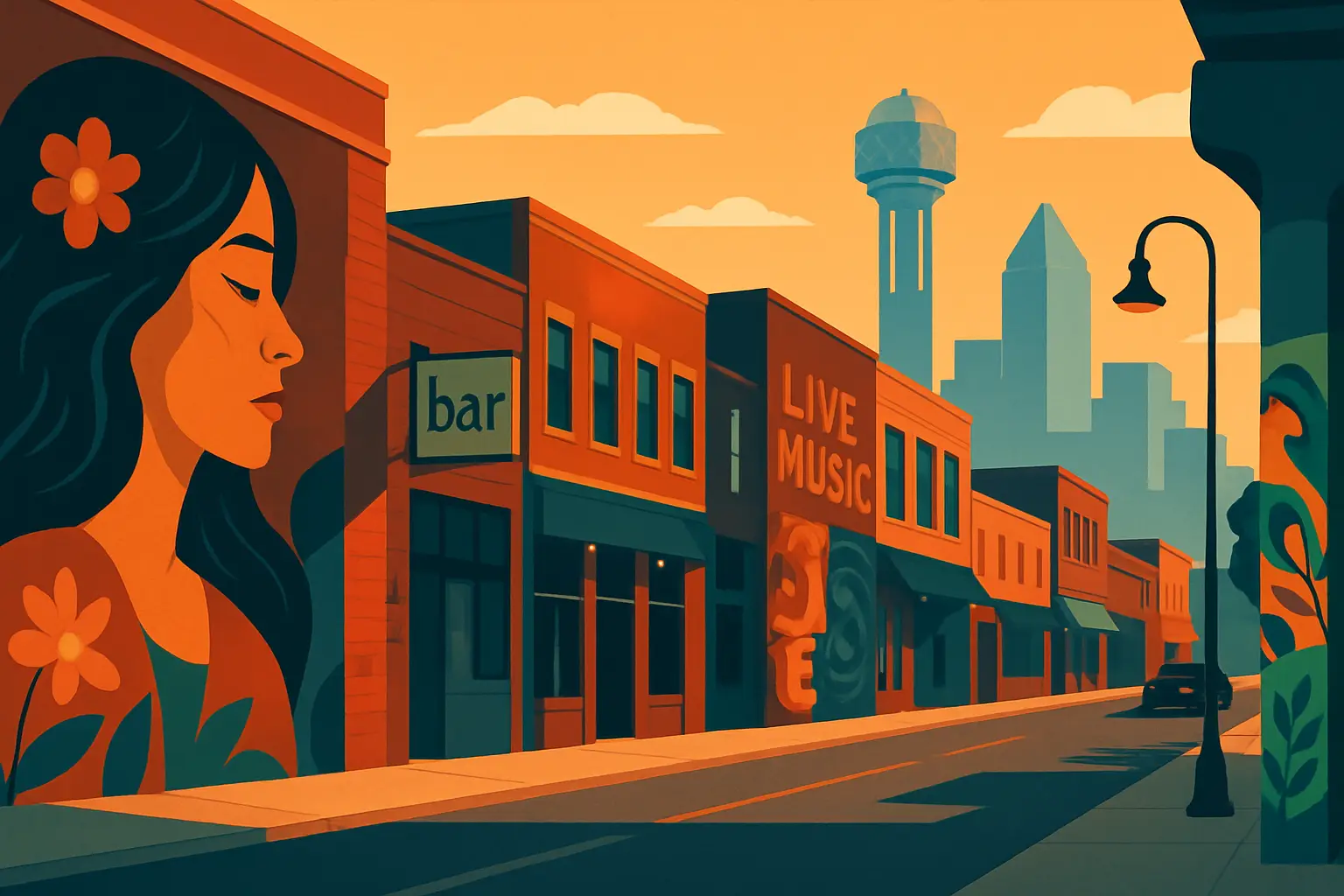
The 1990s revival had a specific character: predominantly white and rock-oriented, which was somewhat ironic given the neighborhood's origins. The tension between Deep Ellum's Black cultural history and its 1990s demographic identity is something Dallas artists and historians have grappled with explicitly. The murals that now define the neighborhood's visual landscape include work that directly acknowledges that history — images of Blind Lemon Jefferson, references to the Central Track era, documentation of what was here before.
A second decline hit in the early 2000s, when a series of high-profile shootings near the venue district caused the city to impose a 'bar card' requirement on Deep Ellum venues — a special permit that effectively made operating a music club significantly more expensive and procedurally difficult. Many venues closed. The neighborhood contracted again.
The current Deep Ellum — the version that attracts 30,000 people to its annual Deep Ellum Arts Festival in April — emerged from that second trough starting around 2010. The development of the DART rail line through the neighborhood in 2010 brought the elevated track infrastructure that became the canvas for the pillar murals. New breweries, restaurants, and venues moved in. The neighborhood's third act is the one most visitors see today.
Deep Ellum has the highest concentration of street murals in Dallas — the neighborhood claims over 200 pieces of public art on its building exteriors, alleyways, and infrastructure. The scale makes it one of the larger mural districts in the American South.
The works range in character considerably. Some are commissioned by the Deep Ellum Foundation or building owners and created by nationally recognized muralists. Others are grassroots pieces that appeared organically, in the tradition of the aerosol art that defined the 1990s revival. A few are advertising-adjacent (brand-sponsored murals are common in heavily photographed urban districts), but the majority are artistic works in their own right.
The DART Pillars on Commerce Street are the most structured public art installation: 42 columns, each painted by a different artist, each with a distinct visual language. Walking the full length takes about 15 minutes and gives a useful survey of the range of artistic approaches in the neighborhood — from photorealistic portraiture to abstract geometry to collage-style text work.
The Painted Garage at 2714 Elm Street is one of the most photographed single buildings — every exterior surface painted in a grid of primary colors with graphic figures. The alley between Main Street and Commerce Street in the 2700 block concentrates murals in a narrower space and functions as an outdoor gallery corridor that's relatively quiet during daytime hours.
The Deep Ellum Foundation maintains a walking map of the major murals, available at the Deep Ellum Art & Entertainment District booth. The murals change: new ones go up throughout the year, and older ones are sometimes painted over, so no guide is fully current.
The two main commercial corridors of Deep Ellum are Elm Street and Main Street, running roughly parallel between Good-Latimer Expressway to the west and Malcolm X Boulevard to the east — a walkable stretch of about six blocks.
For live music:
- Trees (2709 Elm St.) — The anchor of the revival. Indie, rock, and electronic bookings from the national touring circuit. Standing room, 1,000 capacity. Tickets typically $15–30.
- Club Dada (2720 Elm St.) — Smaller, more intimate, with a covered outdoor patio and a broader mix of genres including jazz nights. Long the neighborhood's most reliably weird venue, in the best sense.
- The Bomb Factory (2713 Canton St.) — The neighborhood's largest venue at 4,000 capacity. National touring acts that have outgrown club-scale rooms book here. The adjacent parking lot hosts Deep Ellum Arts Festival headliners in April.
For drinks:
- Deep Ellum Brewing Company (2823 St. Louis Ave.) — The flagship craft brewery of the neighborhood, known for Dallas Blonde (golden ale) and Double Brown Stout. Taproom is open Wednesday through Sunday; the production facility hosts occasional public events.
- Peticolas Brewing (2026 Farrington St.) — One of the more respected Texas craft brewers. Taproom on Saturdays only, but their beers appear on most Deep Ellum bar menus.
- The Rustic (3656 Howell St., technically just north of Deep Ellum proper) — An 18,000-square-foot outdoor bar and music venue with live country and rock. Less Deep Ellum in character but often included in area guides.
For food:
- Pecan Lodge (2702 Main St.) — See Quick Tips. Brisket, beef ribs, pulled pork, smoked turkey. The Trough (a half-pound of each smoked meat) is the full test of what they do.
- Mudhen Brewing and Eatery (1621 Commerce St.) — More casual, brewpub-style food alongside their own beer program. Burgers and fried items.
- Ruins Bar (2653 Main St.) — A cocktail bar with a theatrical dark interior; one of the better cocktail programs in the neighborhood.
Every April, Deep Ellum closes its streets to traffic for the Deep Ellum Arts Festival — a three-day outdoor event that has run continuously since 1991, making it one of the longest-running arts festivals in Texas. The festival occupies Main Street, Elm Street, Commerce Street, and the surrounding blocks, drawing an estimated 30,000 to 60,000 attendees over the weekend.
The format is a mix of juried visual art booths (200+ exhibitors), live music on multiple outdoor stages, food vendors, and the kind of street-level activity that happens when this many people occupy a walkable district simultaneously. Admission is free; the art is for sale. The headliner stage is typically at the Bomb Factory lot, with separate stages scattered through the neighborhood for different genres.
The festival in 2026 was held the weekend of April 17–19. The 2027 dates have not yet been announced but typically fall in the third weekend of April. If your Dallas trip lands in late April, it's worth checking whether the festival overlaps.
How do I get to Deep Ellum from downtown Dallas? The DART Green and Orange lines stop directly at the Deep Ellum Station on Commerce Street. From Union Station (the downtown DART hub, also Amtrak), the train takes about 8 minutes. Rideshare from downtown takes 5–10 minutes depending on traffic on Elm Street. Driving requires planning: street parking on Elm and Main fills quickly after 8 p.m. The structured garage at 2424 Elm Street (at the corner of Good-Latimer) is the most useful for evening visits.
Is Deep Ellum safe? Deep Ellum has a mixed reputation within Dallas — the neighborhood's history of periodic crime incidents is real, and some locals treat the nighttime district cautiously. The core blocks of Elm and Main Streets between Good-Latimer and Malcolm X Boulevard are consistently well-populated on evenings with active music programming, which is most nights. Standard urban caution applies: stay on lit streets, be aware of your surroundings, and don't leave valuables visible in parked cars.
What is the best time of day to visit? Midday is best for murals and food (Pecan Lodge opens at 11 a.m. and the streets are calm enough to photograph the art). Evenings after 8 p.m. are best for music. The 5–8 p.m. window on weekdays is a transitional period — restaurants and bars are open but the music venues haven't started.
Is Deep Ellum the same as the Design District? No. The Dallas Design District is a separate area northwest of downtown, primarily home to interior design showrooms and some galleries. Deep Ellum is east of downtown and is the live-music and arts district. The two are sometimes confused in travel guides that use 'arts district' loosely.
What else is near Deep Ellum? The Dallas Farmers Market is a 10-minute walk northwest, near the Convention Center. Fair Park — a 277-acre National Historic Landmark containing the Cotton Bowl stadium and nine Art Deco museums — is about 1.5 miles east, walkable in about 25 minutes or a short rideshare.