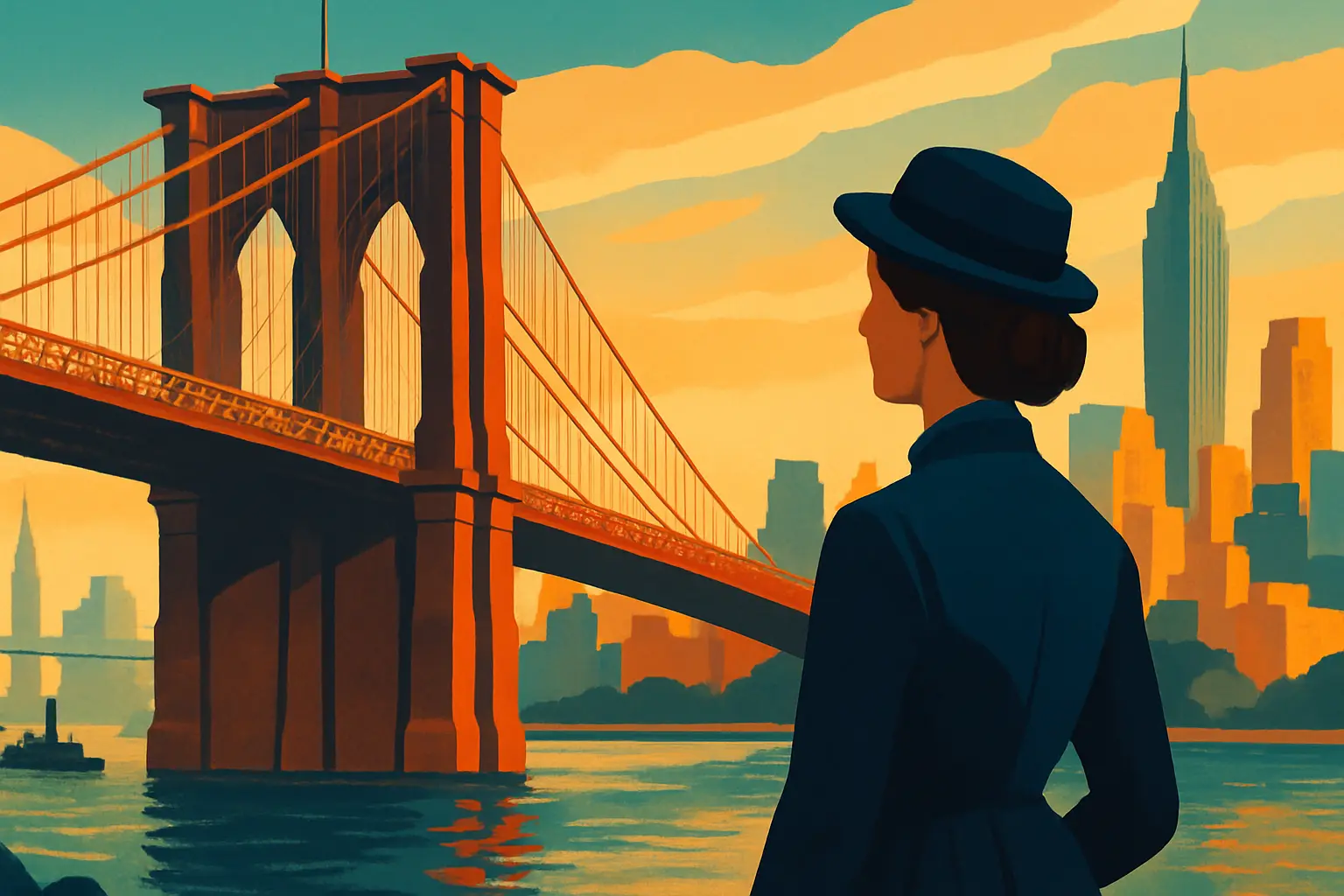
John Augustus Roebling had already built four suspension bridges — including the Cincinnati-Covington Bridge over the Ohio River — when he proposed spanning the East River between Manhattan and Brooklyn in 1857. The East River crossing was technically more ambitious than anything previously attempted: the 1,595-foot main span would be nearly twice as long as any existing suspension bridge, and the towers would need to be founded on bedrock beneath a tidal strait with powerful currents.
New York approved the project in 1869. Roebling was surveying the Fulton Ferry Landing on June 28 of that year, standing on the edge of a dock to sight his instruments across the river, when an incoming ferry pinned his foot against the dock piling. His toes were crushed. He refused amputation. Tetanus set in within two weeks, and John Roebling died on July 22, 1869 — before a single foundation stone had been placed and three weeks after the state formally authorized the bridge.
His 32-year-old son Washington Roebling inherited the project.
Washington Roebling's most pressing problem was the riverbed. The tower foundations needed to reach solid bedrock — 44 feet down on the Brooklyn side, 78 feet on the Manhattan side — through mud, silt, and water. The solution was pneumatic caissons: massive wood-and-iron chambers sealed at the top and open at the bottom, sunk to the riverbed and filled with compressed air to hold back the water and mud. Workers entered through pressurized airlocks, excavated by hand and blasted with gunpowder, and hauled debris out through the locks.
Six hundred men worked in each caisson at a time, in near-total darkness, under air pressure roughly three times normal atmospheric pressure. When they exited too quickly — as they often did at shift's end — nitrogen bubbles formed in their bloodstream. Workers called the resulting paralysis, joint pain, and death caisson disease. Doctors had no effective treatment. Fourteen men died from it during the Brooklyn Bridge construction; hundreds more suffered lasting disability.
Washington Roebling developed severe caisson disease in 1872 after inspecting the Manhattan caisson during a particularly dangerous blasting incident. He was bedridden and partially blind by the time he recovered — and never returned to the construction site. He would spend the next eleven years watching the bridge rise from the window of his house at 110 Columbia Heights in Brooklyn Heights.
Get short, interactive stories that make each place easier to remember while you travel.
The standard telling of the Brooklyn Bridge credits Washington Roebling with overseeing construction despite his illness. The more accurate account credits his wife, Emily Warren Roebling, who effectively ran the project.
Emily Roebling — a skilled mathematician who had studied engineering informally through her correspondence with Washington — spent the years between 1872 and 1883 as the primary line of communication between her bedridden husband and the construction site. She carried Washington's written instructions to the chief engineers daily. She met with contractors, politicians, and financiers on the bridge's behalf. When the board of trustees moved to remove Washington from the project in 1882 on grounds that he was physically incapable of directing it, Emily Roebling appeared before the board and argued for his reinstatement — successfully.
She learned enough about cable spinning, caisson engineering, and structural load calculations that she could evaluate and transmit technical directives without a translator. The engineers on site came to treat her as their effective supervisor.
When the Brooklyn Bridge opened on May 24, 1883, Emily Warren Roebling was the first person to cross it — by horse-drawn carriage, carrying a rooster as a symbol of victory — ahead of President Chester Arthur, New York Governor Grover Cleveland, and the assembled dignitaries. Washington watched from his Columbia Heights window through his telescope.
A plaque at the Brooklyn tower acknowledges her contribution. It was added in 1983, a full century after the opening. Before that, standard accounts of the bridge mentioned her only in passing, if at all.
The Brooklyn Bridge uses a wire-spinning technique that John Roebling had developed over his previous bridges: individual steel wires — each thinner than a pencil — grouped into strands, and strands bundled into cables. A traveling spinning wheel carried wire back and forth across the span on a temporary ropeway, building up each cable one wire at a time.
The four main cables each contain 5,434 individual wires. Combined, the wire in the four cables totals approximately 14,357 miles — enough to circle the Earth more than halfway. When complete, the cables were wrapped tightly in wire and the suspension hangers were attached, distributing the deck load across all four cables.
The main span of 1,595.5 feet was the longest in the world at opening and held that record for three years until the Niagara Railway Suspension Bridge was completed. The two granite towers stand 276 feet above the water — they were the tallest structures in the Western Hemisphere when the bridge opened in 1883, exceeding even the unfinished base of the Washington Monument.
John Roebling had specified steel wire rather than the iron wire then standard in bridge construction, betting on steel's superior tensile strength. The bet proved correct: despite several contractors substituting cheaper, weaker wire in some shipments during construction — a fraud that Washington Roebling caught and documented — the bridge has never experienced a structural failure in over 140 years of continuous use.
The formal opening ceremony on May 24, 1883 was one of the largest public events in New York City history. President Chester Arthur crossed from Manhattan to Brooklyn by carriage. Governor Grover Cleveland presided over ceremonies on the Brooklyn side. The bridge was lit by electric lights — still a novelty in 1883 — and fireworks were fired from both towers. Emily Roebling crossed first; Washington remained at his window.
The bridge immediately began carrying more traffic than its planners anticipated. Pedestrians, horses, cable cars, and wagons crowded the deck daily.
Six days after the opening, on May 30, 1883, a woman near the Manhattan stairway stumbled and cried out. The crowd — already dense with Memorial Day visitors — took the cry as a sign of structural collapse and panicked. People were trampled and crushed in the surge toward the exits. Twelve people were killed and 35 injured in the stampede. The bridge was structurally undamaged; the disaster was purely a crowd panic, but it reinforced early public anxiety about whether the bridge could actually hold the loads it was carrying.
P.T. Barnum addressed the anxiety in his own way the following year: in May 1884, he led 21 elephants across the bridge to demonstrate its stability. The stunt worked well enough that the story has stayed in circulation ever since.
The pedestrian walkway runs along the center of the bridge, elevated above the vehicle lanes on both sides. The walk from the Manhattan entrance to the Brooklyn entrance is approximately 1.1 miles, with a gentle rise to the center span and a matching descent. Most walkers cover it in 30 to 45 minutes; with stops at the towers and center for photos, plan for 60 to 90 minutes.
Manhattan entrance: Since the June 2026 redesign, pedestrians enter from the south side of the bridge approach on Centre Street, near Chambers Street and City Hall Park. The new stairway feeds directly onto the elevated walkway without the cyclist-pedestrian conflict that plagued the old ramp. Cyclists have their own separate ramp on the north side. The nearest subway is the 4/5/6 at Brooklyn Bridge-City Hall, or the J/Z at Chambers Street.
Center span: The two Gothic-arched towers are the best photo position for the Manhattan skyline behind you. In summer, both towers are framed by the skyline most effectively from 6 to 9 a.m., before the sun moves overhead. The water below is the East River, technically a tidal estuary connecting Upper New York Bay to Long Island Sound — not a true river.
Brooklyn entrance: The walkway descends to street level near Tillary Street and Adams Street in downtown Brooklyn. Most visitors turn left (south) onto Washington Street in DUMBO — the gap between the two brick warehouse buildings at Washington and Water Streets frames the Manhattan Bridge perfectly and is one of the most reproduced images in New York photography. From there, DUMBO's galleries, restaurants, and Brooklyn Bridge Park are immediately accessible.
Is it free? Walking the Brooklyn Bridge is completely free and open 24 hours. There is no ticket, no reservation, and no fee for pedestrians.
How crowded does it get? On summer weekends between 10 a.m. and 4 p.m., the elevated walkway can be genuinely uncomfortable — shoulder-to-shoulder in the most congested sections near the towers. Weekday mornings before 9 a.m. are the most manageable. The bridge never closes for crowd control; there is no timed-entry system.
Can you bike across? Yes. Cyclists use the dedicated lane added in the 2026 redesign, entering from the north ramp on the Manhattan side. The crossing is approximately 15 to 20 minutes by bike.
What's on the Brooklyn side? Descending into DUMBO gives you immediate access to some of the best eating and wandering in Brooklyn. The Brooklyn Heights Promenade — the classic elevated walkway along the Brooklyn Heights waterfront — is a 15-minute walk south from the Brooklyn tower and provides the quintessential elevated view of the bridge from the water side. For food in DUMBO: Grimaldi's Pizzeria (under the Manhattan Bridge at 1 Front Street) and Juliana's (19 Old Fulton Street) are the two competing coal-fired pizza institutions, reliably excellent and reliably busy. Superfine (126 Front Street) is a neighborhood restaurant with good weekend brunch.
Is the bridge wheelchair accessible? The 2026 Manhattan redesign improved accessibility at the Manhattan approach, but the bridge walkway itself has a notable grade change at both towers. Pushchairs and manual wheelchairs can make the crossing; it is strenuous. The Brooklyn Bridge Park below has fully accessible waterfront paths with equivalent East River views.