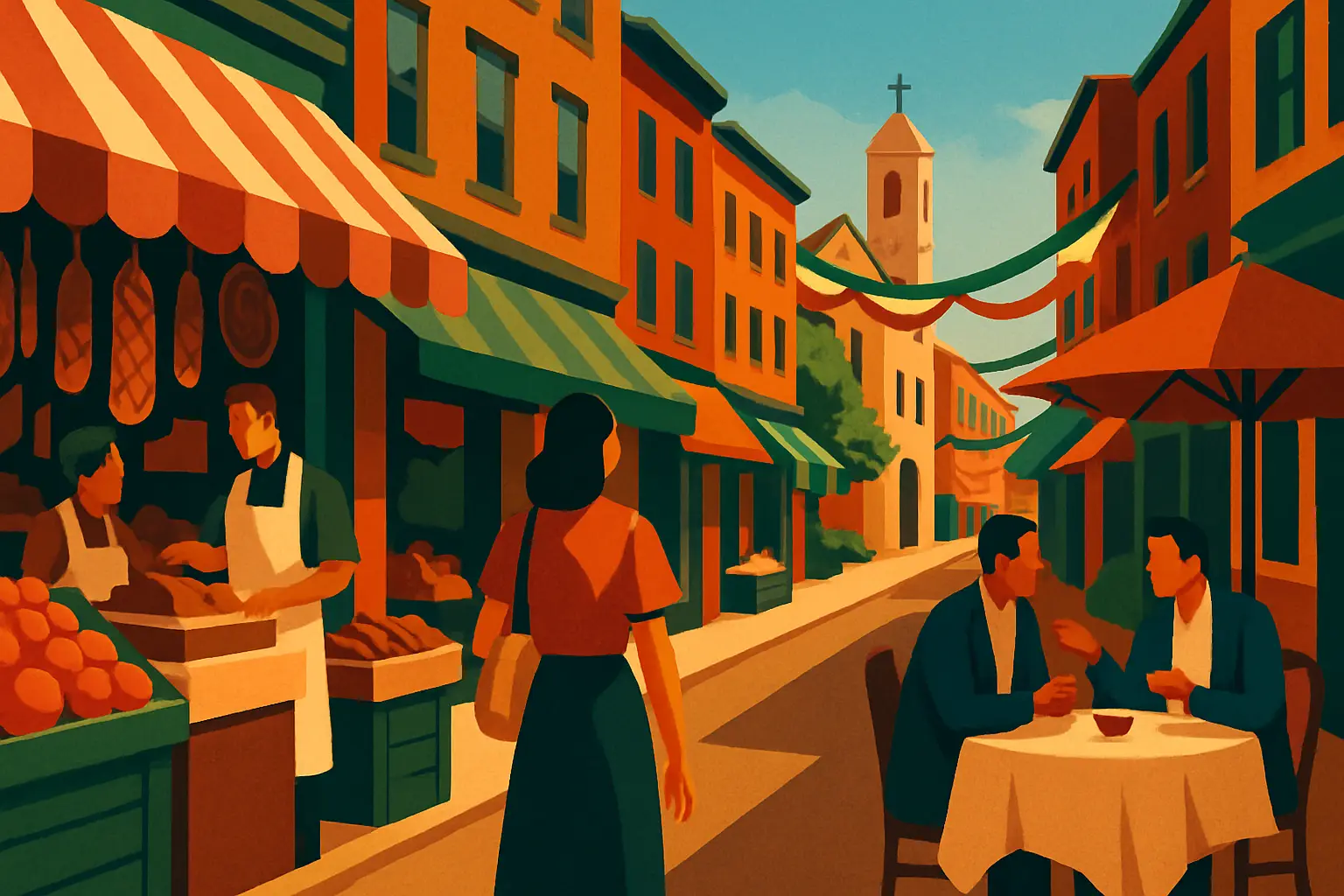
The Italian-American enclave on Mulberry Street in Manhattan was once genuinely what its name promised — a dense residential and commercial neighborhood where southern Italian immigrants lived, worshipped, and ran businesses from the 1880s onward. By the 1980s, rising rents and generational dispersal had reduced it to a remnant: a short commercial strip maintained largely for tourist purposes, with restaurants designed for visitors rather than residents. Today the 'neighborhood' occupies roughly four blocks and is bordered by Chinatown expansion on all sides.
Arthur Avenue survived for structural reasons. The Belmont neighborhood of the Bronx — centered on the cross streets of Arthur Avenue and 187th Street — sits between Fordham University's campus, the Bronx Zoo, and the New York Botanical Garden. It is not adjacent to any Manhattan transit hub that would attract tourist foot traffic. The Italian families who settled here beginning in the 1890s, mostly from Calabria and Sicily, were priced into the Bronx rather than the more expensive Lower East Side; they built a commercial corridor dense enough to sustain itself without outside visitors.
The neighborhood's population has shifted significantly since the postwar decades — today Belmont is substantially Latino, particularly Albanian and Mexican immigrants who have moved alongside the remaining Italian-American families. But the commercial strip on Arthur Avenue retained its Italian-American business identity because the anchoring institutions — the 1940 retail market, the pasta shops, the cheese sellers — are owned by families now in their third and fourth generation who have not sold. The food businesses, in other words, survived not because of tourism but because the buildings stayed with the families.
The Arthur Avenue Retail Market at 2344 Arthur Avenue was built in 1940 as part of Mayor Fiorello La Guardia's campaign to clear New York City's pushcart vendors off the streets. Pushcarts — mobile food and goods sellers who set up along the curb — were ubiquitous in immigrant neighborhoods throughout the first half of the 20th century. They were also a source of traffic congestion, sanitation complaints from competing businesses with storefronts, and political friction. La Guardia consolidated the vendors into 12 city-owned indoor markets across the five boroughs; the Belmont market on Arthur Avenue is one of the few that survived intact.
The building itself is modest: a single rectangular room under a corrugated metal roof, entered through a door on Arthur Avenue. What's inside has not been reorganized in decades. Mike's Deli, the market's anchor tenant, runs a counter along the east wall stacked with house-cured meats, 30-odd varieties of olives, fresh mozzarella made twice daily, and a rotation of prepared foods that includes stuffed peppers, eggplant rollatini, and a baked ziti that sells out by noon on Saturdays. Mike's will build a sandwich to specification or press one of theirs — the Mike's Special (prosciutto di Parma, fresh mozzarella, roasted peppers, artichoke, sun-dried tomatoes on a hero roll) is the most ordered item.
Peter's Meat Market occupies the back corner: beef, veal, pork, whole rabbits, and offal cuts that most Manhattan butcher counters stopped stocking by the 1990s. The tripe — honeycomb, book, and flat — is fresh, not pre-cooked, and sold by the pound. A cigar roller works from a booth near the center of the market, rolling by hand on a small table; the operation has been in the market since the 1970s. The produce stand near the entrance runs seasonal Italian vegetables — Cubanelle peppers, long hots, cardoons in fall — that are difficult to find at standard grocery stores.
Get short, interactive stories that make each place easier to remember while you travel.
The strip of independent food businesses on and around Arthur Avenue is the densest concentration of Italian-American specialty retail left in New York City. These are the ones with the longest track records.
Borgatti's Ravioli & Egg Noodles (632 E 187th St) was founded in 1935 by Mario Borgatti and is now run by his grandson Jeff. The shop makes fresh pasta by machine and by hand — egg noodles, ravioli, stuffed shells, cavatelli — using the same equipment bought in the postwar decades. The cases contain perhaps 20 pasta varieties on any given day. Borgatti's does not have a website; they sell only in the shop. A pound of fresh egg noodles runs about $4.50. Closed Sunday and Monday.
Calandra's Cheese (2314 Arthur Avenue), in business since 1953, makes fresh mozzarella daily — the hand-pulled, fist-sized bocconcini style common in southern Italian markets, not the low-moisture block sold in supermarkets. The cheese counter also carries 15-20 varieties of provolone, aged at different periods; the 12-month provolone is dry enough to eat like Parmesan. Calandra's scamorza — a smoked mozzarella — is made in-house.
Teitel Brothers (2372 Arthur Avenue, est. 1915) is the oldest business on the strip — a grocery that has operated from the same storefront for over a century, selling canned Italian goods, dried pasta, olive oils, and a selection of prepared foods. The price markups are below what you'll pay at Manhattan specialty importers for comparable product.
Artuso Pastry Shop (670 E 187th St, since 1946) is the neighborhood's bakery anchor. Cannoli are filled to order — the shells stay crisper than pre-filled ones — and the sfogliatelle are baked in small batches through the morning. The lemon granita in summer uses fresh-squeezed juice; the baba al rum has remained structurally unchanged since the shop opened.
Borgatti's: 632 E 187th St — closed Sun/Mon; arrive early Saturday, the best shapes sell out by noon
Calandra's Cheese: 2314 Arthur Ave — fresh mozzarella made daily by 9 a.m., sold hot if you arrive in the morning
Artuso Pastry: 670 E 187th St — cannoli filled to order on request; the ricotta filling is made in-house, not from commercial supply
Arthur Avenue has a cluster of sit-down restaurants operating in very different registers. Knowing which is which saves a wasted reservation.
Dominick's Restaurant (2335 Arthur Avenue) is the neighborhood institution — no printed menu, communal seating, cash only, server recites the day's options. The cooking is unmistakably old-school red sauce: linguine with clams, chicken scarpariello, veal chop, osso buco. The portions are large, the prices are below what a comparable dish would cost in Manhattan, and the environment is deliberately unchanged from what it was in the 1960s. This is the most authentic experience on the street, which also means it comes with the longest wait on weekends. Reservations are not taken — arrive at 5:30 p.m. to minimize hold time. Cash only.
Roberto's Restaurant (603 Crescent Ave) sits one block off Arthur Avenue and operates at a more refined register — cloth napkins, a printed menu, a real wine list. The cooking is southern Italian with a serious kitchen behind it: housemade pastas, a whole branzino on the wood-fired grill, and a cacciucco (Livornese fish stew) when fresh catch is available. Reservations accepted and recommended on weekends.
Zero Otto Nove (2357 Arthur Avenue) is an outpost of a Salerno-style Neapolitan pizza concept, opened by Roberto Paciullo. The wood-fired oven produces a charred, chewy crust closer to the Neapolitan original than most New York versions; the toppings are spare by design. The restaurant also serves pasta. Good option if Dominick's has a long wait and you want to eat on the strip.
Full Moon Pizzeria (600 E 187th St) is the neighborhood's old-school New York slice shop — coal-oven, large pies, counter seating and a few tables. The slice is $3–4 and doesn't pretend to be anything other than what it is.
Arthur Avenue's position in the Bronx makes it a natural connector to two of the borough's major institutions, both within walking distance of the retail strip.
The New York Botanical Garden (2900 Southern Blvd) is a 250-acre campus with 50 distinct plant collections, a Victorian-era Enid A. Haupt Conservatory, and a landscape section that replicates the original old-growth Thain Family Forest — 50 acres of what the Bronx looked like before European settlement. From Arthur Avenue, it's a 12-minute walk northeast along Bedford Park Boulevard. In September, the native plant collections and the fall chrysanthemum garden are at peak. General admission runs $15–$30 depending on day and season.
Fordham University's Rose Hill campus is a 15-minute walk from Arthur Avenue and is worth seeing for its architecture — a Collegiate Gothic quad, a campus church, and a Jesuit administration building that opened in 1841, making it one of the oldest continually operating university buildings in New York. The university is open to visitors during the week; there's no admission. If you're coming from Grand Central on Metro-North, you'll walk through the Fordham campus on the way to Arthur Avenue.
Bronx Zoo (2300 Southern Blvd), the largest metropolitan zoo in the United States, is a 20-minute walk south of Arthur Avenue or accessible directly from the 2/5 train at East Tremont/West Farms Square. Admission to the full campus runs $39.95 for adults. Worth combining with an Arthur Avenue lunch only if you're planning a full Bronx day — trying to cover Dominick's and the zoo in one afternoon is more rush than either deserves.
How long does the trip take from Manhattan? From Grand Central, Metro-North gets you to Fordham in 22 minutes — faster than most subway rides in Manhattan itself. The 4/5/6 to Fordham Road is slower at 35–45 minutes from 42nd Street. Either option is a genuine 'day out' in a borough most Manhattan visitors never enter.
What should I buy to take home? Fresh pasta from Borgatti's (lasts 2–3 days refrigerated, or freeze immediately), fresh mozzarella from Calandra's, canned goods or dried pasta from Teitel Brothers, and pastry from Artuso's. The indoor market at Borgatti's and Calandra's pace the visit; budget an hour just for the market and the immediate shops around it.
Is it safe? Yes. The Belmont neighborhood around Arthur Avenue has the character of a working commercial district — busy on weekday mornings, active on weekends, and populated by people running businesses and doing errands. The Bronx's crime rate has dropped substantially since its peak in the 1980s and 1990s; Belmont specifically has remained a stable, owner-occupied neighborhood. The main street is well-lit and active during business hours.
When is the best day to go? Saturday morning, arriving around 9–10 a.m. The market is fully staffed, the fresh mozzarella is still warm, Borgatti's has its full selection, and Artuso's has just finished the morning pastry run. Most businesses close by 4–5 p.m. on Saturdays and are closed or running limited hours Sunday afternoon and all day Monday.
How does it compare to the Mulberry Street Little Italy? The comparison favors Arthur Avenue by a wide margin for food quality and authenticity, but Mulberry Street's proximity to SoHo and the Village means it captures foot traffic that Arthur Avenue never sees. If you visit Arthur Avenue expecting Mulberry Street's tourist infrastructure — English-language menus explaining every dish, menus in five languages, a host standing outside — you'll be confused. Go for the food, not the atmosphere, and it won't disappoint.