1. What Alcatraz Actually Is — and Why It's Been So Many Things
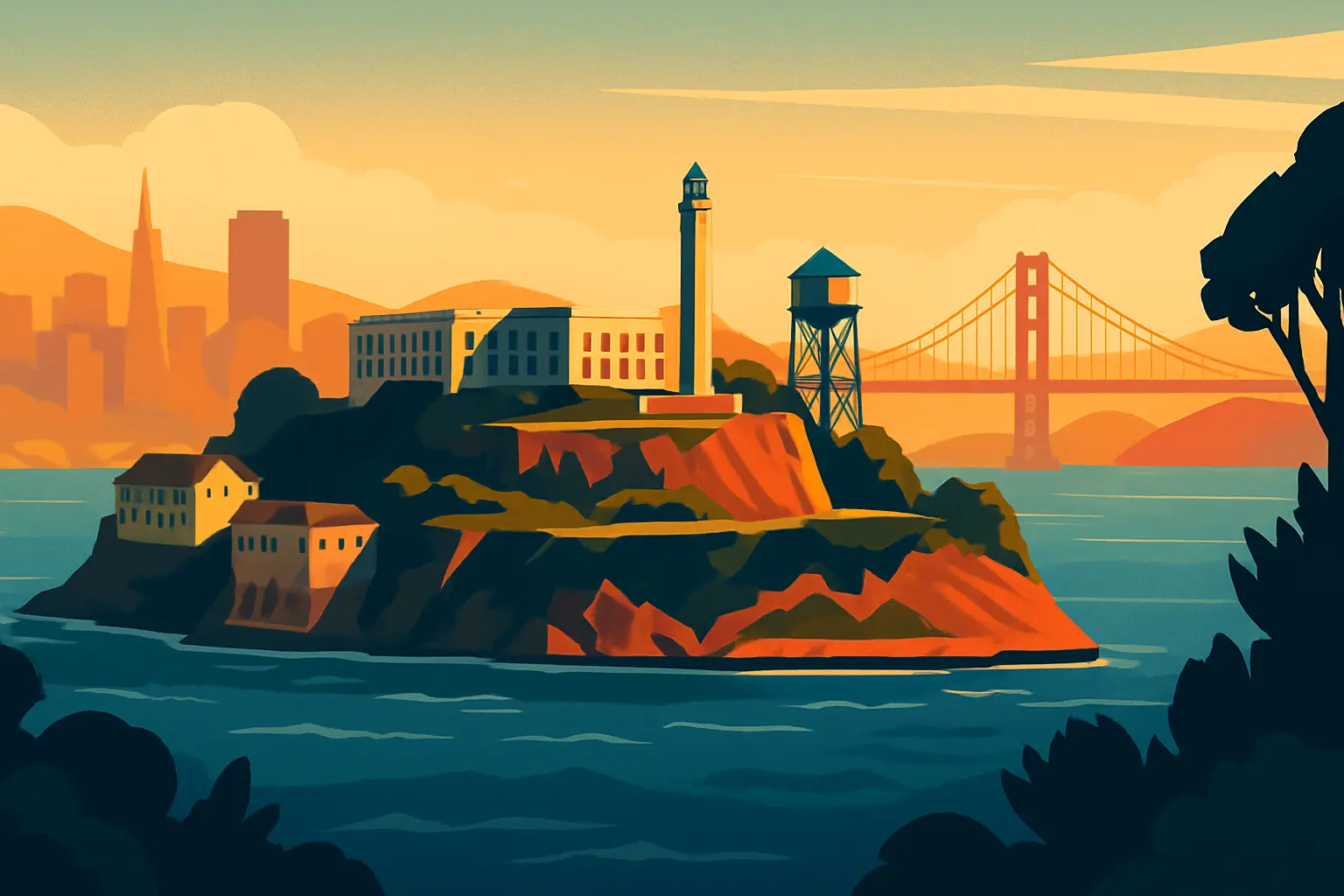
Alcatraz sits in the middle of San Francisco Bay, a sandstone-and-basalt outcrop that rises about 135 feet above the water at its highest point. Its position is what has always mattered: any vessel entering the bay through the Golden Gate has to pass within artillery range of the island, and any prisoner escaping from it faces 1.25 miles of 50-degree water and one of the most disorienting current systems on the West Coast. That combination — commanding view, hostile surroundings — is why the same 22 acres have been a naval landmark, a fortress, a prison, and eventually a protest site.
The island was named Isla de los Alcatraces — 'Island of the Gannets,' referring to the seabirds nesting on it — by Spanish naval lieutenant Juan Manuel de Ayala in 1775, on the first Spanish survey of San Francisco Bay. English speakers eventually collapsed 'los Alcatraces' into 'Alcatraz.' Long before Ayala's ship arrived, the Ohlone people who lived around the bay considered the island a place of spiritual significance and, according to their own accounts, a place where individuals were sent for isolation and reflection — a use the U.S. government would eventually mirror in a much crueler form.
2. The Civil War Fort and the Military Prison Years
The United States acquired California in 1848 and began fortifying San Francisco Bay almost immediately. President Millard Fillmore reserved Alcatraz for military use in 1850. Construction of Fort Alcatraz began in 1853; by 1859 the island held more than 100 cannons and was the most heavily fortified site on the West Coast. It never fired a shot in combat. What the fort did do, almost from the start, was hold prisoners.
By 1861 the Army was using Alcatraz as a military prison, initially for Confederate sympathizers arrested in California. Over the next several decades it expanded to hold Union deserters, court-martialed soldiers, Spanish–American War prisoners, and — significantly — Hopi men from Arizona who in 1895 refused to send their children to government boarding schools. Nineteen of them were shipped to Alcatraz and held for months without trial. In 1907 the site was formally redesignated the Pacific Branch, U.S. Military Prison. Between 1909 and 1912 the military demolished the original fort and built the concrete cellhouse that now dominates the top of the island — the same building visitors walk through today.
3. The Federal Penitentiary Era: 1934 to 1963
In 1933 the Department of Justice took the island from the Army and converted the cellhouse into a maximum-security federal prison — designed specifically to hold inmates the regular federal system could not control. The Federal Bureau of Prisons opened U.S. Penitentiary, Alcatraz Island on August 11, 1934. Its purpose was containment and deterrence: prisoners could not choose to come to Alcatraz, they had to be sent, and being sent was itself a public message that the Bureau had run out of patience.
Al Capone arrived on the first train of transfers in 1934. George 'Machine Gun' Kelly followed. Alvin Karpis, once the FBI's Public Enemy Number One, served the longest sentence in Alcatraz history — 26 years. Robert Stroud, who acquired the nickname 'the Birdman of Alcatraz' from a Hollywood adaptation, actually studied birds at Leavenworth; on Alcatraz he was allowed no animals at all and lived largely in isolation.
The daily reality of the prison was not the drama the nickname suggests. The cellhouse held roughly 260 inmates at a time — small, by federal-prison standards — and enforced a routine of counts, work assignments, and long stretches of silence. Water for showers was kept warm on purpose, to prevent inmates from acclimating to the cold of the bay in case they ever attempted to swim it. Meals in the dining hall were, by prisoner accounts and government audits, unusually good — the theory being that food was one of the few things worth keeping stable in a place where nearly everything else was designed to grind.
4. The 1962 Escape and the Closure of the Prison
On the night of June 11, 1962, Frank Morris and brothers John and Clarence Anglin left papier-mâché dummy heads in their cell bunks, crawled through holes they had spent months widening around the ventilation grates in their cells, climbed to the roof through a utility corridor, slid down a drainpipe, and pushed off from the northeast shore of the island on a raft they had sewn from more than 50 stolen raincoats. They were never officially seen again. The FBI closed its file in 1979, concluding that the men most likely drowned in the bay, but the U.S. Marshals Service still lists them as fugitives.
The escape did not close the prison, but it made a decision already forming inside the Bureau of Prisons much easier. Alcatraz was expensive — every gallon of water, every food shipment, every guard rotation had to come across the bay by boat. The saltwater environment was actively destroying the buildings. Attorney General Robert Kennedy announced the closure in 1963, and on March 21, 1963, the last 27 prisoners were transferred off the island. The cellhouse doors were locked, and Alcatraz sat empty for the next six years.
5. The Native American Occupation, 1969 to 1971
On November 20, 1969, 89 Native American activists calling themselves Indians of All Tribes landed on Alcatraz and claimed the island under the terms of the 1868 Treaty of Fort Laramie, which they read as entitling Indigenous nations to reclaim any surplus federal land. The occupation lasted 19 months and became the longest sustained Indigenous protest in U.S. history to that point. At its peak, more than 400 people lived on the island. Richard Oakes, a Mohawk activist and college student in San Francisco, was one of the initial organizers; John Trudell, later chairman of the American Indian Movement, broadcast a nightly show called Radio Free Alcatraz that reached listeners across the country.
The federal government cut off electricity and water; a fire in June 1970 destroyed the warden's house, the officers' club, and the lighthouse keeper's quarters. The last 15 occupiers were removed by federal marshals on June 11, 1971. The occupation did not end because it had failed. It ended because President Richard Nixon, under sustained pressure from Indigenous organizing that Alcatraz had helped make visible, formally reversed the federal policy of 'termination' — under which the government had been dissolving tribal recognition — and began the shift toward tribal self-determination. Signs and murals from the occupation are still visible on the water tower and on several buildings, deliberately preserved by the Park Service.
6. What Visiting Alcatraz Is Actually Like Today
Ferries leave from Pier 33 Alcatraz Landing, on the Embarcadero about a 15-minute walk from Fisherman's Wharf. The crossing takes 15 minutes. On arrival you land at the dock, watch a short introductory film in the barracks building, then walk (or take the SEAT shuttle) up the switchback road to the cellhouse at the top of the island.
Inside the cellhouse you're handed a headset and the 'Doing Time' audio guide, which walks you through cell blocks A, B, C, and D, the library, the dining hall, the recreation yard, and the shower room. The tour is timed to your own pace, but budget about 45 minutes for the audio itself and another hour to wander the rest of the island — the parade ground, the gardens (which volunteers have restored to their federal-prison-era plantings), and the ruins of the warden's house.
Return ferries run continuously and your ticket is open-return, meaning you board whichever boat you like on the way back. Most visitors stay 2.5 to 3 hours in total. Dress in layers regardless of the weather in the city — the island is exposed, and it is almost always significantly colder and windier on Alcatraz than at Pier 33.
7. Is Alcatraz Worth It? Practical Questions Answered
Is it a tourist trap? Not really. The audio tour is genuinely excellent, the National Park Service exhibits are careful and substantive, and the physical space — a decaying federal prison on an island in a national park — is impossible to fake. What you get out of Alcatraz depends heavily on whether you wear the headset and take the audio guide seriously. If you do, it is one of the more affecting historical sites in the American West.
How do I actually get tickets in summer? Book at alcatrazcitycruises.com exactly 90 days before your desired date, at 8 a.m. Pacific, the moment inventory releases. If you miss that window, check the site every morning for cancellation releases — small blocks of tickets appear regularly a few days out. Third-party resellers usually charge a significant markup for the same tickets and are worth avoiding.
Is the water really unswimmable? The bay is cold (50–60°F year-round) and the currents are strong, but the shark risk is largely mythical — the sharks in San Francisco Bay are mostly non-aggressive species. Every year hundreds of open-water swimmers complete the Alcatraz-to-shore route in the Escape from the Rock and Alcatraz Sharkfest events. Doing it without a wetsuit, a support boat, and a clear weather window is a different question.
What if I only have a few hours in San Francisco? Alcatraz needs a half-day minimum once you factor in the pier, the crossing, and the island itself. If your window is tight, North Beach or the Mission District give you more of the city in less time. Alcatraz rewards planning; it does not reward improvisation.