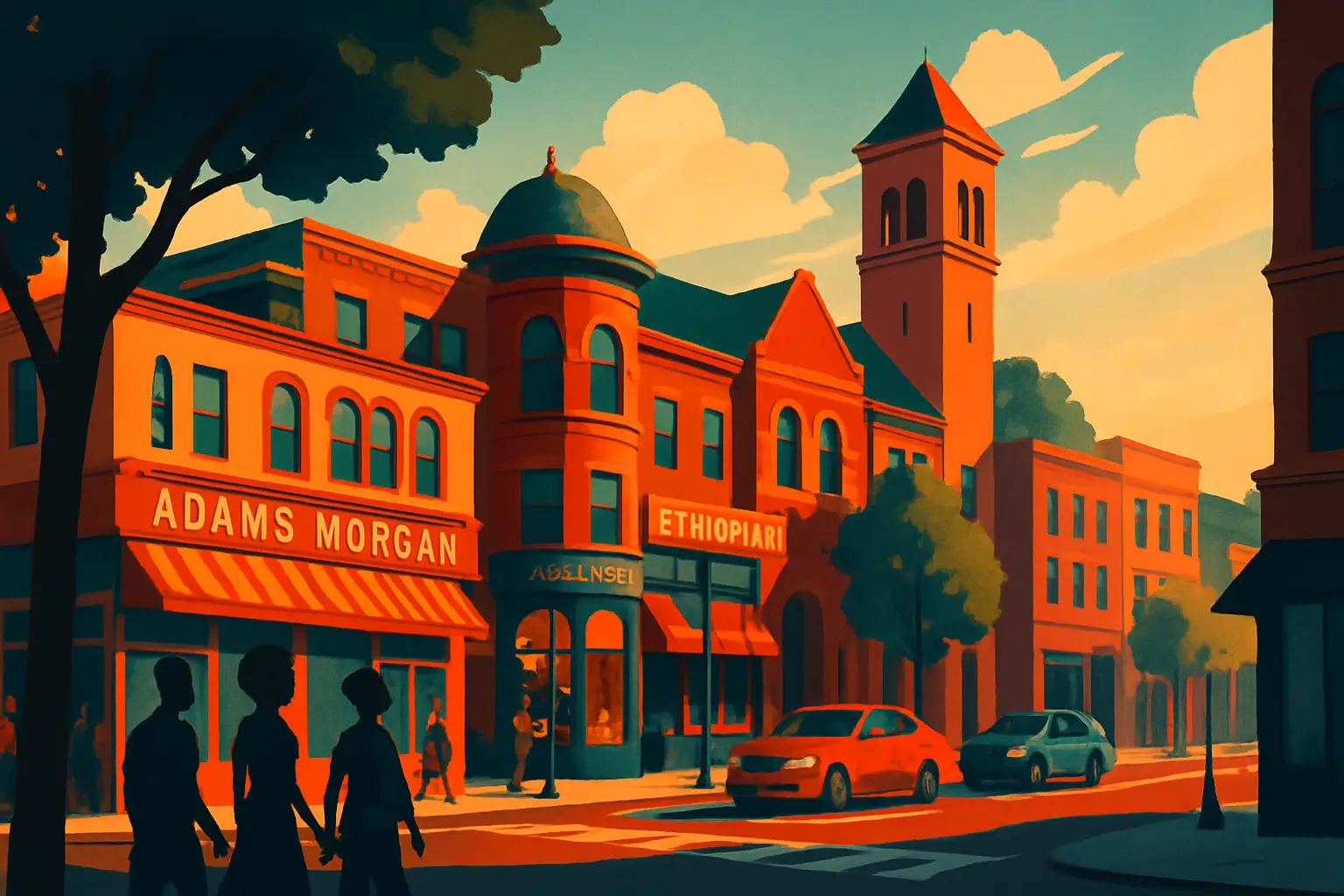
The name 'Adams Morgan' is not the name of a person. It is the combined name of two elementary schools that stood in this neighborhood during the era of DC's legally segregated school system.
John Quincy Adams Elementary served the neighborhood's white children. Thomas P. Morgan Elementary served its Black children. In the years following the Supreme Court's 1954 decision in *Brown v. Board of Education*, when the schools began to integrate, community leaders in the neighborhood took the unusual step of naming the community after the two schools together — a deliberate act of acknowledgment that two separate worlds had occupied the same blocks and were now being asked to share them.
The combined name appears in neighborhood association records from the late 1950s and was in common use by the 1960s. It is one of the only American neighborhood names that directly encodes a civil rights milestone in its etymology. Most people who use the name — locals included — don't know the backstory. The Adams school building still stands; the Morgan school building was demolished.
This origin story matters for understanding what Adams Morgan became: a neighborhood that, by geography and history, was positioned to absorb successive waves of immigration and change in ways that more settled or homogeneous DC neighborhoods did not. By the 1970s, significant Latin American and Central American populations had moved in. By the 1980s, Ethiopian immigrants fleeing civil war and famine had established what would become the largest Ethiopian diaspora community in the United States, concentrated partly in this neighborhood and partly in the nearby Shaw and Columbia Heights areas.
Washington DC has the largest Ethiopian diaspora population of any city in the United States — estimates range from 75,000 to 200,000, a range that reflects the difficulty of counting a population that includes a significant proportion of undocumented residents and long-term green card holders counted inconsistently in Census data. The community is concentrated in several DC-area neighborhoods, with the commercial core spread between Adams Morgan, Shaw, Columbia Heights, and the Maryland suburbs.
The Ethiopian restaurant corridor on 18th Street NW developed in the 1980s as the first wave of Ethiopian immigrants — many of them political refugees from the Derg regime, the communist military junta that ruled Ethiopia from 1974 to 1991 — established themselves in the neighborhood. Low commercial rents and an existing immigrant community infrastructure made Adams Morgan a natural anchor point.
Meskerem Restaurant (2434 18th St NW) is among the oldest surviving Ethiopian restaurants in DC, having operated at this location since the early 1980s. The name means 'September' in Amharic — the beginning of the Ethiopian new year and the end of the rainy season. The restaurant uses traditional basket-style seating on the upper floor for special occasions. The injera is made in-house daily.
A short walk from 18th Street, Dukem on U Street NW is another institution, named for a town in central Ethiopia and known for consistently excellent kitfo (Ethiopian beef tartare, typically served lightly cooked). The restaurants on 18th Street itself tend toward the tourist-accessible end of the spectrum; the spots on U Street and Columbia Road draw more of a community clientele and are often smaller and plainer in decor with no corresponding drop in quality.
Ordering at these restaurants follows a straightforward logic: pick a combination platter, specify your heat preference for the wats (spice levels vary considerably by establishment), and allow 15–20 minutes for the kitchen to assemble the full spread on the injera base. Most restaurants do not rush the meal.
Get short, interactive stories that make each place easier to remember while you travel.
18th Street NW between Columbia Road and Kalorama Road is the densest concentration of bars in Adams Morgan — a stretch of about four blocks that functions as one of DC's main late-night destinations, distinct in character from the more upscale Georgetown bar scene or the dive-bar intensity of the H Street Corridor.
Madam's Organ (2461 18th St NW) is the neighborhood's most visually identifiable bar. The name comes from a pun — 'Adam's Organ' shortened to 'Madam's Organ,' with a five-story mural of a red-haired woman on the building's exterior that has appeared on more Adams Morgan photographs than any other single image in the neighborhood. Inside it's a three-level blues and roots music bar, with live music most nights and a roof deck that fills fast on summer evenings. The bar has operated at this location since the early 1990s and survived multiple rounds of DC's ongoing bar and nightlife evolution largely unchanged in concept.
Jack Rose Dining Saloon (2007 18th St NW) occupies the opposite end of the strip's register — a serious whiskey program in a space that manages to be warm and neighborhood-bar comfortable despite its encyclopedic collection. The bar is named for a cocktail, the Jack Rose, made with applejack brandy, grenadine, and citrus. The roof deck overlooks 18th Street from above the main commercial action; the interior room with the full bottle collection is better for a quieter evening of focused drinking.
The Diner (2453 18th St NW) is open 24 hours and serves the function that every true neighborhood strip needs: a place to eat at any time, for any reason, at any state of consciousness. It has been operating in Adams Morgan since 1997. The menu is American diner standards — eggs, pancakes, burgers, breakfast all day — and it is reliably good at what it does. At 2 a.m. on a weekend, the Diner is one of the most representative cross-sections of DC you can find at a single moment: diplomats, students, service workers finishing late shifts, tourists, and everyone else the neighborhood contains.
Tryst (2459 18th St NW), directly next door to Madam's Organ, functions as the neighborhood's living room during daylight hours — a coffee shop with deep couches, slow wifi, and a tolerance for people who occupy a table for three hours on a single latte. It is part of the same building as a related bar that opens in the evening.
While 18th Street is the bar strip, Columbia Road NW is the neighborhood's other main axis — and it tells a different story about what Adams Morgan actually is day-to-day.
The stretch of Columbia Road from 18th Street east toward Columbia Heights has a dense concentration of Central American businesses: Salvadoran pupuserias, Guatemalan bakeries, Honduran restaurants, money transfer offices serving families sending remittances home, and Spanish-language services of every kind. This commercial ecology developed starting in the 1970s and 1980s as immigrants from El Salvador, Guatemala, and Honduras arrived in significant numbers — part of a larger Central American diaspora in the DC area driven by the civil conflicts of that era.
The Adams Morgan Farmers Market operates on Saturday mornings in the parking lot behind the Kalorama fire station on Columbia Road, roughly between 18th Street and Ontario Road. It runs from June through late November and draws a combination of neighborhood regulars buying produce and restaurant-industry buyers shopping the local farms. The market is smaller than the more famous Eastern Market or FRESHFARM Markets, but it operates on a human scale that makes it more pleasant to navigate.
The intersection of 18th Street and Columbia Road is one of the most photographed corners in DC — partly because the street-level commercial mix is so compressed and legible in a single frame, and partly because the hills and irregular street grid of this part of Northwest create framing that's unusual for a city as relentlessly flat as DC's central core.
Immediately north of Adams Morgan, the neighborhood transitions abruptly into Kalorama — one of DC's most expensive and historically significant residential enclaves, separated from Adams Morgan by its wealth but intertwined with it by geography.
Kalorama (the name comes from the Greek for 'fine view,' applied by the landowner in the early 19th century) has housed an unusual number of significant figures. Woodrow Wilson lived at 2340 S Street NW after leaving the presidency in 1923 — the only president to remain in Washington DC after leaving office. The house is now the Woodrow Wilson House Museum and is open for tours on Saturdays and Sundays, noon to 4 p.m. The interior is preserved largely as Wilson left it, including his private library, his initials on the floor tiles, and the wheelchair lift installed as his health declined after his stroke.
Barack and Michelle Obama moved to 2446 Belmont Road NW after leaving the White House in January 2017 — one of the few instances of a former president remaining in Washington rather than returning to their home state. The house is not open to the public and is surrounded by a small security perimeter, but it has become a minor pilgrimage point for politically-minded visitors, visible from the street.
The French, Finnish, and several other foreign embassies are located in Kalorama proper. The neighborhood's strict historic preservation rules and extremely high property values have kept its character remarkably consistent — walking into Kalorama from Adams Morgan is a transition measured in about half a block.
Every September, Adams Morgan closes 18th Street to traffic for Adams Morgan Day — a street festival that has run continuously since 1978, making it one of the longest-running neighborhood festivals in Washington DC.
The festival typically takes place on the second Sunday of September, which in 2026 falls on September 13. 18th Street between Columbia Road and Florida Avenue NW is closed to vehicles and given over to food vendors, live music stages, craft booths, and the kind of organized chaos that a neighborhood with Adams Morgan's mix of residents and businesses produces when it gathers in the same outdoor space.
The event draws somewhere between 40,000 and 60,000 people over the course of the day — large enough to fill the corridor wall-to-wall at peak hours but small enough that it retains a neighborhood-festival quality rather than the anonymous scale of a major music festival. The Ethiopian restaurants typically set up outdoor booths. Latin American food vendors compete for space with the neighborhood's bars, several of which set up outdoor drinking areas. Multiple music stages with different genres run simultaneously.
The festival begins at noon and runs until around 8 p.m. Arriving between noon and 1 p.m. gives you access before peak crowds. By 4 p.m. the crowd density makes moving through the main strip slow. The Metro to Woodley Park-Zoo/Adams Morgan or U Street and walking in is strongly recommended — the neighborhood's streets within a half-mile radius are impassable for driving on festival day.
How do I get to Adams Morgan? Adams Morgan has no direct Metro station. Your options:
- Red Line to Woodley Park-Zoo/Adams Morgan — exit the station and walk south on Connecticut Avenue, then turn east on Calvert Street NW or Columbia Road. About 10–13 minutes of flat to slightly downhill walking.
- Green or Yellow Line to U Street/Cardozo — exit and walk west along U Street NW and then north on 18th Street or Columbia Road. About 12 minutes.
- Red Line to Dupont Circle — exit at the Q Street exit and walk north on Connecticut Avenue to Columbia Road. About 15–18 minutes.
- Rideshare drops directly on 18th Street NW — the easiest option if you're coming from a distant part of DC or Virginia.
Is Adams Morgan safe? Adams Morgan is safe for visitors during the day and during early evening bar hours. The 18th Street corridor after midnight on weekends draws large crowds that can feel chaotic, and petty theft (phone snatching, pickpocketing in crowded bars) does occur at higher rates than in quieter DC neighborhoods. Walking to the Woodley Park Metro through Rock Creek Park after midnight is not recommended — take a rideshare for that leg. The Rock Creek Park path that runs between the neighborhood and the Woodley Park station is well-traveled during daylight hours and fine for a return walk when the sun is still up.
What should I not miss? The three things that Adams Morgan does that nothing else in DC replicates: Ethiopian food on 18th Street (specifically a shared combination platter at a sit-down restaurant rather than a quick order), the whiskey collection at Jack Rose, and the Saturday morning farmers market on Columbia Road if you're here on a weekend. The Woodrow Wilson House Museum is one of DC's least-visited and most genuinely interesting historic interiors.
How does Adams Morgan connect to nearby DC neighborhoods? Adams Morgan is walkable to Dupont Circle to the south (15 minutes) and to Columbia Heights to the east (10 minutes). Georgetown is accessible via a 25-minute walk downhill or a short rideshare. The U Street Corridor, with its own music and dining scene rooted in a different but related history, is directly east along U Street NW.