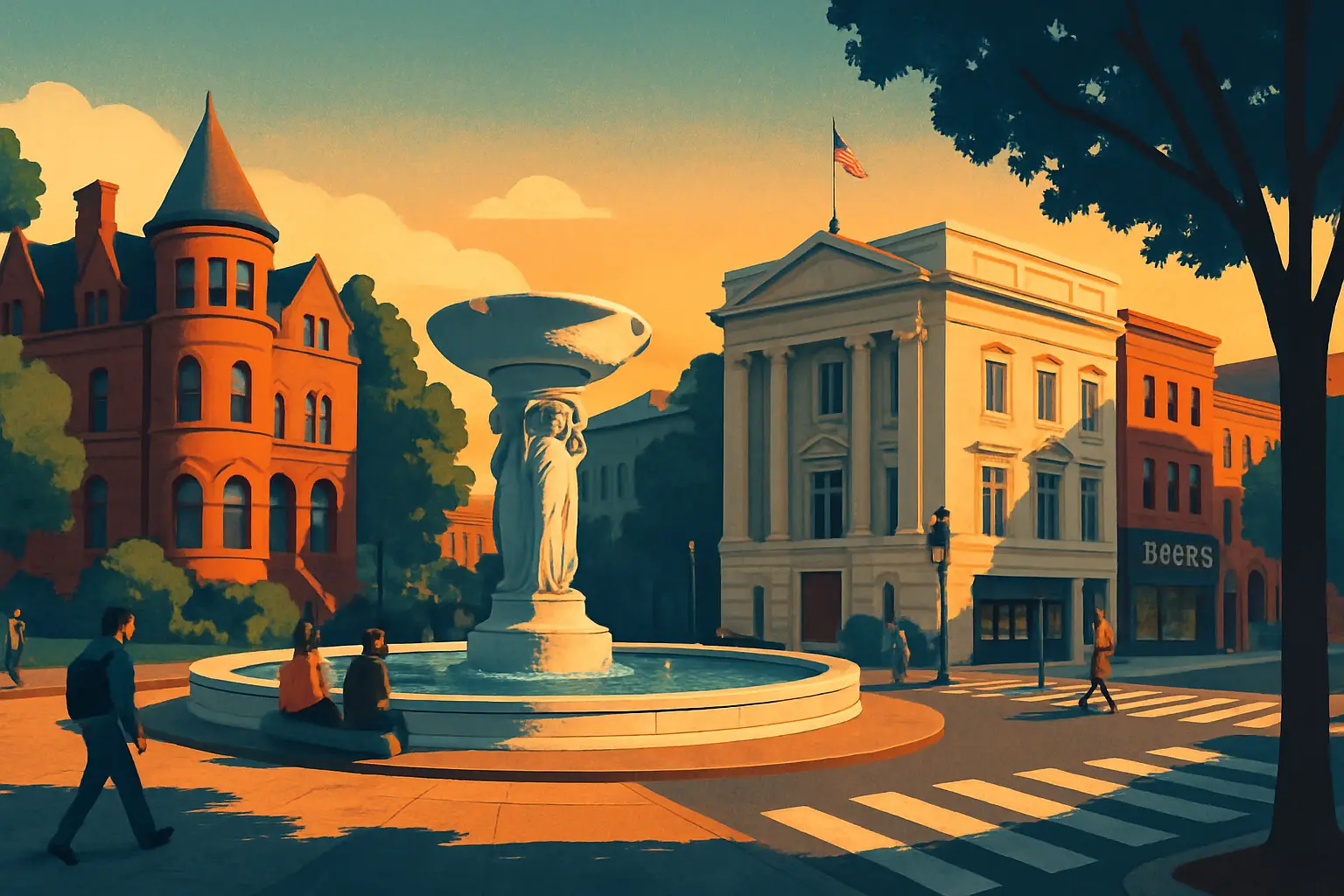
The circular intersection at the heart of this neighborhood was not an accident of urban planning. It was deliberate — part of Pierre Charles L'Enfant's 1791 plan for Washington DC, which laid out a grid of lettered and numbered streets bisected by diagonal avenues named after states. The avenues created awkward intersections, and those intersections were designated as public circles. The one now called Dupont Circle was originally simply the convergence of Connecticut Avenue, Massachusetts Avenue, and New Hampshire Avenue.
For most of the 19th century, the area north of the White House was swampy, sparsely developed, and outside the social geography that made DC legible. That changed in the 1880s and 1890s, when the completion of the Connecticut Avenue streetcar line made Dupont Circle accessible from downtown in minutes. Senators, railroad magnates, and industrialists began building mansions along Massachusetts and New Hampshire Avenues — the radiating diagonal boulevards that gave the neighborhood its bones. The houses were large even by Gilded Age standards: three and four stories, stone and brick facades, carriage houses on the alleys behind.
The circle itself was renamed in 1884 to honor Rear Admiral Samuel Francis Du Pont, the Union Navy commander whose fleet captured Port Royal, South Carolina — one of the first significant Union victories of the Civil War. The current fountain at the center was installed in 1921, designed by sculptor Daniel Chester French, who is better known for the Lincoln Memorial statue installed the same year. French's Dupont fountain is less celebrated than Lincoln but sits in the same company of ambition: three allegorical figures representing the sea, wind, and stars, carved in white marble around a central basin.
Massachusetts Avenue NW northwest of Dupont Circle carries the informal designation Embassy Row — a stretch of large mansions from which most of the original owners departed by the 1930s. The Great Depression gutted the fortunes that had built these houses, and one by one the families sold. Governments purchased them, converted the ballrooms into chanceries, and hung flag poles over the front doors.
The transition was not immediate or uniform. Some buildings passed through multiple owners before becoming official diplomatic property. The Anderson House (2118 Massachusetts Ave NW) was completed in 1905 for diplomat Larz Anderson and his wife, Isabella Weld Perkins, the wealthiest woman in Boston. Anderson paid for much of the construction out of his personal fortune and used the house for diplomatic entertaining. When he died in 1937 his widow donated it to the Society of the Cincinnati — the oldest patriotic organization in the United States, founded in 1783 by officers of the Revolutionary War — and it remains their headquarters today, open to the public as a free museum with rooms that look largely as they did in 1905.
Further along Massachusetts Avenue, the Walsh-McLean House (2020 Massachusetts Ave NW) was built in 1903 by Thomas Walsh, an Irish immigrant who struck gold in the Colorado mountains in the 1890s and became one of the wealthiest men in America. His daughter Evalyn Walsh McLean inherited the property and, more famously, the Hope Diamond — the 45.5-carat blue diamond that Walsh bought in 1908 and that McLean wore openly to society events until her death in 1947. The diamond is now at the Smithsonian. The house is now the Embassy of Indonesia, the largest diplomatic property on Massachusetts Avenue.
Get short, interactive stories that make each place easier to remember while you travel.
In 1974, a bookshop called Lambda Rising opened at 1724 20th Street NW, in a small storefront half a block from the Dupont Circle fountain. It was one of the first openly gay bookstores in the United States — an inventory of books about or by LGBTQ+ people at a moment when most such titles were published by small presses and available only by mail order, if at all.
Lambda Rising operated for 35 years, closing in 2009. During that time it served as more than a retail store. It functioned as a community bulletin board, a directory of LGBTQ+ organizations in DC and beyond, a safe space for people who had just arrived in the city and didn't know where to go, and a source of political organizing literature during the AIDS crisis, when the DC LGBTQ+ community lost hundreds of people and organized relief networks, protest movements, and mutual aid systems partly through the store's network of regulars.
The store's physical location on 20th Street — a block that also contained bars and restaurants increasingly serving a gay clientele — anchored what became known as the Dupont Circle gay neighborhood, the social and cultural center of LGBTQ+ life in Washington DC from the late 1970s through the early 2000s. That designation has since shifted, with Adams Morgan and Logan Circle drawing a younger demographic, but the history is embedded in the streetscape. JR's Bar (1519 17th St NW) has operated as a gay bar since 1986 and remains a neighborhood anchor. Cobalt (1639 R St NW) had a longer history as a dance club before closing; the building now houses other tenants. Lambda Rising's original storefront is now a sandwich shop. The history is present if you know where the addresses point.
In October 1987, a patchwork quilt the size of a football field was unfolded on the National Mall between the Washington Monument and the Lincoln Memorial. It contained 1,920 panels, each one made by friends, family members, or community organizations to memorialize someone who had died of AIDS. The quilt had been conceived earlier that year by activist Cleve Jones in San Francisco, but its first public display — on a weekend that also saw the Second National March on Washington for Lesbian and Gay Rights — happened in DC, with thousands of Dupont Circle residents and members of the broader LGBTQ+ community carrying panels down the Mall.
By 1992, the AIDS Memorial Quilt contained 20,064 panels — too large to display in its entirety — and continued to grow. It is now maintained by the NAMES Project Foundation and contains more than 110,000 panels representing over 105,000 people who died of AIDS in the United States. Individual panels are still accepted.
The 1987 display happened at a moment when Dupont Circle was at the center of DC's AIDS response. The Whitman-Walker Clinic (now Whitman-Walker Health, headquartered at 1525 14th St NW, roughly a mile south of Dupont Circle) was founded in 1973 and became the primary AIDS service organization in Washington DC during the epidemic's worst years — providing testing, treatment, and support services when federal response was still minimal and stigma was severe. The clinic continues to operate today as a community health center.
Kramerbooks & Afterwords (1517 Connecticut Ave NW) opened in 1976 as one of the first combination bookstore-café operations in the United States — a format so common now that it's hard to remember it was novel. The café attached to the back of the bookshop serves food until 1 a.m. on weeknights and stays open 24 hours on Friday and Saturday, which for decades made it the default late-night gathering spot for Washington's political, journalistic, and activist circles.
The store became nationally known in 1998 during the Monica Lewinsky investigation, when independent counsel Ken Starr subpoenaed Kramerbooks' sales records, seeking to confirm that Lewinsky had purchased books she'd mentioned to Linda Tripp in secretly recorded conversations. Kramerbooks' owners refused to comply, citing First Amendment protections and what they characterized as government overreach into readers' privacy. They fought the subpoena publicly — taking out newspaper ads, appearing on television, and generating enough political attention that Starr ultimately backed down before a court ruling was necessary.
The episode permanently associated Kramerbooks with the principle that what you read is not the government's business — a stance that won the bookshop a loyal following that has outlasted the political moment. The store carries a wide general inventory but is particularly strong in history, politics, and literary fiction. The café menu runs from breakfast through late-night drinks, and the layout — bookshelf walls, small tables pushed between stacks — is functional rather than designed.
Dupont Circle's restaurant density is high enough that the quality varies significantly by block. These are the specific addresses worth knowing.
**Tabard Inn** — 1739 N St NW. Three connected Victorian townhouses converted into a hotel and restaurant in 1922. The dining rooms are a series of small parlors with original wood paneling and fireplaces. Weekend brunch is the meal most worth planning around: the eggs Benedict and mushroom dishes are staples; the full menu runs to about 25 items. Reservations recommended for weekend mornings.
**Pizzeria Paradiso** — 2003 P St NW. Wood-fired pizza opened in the Dupont Circle neighborhood in 1991, one of the earlier upscale pizza operations in DC. The dough ferments for 36 hours; the margherita is the reference point. The downstairs Birreria sells Belgian and American craft beer. Walk-in friendly at lunch, busier at dinner.
**Al Tiramisu** — 2014 P St NW. A consistently quiet Italian restaurant in a neighborhood that has cycled through trendier options. Small room, neighborhood-restaurant energy, pasta made in-house. Reliable for a dinner that is not an event.
**Kramerbooks Afterwords Café** — 1517 Connecticut Ave NW. Directly attached to the bookshop. Full menu from breakfast through late night. The burgers and salads are competent; the reason to be here is the hours and the room, not the food specifically. The best use is a late evening after a neighborhood walk.
**Lapis** — 1847 Columbia Rd NW. Afghan restaurant about a 15-minute walk north in Adams Morgan. Mentioned here because Dupont Circle visitors often combine the two neighborhoods; Lapis is one of the best restaurants in either area. Lamb dishes and the bolani (stuffed flatbread) are the core of the menu.
Is Dupont Circle safe for visitors? Dupont Circle is one of the lower-crime areas in Washington DC. The Connecticut Avenue commercial corridor and the blocks immediately surrounding the Circle are well-trafficked through evening hours. The neighborhood has a residential density — people are on the street at most hours — that tends to deter the opportunistic crime more common in purely tourist zones. The standard DC cautions about keeping phones out of sight on public transit apply here as everywhere.
How long should I spend? A focused visit — the Circle itself, a walk along Massachusetts Avenue past Anderson House and several embassy facades, Connecticut Avenue browsing and a meal — takes two to three hours. If you combine it with the Phillips Collection (1600 21st St NW), one of the best private modern art museums in the United States, add an hour minimum; the museum is two blocks from the Circle and has one of the largest Rothko collections in the country.
How do I get there from the National Mall? The Dupont Circle Metro station is on the Red Line, which connects directly to Metro Center — five minutes from the Mall's museum corridor. The station has two entrances: the Q Street (north) entrance puts you closer to the Connecticut Avenue commercial strip; the 19th Street (south) entrance puts you closer to the Circle itself. Both exits are roughly equivalent for most visits. The walk from the White House along Connecticut Avenue takes about 20 minutes.
Can I combine this with Georgetown or Capitol Hill? Georgetown is about a mile and a half west along Massachusetts Avenue — a 25-minute walk or a short ride. Georgetown and Dupont Circle make a natural pairing for a full DC afternoon: the Federal-era architecture and waterfront in Georgetown, the Gilded Age mansions and bookshop scene in Dupont. Capitol Hill is on the opposite side of the city and is better combined with Mall museums than with Dupont.
Best time to visit? The DC LGBTQ+ Pride Parade runs along P Street NW through Dupont Circle in June and is the neighborhood's most attended annual event. The Circle's plaza is particularly good in the spring shoulder season (April–May) and early fall (September–October) when the midday crowds are thinner and the outdoor chess tables are at their best. Summer evenings are active and warm; the late-closing hours at Kramerbooks make them worth planning around year-round.