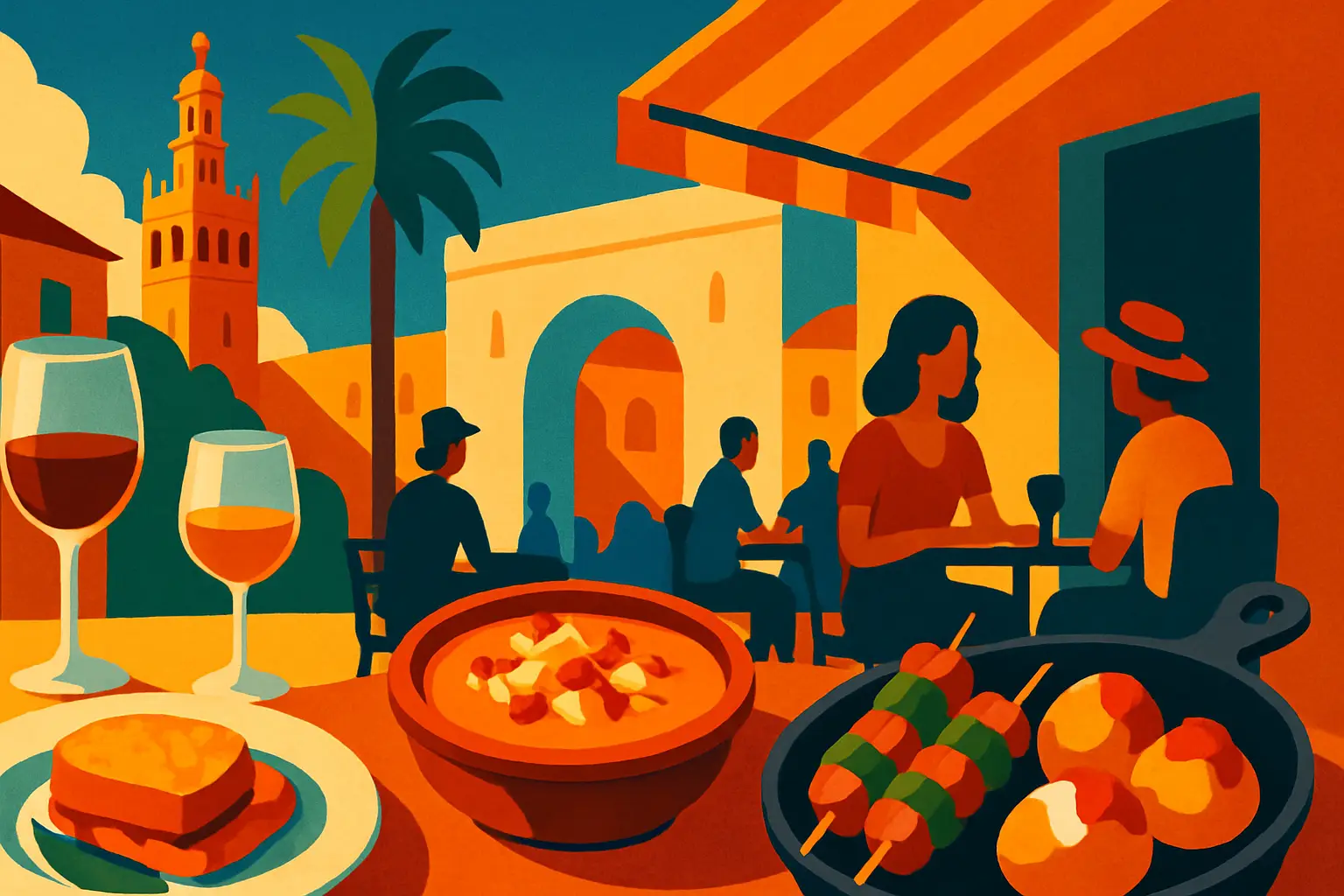
The distinction between Sevillian food and the rest of Spain is not just regional pride. It is structural.
Seville sits at the center of Andalusia, a region under Moorish governance from 711 to 1248 — longer than any other major Spanish city. That occupation left a permanent culinary trace. The Moorish legacy shows in the use of cumin and coriander in dishes that would carry none of those spices further north, in the espinacas con garbanzos (spinach and chickpeas) that is the city's defining vegetarian preparation and appears on menus from the oldest bars to the newest kitchens, and in the tradition of using bread as a thickener in cold soups — a technique that predates modern European cooking.
After the Reconquista in 1248, Seville became the wealthiest city in Spain. As the sole authorized port for trade with the Americas from 1503 onward, more wealth passed through its dockyards for most of the 16th century than through any other port in Europe. The food culture that emerged was lavish: elaborate pastries from the city's convents (still sold through rotating wooden hatches at the Convento de San Leandro on Calle San Leandro), high-quality jamón from Andalusia's interior, and the pescaíto frito tradition — fish fried in olive oil at a specific temperature that produces a texture unlike any other frying tradition in Spain.
The eating rhythm is late even by Spanish standards. Lunch begins at 2:30 or 3 PM. Evening tapas begin around 8:30 PM. Dinner before 9:30 PM is unusual, and on weekends the serious evening tapeo continues past midnight. The kitchens in Seville's best tapas bars are moving at full speed at 11 PM. Plan accordingly.
Spain's cold soups are Seville's most underestimated food category, because they look simple and because every tourist restaurant serves a mediocre version. Understanding the difference between a good and a bad one changes how much of the menu makes sense.
Salmorejo (from Córdoba originally, now equally at home in Seville) is the most specific: ripe tomatoes, stale bread, olive oil, and a small amount of garlic, blended until completely smooth and emulsified into a thick, almost spreadable consistency. A high proportion of bread to tomato is what makes it thick. The toppings are jamón ibérico cut into fine strips and hard-boiled egg passed through a fine sieve so it falls over the surface in soft crumbs. At El Rinconcillo (Calle Gerona 40) — in business since 1670, with chalk still used on the wooden bar to track tabs — the salmorejo is the right starting point for understanding the dish.
Gazpacho in Seville bears little resemblance to the bottled versions sold across Europe. Properly made, it includes ripe tomato, cucumber, green pepper, onion, stale bread, olive oil, and — specifically — sherry vinegar, a product of the Jerez region 90 kilometers southwest. That sherry vinegar is what separates a Seville gazpacho from generic versions: it should be sharp and bright, not sweet.
Ajo blanco is the oldest of the Andalusian cold soups — a white almond and garlic purée, silky and savory, often served with green grapes or melon floating in it. It predates the tomato (which arrived from the Americas in the 16th century) and represents the earlier Moorish-influenced cold soup tradition. Less ubiquitous than salmorejo, but any bar that takes its food seriously will have it.
Get short, interactive stories that make each place easier to remember while you travel.
Seville is not on the coast, but the Guadalquivir river was historically navigable from the Atlantic as far as the city's dockyards, and the coastal fish markets of Cádiz and Huelva are less than two hours away. The result is a city with a frying tradition built on fresh seafood.
Pescaíto frito — the Andalusian diminutive of 'fried fish' — refers to small fish coated in a specific fine semolina flour and fried in abundant, very hot olive oil until the exterior is almost shattering-crisp and the interior barely cooked. The technique requires oil at 180–190°C and a completely dry, lightly dusted fish. The most commonly fried types are boquerones (fresh anchovies), cazón (a small Andalusian shark species, mild and meaty), acedías (small flatfish specific to the Guadalquivir estuary), and chocos (cuttlefish).
Tortillitas de camarones are perhaps the most specific preparation: a thin, crispy fritter made from rice flour, chickpea flour, small raw shrimp (camarones), parsley, and onion, fried flat in olive oil until lacy and translucent around the edges. They originated in the Bay of Cádiz and are found throughout Seville. A good version dissolves at the first bite into shrimp and herb. A bad version (too thick, oil not hot enough) is gummy.
At Casa Morales (Calle García de Vinuesa 11) — a wine-and-tapas bar operating since 1850, with original ceramic amphorae still lining its walls — the tortillitas de camarones and fried boquerones are consistently good at a fraction of the price of tourist-facing places near the Cathedral.
Espinacas con garbanzos is the dish that best illustrates Seville's Moorish culinary inheritance, and it appears in every serious tapas bar in the city. Cooked spinach and boiled chickpeas, sautéed in olive oil with garlic, cumin, paprika, and a splash of sherry vinegar — the cumin, which is not commonly used in the cooking of northern Spain, is the tell. The dish is directly descended from the combination of legumes, leafy greens, and warm spice that defines medieval Andalusian cooking, and it has not changed substantially in several centuries.
Pringá is less well-known outside Seville and rewards seeking out. It is the slow-cooked meat filling from the Sevillian cocido — a long-braised assemblage of pork shoulder, ribs, morcilla (blood sausage), chorizo, and lard, cooked together until everything collapses into a unified, intensely savory paste. Served warm and spread on a small toasted bread roll, it is one of the city's most satisfying single bites. At Bodeguita Romero (Calle Harinas 10), just south of the Cathedral — a narrow bar that has been serving this for decades — the montadito de pringá (€2–€3 per piece) arrives warm, with the fat still liquid inside the roll.
Caracoles (snails) appear seasonally on Seville bar menus in a manner not found in most Spanish cities — simmered in a broth of mint, cumin, and tomato, eaten by sucking them from the shell at the bar. The bars along La Alameda de Hércules on summer and early-autumn evenings serve caracoles from large earthenware pots, and the ritual of eating them standing — bowl in one hand, toothpick in the other — is one of the more specific social experiences in the city.
Centro — Plaza de la Alfalfa and Calle Sierpes: The oldest bar institutions sit here. El Rinconcillo (Calle Gerona 40) has been in business since 1670. Casa Morales (Calle García de Vinuesa 11) operates since 1850 with its original ceramic jug wall intact. Confitería La Campana (Calle Sierpes 1), open since 1885, is the place for breakfast pastries — particularly the torrijas (egg-soaked fried bread, the Sevillian answer to French toast) it keeps on its menu year-round. For contemporary tapas without tourist pricing, the bars around Plaza de la Alfalfa and the small streets behind it (Calle Candilejo, Calle Boteros) run a lively tapas scene aimed at locals in their twenties and thirties.
La Macarena — north of Centro: This is where Sevillanos actually eat without an audience. The neighborhood north of the old city walls, around the Basílica de la Macarena, remains the most resistant part of Seville to tourist infrastructure. Tapas cost 30–40% less than equivalent quality near the Cathedral. The Mercado de Feria (Calle Feria) anchors the neighborhood, and the bars surrounding it operate a free-tapa culture with each drink that is now rare in the rest of the city.
Alameda de Hércules: The wide, tree-lined boulevard running through the north of Centro is Seville's most culturally layered bar street. One of Seville's most cited tapas bars — Eslava at Calle Eslava 3 — operates here, with a kitchen that has been doing creative Andalusian cooking for two decades. The lamb with honey and thyme is the dish most discussed. Book ahead for a table; the bar operates on walk-ins.
[Triana](/es/blog/seville-triana-neighborhood-guide) — historically the neighborhood of potters, bullfighters, and gitano flamenco artists — is Seville's most atmospheric quarter for a meal. The Mercado de Triana (Calle San Jorge 6), built within the ruins of the Castillo de San Jorge — the former Inquisition prison, partly excavated beneath the market floor — is the best market in the city for fresh produce. The riverside promenade Calle Betis has a string of bars and restaurants with direct views across the Guadalquivir to the Torre del Oro.
The 24th Bienal de Flamenco de Sevilla runs from September 9 to October 3, 2026 — the world's most important biennial flamenco festival, with more than 50 performances across 11 venues in the city, including 22 world premieres. The Bienal happens every two years, and this September window makes Seville an exceptional place to be.
The festival's connection to food matters because Seville's tapas culture and its flamenco culture were built around the same bars, the same late nights, and the same physical spaces in Triana and the old city. The tablaos around the Barrio de Santa Cruz and the bars of Alameda de Hércules fill late on festival nights with performers and audiences alike. The late-night tapeo — beginning around 10:30 PM and continuing past 1 AM at bars along Alameda, Calle Feria, and Plaza de la Alfalfa — is at its liveliest during Bienal week.
Practically: performances at the main venues (Teatro de la Maestranza, Teatro Central, Teatro Lope de Vega) begin at 9 PM, which means either dinner before 8 PM or a serious late-night tapas session afterward. The bars nearest those venues are busiest between midnight and 2 AM on performance nights. This is not a problem — it is the correct Sevillian use of those hours.
Does Seville still have free tapas? Yes, in specific neighborhoods. In La Macarena, around Calle Feria and the bars near Alameda de Hércules, ordering a drink typically brings a small tapa at no extra charge. This is not universal — tourist-facing bars near the Cathedral operate on a paid-tapa model — but it remains a genuine feature of local bar culture in Seville in a way it no longer is in Madrid or Barcelona.
What does food actually cost in Seville? Seville is notably cheaper than Madrid or Barcelona for equivalent quality. A caña (small draft beer) costs €1.50–€2.50 at a neighborhood bar. A paid tapa runs €2–€4. A montadito de pringá at Bodeguita Romero is €2.50. A full menú del día — three courses, wine, and water — at a non-tourist restaurant runs €12–€15 at lunch, Monday through Friday. A tasting menu at Abantal (Seville's Michelin two-star restaurant, Calle Alcalde José de la Bandera 7) runs around €110 per person.
Is September a good time to eat in Seville? It is arguably the best month. July and August can see temperatures above 40°C, and many Sevillanos leave in August — some neighborhood bars close for the month entirely. By September, temperatures drop to the high 20s and low 30s, the city fills up again, and the Bienal de Flamenco brings the cultural institutions to life at the same time. The combination of cooler evenings and a live city makes September the best window for experiencing both the food and the street life together.
How does Seville compare to Granada for food? The kitchens share Moorish roots and similar ingredients, but Granada retains the free-tapa tradition even more consistently — a Granada bar will often bring three or four small tapas across a long evening without a separate charge. Seville's food has evolved more; it has more interesting contemporary kitchens, while Granada's traditional bars still offer some of Europe's best food value. If you have time for both, you should do both — see the Seville city guide for context on the broader visit.