1. Tarraco: why this city mattered more to Rome than Barcelona did
Roman Barcino — the settlement under modern Barcelona — was a modest colony of perhaps 5,000 people that functioned primarily as a commercial port. Tarraco was something different entirely.
Rome's legions landed at Tarraco in 218 BCE during the Second Punic War, using it as a base to push Carthaginian forces out of the peninsula. By the 1st century BCE, Tarraco had become the capital of Hispania Citerior — the near province of Hispania, which covered roughly two thirds of the modern Iberian Peninsula. Augustus himself wintered in the city in 26–25 BCE while directing the Cantabrian Wars in the north, and the city became the first in Hispania to mint coins bearing the emperor's face. At its peak, Tarraco housed between 30,000 and 40,000 people within its walls.
The city occupied a pronounced promontory above the sea, organized on three descending terraces connected by staircases and colonnaded streets. The upper terrace held the provincial forum and imperial cult complex. The middle terrace held the circus, where chariot races were staged for up to 30,000 spectators. The lower terrace held the colonial forum, the commercial port, and the amphitheatre. All three layers are still accessible today — in different states of preservation, but structurally intact enough to understand the original logic of the city.
In 2000, the UNESCO Archaeological Ensemble of Tarraco was inscribed as a World Heritage Site. A combined ticket covering all MNAT-managed sites costs €15 for adults; individual sites are €5–7. The Tarragona Card (available at the tourist office near Rambla Nova) covers all UNESCO sites plus unlimited city bus travel and typically pays for itself with three or more site entries.
2. The Amfiteatre: gladiators with the Mediterranean behind them
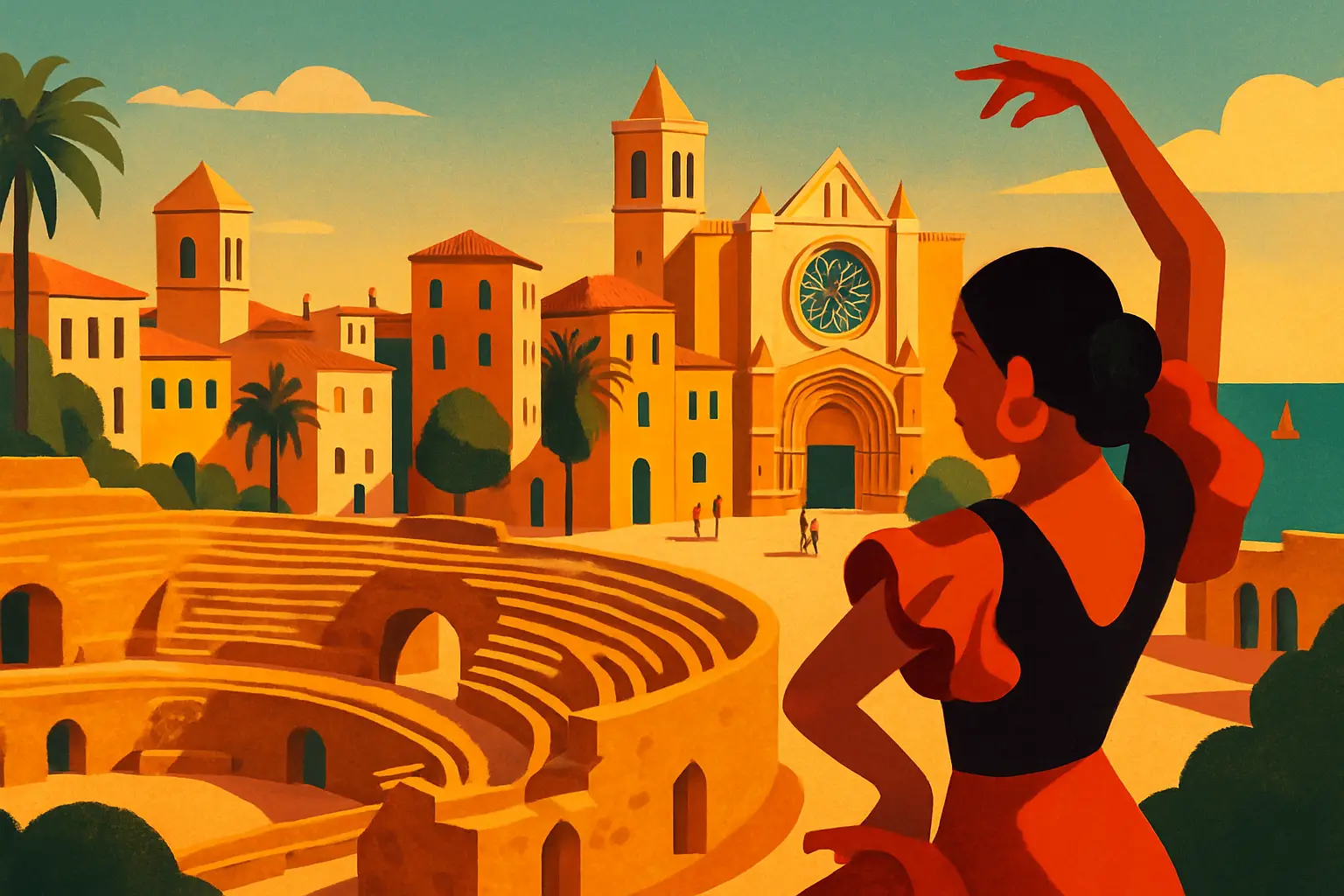
The Amfiteatre de Tàrraco was constructed in the 2nd century CE on the eastern edge of the Roman promontory, positioned so that spectators in the upper tiers looked across the arena toward open sea. It held approximately 14,000 people, staged gladiatorial combat and public executions, and in 259 CE became the site of the martyrdom of Bishop Fructuosus of Tarragona and his two deacons — burned alive in the arena during the Valerian persecutions. A Byzantine basilica was built inside the amphitheatre's oval in the 6th century to commemorate the martyrdom; the visible stone foundations in the arena floor are its remains.
The combination of setting, scale, and preservation makes this one of the most striking Roman monuments in Spain. Unlike Mérida's amphitheatre (larger but landlocked) or Italica's (fragmentary), Tarragona's arena sits close enough to the Mediterranean cliff edge that the sea and sky frame the far end of the oval. In late afternoon, the light on the stone is exceptional.
Access is through the MNAT ticket system. In July and August, queues form at the entrance from around 10:00am. Arriving before 9:30am — when the site opens — avoids most of the morning rush. The site closes at 7:30pm in summer. A 20-minute walk around the exterior on the cliff-top promenade, Passeig Arqueològic del Miracle, gives a sense of the amphitheatre's relationship to the sea before you descend into it.
3. The Circ Romà: a chariot circuit under a medieval city
Medieval Tarragona did not demolish the Roman circus. It built directly on top of it, using the circus's vaulted substructure as the literal foundations of the medieval city center.
The Circ Romà of Tarraco was one of the largest chariot racing circuits in the Roman Empire: 325 meters long and 115 meters wide, with seating for approximately 30,000 spectators. It was built in the 1st century CE on the middle terrace of the promontory. When the Roman empire declined and urban population shrank, the circus did not fall into ruin — it was simply occupied. The arches and vaults became the basements of new buildings; the central track became the open space that is now Plaça de la Font, Tarragona's main square.
Today, roughly a third of the underground circuit is accessible on a ticketed visit through the MNAT system. You enter via the Pretori i Circ Romà complex on Carrer de Sant Ermenegild, descend into the vaulted undercroft, and walk the original chariot track beneath the medieval city. From the tower above (the Torre del Pretori, also called Pilate's Tower by medieval tradition, though it has no connection to Pontius Pilate), the layout of the circus and the medieval city built above it becomes legible as a single palimpsest: one city drawn over another, neither fully erased.
The Plaça de la Font above the circus is where you have coffee after the underground visit. Sitting at a terrace table on the square while knowing that a Roman chariot circuit runs 8 meters directly beneath you is one of the stranger experiences available on a day trip from Barcelona.
4. Passeig Arqueològic: walking between two sets of Roman walls
The Passeig Arqueològic Muralles is a one-kilometer promenade built into the space between Tarragona's inner and outer Roman defensive walls. The inner wall — massive, polygonal blocks of local limestone fitted without mortar — dates to approximately 218 BCE, making it the oldest Roman military construction outside of Italy. The Roman legions built it in the first weeks of their arrival in the peninsula, before Carthage was defeated, before Rome's provincial system was formalized, before Tarraco was even officially a city.
The walk takes about 30 to 40 minutes at a relaxed pace. Bronze statues of Augustus and of two Roman soldiers are positioned along the route — somewhat tourism-board in spirit, but useful for scale. The wall's height varies between 5 and 10 meters; in several sections the original pre-Roman Iberian stonework is visible at the base, with the Roman construction built directly on top. The outer defensive wall was added in the medieval period by the English during the Hundred Years' War — a later layer in the same palimpsest logic that characterizes everything in Tarragona.
Enter from Porta del Rosari on Avinguda de Catalunya. The site is managed by the city rather than MNAT and is not covered by the combined UNESCO ticket — entry is approximately €4 for adults. It is one of the least crowded major Roman monuments in Spain, even in August, partly because it requires walking rather than standing and looking.
5. The Cathedral and old town: 1,700 years of layering
The Catedral de Tarragona stands on the highest point of the Roman promontory — the same elevated platform that held the imperial cult complex of Roman Tarraco, then a Visigothic cathedral, then a mosque during the brief Moorish occupation of the 8th century, then the current Romanesque and Gothic cathedral, construction of which began in 1171 and continued for three centuries.
The building is one of the most architecturally coherent medieval cathedrals in Catalonia — less altered than Barcelona's La Seu, built in a more restrained Catalan Romanesque style that transitions to Gothic in the nave and choir. The cloister is exceptional: a 12th-century Romanesque cloister with carved capitals depicting scenes from the life of Christ, the martyrdom of local saints, and — famously — a carved frieze of rats conducting a mock funeral for a cat, one of the most reproduced pieces of medieval grotesque humor in Spain. The Cathedral museum houses the Tapestry of Creation (12th century), one of the finest surviving examples of Romanesque textile art in Europe.
Admission to the Cathedral and cloister is €5; the museum is included. The old town immediately surrounding the Cathedral — Part Alta — retains its medieval street pattern overlaid on the Roman upper terrace. The Plaça del Pallol and the lanes around Carrer dels Cavallers are quiet in the morning and fill with local lunch traffic after 1:30pm.
6. Les Ferreres Aqueduct: the most undervisited Roman structure in Spain
Four kilometers north of Tarragona's old town, in the pine forest above the AP-7 motorway, stands the Aqüeducte de les Ferreres — known locally as Pont del Diable (Devil's Bridge), because medieval inhabitants could not explain how it was built without supernatural assistance.
The aqueduct was constructed in the 1st century BCE to carry water from the Gaià river to Tarraco, a distance of approximately 15 kilometers. Its surviving section is 249 meters long, reaches 27 meters at its highest point, and consists of two tiers of arches stacked on top of each other — the same engineering logic as the Pont du Gard in France, which is better known but not significantly more impressive. The aqueduct carried water across a forested ravine; the ravine is still there, and the structure still crosses it.
Entry is free. The upper walkway is accessible on foot — a narrow path with low barriers that runs the length of the upper tier. The views from the upper walkway across the pine forest and toward the Tarragona skyline are among the best in the area. Most visitors who make it to Tarragona skip the aqueduct because it requires a separate trip outside the city center. They are wrong to do so: this is the best-preserved Roman aqueduct in Spain and the most structurally vertiginous thing you can stand on for free in Catalonia.
Bus L5 from Plaça Imperial Tarraco connects to the aqueduct area; check current schedules at the Tarragona city bus website, as frequencies change seasonally. A taxi from the old town costs approximately €10 one way.
7. Getting there: every train option from Barcelona explained
R16 regional train (recommended): From Barcelona Sants or Passeig de Gràcia, the R16 Media Distancia service runs directly to Tarragona station in 1 hour 10–20 minutes. Fare: €8.10 each way. Trains run roughly every 30 minutes during peak hours. Tarragona station is on the edge of the old town — walk 10 minutes uphill to Rambla Nova, the main boulevard, and you are at the entrance to the historic center. This is the correct option for a day trip: direct, inexpensive, and deposits you at the right place.
AVE (high-speed, not recommended for day trips): The high-speed service stops at Camp de Tarragona station, 10 kilometers from the city center in an industrial area with no walkable amenities. A connecting bus runs to Tarragona (15–20 minutes) but has limited frequency; a taxi costs approximately €15. The time saved over the R16 is largely consumed by the station transfer. Only worth it if you are continuing to Valencia or Madrid on the same journey.
By car: The AP-7 motorway from Barcelona takes about 1 hour (tolled). Parking is available in the city center at Parc Central parking garage on Carrer de la Unió and at the surface lot below Rambla Nova. Driving is the better option if you plan to visit the aqueduct, which is awkward on public transport in peak summer season.
•Departure station: Barcelona Sants (best) or Passeig de Gràcia
•Train: R16 Media Distancia, direction Tortosa or Salou-PortAventura
•Journey time: 1h 10–20 min | Fare: €8.10 each way
•Arrival: Tarragona station — 10-min walk uphill to the old town
•First train from Sants: approximately 6:40am | Last return from Tarragona: approximately 10:30pm
8. Common questions: crowds, what's closed, and how to combine Tarragona with other day trips
How crowded is Tarragona in August? Manageable — significantly less crowded than Montserrat and incomparably less crowded than Barcelona itself. The amphitheatre queues from about 10am; arriving at opening time (9:30am) means walking straight in. The walls walk and the aqueduct have virtually no crowds at any hour. The UNESCO combined ticket system means there is no separate queuing at each site after the initial purchase.
What's actually closed in 2026? The Fòrum Local (colonial forum) and Castellarnau House are closed for structural renovation works. The Necropolis and Early Christian Museum remains under partial restoration — the site is technically open but the museum exhibits are substantially reduced. These closures affect two of the six main sites but not the most spectacular ones: the amphitheatre, the circus, the walls walk, and the aqueduct are all open and unaffected.
Can I do Tarragona and PortAventura in the same day? Theoretically possible — PortAventura is 12 kilometers north of Tarragona and the train stop is on the same R16 line. In practice, doing justice to the Roman sites takes a full day; PortAventura alone takes a full day. Combining them produces a rushed version of both. Pick one.
How does Tarragona compare to other day trips from Barcelona? It depends what you want. Montserrat is the right choice for hiking, sacred architecture, and Catalan identity — very different in character. Tarragona is the right choice if you want to understand Roman Spain specifically, or if you have already been to Montserrat. Sitges is a pure beach day. Tarragona is an active historical visit with a beach available as a bonus — the Platja del Miracle immediately below the amphitheatre is swimmable in August and has free access.
Is one day enough? Yes, for the main sites — amphitheatre, circus underground, walls walk, cathedral cloister, and aqueduct — if you start early and move efficiently. Add a second day only if you want to visit the MNAT museum in depth or explore the Part Alta neighborhood at a slower pace.