1. The geology: why this mountain looks like nothing else in Europe
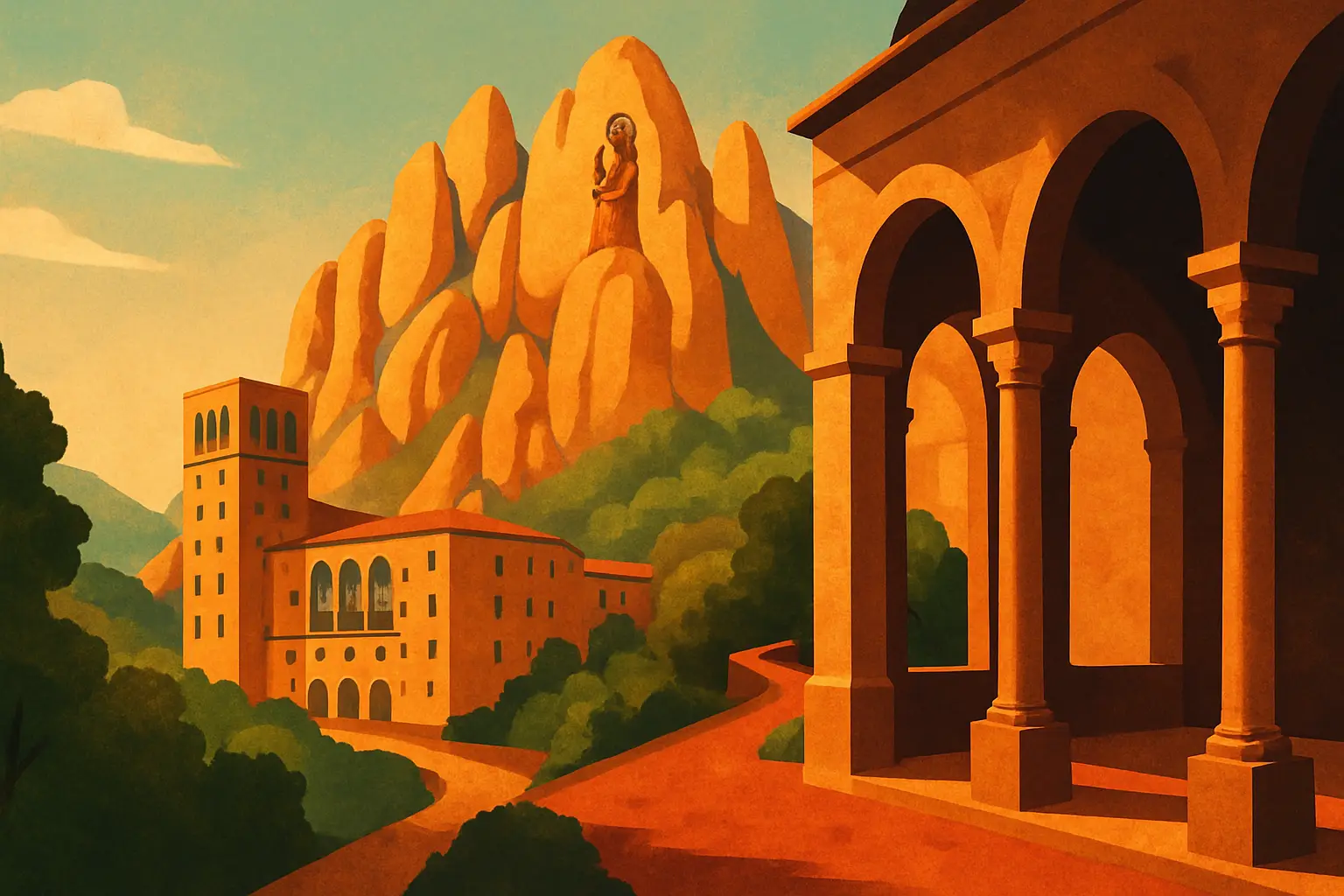
Montserrat's silhouette — a skyline of rounded pinnacles, columns, and bulging formations that Catalan speakers call gerns — is not the result of volcanism or tectonic collision. It is the product of an ancient river delta.
Around 50 million years ago, during the Eocene epoch, rivers flowing down from what would become the Pyrenees deposited enormous quantities of sediment in a delta at the edge of an inland sea. That sediment — a mixture of limestone, sandstone, and river stones — compressed over millions of years into the conglomerate rock that now makes up the entire massif. When the land uplifted and the sea retreated, water erosion went to work on the rock, wearing away the softer surrounding material and leaving behind the harder conglomerate in the shapes that now define the mountain's profile.
The result is 1,115 documented climbing routes on the mountain's faces, walls, and chimneys — Montserrat is one of the most technically rich rock climbing destinations in Europe, used year-round by climbers from across the continent who come specifically for multi-pitch routes that can reach 400 meters of vertical gain. The mountain was declared the Parc Natural de la Muntanya de Montserrat in 1987. From most elevated points on the massif, on clear days, you can see the Mediterranean coast 50 kilometers away and the snow-capped Pyrenees to the north.
2. La Moreneta: the Black Madonna who became Catalonia's patron saint
The monastery's origin story involves a cave, a glowing light, and a statute that became impossible to move.
According to the account recorded by Abbot Garí in 880 AD, shepherds on the Montserrat hillside saw a light descending from the sky, accompanied by music. They followed the phenomenon to a cave and found a carved wooden figure of the Madonna and Child. The local bishop attempted to carry the figure to Manresa, the nearest city, but the statue became immovably heavy at the cave site — interpreted as a divine signal that the Madonna wished to remain on the mountain. A small chapel was built in the cave. More than a century later, in 1025, Abbot Oliba of Ripoll formalized the community by establishing the Benedictine monastery of Santa Maria de Montserrat at the same location.
The statue itself — La Moreneta, the Dark One — dates to the late 12th century and is a Romanesque polychrome wood carving approximately 95 centimeters tall. The Madonna is seated on a throne, holding the sphere of the world in her right hand while the Christ child sits upright on her knee. The dark coloring that gives the figure its name, and the basis of its Catalan identity, comes primarily from centuries of candle smoke and oxidation rather than from original pigmentation — scientific analysis in the 1990s confirmed the original surface was painted in natural tones.
The statute is displayed behind the main altar of the basilica. To venerate it directly, visitors queue to enter through a side passage that brings them within arm's reach of the sculpture in its glass enclosure. The queue is free, runs most of the day, and is significantly shorter before 10am and after 5pm. The basilica itself is always open and does not require queuing — only the close-up viewing passage does.
3. The Escolania: singing in the same basilica since the 13th century
The Escolania de Montserrat is one of the oldest continuously active boys' choirs in Europe. The first documented reference to a group of singing boys at the monastery dates to 1307 — though the monastic tradition of choral education there is likely older. The current choir consists of approximately 50 boys between the ages of 9 and 14 who live at the monastery, attend the Escolania's own school, and receive musical training as part of their daily schedule.
Every weekday at 1pm and Sunday at 12pm and 6:45pm, the choir sings the Salve Regina in the basilica. The performance lasts around 10 minutes. Entry to the basilica for this is free, and no booking is required — arrive 10 to 15 minutes early and take a seat in the nave. The choir is not visible during the performance (they sing from an elevated gallery above and behind the nave), which makes the experience stranger and more atmospheric than you'd expect: sound that seems to come from the building itself, filling a Catalan Gothic interior that has been active in some form since the 12th century.
In August, some of the additional evening performances are suspended for choir holidays. The 1pm Monday-to-Friday slot runs through the summer and is the most reliable. On Sunday mornings, the basilica is particularly crowded; the 12pm performance is shorter and more formal than the weekly version.
4. The Museu de Montserrat: the art collection nobody expects
The art museum behind the monastery's main square is one of the most undervisited significant museums in Spain. It should not be.
The Museu de Montserrat was assembled over centuries through donations to the monastery — primarily from Catalan collectors and families who chose to endow their collections to the Benedictine community rather than to public institutions. The result is a collection that spans Egyptian antiquities, Byzantine icons, Renaissance and Baroque paintings, and a substantial grouping of modern Catalan art.
The collection includes: an El Greco from his Toledo period; a Caravaggio depicting Saint Jerome; early academic paintings by Pablo Picasso from his adolescence in Barcelona (loaned and donated through the Catalan artist community's relationship with the monastery); works by Salvador Dalí and Joan Miró; and a series of Impressionist and Post-Impressionist pieces that would be headline works in any regional museum.
The museum opens at 10am. Admission is €10 for adults, €7 for students and seniors. Combining the museum with the rest of the monastery makes the cost of the trip significantly different from a simple pilgrimage — this is a serious cultural visit. Budget 45 minutes to an hour if you move through quickly; art-focused visitors spend longer.
The first hour after opening, before 11am, is consistently the quietest window and the best time to spend inside it.
5. Hiking the mountain: Sant Joan, Santa Cova, and Sant Jeroni
Two funiculars depart from immediately below the monastery plaza, opening two very different experiences of the mountain above and below.
•**Sant Joan funicular (up):** The upper funicular runs from the monastery level to the Sant Joan station at approximately 1,000 meters elevation. From the top station, a well-marked path leads to the **Ermita de Sant Joan** — a 14th-century hermitage with panoramic views across the Bages plain and, on clear days, the Mediterranean — in about 20 minutes on foot. From Sant Joan, continuing along the marked GR path for another 30 to 40 minutes brings you to the **cim de Sant Jeroni** at 1,236 meters, the highest accessible point on the massif. The views from the top include the entire rock skyline of Montserrat from above. Return to the monastery via the same path takes about 1 hour total; physically moderate with some exposed sections near the summit. Funicular return ticket: €10.50 adults.
•**Santa Cova funicular (down):** The lower funicular descends from the monastery to a point about halfway down the southern face, from which a 20-minute walk along a terrace path leads to the **Santa Cova** — the cave where, by tradition, the shepherds found La Moreneta in 880 AD. The current chapel in the cave is Baroque, constructed in 1696, built over the original medieval shrine. Along the path from the funicular to the cave, 15 stations of the mysteries of the rosary are marked by sculptural monuments; six of the 15 were designed by Antoni Gaudí and Josep Puig i Cadafalch in the late 19th century — including a sculptural grouping by Gaudí representing the Annunciation that is largely unknown outside specialist circles. Funicular return ticket: €8 adults.
•**The old footpaths (Camins de l'Anima):** A network of historic pilgrimage paths leads from the valley floor up to the monastery without any mechanized transport. The most used is the Sant Joan path from the Monistrol de Montserrat FGC station — approximately 2 hours uphill, 600m elevation gain, and almost no one does it in August heat. In spring and autumn it is a worthwhile alternative: the path passes through orchards and hermitages, and deposits you at the monastery from the opposite direction from the funicular, having earned the arrival.
6. Getting there: every transport option from Barcelona explained
From Plaça Espanya metro station in Barcelona, board the FGC (Ferrocarrils de la Generalitat de Catalunya) line R5, direction Manresa. Trains depart roughly every 30 minutes from approximately 8:36am. The journey to the mountain takes about one hour depending on which station you exit.
For the cable car (Aeri de Montserrat): Exit at Aeri de Montserrat station. The cable car terminus is right at the station exit. It runs every 15 minutes and takes about 5 minutes to the monastery level. Return ticket: €13.50 adults. The cable car is the faster option and most popular — in August, expect a queue of 20–40 minutes at peak times (10am–2pm).
For the rack railway (Cremallera): Continue one stop to Monistrol de Montserrat station. The Cremallera rack railway departs from the adjacent station and takes 17 minutes up to the monastery. Return ticket: €8.50 adults. The cremallera is quieter than the cable car throughout summer, passes through rocky terrain with good window views, and is the better option if you're arriving at 9am or earlier.
Combined tickets (FGC return + Aeri or Cremallera return) are sold at Plaça Espanya FGC station and online. The Trans Montserrat ticket (€37.50 adults) covers FGC both ways, Aeri or Cremallera both ways, and unlimited use of both mountain funiculars — worthwhile if you plan to visit Santa Cova and Sant Joan on the same day.
By car: the AP-2 motorway from Barcelona, then the C-55 via Abrera, and finally the BV-1121 mountain road to the monastery. Journey time 50–70 minutes from Barcelona center. Paid parking at the monastery level. Driving is the least convenient option in summer, as the mountain road is narrow and parking fills by 10am on busy days.
7. How to spend a full day on the mountain — in the right order
The sequence matters more than the individual elements. Most visitors make the mistake of going straight to the basilica queue and losing the best two hours of the morning on that alone. A better order:
8:36am — Depart Plaça Espanya on the FGC (or the 9:06am departure if you accept slightly more crowds). Take the Cremallera from Monistrol for a quieter journey.
10:00am — Arrive. Head directly to the Museu de Montserrat before the coach groups arrive. Spend 45–60 minutes with the Caravaggio, the Gaudí-adjacent sculptural works, and the Catalan modern collection.
11:15am — Walk through the monastery buildings and the upper terrace. The views from the terrace east toward the Llobregat river valley are the best angle on the mountain's geological profile from close range.
11:45am — Take the Santa Cova funicular down and walk the terrace path to the cave. The Gaudí sculptural stations along the path are underlit in most visitor accounts. Return by funicular.
12:45pm — Return to the basilica and take a seat inside. The Escolania choir performs at 1:00pm — the whole reason to organize your day around this moment.
1:15pm — After the choir, queue to venerate La Moreneta in the side passage if you haven't yet, or skip this and go directly to lunch. The monastery has a cafeteria and a sitdown restaurant (the restaurant requires a reservation on busy days; the cafeteria does not).
2:30pm — Take the Sant Joan funicular up for the afternoon hike. The mountain is warmer in the afternoon, but the light is better for the views from Sant Joan hermitage, and the funicular crowds thin after 2pm. The round trip to the hermitage and back to the funicular station takes about 45 minutes.
4:30pm — Return to the monastery level and begin the descent. The Cremallera at 5pm is quieter than anything in the morning.
8. Common questions: crowds, kids, Montserrat vs. other day trips from Barcelona
How crowded is Montserrat in August? Very, by 11am. It is the single most visited day trip from Barcelona and handles approximately 3 million visitors per year, the majority concentrated between June and September. The difference between arriving at 9am and arriving at 11am is significant: the former involves a peaceful monastery plaza with space to look at the architecture; the latter involves dense crowds and cable car queues. The afternoon — from about 3pm onward — becomes calmer as coach tours depart.
Is it suitable for children? Yes, with planning. The monastery and museum are genuinely engaging for children older than about 7. The Sant Joan funicular and short hike to the hermitage (20 minutes, paved path, no exposure) works well for most ages. The Santa Cova cave is intrinsically interesting for children. The main challenge is the heat in August — carry water from Barcelona, as the monastery prices are high for drinks.
How does Montserrat compare to Sitges or Tarragona as a day trip? Different purposes entirely. Sitges and Tarragona are beach and coastal day trips — relaxing, relatively low-effort, easily compressed into an afternoon. Montserrat is an active day trip: you're climbing, hiking, and engaging with a working monastery, a museum, and sacred art. It requires more planning and is better suited to travelers who want to understand something about Catalonia rather than simply see more of its coast.
Can I combine Montserrat with [Barcelona's Gothic Quarter](/es/blog/barcelona-gothic-quarter-barri-gotic-guide) in the same day? Technically possible but inadvisable. Montserrat done properly (museum, choir, both funiculars, Sant Joan hike) fills a full day. If you're short on time, see the El Born neighborhood in the evening after a half-day on the mountain — both are within 5 minutes of FGC line R5 connections back to the city center.