1. What Santiago actually is — Galicia's medieval capital
Santiago de Compostela is the capital of Galicia, Spain's northwest corner — geographically and culturally closer to Portugal than to Castile. The city of roughly 100,000 was built around a single reported event: in 830 AD, Bishop Teodomiro of Iria Flavia announced the discovery of a tomb he identified as the burial place of the Apostle James (Saint James the Greater). Whether or not that identification was accurate — a debate historians have conducted for twelve centuries and have not settled — the consequences were undeniable. Santiago became one of Christendom's three great pilgrimage destinations alongside Jerusalem and Rome, and the city that grew around that route is now a UNESCO World Heritage Site (designated 1985). The designation covers the entire historic center, not just the cathedral.
The old city is built almost entirely from grey Galician granite, which turns warm amber in afternoon sun and dark and sculptural in rain. Galicia is the rainiest corner of Spain — even August brings occasional showers — and the streets are arcaded against the weather, organized around a sequence of medieval plazas that make the city intuitive once you learn their arrangement.
Galicia's regional language, Galego, appears alongside Spanish on every street sign and institution. It is a Romance language more closely related to Portuguese than to Castilian, and you will hear it in markets, bars, and among older residents. Visitors fluent in Spanish will be understood everywhere; knowing that 'rua' is the Galician word for 'calle' (street) helps you read signs and menus.
2. The Cathedral — beyond the Baroque facade
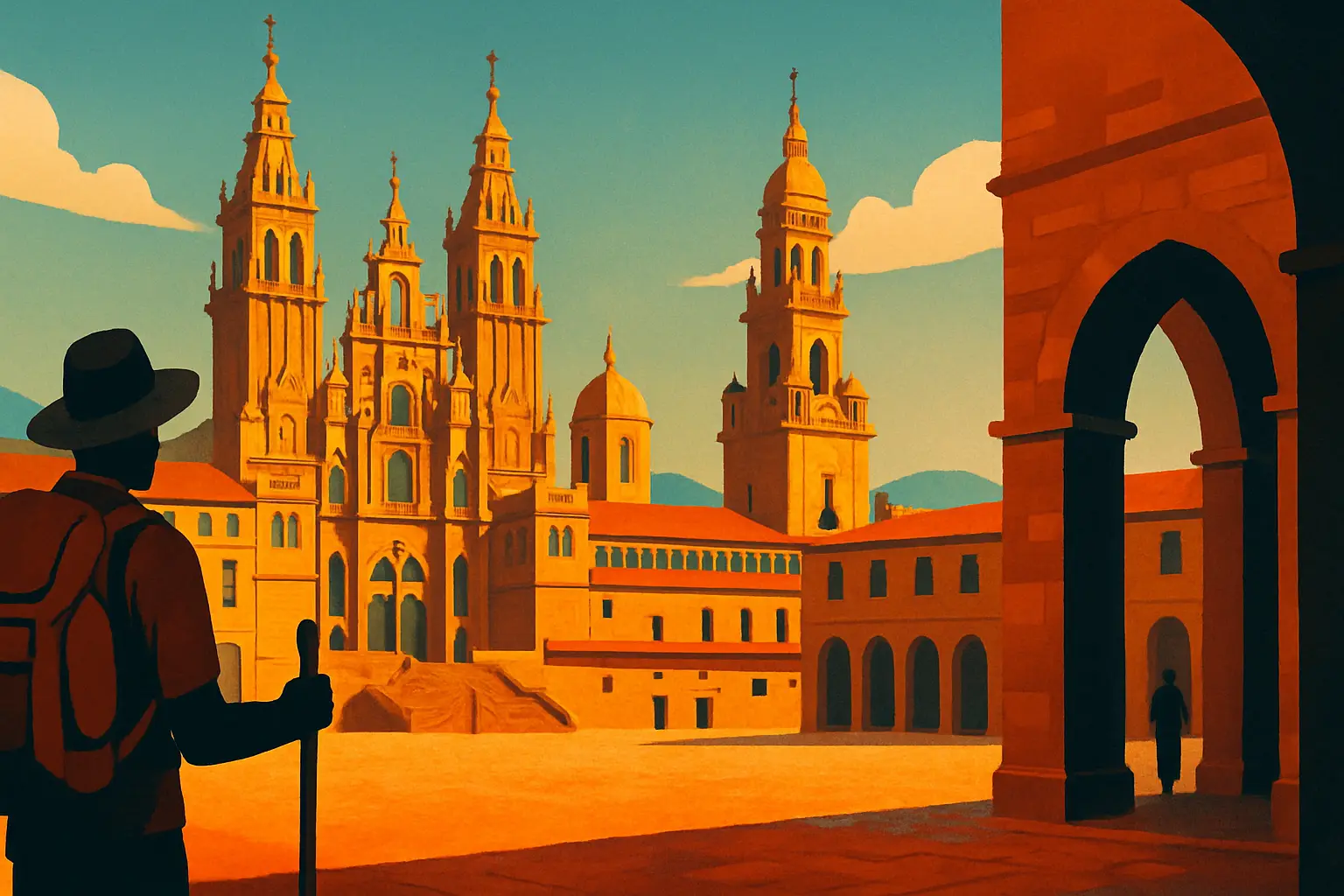
Every photograph of Santiago de Compostela shows the same image: the twin Baroque towers of the Catedral de Santiago, completed in 1750 by the architect Casas Novoa, rising 76 meters above the Praza do Obradoiro. The towers are extraordinary, but they are among the cathedral's youngest elements — a building under continuous construction since the 11th century.
The part that most rewards unhurried attention is the Portico de la Gloria (Portico of Glory), a triple archway completed in 1188 by the sculptor known as Master Mateo. Two hundred carved stone figures occupy the arches: prophets, apostles, seated musicians, and fantastical creatures arranged in a theological program scholars have spent centuries decoding. Fragments of the original polychrome paint remain detectable — the portico was never meant to appear as plain grey stone but as a riot of color. The central pillar (Parteluz) shows a seated Saint James; the small figure kneeling on the reverse side of the pillar's base is believed to be a self-portrait of Master Mateo, the only known medieval sculptor to sign his work from his knees.
The Pilgrim Mass takes place daily at noon (12:00). It is free, open to all, and fills to capacity by 11:30 AM. The 7:30 PM Vespers is smaller, quieter, and — when the late light of a long Galician summer evening reaches the rose window — more intimate. Cathedral entry is free. The Museo Catedralicio costs €6 and includes access to the crypt beneath the high altar and the rooftop terrace with views across the Praza do Obradoiro.
3. The historic center — four plazas and the streets between
Santiago's old city becomes legible once you understand its four linked plazas. Praza do Obradoiro is the main stage — the cathedral's west facade, the place where pilgrims finish and take photographs. On its north side, the Hostal dos Reis Catolicos was commissioned by Ferdinand and Isabella in 1501 as a pilgrim hospital; it is now one of Spain's most historic Parador hotels, and its Plateresque facade is as ornately carved as anything on the cathedral.
Walking around the cathedral's south flank brings you to Praza das Praterias (Silversmiths' Square), where the cathedral's oldest surviving exterior facade faces the square — 12th-century Romanesque stonework that was never replaced by later renovation. Continue east to Praza da Quintana, a split-level space with the Puerta Santa (Holy Door) on the cathedral's eastern wall, opened only during Holy Years when July 25 falls on a Sunday.
The main streets for eating and walking are Rua do Franco and Rua das Orfas, running parallel south from the Obradoiro. Both are lined with restaurants and cafes under stone arches that keep the rain off. Prices are noticeably better one block off the main strip — the arcaded lanes just behind the tourist lanes serve the same Galician food to a more local clientele, at €3–5 less per dish.
4. Galician food — what to eat, where, and in what order
Santiago sits at the center of Galicia's food culture, built on Atlantic seafood, pork, and white wine in proportions unlike any other Spanish regional kitchen. The city draws on morning-landed catch from the Atlantic coast 90 kilometers west, river products from the Galician interior, and the smallholder agriculture that produces the pimientos, greens, and potatoes that frame everything.
The correct starting point is pulpo a feira (octopus Galician style): boiled octopus sliced onto a wooden board, dressed with olive oil, coarse sea salt, and smoked paprika. The combination of the paprika smoke and the particular sweetness of properly cooked octopus produces a flavor that is immediately and unmistakably Galician. It is unlike any other tapa in Spain. The Rias Baixas region supplies most of the city's octopus; eating it in Santiago at the Mercado de Abastos — where vendors buy directly from the boats — is where it makes the most sense.
•**Empanada gallega**: Enclosed pastry filled with tuna, sardines, or chorizo. Every bakery in the city sells it from morning; a good slice costs €3–4.
•**Pimientos de Padron**: Fried small green peppers from the town of Padron, 25 km south. Most are mild — a random few are intensely hot. Peak season runs June through September.
•**Tarta de Santiago**: Dense almond tart dusted with powdered sugar through a stencil in the shape of the Cross of Saint James. The best versions use ground blanched almonds and orange zest. Around €3 per slice at any pastelleria.
•**Albarino wine**: The white wine of the Rias Baixas D.O., dry and mineral with a citrus-and-peach character. A glass costs €3–5 at any bar in the historic center. It pairs with Galician seafood the way the region intended.
•**Where to eat**: Mercado de Abastos (Rua das Ameas, Tue–Sat 8 AM–2 PM) for fresh octopus and shellfish. Rua das Orfas for sit-down restaurants with a local clientele. Rua do Franco for convenience — quality is fine, prices are tourist-tier.
5. The Botafumeiro — the giant incense burner and when to see it
The botafumeiro is Santiago Cathedral's giant incense burner — one of the largest in the world. It weighs 53 kilograms, stands 1.6 meters tall, and hangs from the transept ceiling on a pulley-rope system called the tirabotafumeiro, operated by eight men called tiraboleiros. When set in motion, it swings in an arc of 65 meters across the full transept width, reaching speeds of approximately 68 km/h. Watching it from the transept floor feels genuinely dangerous, which was not the original point but has always been part of the experience. At least one historical account records the botafumeiro breaking loose from its cable mid-swing, though the 1499 incident — during a mass attended by Catherine of Aragon — resulted in no casualties and has not deterred subsequent operation.
The origin was practical: for centuries, thousands of unwashed pilgrims arrived in the cathedral after weeks of walking through summer heat. Burning frankincense and myrrh in a large vessel was the medieval solution to what the building smelled like. The current botafumeiro dates to 1851 — Napoleon's troops stole and melted down its predecessor during their occupation of the city in 1809.
The botafumeiro swings at the major feast-day masses (July 25, Christmas, Easter, Pentecost) and at other masses when a ceremonial donation has been arranged. It does not swing at the daily noon Pilgrim Mass. Check catedraldesantiago.es for the current schedule before planning your visit around it.
6. Day trips from Santiago — Finisterre, the coast, and A Coruna
Three directions from Santiago each offer a distinct reason to leave the city for a day.
•**Cape Finisterre (Cabo Fisterra)**: 90 km west — 1.5 to 2 hours by bus from Santiago's central bus station, roughly €8 one-way. The fishing village of Fisterra and the lighthouse at the cape (Faro de Fisterra, in operation since 1853) mark the traditional 'end of the world' — the point beyond which medieval Europeans believed the known world ended. Many pilgrims extend their Camino here and burn their boots or walking poles at the lighthouse.
•**Rias Baixas**: The wine region producing Albarino extends along the southern Galician coast from Padron south toward the Portuguese border. The town of Cambados (50 km southwest) is the capital of the D.O. Rias Baixas and holds a major wine fair each July. Sanxenxo, nearby, is Galicia's busiest summer beach resort. A car is the practical option for a full-day circuit of the estuary towns.
•**A Coruna**: 73 km north — 30 minutes by Renfe Avant train from Santiago (from €8). Galicia's largest city has the **Torre de Hercules**, a working Roman lighthouse from the 1st century AD and the only functioning ancient lighthouse in the world (UNESCO World Heritage Site). The city's glass-balconied seafront along the Avenida da Marina is one of the most recognizable urban facades in Spain.
7. When to go, how to get there, and can you visit without the Camino?
Santiago receives more rainfall than any other major Spanish city — Galicia's Atlantic climate means even summer brings occasional showers. July and August are the driest months, but pack a light waterproof layer regardless. The practical upside: while Seville and Madrid record temperatures above 38°C in summer, Santiago rarely exceeds 27°C (81°F). The city is walkable in conditions that would flatten you in Andalusia.
The Feast of Saint James (July 25) is the city's largest annual event — fireworks launch from the cathedral towers on the night of July 24, hotels sell out months in advance, and the botafumeiro swings at the feast-day mass. The next Holy Year (Ano Santo), when the feast falls on a Sunday and pilgrims earn a papal indulgence, will be 2027 — already driving a surge in Camino bookings for next year.
•**Can you visit without the Camino?** Yes. Santiago works as a complete destination for independent travelers. The pilgrimage history is present everywhere and requires nothing from you.
•**Best months**: May, June, and September offer the best weather-to-crowd balance. August is busy but climatically pleasant compared to southern Spain.
•**By air**: Santiago de Compostela Airport (SCQ) has direct flights from Madrid (1h 10m, from ~€40), Barcelona (1h 30m), and several European cities including London. City bus to the center: ~€3, 30 minutes.
•**By train**: Renfe high-speed from Madrid takes approximately 5h 30m (from €35 advance booking). From A Coruna: 30 minutes by Renfe Avant train.
•**From Portugal**: Rede Expressos buses from Porto run three times daily — roughly 3 hours, €15–20.
•**Cathedral Museum**: €6. Includes the crypt under the high altar and the rooftop terrace with views over the Praza do Obradoiro from above. Free entry to the cathedral itself at all hours.