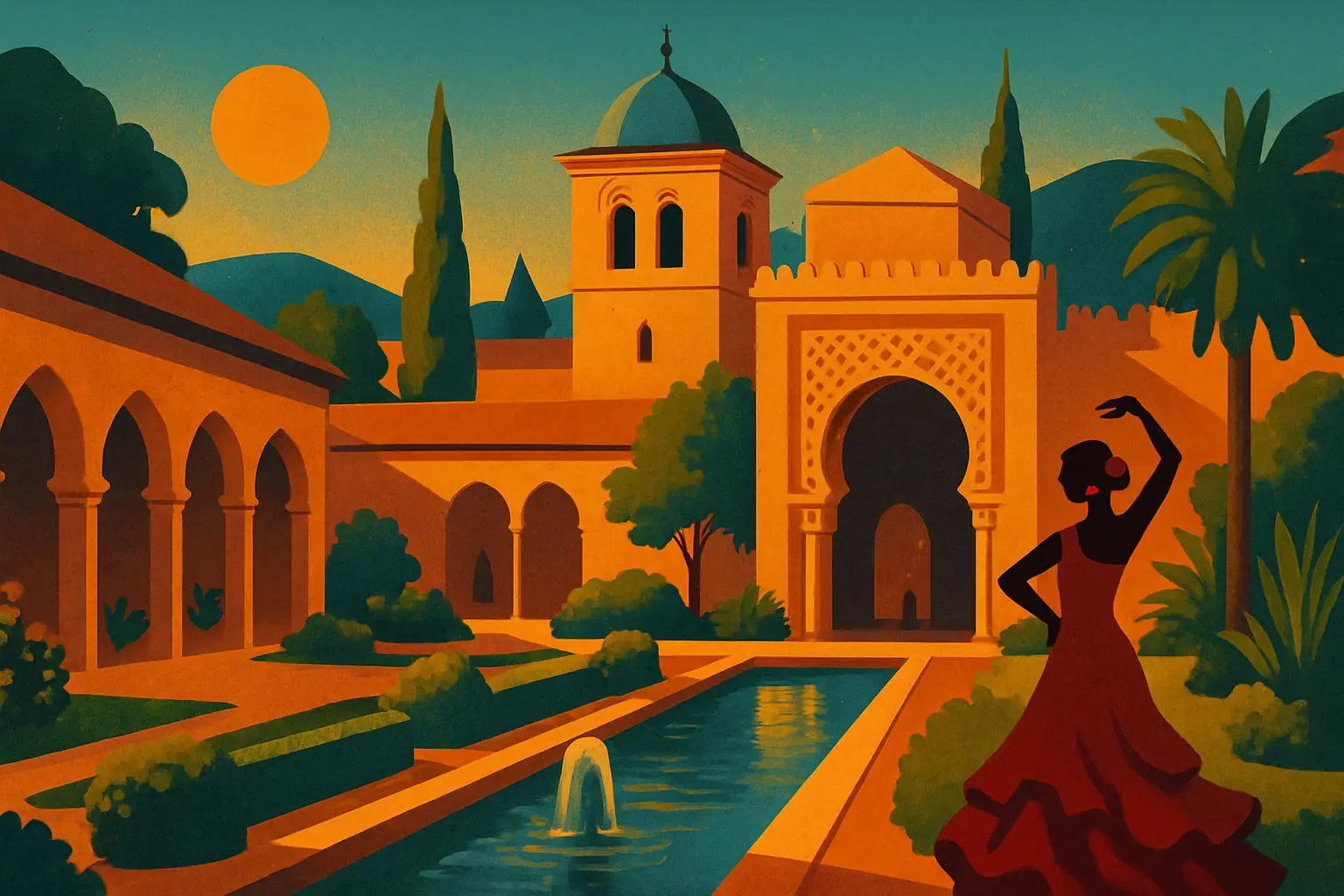
Ruzafa's history covers about eleven centuries and involves three complete reinventions. The first was under Moorish rule. When the city was known as Balansiya and governed from Córdoba, a royal garden complex called al-Rawda — the garden, or enclosed paradise — stood in the fertile lowland south of Valencia's Roman walls, fed by the Turia river's irrigation channels. The name survived the centuries that followed: Russafa in Valencian, Ruzafa in Castilian Spanish. By the time Christian forces retook Valencia in 1238, the garden had become a functioning village with its own market, its own fields, and its own identity distinct from the walled city to the north.
By the 19th century, Ruzafa had grown into an independent municipality just outside Valencia proper — a community of smallholders, market gardeners, and artisans who supplied the city with produce and manufactured goods. When Valencia formally annexed Ruzafa in 1877, it absorbed a fully functioning town rather than an empty quarter. The neighborhood's parish church, the Parròquia de Sant Valero at Plaça del Rosario, 1, dates from the 18th century and was already old when the annexation happened. The covered market came shortly after.
The 20th century reshaped the neighborhood into a working-class industrial district. Factories, workshops, and immigrant families — particularly Galicians who came south during mid-century industrialization — filled the streets. By the 1980s and 90s Ruzafa had fallen behind more prosperous Valencia neighborhoods in investment, rents were low, and the buildings were tired. That is when artists began arriving.
The transformation of Ruzafa followed a pattern that reshaped urban neighborhoods across Europe during the 2000s and 2010s — the same dynamic that changed Berlin's Prenzlauer Berg, Lisbon's Mouraria quarter, and Barcelona's El Born: artists drawn by cheap studios, then cafés following the artists, then restaurants following the cafés, then a broader creative class, until the neighborhood has entirely reinvented itself while retaining the specific energy those first arrivals generated.
In Ruzafa, the acceleration was visible through the 2010s. The artists who came for cheap studio space in the neighborhood's former workshops brought their aesthetic to the walls. A street art scene developed that is now one of the most concentrated in Valencia, with large-scale murals covering entire five-story façades on Carrer de Sueca, Carrer de Cuba, and the blocks around the market building. The murals rotate as new works replace old ones — the neighborhood looks slightly different every few months.
Simultaneously, international food arrived without coordination: a Venezuelan arepa spot, a Japanese ramen kitchen, an Argentine restaurant, a craft beer bar, a Middle Eastern kitchen with a tandoor. Each opened because the rent was manageable and the local clientele skewed young and curious. By the early 2020s, Ruzafa had become the answer to the question visitors to Valencia reliably ask: where do actual Valencians go on a Saturday night? The answer is still here, even now that the neighborhood has been discovered and written about. It still functions as a neighborhood rather than a backdrop — residents do their shopping here, children play in the squares, and the bar scene belongs to the people who live in the buildings above it.
Get short, interactive stories that make each place easier to remember while you travel.
The physical center of Ruzafa is the Mercat de Russafa at Carrer del Doctor Serrano, 14 — a covered market building from the early 20th century, smaller and less grand than Valencia's famous Mercat Central, but genuinely embedded in neighborhood daily life. On weekday mornings it operates as a standard fresh market: fish, produce, cheese, and a handful of prepared-food stalls. The building is unassuming from the outside; inside it has the specific atmosphere of a market that people actually use rather than photograph.
On Saturdays, the market and the surrounding Plaça del Mercat de Russafa transform into something larger. An artisan and vintage market fills the square — local farmers selling seasonal produce directly, small-batch cheesemakers, artisanal bread bakers, craft charcuterie, handmade ceramics, vintage clothing, and independent designers with stalls. The market runs from approximately 9 AM to 2:30 PM. It draws an even mix of tourists who have found their way here and the neighborhood's own residents doing their actual weekly shopping.
Around the plaza, café terraces fill by 10 AM with people who came for the market and are staying for brunch. This is the specific Valencia version of the late-morning weekend ritual — coffee, something from the market stalls, a glass of cava at noon. It does not require a plan. It requires showing up before the tables fill.
Ruzafa's restaurant scene is more varied per square meter than almost anywhere in Valencia, and far less tourist-facing than the old city. A few landmarks worth knowing:
**Canalla Bistró** — Chef Ricard Camarena holds Michelin stars at his flagship Valencia restaurant; Canalla Bistró is his casual format, with small plates drawing on Asian, Latin American, and Valencian influences that change regularly. It is the most consistently excellent kitchen in the neighborhood and gets booked quickly — reserve two to three days ahead.
**Ubik Café** — Carrer de Literato Azorín, 13. A bookshop-café hybrid that hosts literary events, book launches, and readings in a narrow, shelf-lined space. The coffee is good; the menu runs to sandwiches and simple lunch dishes. It functions as the neighborhood's intellectual living room and is equally suited to a quiet afternoon with a book or a crowded Thursday evening event.
**Carrer de Sueca** — The main bar street, running north–south through the neighborhood. Walk it from north to south after 9 PM on a Friday or Saturday and you will find the evening already in motion: people moving between bars, groups meeting outside, the specific sociability of a neighborhood with a working social infrastructure. No single bar on the street is the definitive destination — the street itself is the point.
**International dining** — Ruzafa's international food density is the highest in Valencia. Genuine South American, Middle Eastern, Japanese, and Southeast Asian kitchens operate alongside Valencian restaurants on the same blocks. Prices are set for a local clientele: a full dinner for two at most places runs €25–€40 including wine.
**Natural wine and craft beer** — Ruzafa was early to both movements in Valencia. Several bars on and around Carrer de Cuba and Carrer de Sueca carry 8–12 local and regional craft taps alongside curated natural wine lists. Prices are €3–€5 for wine, €4–€5.50 for a craft pint — substantially less than equivalent quality in Barcelona.
Ruzafa's street art is not concentrated in one walkable route — it is distributed through the grid in a way that rewards wandering rather than following a map. The densest sections are along Carrer de Cuba and the blocks east of the market building toward Carrer de Dénia, where building owners have allowed murals to cover entire five-story façades. The styles range from photorealistic portraiture to geometric abstraction to political imagery. Because there is no organized curation committee, the effect is genuinely varied — it reflects whoever asked permission and had a wall available, not a civic art program.
For more organized cultural programming, several former workshops and ground-floor commercial spaces in the neighborhood now operate as contemporary art galleries, with rotating exhibitions and opening nights — typically Thursday or Friday evenings — that spill onto the sidewalk and serve as an informal neighborhood social event. These are not ticketed; you walk in during posted hours.
Parròquia de Sant Valero at Plaça del Rosario, 1 — the neighborhood's 18th-century parish church — is the oldest continuously functioning institution in Ruzafa. It is not a tourist attraction, but it grounds the neighborhood's timeline. Standing in front of it, you are looking at what was the center of a separate municipality before Valencia's expansion absorbed it. The plaza in front of the church is quiet and local in a way that the market plaza, two blocks away, is not.
Ruzafa sits roughly 1.5 kilometers south of Valencia's old city and about 2 kilometers from the Malvarrosa beach — close enough to both that it makes a useful base for a day that combines multiple parts of the city. The historic center in the morning, Ruzafa for lunch and the afternoon, and either the City of Arts and Sciences (15 minutes by bike south along the old Turia riverbed) or the beach for the early evening is a full, coherent day.
For the paella question — which every Valencia visitor eventually asks — Ruzafa is not the right neighborhood. Paella is Valencian in origin, and the traditional version requires a specific setting: a rice restaurant, usually south of the city toward the Albufera lagoon, at a long Sunday lunch. The places in Ruzafa serve international food, modern small plates, and neighborhood cooking — not the rice-over-firewood paella that defines the city's best versions. Those are found in the villages around the Albufera — El Palmar, El Perelló, La Canyada — a 20-minute bus or taxi ride from the neighborhood.
For a fuller picture of Valencia beyond Ruzafa — the Cathedral, the City of Arts and Sciences, the Albufera, and overall transport — the Valencia city guide covers the broader orientation.
**Best months:** September and October are ideal — summer heat is past, the neighborhood is fully operational after August, and outdoor terraces are at their best. April and May are also excellent.
**Safety:** Ruzafa is one of the safest neighborhoods in Valencia. Standard urban precautions apply — watch your bag in crowded bar situations — but there is nothing specific to worry about here.
**Budget:** Coffee: €1.80–€2.20. Glass of wine or beer at a neighborhood bar: €2.50–€4. Weekday lunch menú del día: €12–€15. Dinner at a mid-range Ruzafa restaurant: €25–€40 per person including wine.
**Saturday market produce:** Farmer's market pricing — cheaper than a supermarket, often significantly. A decent morning haul of fruit, cheese, bread, and olives runs €10–€15.
**Valencian vs. Castilian:** Some bars and shops in Ruzafa operate primarily in Valencian rather than Castilian Spanish. A basic buenas and gràcies (thank you in Valencian) go a long way. No one expects tourists to speak Valencian; the gesture is noticed and appreciated.