The name Pamplona derives from Pompaelo — the settlement that Gnaeus Pompey established around 74 BC near the confluence of the Arga and Ulzama rivers during his Pyrenean campaigns. The Romans chose the site for the same reason people have lived here ever since: a raised plateau above two rivers, defensible from all sides, with the Pyrenean passes within a day's march to the north. The site of the current cathedral still sits on the highest point of the Roman Pompaelo.
After the Visigoths, the Moors, and the Frankish armies of Charlemagne (who sacked the city in 778, a campaign that inspired the epic poem *Chanson de Roland*), Pamplona became the capital of the Kingdom of Navarre in the early 10th century. That kingdom lasted nearly five centuries as an independent state before it was absorbed by Castile in 1515 — but Navarre retained its own laws, institutions, and border customs long after annexation. The separate identity survived: Navarra is today one of Spain's autonomous communities with its own fiscal arrangement and a bilingual culture (Castilian and Basque/Euskara) that marks it as distinct from both Spain's Castilian heartland and the Basque Country next door.
For the outside world, Pamplona's name was set in stone in 1926 when Ernest Hemingway published *The Sun Also Rises*, a novel set largely during the San Fermín festival. Hemingway had attended San Fermín the previous year and made Pamplona — specifically the bulls, the wine, and Café Iruña on Plaza del Castillo — into an archetype of romantic, chaotic southern Europe. The novel's centenary in 2026 has brought another wave of literary tourism, but the actual city is far richer than the narrow Hemingway frame.
Pamplona's old city — the Casco Antiguo — sits on a promontory above the Arga River gorge. It is small enough to walk in an afternoon but complex enough to reward multiple visits. The medieval core is divided into six historic quarters that once functioned as semi-independent communities with their own walls, churches, and conflicts: Navarrería (the oldest, around the cathedral), San Cernin (San Saturnino), San Nicolás, San Juan, Mercado, and Tejería. Traces of the old dividing walls between them survive in the street pattern — you'll notice slight kinks and narrowings where barrio boundaries used to run.
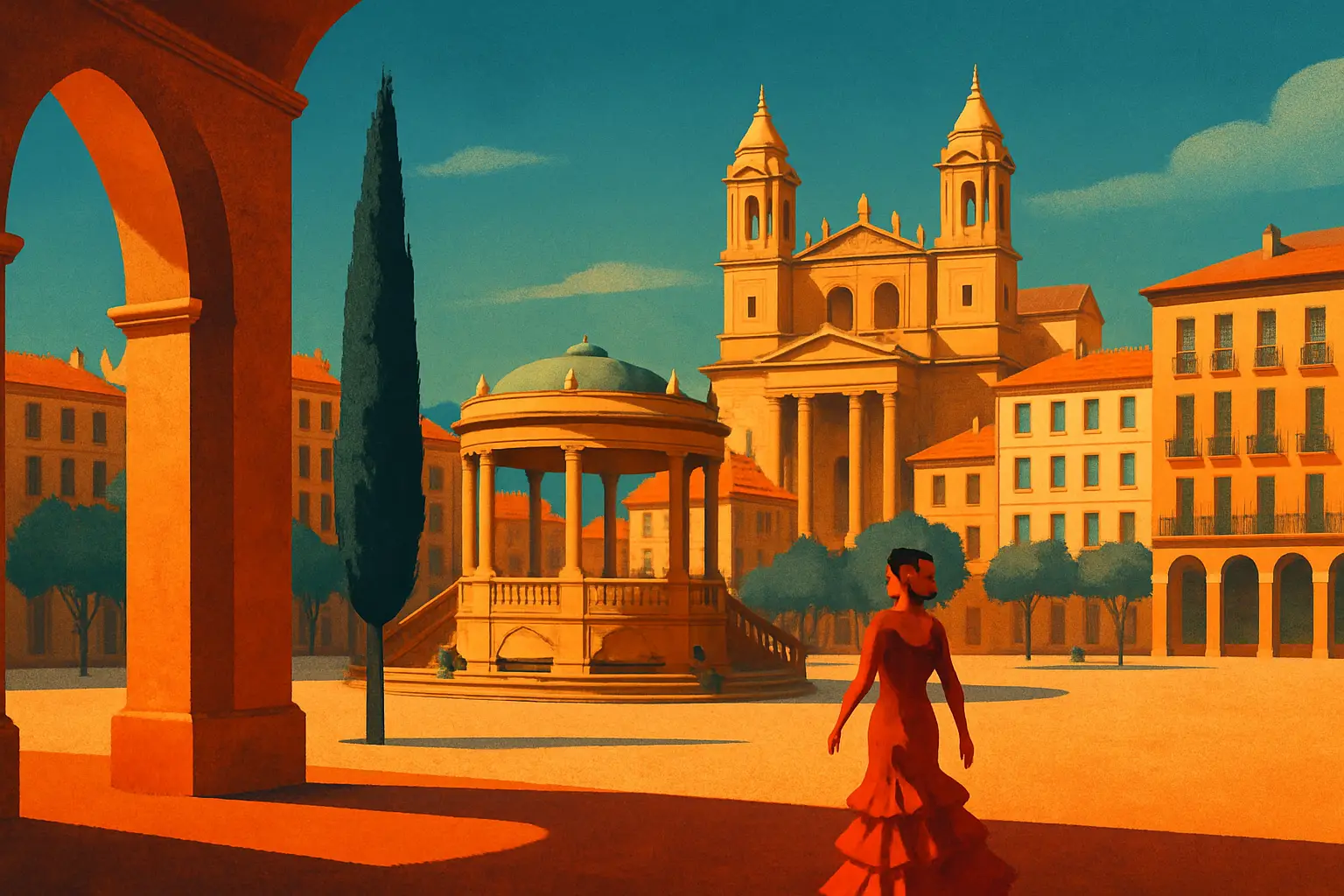
Plaza del Castillo is the social center of the city, a 76-meter-long rectangular square ringed by uniform arcaded buildings where Pamploneses have gathered for centuries. The most important building on it is Café Iruña (Plaza del Castillo, 44), opened in 1888 with a belle époque interior of mirrored panels, carved wood columns, and painted ceilings. Hemingway drank here every San Fermín he attended, and a bronze statue of him marks his usual corner. But Café Iruña is not a museum piece — it's a functioning café that serves breakfast, lunch, and coffee to working Pamploneses. The café au lait and the tortilla española at the bar are exactly what they look like.
Calle Estafeta, running northwest from the old quarter toward the Plaza de Toros, is the most famous street in Pamplona: the central section of the encierro (bull run) route, where the bulls funnel at speed through a narrow canyon of five-story stone buildings. For 357 days a year it is simply one of the old city's best pintxos streets, lined with bar façades and outdoor tables. Walking it on a September evening, with the stone walls lit and the bars pulling in locals, it's easy to see why the street works — architecturally, it was built for exactly this kind of gathering.
Get short, interactive stories that make each place easier to remember while you travel.
The exterior of Pamplona's cathedral is misleading. The west façade — the face that greets you as you approach from the old city — is a neoclassical construction added in 1783 by architect Ventura Rodríguez after the Romanesque original crumbled beyond repair. It looks like a French provincial cathedral transplanted to Spain, and it is fine but unremarkable. Go inside.
The interior of the Catedral de Santa María la Real (Calle Dormitalería, s/n) is Gothic, built in phases from 1394 to 1501, and the cloister attached to its north side is genuinely extraordinary. The cloister of Pamplona Cathedral was described by 20th-century art historian José Gudiol as one of the finest creations of universal Gothic art — a claim that has held up. Built in two phases (late 13th and mid-14th century), the carved stone decoration of the vaulted galleries achieves a density of imagery that surpasses contemporary Gothic cloisters at Burgos, León, and Toledo. Each capital tells a story: the Annunciation, scenes from the Passion, episodes from the life of the Virgin, animals both real and imagined. A slow walk around the four galleries takes 45 minutes at minimum if you're paying attention.
The cathedral stands on the highest point of the Roman Pompaelo. Below the current floor level, Roman-era structures have been found during excavations — the continuity of sacred use on this site runs more than two thousand years. The Diocesan Museum inside the cathedral complex holds medieval sculpture, an outstanding 14th-century ivory Virgin (the Virgen de los Reyes), and Romanesque capitals salvaged from the earlier church. Admission to cathedral, cloister, and museum: €5.
On the southern edge of the Casco Antiguo, where the old city walls gave way to open ground, Felipe II ordered the construction of a new military citadel in 1571 to defend against French incursions through the Pyrenean passes. The design was entrusted to Giacomo Palearo — an Italian military engineer known as *el Fratín* — who produced a textbook example of 16th-century Renaissance fortification: a regular pentagon with five angled bastions at its corners, named San Antón, El Real, Santa María, Santiago, and Victoria.
The geometry was not arbitrary. Star-shaped fortresses were the military engineering response to artillery — the angled bastions eliminated dead ground that could shelter attacking infantry, so every approach was covered by flanking fire from at least two adjacent bastions. The system, developed in Italy in the early 1500s, spread across Europe with Philip II's empire, and Pamplona's example (construction completed 1645) is one of the best-preserved in Spain.
The Ciudadela ceased military use in the 20th century and was converted into a public park and cultural complex. It is free to enter at any time the gates are open. From inside, the scale becomes clear: the pentagonal walls enclose a parade ground large enough to hold outdoor markets and concerts, and the moat gardens running around the exterior have been planted with trees that shade the old rampart walks. The Sala de Armas (the old armory building) hosts rotating contemporary art exhibitions. If you visit in the evening, the illuminated stonework of the bastions against a clear sky is one of Pamplona's most photogenic views.
Pamplona's pintxos culture operates on the same logic as San Sebastián's but with a Navarrese twist. The bars are less formal, the prices are slightly lower, and the Navarra wine pairings — specifically the dry Garnacha rosado produced in the Navarra DO — are worth knowing.
The two main pintxos streets are Calle Estafeta and Calle San Nicolás, both in the Casco Antiguo. The Thursday-to-Sunday evening rush (8 to 10 p.m.) is the canonical time: bars lay out fresh trays and the entire street becomes a slow-moving outdoor party. Stand at the bar, ask for a glass of the house rosado, and choose from the counter — pintxos here run €2–€3.50 each and are designed to be eaten in two or three bites.
Specifically Navarrese things to eat here that you won't find at San Sebastián:
**Piquillos rellenos de bacalao** — small red peppers (piquillos are grown in Lodosa, 65 km south of Pamplona) stuffed with salt cod and served warm. The sweetness of the pepper against the salt cod is the combination.
**Cogollos de Tudela** — little gem lettuces from the Tudela market garden region, often split and grilled or served raw with anchovies. A Navarra specialty virtually unknown outside the region.
**Chuletillas al sarkopeno** — lamb chops grilled over vine shoots, a preparation from the wine-growing south of Navarra. The smokiness is specific to the fuel.
**Navarra Garnacha rosado** — the dry rosé made in Navarra from old-vine Garnacha is pale salmon in color, bone-dry, and high in acidity. It predates Provence rosé as a serious wine style. A glass at the bar costs €2–€3.
Pamplona is the first major city on the Camino Francés — the most popular route of the Camino de Santiago — and the destination for Day 2 of the journey from Saint-Jean-Pied-de-Port. Pilgrims cross the Pyrenean ridge to Roncesvalles on Day 1 (25 km, 1,400 m of ascent), rest at the monastery there overnight, and then walk the 48 km to Pamplona on Day 2, entering the city through the Portal de Francia — the medieval gate in the city wall — before crossing the Puente de la Magdalena footbridge over the Arga River.
At peak walking season (April to October), an estimated 10,000 pilgrims pass through Pamplona each month. This creates a specific texture to the city: the pilgrimage route through the old town is marked by small brass scallop shells set into the pavement, the Casco Antiguo has an unusually high density of albergues (pilgrim hostels, from €15–€20 a night), and by 7 a.m. the streets around the Portal de Francia already have walkers adjusting their packs.
You do not need to be walking the Camino to experience this dimension of Pamplona. The Museo de Navarra (Calle Jarauta, 64 — entrance at Calle Curia, 8) holds one of the best collections of Romanesque art in Spain, partly assembled from churches along the Navarrese section of the pilgrimage route. The ground floor's carved capitals and carved sarcophagi from the 12th and 13th centuries represent the artistic peak of the Romanesque style that the Camino's patronage made possible. Free on Saturdays from 2 p.m. and all day Sunday; €2 at other times.
Best months to visit: September through November and March through May. September in Pamplona means warm days (22–26°C), quieter streets, and the full pintxos calendar running. The city is calm and welcoming; accommodation prices are 60–70% lower than July San Fermín rates. October brings the vendimia harvest from nearby Navarra wine country. November is cool and occasionally rainy but the cathedral and Ciudadela are effectively crowd-free.
San Fermín (July 6–14): If you want to see it, book at least six months ahead — rooms go in January. The eight-day festival transforms the city completely: the population temporarily triples, accommodation prices multiply by four to five times, and the encierro (bull run) takes place every morning at 8 a.m. through Calle Estafeta to the Plaza de Toros. Standing on the route requires arriving by 6 a.m. Many Pamploneses leave during the week — the festival is for visitors. Outside the festival, the Plaza de Toros (Paseo de Hemingway, 5) offers guided tours daily at 10:30 a.m. and 12:30 p.m. (€8) covering the history of the encierro and the corridas.
**Getting there by train:** Renfe runs daily intercity trains from Madrid Chamartín to Pamplona (3 h 30 min, from €20) and from Zaragoza (2 hours). The station is on Avenida San Jorge, a 20-minute walk or a short bus ride from the Casco Antiguo.
**Getting there by bus:** ALSA runs direct coaches from Madrid (4 hours), Barcelona (5 hours), and Bilbao (90 minutes). The bus station (Avenida Yangüas y Miranda) is 10 minutes on foot from Plaza del Castillo.
**Day trip: Olite** — 42 km south by direct bus or car. The **Palacio Real de Olite** is a medieval royal castle so theatrical it looks built for a film set — towers, battlements, and courtyard gardens. The village around it is wine country; the Garnacha produced here is the backbone of Navarra rosado.
**Day trip: Roncesvalles** — 47 km north by bus (two daily services). The 12th-century Augustinian monastery at the top of the Pyrenean pass is the traditional starting point of the Camino Francés in Spain. The cloister, the chapter house, and the silver Virgin figure inside are Romanesque; the surrounding beech forests in September and October are remarkable.
**Day trip: Estella-Lizarra** — 43 km southwest, on the Camino route. A Romanesque town with a 12th-century palace (the oldest secular Romanesque building in Spain) and several well-preserved churches. Almost no tourists and excellent local restaurants serving Navarrese cocina de mercado.