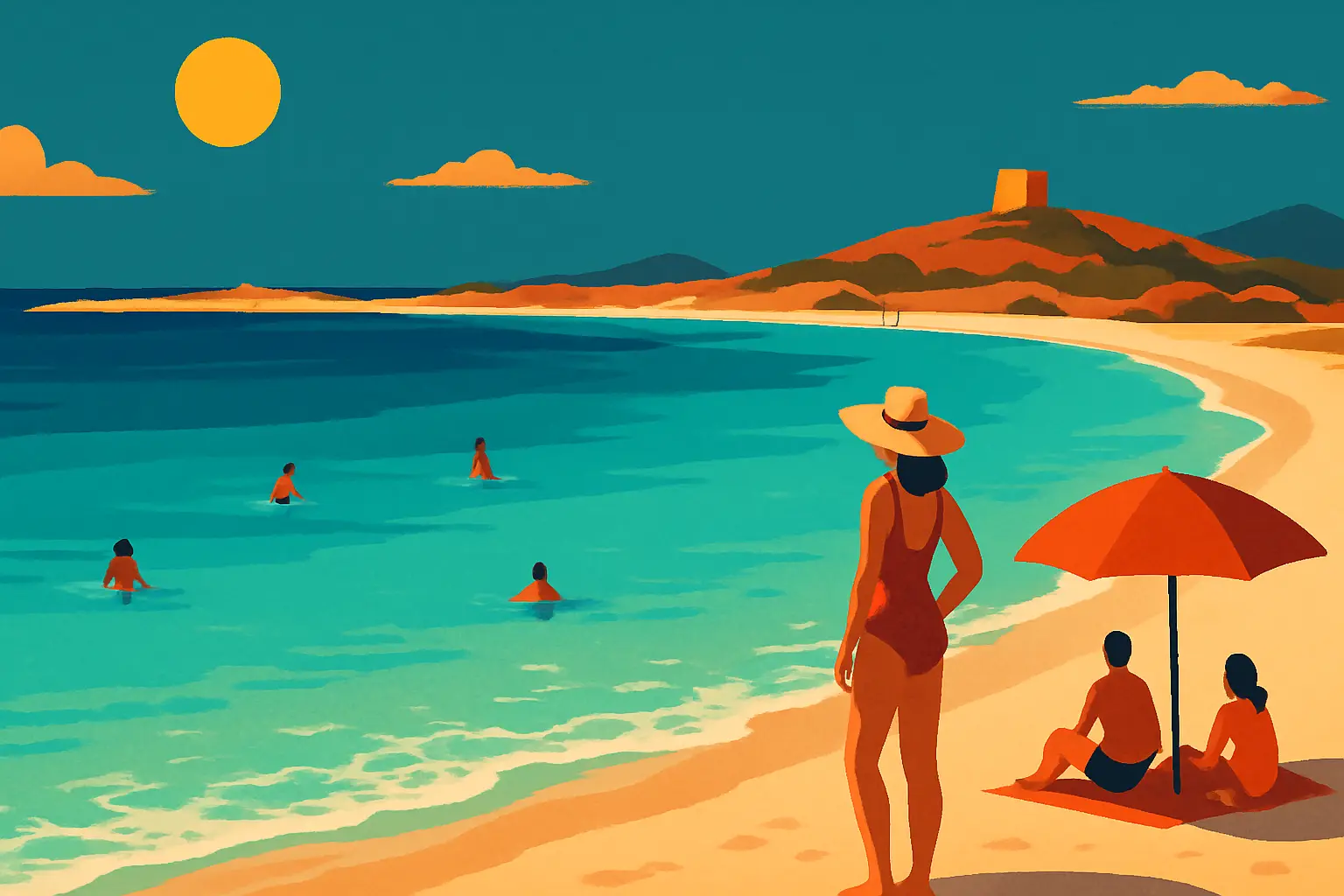
1. What Formentera actually is — the island that resists being ruined
Formentera is the smallest and southernmost of the four main Balearic Islands. It covers 83 square kilometers (for comparison, Ibiza is 572 km²), has around 12,000 permanent residents, and swells to a population of 90,000-100,000 in August — an extraordinary ratio that shapes the entire island experience. It is not accessible by air; there is no airport. The only way to arrive is by ferry from Ibiza, which takes 30-40 minutes from Ibiza port and defines the island's character: Formentera is, by physical constraint, a place you have to want to reach.
The island's shape is unusual — two landmasses connected by a narrow sandy isthmus, with the flat central plateau (La Mola) rising to Sa Talaiassa at 195 meters, the island's high point. The north is dominated by the Ses Salines nature reserve: salt flats, pine forests, and the extraordinary beach peninsula of Ses Illetes. The south coast is defined by the long, wind-exposed Playa de Migjorn, which stretches nearly 8 kilometers and is far less visited than the northern tip.
Development has been deliberately constrained by two forces: the island's small size and the legal protections around the Posidonia oceanica seagrass meadows. These protections limit coastal construction, restrict where pleasure boats can anchor (mooring buoys replace anchors in protected zones to prevent seagrass damage), and create a natural ceiling on how intensively the coastline can be used. The result, in a region where much of the Mediterranean coast has been comprehensively overdeveloped, is a place that looks, in significant stretches, much as it did forty years ago.
2. Ses Illetes and the Ses Salines nature reserve — what makes the north extraordinary
Ses Illetes occupies the northern tip of Formentera, a 400-meter strip of white sand narrowing to a point where the island seems to dissolve into the sea. The water on the lagoon (eastern) side reaches perhaps 30 centimeters at its shallowest over white sand, with a color — somewhere between pale turquoise and aquamarine — that reads as implausible even when you're standing in it. The open sea side of the same strip has slightly deeper water, larger waves, and noticeably better underwater visibility for snorkeling: you can see the bottom clearly at 8-10 meters.
The surrounding Ses Salines Natural Park extends across the southern tip of Ibiza and the northern coast of Formentera as a single protected zone. Within it, Estany Pudent (the Stinking Pond — its historical name, earned from the sulfurous smell of the evaporating salt flats) and Estany des Peix are shallow saltwater lagoons that serve as wintering grounds for flamingos and over 200 other bird species. The flamingos typically arrive from the Camargue in September and October, but small groups are occasionally visible in August along the Estany Pudent causeway road.
South of Ses Illetes, still within the park boundary, Playa de Llevant runs along the eastern edge of the Ses Salines peninsula. It faces the open sea between Formentera and Ibiza and picks up a consistent chop that makes it excellent for windsurfing but less comfortable for swimming. Unlike Ses Illetes, Llevant rarely reaches capacity — a 10-minute walk south from the crowded northern tip finds entirely different crowds.
Cala Saona, on the western coast, is Formentera's most dramatic sunset beach: a small cove backed by red ochre cliffs that amplify the evening light. It's a 15-minute bike ride from Sant Francesc Xavier and closes significantly earlier than the northern beaches — by 7 PM the cove falls into shadow as the cliffs to the west block the sun. Arrive at 6 PM and leave before the shadow arrives.
3. The Posidonia question — why the water looks like this and why it matters
The characteristic color and clarity of Formentera's water is not an accident of geography or light. It is biological. Posidonia oceanica — an endemic Mediterranean seagrass, not an alga — forms dense underwater meadows that cover much of the seabed around Formentera and southern Ibiza at depths of 0-40 meters. These meadows filter suspended particles from the water column, produce oxygen at rates significantly higher than terrestrial forests per unit area, and create structured habitat for hundreds of fish and invertebrate species that make the snorkeling around the island unusually productive.
In 1999, the Posidonia meadows around Ibiza and Formentera were inscribed as a UNESCO World Heritage Site — one of the few marine sites in the Mediterranean to receive this designation. The 2012 scientific study that generated widespread attention found one meadow patch extending 15 kilometers off the Formentera coast and estimated its age at between 80,000 and 100,000 years based on genetic analysis — meaning this single organism (Posidonia reproduces clonally) was growing in the same location during the last Ice Age, when sea levels were 100 meters lower than today.
The legal protections that follow from this status are substantive and visible. Pleasure boats cannot anchor anywhere over Posidonia meadows — the entire coastline around Ses Illetes and much of the eastern shore is served by mooring buoys instead. Coastal construction within protected zones requires extensive environmental review. These aren't dormant regulations: enforcement is visible and fines for illegal anchoring run to €600,000 in aggravated cases. The protection also means that the number of boats that can legally use the northern anchorage at any one time is capped — which is why Ses Illetes, despite being extraordinarily famous, doesn't have hundreds of yachts at anchor in front of it the way comparable beaches in Croatia or Greece might.
4. The ferry from Ibiza — how to get there and what to expect
The only way to reach Formentera from mainland Spain, and the only practical way to arrive from anywhere, is by ferry from Ibiza. Two companies operate the route: Balearia and Trasmediterranea. Both depart from the main ferry port in Ibiza Town (Eivissa); Balearia also operates a service from Playa d'en Bossa that saves about 20 minutes if you're staying on the southern coast of Ibiza.
The crossing takes 30-40 minutes depending on the vessel and weather. In August, departures run roughly every 30-60 minutes from 7:00 AM through late evening — typically 10-15 sailings in each direction daily. The boats themselves are car ferries capable of transporting vehicles, bicycles, and scooters, though most day visitors travel on foot or with a bicycle.
Practical details that matter in August:
- Book round-trip tickets online before you go, not at the port window. The 5-7 PM return ferries on weekends in August fill completely.
- Bicycles travel free or at minimal cost; add them at booking.
- The crossing is smooth in calm conditions; in the 20-25 knot winds that roll through occasionally in August, smaller vessels make the trip noticeable. If you're prone to seasickness, take a fast ferry (Jet Ferry) rather than a slower ro-ro.
- There is no ferry from mainland Spain to Formentera directly. From Barcelona or Valencia, you ferry to Ibiza first (6-8 hours overnight), then take the Formentera connection.
•Balearia from Ibiza port: every 30-60 min in peak season | 30-35 min crossing | Book online
•Trasmediterranea: similar schedule, slightly slower vessels | same port
•Round-trip fare: €25-30 per person | Bicycles: free or €2-5 extra
•Last ferries back to Ibiza: approximately 9-10 PM | Return transfers fill fast on August weekends
•Ibiza to Formentera by fast ferry: 30 min | By standard ro-ro: 35-40 min
5. From La Savina to La Mola — moving around the island by bike
La Savina is where the ferry docks and where the experience of Formentera begins to diverge sharply from Ibiza. The port is small, the road out of it is flat and tree-lined, and within five minutes of arriving you can collect a bike and be pedaling toward beaches that are already better than anything you've left behind on the larger island.
The main road — the PM-820 — runs 19 kilometers from La Savina east to the lighthouse at La Mola, crossing the entire length of the island with a steady climb in the final 5 kilometers up the La Mola plateau. A separate track runs north from La Savina through the Ses Salines nature reserve to Ses Illetes (7 km, flat). The island's network of secondary roads — camins verds (green lanes), unpaved tracks through the pines — adds texture to any bike route and connects the south coast's Migjorn beach with the interior.
El Pilar de la Mola, the village at the top of the plateau, hosts a craft market on Wednesdays and Sundays from April through October. The market has been running since the 1970s, when the island attracted a significant counterculture community — Bob Dylan, Joni Mitchell, and other musicians spent time here in that decade, and the hippy market tradition that began then has outlasted the era that created it. The items sold (handmade jewelry, leather goods, ceramics) are genuinely craft-produced, not imported trinkets.
Far de la Mola — the lighthouse at the eastern tip of the island — was mentioned by Jules Verne in his 1895 novel *Clovis Dardentor* and offers the most dramatic clifftop view on Formentera: a 100-meter drop to the sea, the Ibiza silhouette to the north on clear days, and the particular quality of late-afternoon light on the La Mola plateau that turns the limestone and pine gold. A small commemorative plaque to Verne stands near the lighthouse entrance.
6. Sant Francesc Xavier, Es Pujols, and where to eat
Sant Francesc Xavier is Formentera's capital and main town — a single-street settlement of 3,000 people built around an 18th-century fortified church with walls a meter thick, built to double as a refuge against pirate raids. The town's main square, Plaça de Sa Constitució, has four or five cafes facing each other across a space that fills with tourists during the day and returns to locals by 9 PM. The Mercat Artesanal behind the church runs on weekend mornings.
For food, Sant Francesc Xavier has the highest concentration of serious restaurants on the island — not luxury restaurants in the Ibiza sense, but the kind of place where the kitchen takes fresh fish seriously. Restaurant Rafalet at Es Ca Marí (a short ride south) serves grilled fresh fish priced by weight, bought from local boats; the dorada (sea bream) and dentón (dentex) arrive at the table in better condition than anything you'll find in most mainland Spanish coastal restaurants at twice the price.
Es Pujols, on the north coast, is the island's main tourist village — bars, souvenir shops, a small beach — and the place least representative of what makes Formentera interesting. It functions as a transit point for arriving visitors and a gathering place in the evening, but it's worth spending as little time there as possible.
On the south coast, Playa de Migjorn has scattered beach bars and chiringuitos at intervals along its 8 kilometers, with Blue Bar near the center being the most famous — a low-key wooden structure that has been hosting sunset sessions since the 1980s and retains an atmosphere that has, against the odds, survived the Instagram era. It opens at noon and runs until around midnight; arrive for the 8 PM light.
7. Is August too crowded for Formentera?
The honest answer is: it depends where you're willing to go. August on Ses Illetes is genuinely crowded by Formentera standards, which means perhaps 800-1,200 people spread across 400 meters of sand on a busy Saturday — not elbow-to-elbow, but not remote. The north of the island, and specifically the Ses Illetes beach, concentrates the majority of day visitors arriving by ferry from Ibiza. If you're arriving from Ibiza on a day trip and going straight to the northern beaches, you will encounter crowds.
Formentera in August is more manageable on the south coast. Playa de Migjorn is nearly 8 kilometers long and serves a local and longer-stay tourist clientele rather than day-trippers. Walking 15 minutes east of the main Blue Bar access point finds significant stretches with no more than a few dozen people. Cala Saona also sees far fewer visitors than Ses Illetes.
The more meaningful question for 2026 is the solar eclipse aftermath. The August 12 eclipse drew substantial traffic to northern Spain (the path of totality ran over Bilbao and Burgos), and some of that traffic is now in the Balearics during the following weeks. Hotel prices in Formentera remain at annual peak through mid-September. Book accommodation — which is genuinely scarce; the island has fewer than 3,000 tourist beds in total, spread across small hotels, apartments, and rural houses — as far in advance as possible.
•Best time for fewer crowds: late September to early October — water still 77°F, beaches nearly empty, hotels drop 30-40%
•August peak: Ses Illetes and Es Pujols most crowded | Migjorn south and La Mola interior remain calm
•Hotel scarcity: total island capacity under 3,000 tourist beds | Book 3-4 months out for August dates
•Day-trippers from Ibiza: heaviest Saturday and Sunday midday, lighter Monday-Thursday
•What doesn't change: the water clarity — the Posidonia is there year-round
8. How much does a trip to Formentera cost?
Formentera is the most expensive island in the Balearics on a per-night basis, largely because supply is so constrained. Small hotels and rural houses (agroturismos) in August run €200-400 per night; the very limited supply of genuinely good accommodation pushes prices higher than equivalent quality on Mallorca or Ibiza proper.
For a day trip from Ibiza — which is the way most visitors experience the island — the economics are more predictable. Budget roughly:
- Ferry round-trip: €25-30 per person
- Bike rental for the day: €15-22
- Food and drink (one restaurant lunch + snacks): €25-40 per person
- Sunbed rental at Ses Illetes (optional, if any remain): €15-20
Total for a comfortable day trip: €80-110 per person, all-in. Which is, by European day-trip standards, reasonable for one of the most beautiful beaches on the continent.
For those staying on the island: Sant Francesc Xavier supermarkets (Spar and an independent cooperative) stock everything needed for self-catering. The morning fish market at La Savina port, when local boats come in, offers the freshest fish at prices well below restaurant level — typically 7:00-9:00 AM, Tuesday through Sunday.
•Day trip budget (Ibiza → Formentera): €80-110/person including ferry, bike, food
•Hotel range in August: €200-400/night for mid-range | Advance booking essential
•Grocery: Spar in Sant Francesc Xavier | La Savina fish market Tue-Sun 7-9 AM
•Restaurant lunch (set menu, 3 courses + drink): €18-28 away from tourist areas
•Beach bar drinks: €4-6 for a beer, €10-14 for cocktails — significantly above mainland prices