Salvador Dalí was born on May 11, 1904, at Carrer de Monturiol, 6, Figueres — a market town in the Alt Empordà region of Catalonia, 25 kilometers from the French border. He held his first public exhibition in the Municipal Theatre of Figueres in 1919, at the age of fifteen. The theatre was a 19th-century building with a vaulted ceiling, a stage, and a columned courtyard — the kind of provincial civic space that anchored Catalan town culture.
At the end of the Spanish Civil War in 1939, the theatre was damaged by fire as Franco's forces took the region. The ruins stood for decades. In the early 1960s, the mayor of Figueres proposed that Dalí donate works to create a local museum in his honor. Dalí refused the conventional plan and proposed something else: he would convert the ruined theatre into the museum himself, designing every room, every installation, every detail. He would not donate works to a building — he would build a total artwork that happened to contain works.
Construction ran through the late 1960s and early 1970s. Dalí supervised obsessively, dictating the configuration of rooms, the placement of objects, the colors on walls. The geodesic glass dome that now caps the old stage area was influenced by his friendship with American architect Buckminster Fuller, who developed the geodesic form. The Teatro-Museo Dalí opened on September 28, 1974. Dalí was 70 years old.
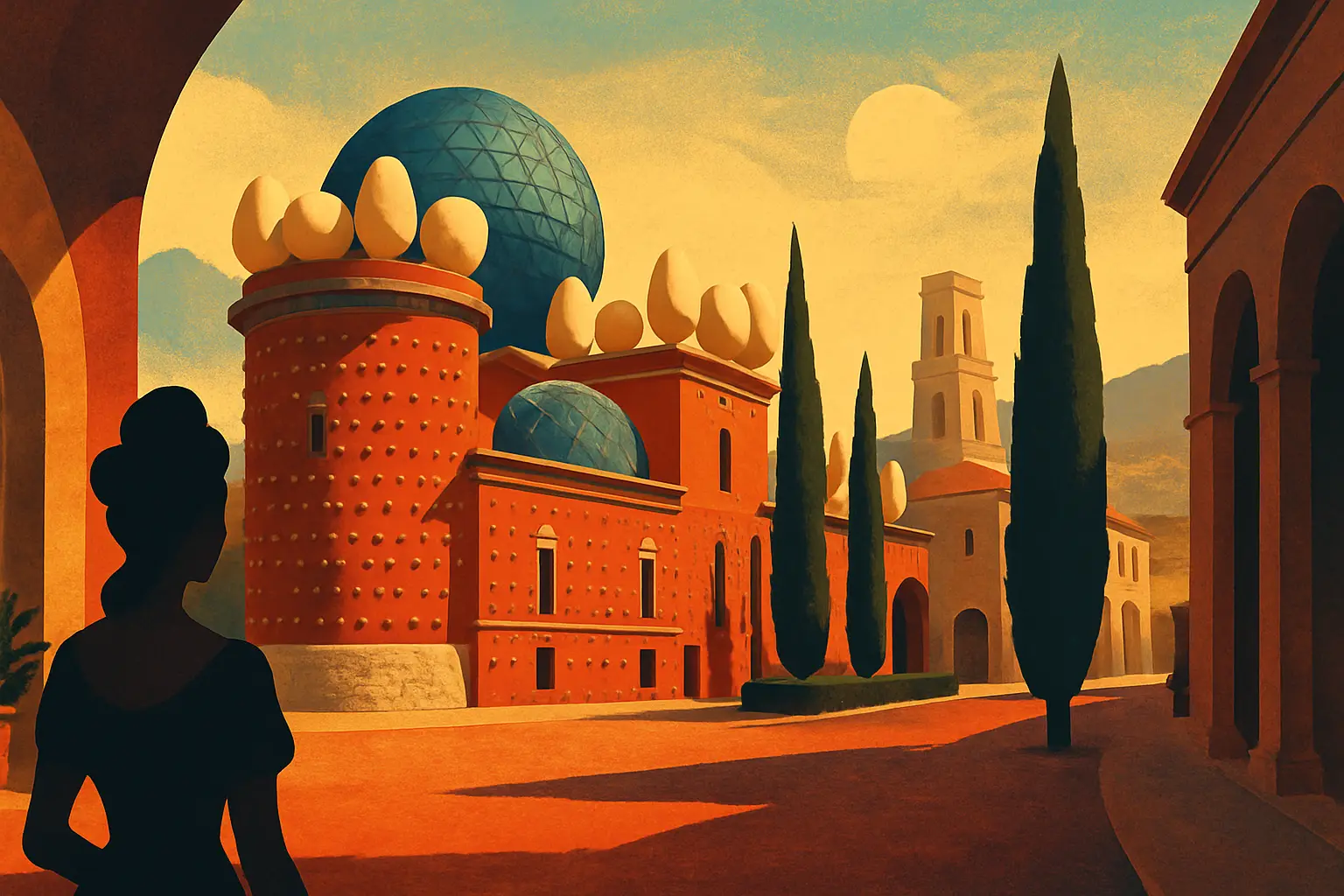
The museum announces itself from the street with enough strangeness that first-time visitors sometimes wonder if they have the right building. The outer walls are ochre-painted, studded at intervals with Oscar statuette figures holding rugby balls — a joke about Hollywood, prestige, and American culture that Dalí found inexhaustible — and crowned along the roofline with giant white egg sculptures. The egg was one of Dalí's defining symbols: he associated it with birth, cosmological perfection, and the Orphic Egg of Greek myth. Eggs appear throughout his paintings; their presence on the roofline stakes a claim on the building before you enter.
The Torre Galatea — a separate pink building immediately adjacent, connected to the museum via a bridge — is where Dalí lived his final years after the death of his wife and muse Gala in 1982. Named for her, the Torre is where Dalí died on January 23, 1989, following a fire in his bedroom the previous year that he barely survived. The Torre is not open to public visits, but standing at the junction between the two buildings you are looking at the place where Dalí chose to end his life — a few meters from where he is buried.
The museum entrance opens onto Plaça de Gala i Salvador Dalí, retaining both names: Dalí's wife and primary model for six decades, Gala was born Yelena Diakonova, a Russian emigrant ten years his senior. She appears in so many of his paintings that cataloguing her appearances in his work requires its own scholarly index.
Get short, interactive stories that make each place easier to remember while you travel.
The ticket entry leads into the open-air courtyard that once served as the theatre's classical colonnade space. The central installation is the Rainy Taxi: a 1941 Cadillac standing in the courtyard with vegetation growing inside it, snails crawling over the upholstery, and a coin-operated mechanism that produces actual rain on the interior mannequins. The rain falls inside a closed car — the boundary between inside and outside dissolved, a luxury object made wet and organic. Dalí called it the original car of Al Capone. He considered it a 'happening' that never repeats, since the snails and vegetation change continuously.
Above the Cadillac, a column of tires supports a boat from which water appears to fall, with an umbrella rising from its hull. Everything in the installation is held together by visual relationships — rain falls from clouds to cars to drivers, interiors become gardens — while making no other kind of sense at all.
Look up through the geodesic dome above the old stage and you see the ceiling painting El Palau del Vent (Palace of the Wind): Dalí and Gala ascending to heaven, their feet visible below them, surrounded by allegories of the artist's creative power. It is a ceiling painting in the grand tradition of European illusionist fresco — trompe-l'oeil perspective, foreshortened figures, sky breaking open — and in the tradition of Dalí, it is also explicitly about himself.
The interior rooms are arranged without the conventional museum logic of chronology, style, or medium. You move through them roughly in sequence but without a prescribed route, which means the experience changes depending on which way you turn.
The Mae West Room on the upper level is the museum's best-known installation and the most underexperienced, because it requires being in exactly the right place. The room contains a large trompe-l'oeil sofa (the Mae West Lips Sofa, originally designed in 1937), two fireplace surrounds, blonde drapery panels, and two framed paintings hung at eye level. From the floor these are separate, odd objects. From the small platform at the room's entrance — reached via a narrow staircase, fitted with a camel-saddle seat and a fisheye lens — they snap together into the face of Mae West, lipstick and all, exactly as in Dalí's 1935 gouache Face of Mae West Which May Be Used as an Apartment.
The Invisible Bust of Voltaire (1941) contains within a painting of two standing figures in a garden a hidden image of Voltaire in three-quarter view — one of Dalí's most technically accomplished double images, where the same brushstrokes describe two entirely different subjects depending on where you focus. The Portrait of Gala with Two Lamb Chops Balanced on Her Shoulder stops people mid-step for its title alone, and then again for the completely straight treatment of an impossible subject.
The Dalí Jewels gallery contains actual jewels Dalí designed over several decades: a beating heart crafted from rubies that pulses via a hidden mechanism, a brooch in the shape of the world's eye, and a royal heart of gold and gemstones. These were designed as Dalí's assertion that jewelry could be a conceptual artwork rather than decoration.
Beneath the museum's main hall, in the crypt under what was the theatre's stage, Salvador Dalí is buried. The tomb is simple to the point of severity: a plain stone slab, his name, nothing else — under the theatrical space he designed. Visitors can descend to view it.
This was Dalí's explicit plan. He wanted to be buried inside his own museum, inside the building he had made into the total artwork of his life, in the town where he was born. He had designed his own tomb. When he died on January 23, 1989, he was 84 years old and had spent his final years in the Torre Galatea in near-total isolation, painting with his arthritic hand using a magnifying glass, receiving almost no visitors. He was interred in the crypt two days later.
Gala, who died in June 1982, is buried in the Gala Dalí Castle in Púbol — a medieval castle in the Baix Empordà that Dalí purchased and renovated for her in the 1960s. It is one of the three sites in the Dalí Triangle (Figueres, Púbol, Port Lligat) managed by the Gala-Salvador Dalí Foundation. The foundation operates all three as part of a single interpretive project: visiting Figueres alone is like reading the first chapter of a book.
Figueres is a functional Catalan market town with a 600-year-old street market running every Tuesday and Saturday in Plaça Nou and Plaça del Gra. The Rambla de Figueres — the town's tree-lined main promenade — has cafés and terraces that are more local in character than anything comparable in Barcelona. Lunch here runs €10–14 for a full menú del día; the Alt Empordà region is known for its anchovies (L'Escala, 30 minutes south, produces some of the best in Spain) and for cured meats like the local fuet.
The two other points of the Dalí Triangle are worth knowing even if you visit only one:
Casa Salvador Dalí in Port Lligat (near Cadaqués): Dalí's home and primary studio for most of his adult life — a fisherman's hut that grew into ten interconnected structures around an olive grove. The swimming pool shaped to Dalí's specifications and Gala's haute couture wardrobe (Balenciaga and Dior pieces she collected over decades) are both on view. Visits require advance booking; maximum group sizes are very small.
Gala Dalí Castle in Púbol: The 12th-century castle Dalí renovated as a private retreat for Gala, with the reported condition that he could not visit without a written invitation from her. The castle contains furniture Dalí designed, a room of stuffed animals, and Gala's tomb. Approximately 60 kilometers south of Figueres, best reached by car.
Tickets: Book online at salvador-dali.org. The foundation offers combined tickets for two or three Triangle sites at reduced prices. Tickets for Figueres cost approximately €20 for adults; the Port Lligat house and Púbol castle charge separately. The Night Experience — theatrical evening visits available in July and August — requires a separate ticket and offers the museum under dramatic lighting conditions that change the entire reading of Dalí's ceiling and the courtyard installations.
How long to spend: The museum takes a minimum of 2 hours if moving quickly; 3 hours is more appropriate for a first visit and allows time to find the Mae West platform, spend time with the ceiling painting, and visit the crypt without rushing. Adding lunch and a walk along the Rambla extends the day to 5–6 hours comfortably.
September timing: September 1–15 is one of the better windows to visit. Summer queues ease significantly, the Alt Empordà weather is warm (77–86°F) but no longer punishing, and the museum runs full summer hours (generally 9 AM to 8 PM). By mid-October, hours shorten and Monday closures resume.
High-speed AVE: Barcelona Sants → Figueres-Vilafant | ~35–40 min | €20–30 | Book at renfe.com
Regional train: Barcelona Sants → Figueres town | ~1h40m | ~€10 | Runs frequently, no advance booking
Bus from Figueres-Vilafant to centre: #TS1 | 10 min | €1.70 | Or taxi ~€8
Museum opens: 9 AM (summer) | 9:30 AM (shoulder/winter) | Closed Mondays October–May
Combined Triangle ticket: all 3 sites | Check salvador-dali.org for current pricing
The short answer is yes — but with a specific caveat. The museum rewards visitors who know what they are looking at. Go expecting a conventional art museum where paintings hang in sequence, and the experience is confusing. Go understanding that the building is the artwork and the artist is buried underneath it — that everything you see was placed with intention by a man who spent 15 years designing his own legacy in his own birthplace — and it is unlike anything else in Europe.
It is also meaningfully different from the Dalí content available in Barcelona. The Museu Picasso and the Fundació Joan Miró are important institutions; neither artist designed his own museum or intended the building as the final statement of his career. Dalí did. What Figueres offers is the only place where you can understand what Dalí wanted to be remembered as — not Cubist, not Surrealist, not simply provocateur, but the artist who turned his childhood theatre into the most surrealist building in the world and then moved in next door to watch it operate.
For day trips from Barcelona by train, Figueres pairs naturally with Girona — the medieval walled city 38 kilometers south, reachable in 15 minutes by regional train — for a two-city day if you start early from Sants. Figueres alone, with lunch and the museum at a proper pace, fills 5 to 6 hours without forcing anything.