The Costa Brava runs for roughly 200 kilometres from Blanes in the south to the French border in the north. Most of it was developed heavily between the 1960s and 1990s: concrete hotel blocks, marina apartments, and beach bars that could be anywhere in the western Mediterranean. Cadaqués escaped this for a structural reason.
The Cap de Creus peninsula, which juts into the Mediterranean at the northeastern corner of Catalonia, is a massif of ancient volcanic rock covered in scrubland and accessed by roads that were, until the mid-20th century, barely drivable. The village of Cadaqués sits on the eastern coast of this peninsula, facing open sea. Its natural harbour is small — too small for significant fishing industry growth — and its connection to the interior was limited to a mule track until the current road was built in the early 20th century. By the time Spanish coastal development accelerated in the 1960s, Cadaqués had already been 'discovered' by the international art world, which gave it a cultural identity that made standard resort development feel inappropriate. The municipality also designated much of the surrounding land as protected, eventually leading to the Parc Natural del Cap de Creus, established in 1998.
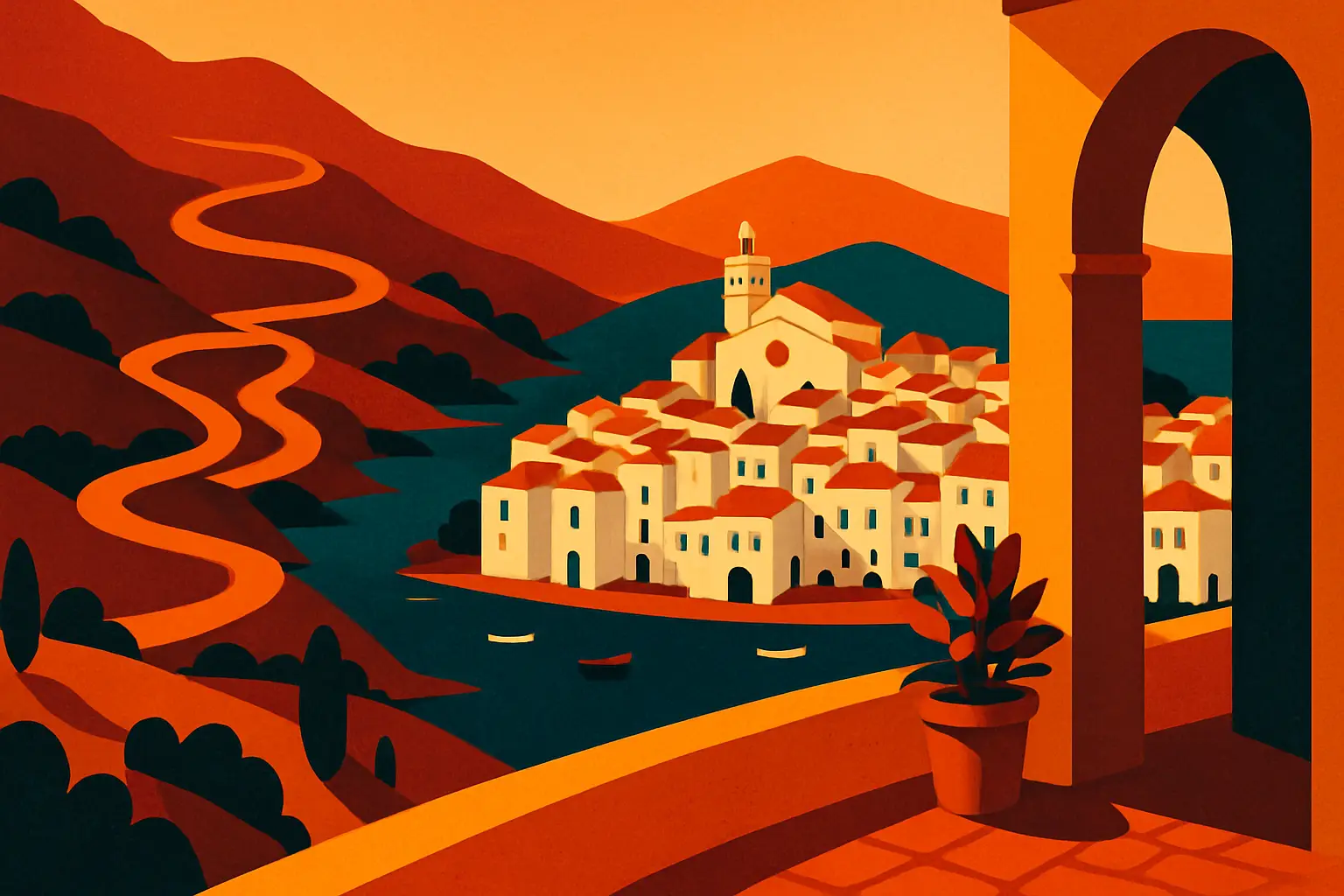
The result is a village that looks, from the harbour, almost exactly as it did in 1920: Carrer de l'Església climbing through narrow arches toward the white facade of the 18th-century Santa María church, Passeig del Mar running along the waterfront below, and the hillside packed with houses painted in the specific shade of white — almost blue-white, not cream — that the Costa Brava sun does something unusual with at dusk.
In 1930, Salvador Dalí bought a fisherman's hut at Port Lligat — a hamlet of boat sheds and a small beach 1.5 kilometres from Cadaqués along the coastal path — and began assembling what would become one of the strangest houses in Spain.
Over 50 years, Dalí expanded the original hut by purchasing and connecting adjacent fishing huts, creating a labyrinthine structure of 1,200 square metres that follows no architectural logic. The result is a sequence of connected rooms and studios at different heights, connected by narrow staircases, with windows that frame specific views of the Port Lligat lagoon and the rocky outcrops beyond. Dalí designed the house not as a residence but as an extension of his working mind: the pool terrace (where he and Gala entertained) features a giant stuffed polar bear and a sofa shaped like Mae West's lips; the studio where he produced much of his major work from the late 1940s through the 1970s is oriented so that the afternoon light hits the canvas at a specific angle.
The white egg shapes that crown the roofline are immediately recognisable from the road. They appear in multiple Dalí paintings, and he was obsessed with the egg as a symbol — fertility, contained energy, the perfection of form. From the coastal path to Port Lligat, you can see the roofline clearly before reaching the entrance.
Gala died in 1982. Dalí retreated to the Castell de Púbol (another Dalí Foundation property, in the Baix Empordà) and then to the tower of the Teatro-Museo in Figueres, where he died in 1989. The Port Lligat house passed to the Gala-Salvador Dalí Foundation, which opened it to visitors in 1997. The maximum of 8 visitors per slot means the experience is genuinely intimate — you see the house as Dalí left it, including his library, his collection of mirrors (he was fascinated by reflection and replication), and the Gala's room, which remains largely as it was during the years when she ran the couple's business affairs and social calendar from the same house.
For the Figueres Dalí Theatre-Museum, which houses Dalí's largest single collection of works, allow a separate day — the two sites together are too much for one visit.
Get short, interactive stories that make each place easier to remember while you travel.
Ten kilometres east of Cadaqués by road (or by boat, which is the better approach in good weather), Cap de Creus is the point where the Pyrenees enter the Mediterranean — the geological end of the mountain chain that forms the spine of the Iberian Peninsula. The lighthouse at the tip marks the easternmost point of mainland Spain and Iberia combined.
The landscape looks like nothing else in Spain. The Parc Natural del Cap de Creus protects 10,700 hectares of ancient volcanic rock, schist, and granite formations worn into abstract shapes by the tramuntana — the cold north wind that blows through this part of the Mediterranean with enough force to uproot trees. Dalí painted this landscape obsessively. The melting forms, the double-image rocks, the flat light bouncing off white stone — all of it appears directly in the Surrealist paintings from his Port Lligat period.
The headland is accessible by car (the road from Cadaqués is steep and single-lane in places), by the Cadaqués-Cap de Creus boat service that runs from June through September (30 minutes each way, check the harbour for schedules), or on foot via a marked trail (4.5 km each way, rocky, allow 3 hours round trip). At the lighthouse, the Bar Restaurant el Far operates seasonally — not a destination restaurant, but a useful stop for coffee and a bocadillo at the end of the world.
The best experience of Cap de Creus is not the lighthouse itself but the approach: the road descends through increasingly alien terrain, the vegetation gets lower and more twisted by the wind, and the rock formations appear that Dalí was clearly painting from life. Stop at any of the unmarked pullouts along the final two kilometres and walk onto the rocks. The silence, broken only by the wind and the sea, is the point.
The core of Cadaqués is walkable in 20 minutes but rewards a slower pace. The village climbs from Passeig del Mar (the waterfront promenade) up through a sequence of narrow lanes to the Iglesia de Santa María, an 18th-century baroque parish church with a carved alabaster altarpiece that art historians consider one of the most significant baroque altarpieces in Catalonia. The exterior is plain white — as everything in Cadaqués is white — which makes the interior decoration more striking by contrast.
A few specific things are worth finding:
- Carrer d'En Riera — the main pedestrian street through the old town, steep enough to require steps in places, lined with gallery spaces and small shops. Cadaqués still attracts working artists and has a density of contemporary art galleries unusual for a village of 2,800 people.
- Museu de Cadaqués — a small permanent collection focused on the 20th-century artistic history of the village, including photographs from the period when Duchamp, Man Ray, and the international Surrealist circle spent summers here. Located at Carrer de Narcís Monturiol, 15.
- Es Pianc and Cala d'en Rafi — two small coves north of the main beach (Platja Gran), accessible by the coastal path. Less crowded than the harbour beach, with cleaner water and access to the rocky Cap de Creus headland from the north.
- Platja Gran — the main town beach, directly in front of Passeig del Mar. Small by Costa Brava standards (about 250 metres), with consistent tramuntana wind conditions that make it a windsurfing destination in the right season.
The local food tradition is heavily anchored in the sea — specifically in the suquet de peix (fish stew with potato, tomato, and picada sauce), musclos al vapor (mussels steamed in white wine and herbs from the Cap de Creus scrubland), and, in winter, the garotes (sea urchin) that the fishing boats bring in from the rocky Cap de Creus seabed. In September, garotes begin to reappear on menus as the summer crowds thin.
**Casa Anita** — Carrer de Miguel Rosset, 16. The most famous restaurant in Cadaqués and one of the most genuinely unusual restaurants on the Costa Brava. No written menu — you eat what they cook, served at long communal tables with wine poured from a jug. The family has operated from this space since the 1960s. Reservations essential; the experience is deliberately old-fashioned and specifically Cadaqués.
**El Barroco** — Carrer de l'Església, 2. A terrace restaurant directly below the Santa María church, serving fresh fish from the local day boats, grilled or in suquet. The position gives views over the rooftops to the harbour. Lunch only, closed mid-October to Easter.
**Sa Gambina** — Plaça de Frederic Rahola. A family-run restaurant at the edge of the harbour square specialising in local shellfish — gambas, cigalas, musclos — and the local Empordà wines. More accessible (no communal tables, a proper menu) than Casa Anita, but the same emphasis on what came off the boats that morning.
**Café de la Havana** — Passeig del Mar, 5. The essential harbour-front café: vermut and beer before lunch, coffee and afternoon pastries, cold local wine in the evening. The terrace faces directly onto the bay. Not a restaurant, but the right place to understand why artists kept coming back to sit and look at this harbour.
Cadaqués sits within the DO Empordà wine region, which covers the Girona lowlands from the Pyrenees foothills to the coast. The region is best known for its whites — particularly wines made from Garnacha Blanca and Macabeo grapes — and for a traditional style of sweet wine called Garnatxa de l'Empordà, made from sun-dried Grenache grapes, amber in colour and tasting of dried apricot and walnut.
The Empordà white wines are the natural pairing for the local fish: the acidity and mineral quality of wines grown close to the sea — the tramuntana wind carries salt from the Mediterranean over the vineyards — matches suquet and grilled fish better than most other Catalan appellations. Several Cadaqués restaurants pour them directly from the producer, without labels.
For those who want to visit wineries, the main Empordà production zone is the lowland area around Vilajuïga, Mollet de Peralada, and Capmany — roughly 25 kilometres west of Cadaqués. The Peralada estate (whose winery is part of a medieval castle complex) is the most notable, and the town of Peralada itself has a small casino and cultural centre worth 90 minutes on a driving day. The wine region is easily combined with a Cadaqués trip if you have a car and are coming from Figueres rather than from Barcelona directly.
Cadaqués is 175 kilometres from Barcelona. The drive via the AP-7 motorway to Figueres and then the C-260 takes approximately 2.5 hours — longer in summer traffic. That is a significant commitment for a day trip, and the honest assessment is: Cadaqués is not a short-day-trip destination. The Casa Dalí booking alone requires arriving at a fixed time; the Cap de Creus visit adds 2 hours minimum; and the village itself rewards time spent sitting at the harbour rather than rushing through.
The recommended approach from Barcelona is two nights minimum, which allows one full day for the Casa Dalí and Cap de Creus, and a second day to walk the coast path, eat at Casa Anita, and understand why people like Marcel Duchamp kept returning for decades. The accommodation stock is limited and books out completely in July and August — September bookings become possible with less advance notice, which is another reason the month works well.
For visitors already in the Figueres area to see the Dalí Theatre-Museum: Cadaqués is 40 minutes from Figueres and the two can be combined in a long day trip from Figueres — museum in the morning, arrive in Cadaqués for lunch, spend the afternoon at Port Lligat and the harbour. This is the most efficient combination and the one that makes the Dalí biography coherent: you see what he built for the public in Figueres and what he built for himself in Cadaqués, and the contrast explains a great deal.
When is the best time to go? September and early October. The water is still warm (23°C), the Casa Dalí slots are available without months of advance booking, and the village returns to something like its normal scale. July and August are technically possible but genuinely packed — the coastal path becomes a queue and the harbour restaurants turn tables so fast the experience suffers.
Is there ATM access? Yes — one ATM on Passeig del Mar and another near the bus stop. Cadaqués is small enough that some smaller restaurants and shops are still cash-preferred. Bring a mix.
Can you stay overnight? Yes, and it is strongly recommended for anyone driving from Barcelona. The village has small hotels and apartment rentals, including the Hotel Playa Sol (Playa Pianc, 3 — directly on the Es Pianc cove, north of the main beach) and several boutique guesthouses in the old town. Book at least two months ahead for July or August; September and October are significantly easier.
Is Cap de Creus suitable for young children? The rocky headland is not stroller-accessible. The boat trip from Cadaqués harbour to Cap de Creus (operating June–September) is the most practical option for families with young children — 30 minutes each way on calm water, which avoids the rocky trail while still seeing the geology and the lighthouse from the sea.