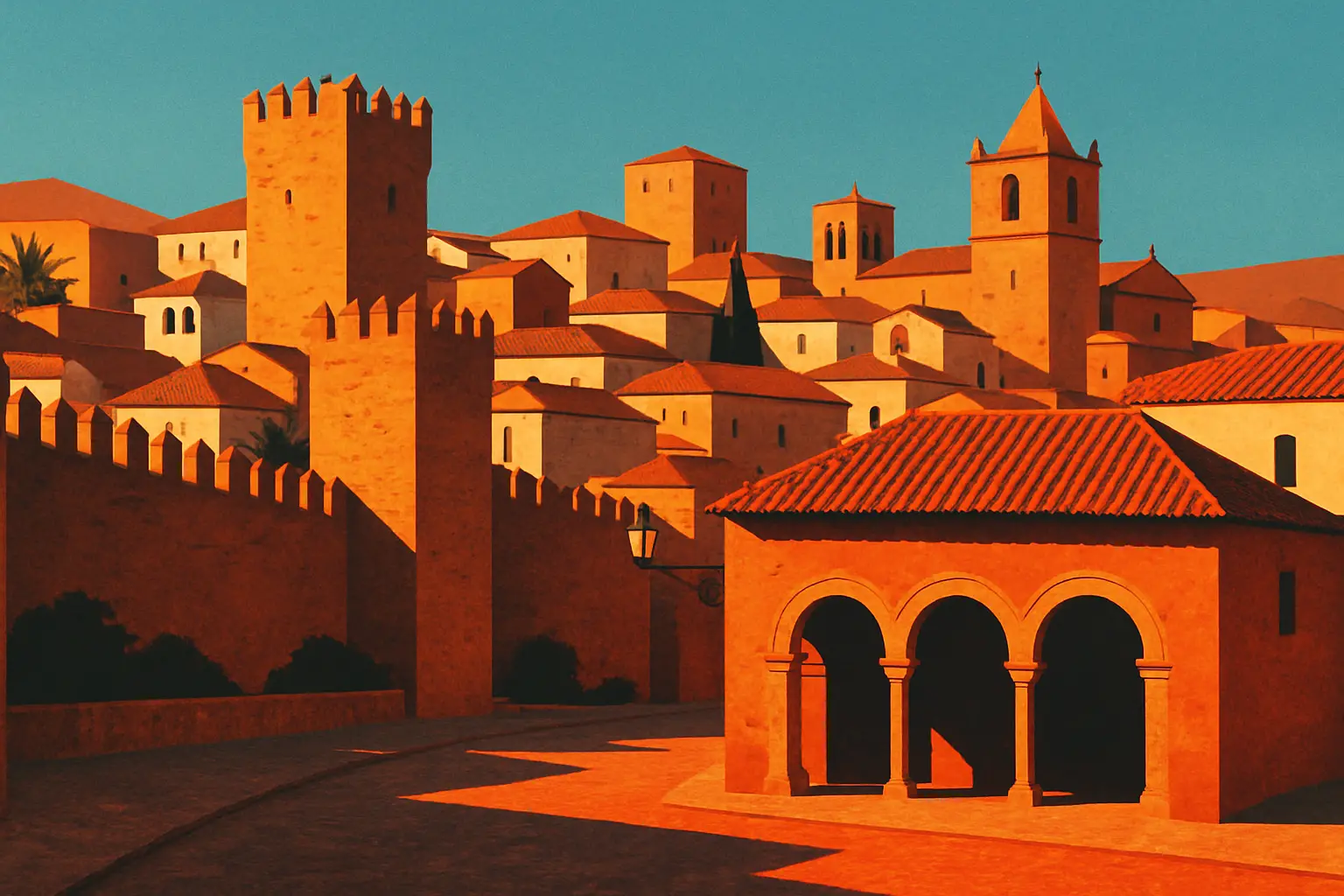
Cáceres old town contains 30 medieval towers, 12 palaces, three convents, and three churches within a walled area of roughly 12 hectares — and none of them have modern buildings between them. What makes this unusual is not the quantity but the survival rate. Toledo, Segovia, and Ávila all have magnificent historic cores interrupted at intervals by 19th and 20th-century construction. Cáceres does not. Satellite dishes are banned inside the walls. Shop signs must meet strict heritage guidelines. The cobblestone layout follows the same logic it did in the 14th century.
The reason the city survived largely intact is ironic: Extremadura was one of Spain's poorest and most depopulated regions for most of modern history. The developers who transformed Spain's urban fabric found Cáceres too small and too remote to bother with. What saves a medieval city in the modern world, it turns out, is being forgotten by people with money. UNESCO recognized the result in 1986. Tourism is only now catching up.
The oldest visible layer in Cáceres is the Roman wall. Sections of the original Norba Caesarina city wall — the Roman settlement founded around 25 BCE — survive integrated into the medieval defensive circuit. Look for the large irregular granite blocks at the base of the walls near the Puerta de Mérida (the southern gate): those are Roman stones, reused by Moorish builders who extended the city during the Almohad period in the 12th century. The Torre del Horno (Oven Tower), near the Jardín de la Muralla park, is the best-preserved Moorish tower — a 12th-century minaret-style structure whose decorative brickwork looks nothing like the granite Christian buildings beside it.
After the Reconquista in 1229, Cáceres became a city of competing noble families who built towers to signal power. By the 15th century, the city had over 100 private towers. Then Ferdinand and Isabella issued a royal decree ordering nobles to demolish them to a uniform height, to break the visual dominance of any single family. The flat-topped towers you see throughout the old city are the legacy of that order. Only the Torre de las Cigüeñas (Tower of the Storks) on Calle de Moret — owned by the Ovando family, royal favorites — was exempted and allowed to stand at full height. Its profile above Plaza de Santa María tells the story of royal authority and noble resistance in a single image.
Get short, interactive stories that make each place easier to remember while you travel.
The *Game of Thrones* production team filmed extensively in Cáceres during Seasons 7 and 8, using it for two distinct locations. The Plaza de Santa María — the main square inside the old city, flanked by the Cathedral of Santa María and the Episcopal Palace — appeared as the streets of King's Landing, with its granite paving and surrounding palace facades requiring almost no dressing to read as a medieval city on screen.
The Palacio de los Golfines de Abajo on Calle de los Golfines — where the Catholic Monarchs held court during their visits to Cáceres — served as an exterior for the Red Keep. The production chose Cáceres specifically because certain camera angles required no CGI additions at all.
For fans doing a deliberate walking tour, the route from Arco de la Estrella along Calle Ancha to Plaza de Santa María covers most filming locations in about 20 minutes. The cathedral steps, specifically, were used in a scene from the final season that requires only mild spoiler knowledge to identify the moment you arrive. Beyond *Game of Thrones*, the old city appeared in the Spanish series *El Ministerio del Tiempo* and in the 2021 film *Los Reyes del Mundo* — the film industry's enthusiasm for it is, in its own way, a certification of authenticity.
Extremadura produces some of Spain's most celebrated ingredients and is almost entirely unknown internationally as a gastronomic destination. That is changing rapidly.
Jamón ibérico de bellota from the Extremaduran dehesa — the open holm-oak forest where pigs range freely and eat acorns before slaughter — is among the finest cured meat in the world. A tasting plate at a good bar in Cáceres costs €8–12 and is essential. Migas extremeñas are fried breadcrumbs cooked with olive oil, garlic, and pimentón de la Vera (a PDO smoked paprika from the nearby La Vera valley) plus chorizo or tocino. Nearly every traditional restaurant serves them as a starter for €6–8.
For restaurants: El Figón de Eustaquio on Plaza de San Juan 12 has served Extremaduran classics since 1948 — the *cochinito frito* (fried suckling pig) and pickled partridge are what to order. Mains run €14–22. If budget allows, Atrio on Plaza de San Mateo 1 inside the old city holds two Michelin stars under chef Toño Pérez, with a tasting menu at €150–180 and a wine cellar of over 40,000 bottles — book at least two weeks ahead.
From Madrid, the Renfe Avant high-speed train from Chamartín station takes approximately 3 hours 30 minutes, with several daily departures. Tickets booked in advance cost €25–45 each way. The Cáceres station is a 15-minute walk from Plaza Mayor. By car, the A-5 motorway covers the 300 km in about three hours.
From Seville, the drive via the A-66 (Via de la Plata) takes around 2 hours 45 minutes across 250 km. There is also a regional train service, though journey times vary considerably.
Cáceres pairs naturally with Mérida's Roman ruins, just 70 km south. The two cities together make the strongest possible case for spending two nights in Extremadura: Mérida covers the Roman theater, amphitheater, and the Museo Nacional de Arte Romano; Cáceres covers the medieval layers on top of that. Together they trace roughly 2,000 years of Iberian history across 70 km of road.
Yes — unambiguously, and especially if you have already visited Toledo, Segovia, or Ávila. The 3.5-hour train each way makes a genuine day trip exhausting; the ideal visit is one or two nights, which gives you the old city at dusk and dawn, when the tour groups are gone and the stone glows amber.
The walled area is small enough to cover thoroughly in half a day — 12 hectares, easy to walk. A second day opens up the surrounding streets, the Mercado Municipal on Calle Pintores (mornings Monday–Saturday), and if you have transport, the 50 km drive north to Monfragüe National Park for black vultures and Spanish imperial eagles — one of Europe's great raptor spectacles.
For travelers deciding between Cáceres and Mérida for a single day trip: Mérida's Roman ruins are more immediately dramatic. Cáceres rewards slower walking and a historical imagination that fills the spaces between the stones. If you can only go once and medieval history is your interest, Cáceres is the stronger choice.
The old city itself is free. The streets, towers, and exterior facades require no ticket — you can walk the entire walled district at any hour without spending a euro. Most of what makes Cáceres memorable is visible from the street.
The Museo de Cáceres in the Casa de las Veletas (Plaza de las Veletas 1) costs €1.20 and is one of the best-value museum tickets in Spain. The basement contains an intact Almohad cistern (aljibe) — a 12th-century Moorish water storage system still partially filled with water — that is genuinely impressive and not to be skipped. Open Tuesday–Saturday 9 AM–2:30 PM & 4–6:30 PM, Sunday 10:15 AM–2:30 PM.
The Cathedral of Santa María (Plaza de Santa María) charges a small entry fee of around €3 and is worth it for the carved stone choir and the climb to the tower for views over the old city. San Mateo, the largest church inside the walls, has free entry.
Accommodation: The most atmospheric option is the Hotel Atrio (Plaza de San Mateo 1), rooms from €200/night. Mid-range, well-positioned: Casa Don Fernando on Plaza Mayor from €90–130/night. September availability is generally good but fills quickly around any local festivals — check the city calendar before booking.