1. Emerita Augusta: why a Roman colony became one of the empire's greatest cities
Mérida exists because of retired soldiers. In 25 BC, the Emperor Augustus needed to reward the veterans — in Latin, emeriti — of his decade-long campaign to pacify the Iberian Peninsula's last holdout tribes, the Cantabrians and Asturians in the north. The standard reward was land. Augustus gave them an entire city.
He chose a site on the Guadiana River in southwestern Iberia, where two rivers met and a natural ford made crossing straightforward. The new city was named Emerita Augusta — City of the Veterans of Augustus — and designated the capital of Lusitania, one of Rome's three Iberian provinces. Lusitania covered roughly what is now Portugal and the western third of Spain.
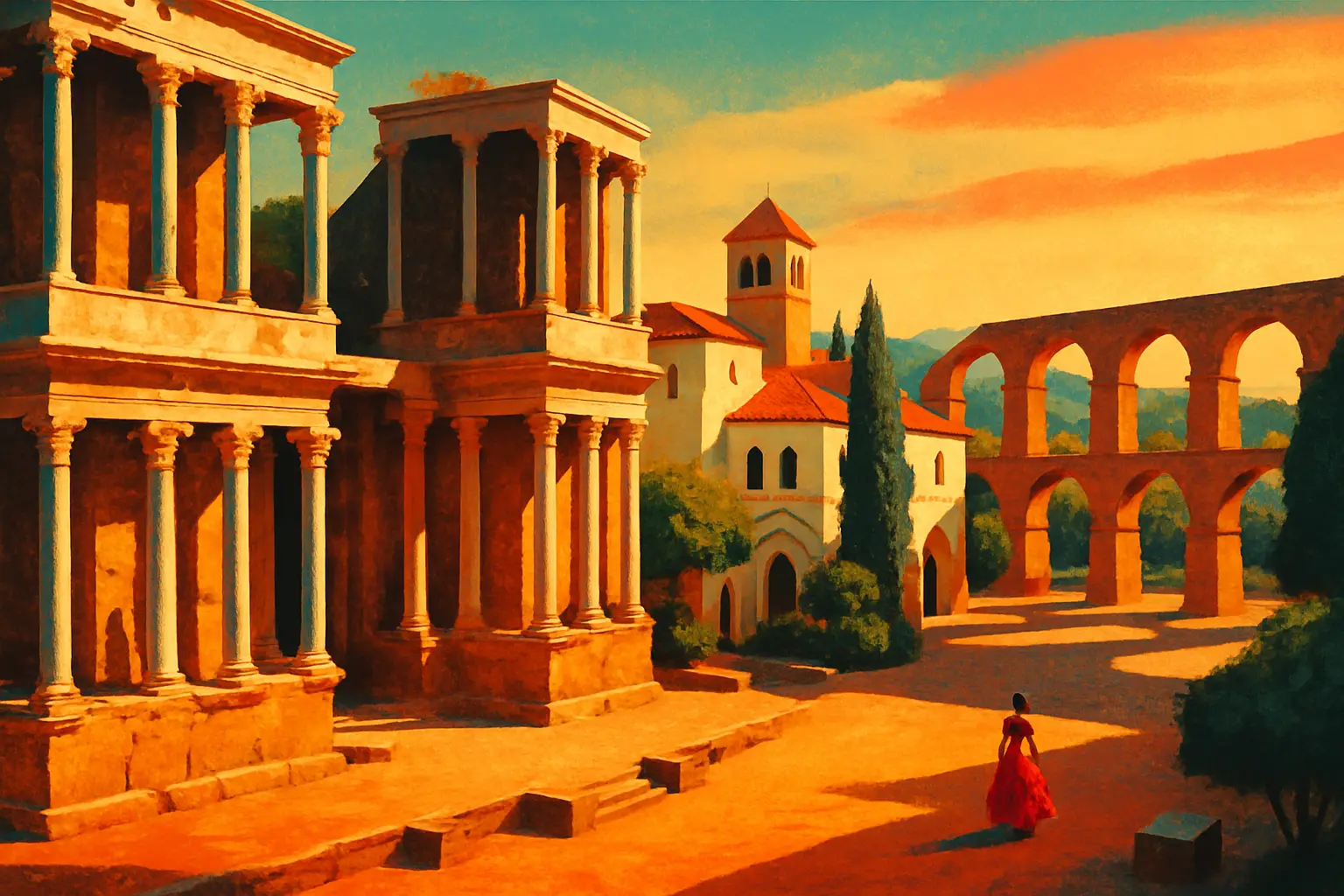
The city grew fast and strategically. The veterans who founded it were not subsistence farmers — they were experienced soldiers who understood how to organize land, build roads, and run logistics. Within two generations, Mérida had become one of the largest cities in the Roman Empire west of Italy, with an estimated population of 30,000 to 50,000 at its peak under Augustus and Tiberius. The public monuments that survive today — the theater, the amphitheater, the temple, the bridge, two aqueducts, a circus — were not all built at once. They accumulated over the first century of Roman rule, each one a statement about the colony's ambition and wealth.
Modern Mérida has about 60,000 inhabitants. It is, in other words, almost exactly the same size as ancient Mérida. The ruins are not the remains of a lost civilization. They are the remains of a city that is still here.
2. Teatro Romano: the theater Marcus Agrippa built, and the plays still performed there
The Roman Theater of Mérida was funded by Marcus Agrippa, Augustus's most capable general and the engineer behind much of Rome's monumental building program. Construction was completed around 16–15 BC, making it one of the earliest Roman theaters on the Iberian Peninsula.
The theater seats approximately 6,000 spectators in three tiers of stone and marble. What visitors see when they walk in — the tall, columned stage backdrop called the scaenae frons — is partly a reconstruction. The original structure collapsed over centuries of abandonment and earthquake. During excavations from the 1920s through the 1960s, archaeologists recovered enough original marble fragments to reassemble the stage wall using the original stones, a technique that still generates debate among purists but gives the theater the visual coherence that makes it the most photographed Roman monument in Spain after the Alhambra.
What makes the theater exceptional is not its scale — Rome, Pompeii, and Orange in France all have comparable structures — but what it is still used for. Every summer since 1933, the Festival Internacional de Teatro Clásico de Mérida has staged Greek and Roman classical plays on this stage: Sophocles, Euripides, Seneca, Plautus. These are full productions with professional casts, set design, and contemporary lighting — performed in the seats where Roman audiences sat 2,000 years ago. The festival runs from late June through mid-August. Tickets are at festivaldemerida.es and should be treated with the same urgency as concert tickets, not museum tickets.
3. The Amphitheater: what the other arena was actually built for
Just east of the theater, connected by a shared entrance through the Conjunto Monumental ticket, stands the Anfiteatro Romano — built in 8 BC, seven years after the theater. It is shaped like an oval rather than the theater's semicircle, and it was designed for a fundamentally different kind of performance: gladiatorial combat and venationes, the staged hunting of wild animals imported from North Africa.
At full capacity the amphitheater held approximately 15,000 spectators — more than twice the theater's capacity — which says something about relative Roman appetites for drama versus bloodsport. The arena floor has not survived, but the underground passages (hypogeum) where gladiators and animals were staged before entering the arena are partially visible from above. Trapdoors in the sand allowed dramatic entrances from below — a theatrical technique borrowed directly from the dramatic arts that performed next door.
The amphitheater shows more signs of age than the theater. The upper tiers have collapsed and the structure that remains is fragmentary. But standing on the arena level and looking up at the surviving stone banks, with the theater's stage backdrop visible over the dividing wall, the scale of what Mérida constructed in a single generation across both sites is impossible to miss.
4. The Temple of Diana and the Arch of Trajan: both named wrong, both worth finding
Two of Mérida's most photogenic monuments share an unusual distinction: neither carries an accurate name.
The Templo de Diana — the Temple of Diana — was almost certainly not dedicated to Diana. The goddess of the hunt became a popular attribution for Renaissance-era scholars who encountered the ruins and assumed a Roman temple must honor one of the classical deities. Modern archaeologists now believe it was actually the city's principal monument to the Imperial cult — the worship of Augustus and his successors as divine — which was required in every provincial capital. That shifts the building's meaning considerably: this was not a place of religious piety but of political loyalty, where Mérida's citizens publicly declared their allegiance to Rome's ruling family.
Fifteen of the original Corinthian granite columns still stand. The site's architectural strangeness comes from what happened in the 16th century: a Spanish nobleman named Francisco de los Cobos built his palatial residence directly into and around the ancient structure, framing his Renaissance windows between Roman columns. His family eventually abandoned the palace. The columns remained. The result is a 2,000-year-old colonnade growing through the ruined shell of a 500-year-old house — one of the more disorienting architectural hybrids in Spain. Free to visit at any hour.
The Arco de Trajano — Arch of Trajan — predates Emperor Trajan (who ruled 98–117 AD) by at least a century. It was named after him because he was associated with Spanish road-building and the arch stands near a major ancient road junction. In fact it was the monumental gateway into Mérida's Foro Provincial, the administrative and judicial headquarters of all Lusitania. At 15 meters high it is one of the largest surviving Roman arches in Spain, its original marble cladding stripped long ago for use in later construction. Also free to visit, and best appreciated at dusk when the granite turns orange.
5. The Roman Bridge and the Miracle Aqueduct: the infrastructure that made the city possible
Roman monuments tend to be remembered for their drama — theaters, temples, arenas. Mérida's two most overlooked major sites are infrastructure, and they are arguably the most impressive things in the city.
The Puente Romano stretches 792 meters across the Guadiana River on 60 granite arches, making it one of the longest intact Roman bridges in the world. Built around 1 BC under Augustus, it served as the main crossing of the Guadiana for nearly 2,000 years and was only closed to motorized traffic in 1991 when a parallel modern bridge was completed. It is now pedestrian only. Walk it in the early morning or at dusk — the light on the water and the scale of the crossing feel different when you are standing on it than in any photograph.
The Acueducto de los Milagros — the Miracle Aqueduct — stands about a 20-minute walk northwest of the theater on the city's edge. Its name is medieval: local farmers looking at the remaining granite piers, some rising 25 meters (the height of a nine-story building), simply could not believe human beings had built them without divine assistance. The visible section runs 830 meters. It originally carried water nine kilometers from Lake Proserpina, a Roman reservoir that still exists today and still supplies water to the city — one of the very few Roman engineering works still performing its original function two millennia later. The aqueduct is free to visit and the surrounding park is a quiet place to sit before the morning heat builds.
6. Museo Nacional de Arte Romano: a museum built directly over a Roman road
The Museo Nacional de Arte Romano at Calle José Ramón Mélida is one of the finest archaeology museums in Spain and one of the most architecturally serious buildings constructed in the country during the 20th century. Designed by architect Rafael Moneo and opened in 1986, it was a deliberate statement about how Spain wanted to engage with its ancient past as it re-entered Europe after the Franco years.
Moneo's building echoes Roman construction in its use of thin red brick arches — tall, repeated, almost hypnotic — that run the full interior height. The effect is of standing inside a modern Roman basilica. At the entrance level, glass floor panels reveal an actual Roman road and residential ruins from Mérida's ancient city, discovered during construction and incorporated into the building's foundation rather than removed.
The collection includes some of the finest Roman mosaics in Spain, displayed flat at floor level so you can read the pictorial detail without crouching. The sculpture rooms hold portrait busts, funerary monuments, and bronze objects from the city's houses and public buildings — a comprehensive record of how Mérida's Roman inhabitants lived rather than just how they built.
Admission is €3. Free on Saturday afternoons after 2pm and all day Sunday. Open Tuesday–Saturday 9:30am–8pm; Sunday 10am–3pm; closed Monday.
7. How to visit Mérida: train, day trip vs. overnight, and what to skip
Mérida is not on Spain's AVE high-speed rail network. Getting there takes longer than the distance suggests, which is the main reason it stays off most international itineraries.
•**From Madrid (Atocha):** Conventional Renfe train, approximately 4 hours. The route follows the Tagus valley into Extremadura — genuinely scenic. Buses from Estación Sur take about 3.5 hours. Driving the A-5 motorway: 345 km, approximately 3 hours 15 minutes.
•**From Seville:** Train approximately 2.5 hours; bus similar. Mérida works as a day trip from [Seville](/es/blog/seville-spain-city-guide-2026) if you take the earliest train and stay until closing time. The two cities together make a logical 2-night pairing for western Andalusia and Extremadura.
•**Day trip vs. overnight:** If your goal is the theater, amphitheater, and museum, a long day trip is manageable. If you want the aqueduct, the Roman bridge at sunset, and a festival performance, plan one night. The historic center has good mid-range hotels within walking distance of every major site.
•**What to skip:** The **Circo Romano** — the Roman Circus where chariot races were held — survives only as outlines in the modern street grid. Worth knowing it exists, not worth rearranging your day to find it.
•**Best months:** April–June and September–October for mild weather and thinner crowds. August for the Festival de Teatro Clásico, but prepare for 40°C+ afternoons. Structure those days around the heat: ruins at 9am, museum from noon, outdoor sites again after 6pm.
•**Getting around on foot:** All major sites except the Miracle Aqueduct are within a 20-minute walk of each other across a flat historic center. A taxi or a 30-minute walk gets you to the aqueduct. No need for public transport within the city.