1. What Bilbao actually is — industrial ruin to cultural capital
Bilbao's transformation is one of the most studied examples of urban regeneration in modern European history, but the statistics flatten a more specific story. In the early 1990s, the Nervion River — which runs through the city center before widening into a 15-kilometer estuary toward the Bay of Biscay — carried the accumulated contamination of a century of heavy industry. Steelworks upstream in the Basque interior, shipyards along the river, and chemical plants on the estuary banks had reduced it to one of the most polluted waterways in Western Europe. When the industries collapsed in the 1980s, they left derelict land directly adjacent to the city center.
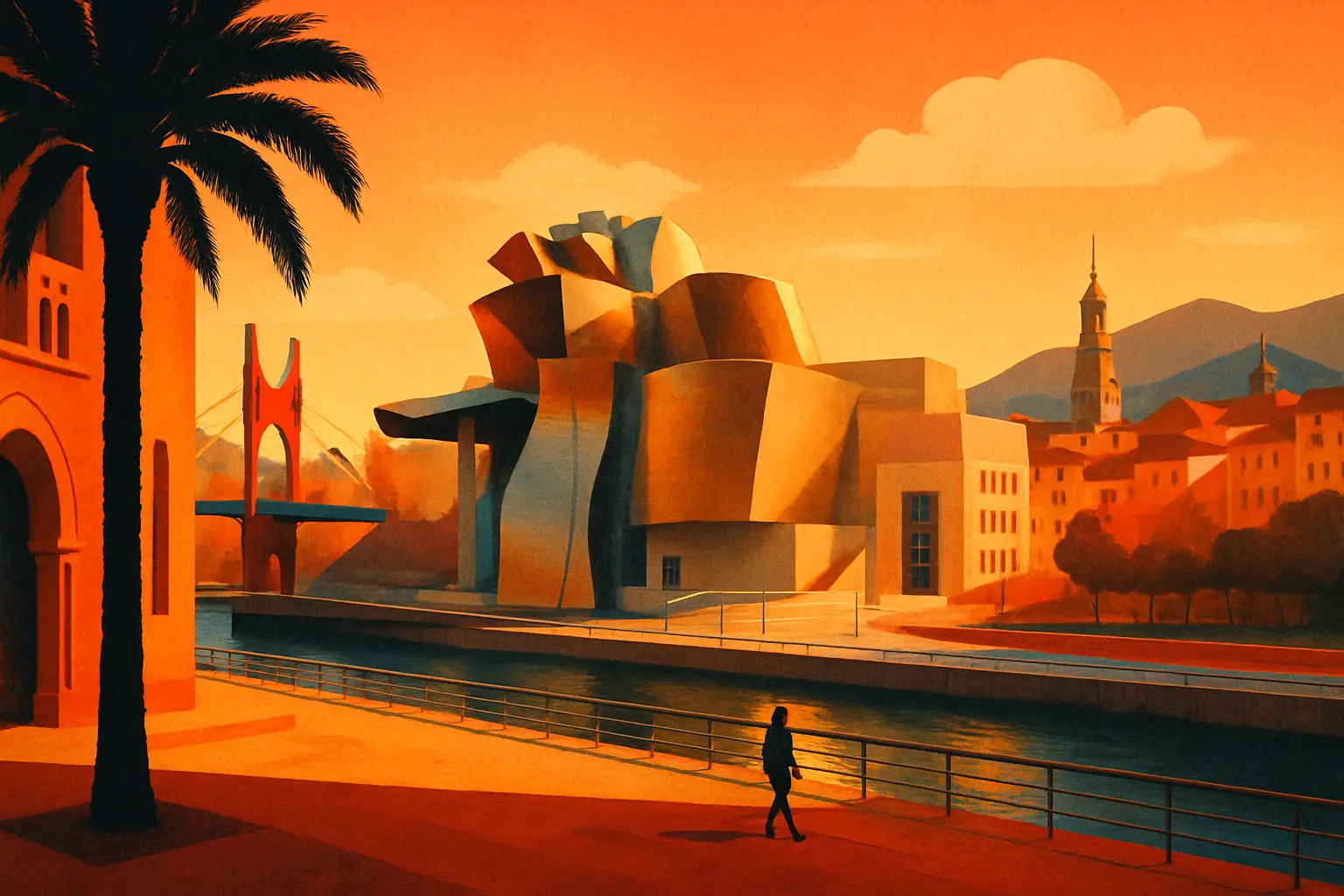
The Basque autonomous government's response, designed with consultants from major European cities and the Guggenheim Foundation, was not a single intervention but a coordinated program: clean the river, build a metro system (Norman Foster designed the distinctive steel-and-glass station entrances, known locally as Fosteritos), commission a new airport terminal, add a footbridge by Santiago Calatrava, and plant an iconic museum on the former dockland beside the Nervion. The Guggenheim opened in October 1997. In its first year, it attracted 1.3 million visitors to a city that had received around 400,000 tourists annually before. The phenomenon was named the Bilbao Effect — the idea that a single iconic building could regenerate an entire urban economy.
The argument has been complicated since. Bilbao's revival owed as much to the metro, the cleaned river, and the broader Basque economic recovery as to the museum alone. But the city that exists today — genuinely liveable, with a functioning medieval old town, an excellent food culture, and a waterfront where people actually want to be — is undeniably different from the one that existed 35 years ago. The museum is the reason most international visitors know to come; the city itself is the reason they stay longer than expected.
2. The Guggenheim Bilbao — Frank Gehry's titanium building and what is inside
The building at Avenida Abandoibarra 2 is one of the most photographed structures completed in the 20th century, and photographs consistently fail it. The standard description — titanium panels, riverside location, vaguely ship-shaped — understates how different it looks from every angle and at every hour. The exterior is covered in 33,000 titanium panels, each unique in shape and orientation, arranged to ripple across the curved surfaces like overlapping scales. In morning light the building is silver-blue; by late afternoon it warms toward gold. On overcast days it matches the Nervion's grey surface. It changes continuously, and looking at it from the riverside terrace for 20 minutes reveals different aspects that a single photograph cannot carry.
Inside, the most important space is the Fish Gallery — a 130-meter-long atrium on the ground floor, designed to hold works too large for any conventional museum room. Richard Serra's The Matter of Time (1994–2005) occupies it permanently: eight large-scale curved steel sculptures that visitors move through rather than around. Serra's intention was physical rather than visual — the steel walls lean, close in, and open around you as you walk, creating spatial disorientation and surprise that cannot be experienced from any single vantage point. It is the most viscerally interesting museum experience in northern Spain.
Temporary exhibitions rotate across three floors and 20 galleries. Check guggenheim-bilbao.eus before visiting for what's currently on view. The permanent collection includes major works by Mark Rothko, Willem de Kooning, and Eduardo Chillida — the Basque sculptor whose large-scale steel pieces appear throughout the building and surrounding plaza. Louise Bourgeois's giant spider sculpture Maman stands at the entrance on the riverside terrace and is worth several minutes of walking underneath.
3. Casco Viejo and the Siete Calles
Bilbao's medieval old town occupies the east bank of the Nervion, a 15-minute walk from the Guggenheim through the modern city center. The Casco Viejo was founded in 1300, and its core is still organized around the original seven streets — the Siete Calles — that constituted the entire city plan for the first two centuries of its existence: Barrenkale Barrena, Barrenkale, Carnicería Vieja, Belostikale, Tendería, Artekale, and Somera. The streets are narrow, shaded, and paved in stone. What they contain is not a medieval museum — most buildings are 19th-century replacements after fires — but a living neighborhood of food shops, pintxos bars, and the compressed density that only exists in districts continuously inhabited for 700 years.
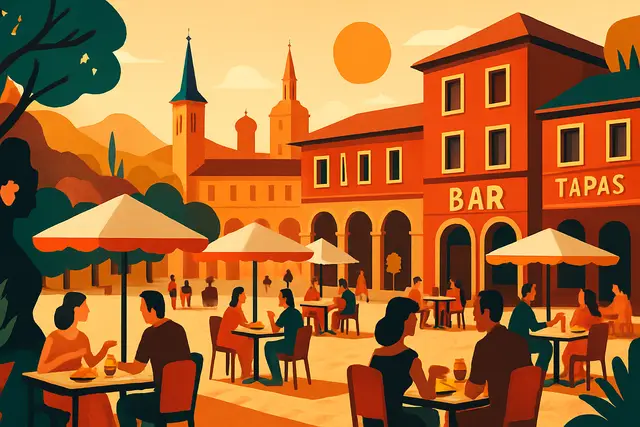
The anchor landmark is the Catedral de Santiago on Calle de la Esperanza, a Gothic structure begun in the 14th century with a cloister visible from the street. More interesting for explorers is the Basilica de Nuestra Senora de Begona, reached via escalators from Plaza de Unamuno up the hill above the Casco — the city's patron church with the best elevated view of Bilbao's old neighborhoods below. The Plaza Nueva (Arriaga Plaza, in some maps) is a colonnaded neoclassical square from 1851 that serves as the social center of the Casco: Sunday-morning antique market, pintxos bars open from noon, and a large terrace shaded by the colonnades. It is quieter than Madrid's Plaza Mayor and, accordingly, better.
4. The pintxos circuit — how Bilbao's bars differ from San Sebastian
Bilbao's pintxos culture is distinct from San Sebastian's in ways that matter for a first-time visitor. San Sebastian's Parte Vieja has been internationally famous for two decades and carries consequences: price creep, bars that have optimized for Instagram recognition, and an implicit expectation of food expertise. Bilbao's Casco Viejo operates differently — residents actually eat there in the evening, and the bars are accustomed to a mixed crowd without the self-consciousness that can accompany San Sebastian's more celebrated scene. For a comparison of how the Basque pintxos tradition developed across the region, that post covers the full cultural backstory.
•**Taberna Inakiren** (Calle Somera 45) — the Casco's most reliable traditional bar; rotating counter of classic preparations, consistent quality, local clientele
•**Bar Ledesma** (Calle Ledesma 8, Ensanche) — run by the same family for over 40 years; the txipirones en su tinta (squid in ink) is among the best in the city
•**Cafe Bar Bilbao** (Plaza Nueva 6) — the Plaza Nueva's most enduring bar, with a tiled interior from the 1920s and a classic vermouth-and-anchovy pairing for aperitivo hour
•**El Globo** (Calle Diputacion 8, Ensanche) — Bilbao's most respected pastry shop; the right place for coffee and a croissant before a morning Guggenheim visit
•**Bitoque** (multiple Ensanche locations) — a Bilbao minichain with modern Basque pintxos, consistent quality, and no tourist markup
5. Mercado de la Ribera and the Nervion waterfront
The Mercado de la Ribera at Erribera Kalea 22 faces the Nervion from the southern edge of the Casco Viejo and dates to 1929 — an Art Deco building with a stained-glass facade running 80 meters along the riverfront, which Guinness has cited as the largest covered market in Europe by floor area. The ground floor is where Bilbao's restaurants buy their fish; the upper levels are general produce, cheese, and meat stalls. It is a working market rather than a curated food hall, which means prices are low and the clientele is local in the mornings. Breakfast at one of the market cafes — coffee and a fresh pastry — runs €2.50–€3.
The renovated waterfront connects the Mercado to the Guggenheim in a 20-minute riverside walk. The route passes under the Zubizuri footbridge — designed by Santiago Calatrava, opened 1997, a white arched structure connecting the Casco Viejo side of the river to the Ensanche — and continues through the regenerated docklands to the museum. At several points along the path, old photographs mounted on panels show the waterfront as it existed before 1997: rusting cranes, industrial warehousing, and a river you could not see past the shore. The contrast with what stands there now is the clearest possible illustration of what the Bilbao Effect actually involved.
6. Day trip: the Vizcaya Bridge and the estuary towns
Bilbao's UNESCO World Heritage Site is 12 kilometers downstream, at the point where the Nervion estuary widens toward the Bay of Biscay. The Puente de Vizcaya — the Vizcaya Bridge — was completed in 1893 and is the world's oldest functioning transporter bridge. Rather than carrying vehicles across a fixed deck, it suspends a traveling gondola from a high iron framework, ferrying passengers and cars across the water while allowing tall ships to pass underneath unrestricted. It has operated continuously since opening, crossing roughly six million passengers a year, and UNESCO designated it a World Heritage Site in 2006 — the first industrial site in Spain to receive the designation.
The bridge connects Getxo on the right bank to Portugalete on the left. The gondola crossing takes 90 seconds and costs €0.45. Walking the upper footbridge, 45 meters above the water, costs €9 and gives a view over the estuary and the open sea beyond. Getxo's waterfront promenade — Belle Epoque villas, a sandy beach at Arrigunaga, and a lighthouse at the estuary mouth — is worth an hour regardless of whether you cross.
For a longer excursion, the Rioja wine region lies an hour southeast of Bilbao by car — a detailed guide to that day trip covers the route, the specific bodegas worth visiting, and how to pair the trip with a Bilbao pintxos evening on return.
7. How to get to Bilbao and how long to stay
Bilbao Airport (BIO) handles more than 6 million passengers a year and connects to most major European hubs, plus domestic routes to Madrid and Barcelona. Metro Line 3 connects the airport to the city center (Abando station) in 30 minutes for €3.25; a direct shuttle bus (Bizkaibus A3247) takes 30–35 minutes and costs €1.50. Taxis from the airport run €25–€35 depending on traffic.
•From Madrid: Renfe high-speed to Miranda de Ebro, transfer to Bilbao — total ~5h | From €25 advance booking
•From San Sebastian: Renfe or Euskotren, 70 minutes | Multiple daily services | €10–15
•From Barcelona: Train via Zaragoza or Pamplona, ~5h 30m | Book several weeks ahead in August
•Within Bilbao: Metro (€1.80) and Euskotram tram (€1.50) cover the main axis | Casco Viejo, Guggenheim, and Ensanche are all walkable — 20 min end to end
•How long to stay: 2 full days for Guggenheim + Casco Viejo + pintxos evening; add a half-day for the Vizcaya Bridge excursion | Budget €120–€180/night mid-range hotel in August
8. Is August a good time to visit Bilbao?
August is Bilbao's warmest and busiest month, but unlike Madrid or Seville — where August highs routinely reach 100–107°F — the Basque coast's Atlantic exposure keeps Bilbao in the 72–79°F range. Evening temperatures drop to the low 60s after 9 PM. Afternoon rain is common, as in any Atlantic climate; a light jacket and compact umbrella are practical rather than optional.
The Guggenheim is at peak crowding in August, but the free Tuesday evening sessions remain reliable. The Casco Viejo handles summer traffic well because the city's resident population of 350,000 provides enough local density to absorb tourists without displacing neighborhood character entirely. For a quieter version of the same city, September is the best month: crowds drop, hotel prices ease 20–30%, and the weather holds through mid-October.
For 2026 specifically: the solar eclipse on August 12 — in which Bilbao sat inside the path of totality with approximately two minutes of complete darkness at 10:10 AM — brought significant additional visitors to the Basque Country. That specific wave of eclipse tourism has passed, but the coverage raised international awareness of Bilbao as a destination, which typically translates into continued elevated travel interest through late August and September.