1. The man who built Salamanca — and how he lost everything doing it
Jose de Salamanca y Mayol (1811–1883) was, at various points in his life, a pharmacist's apprentice, a lawyer, a stockbroker, a railway developer, a government minister, a member of multiple royal courts, and one of the wealthiest men in Spain. He was also the person who invented the modern concept of real estate development in 19th-century Madrid — the idea that you could buy land, build an entire urban neighborhood from scratch, and sell or rent it to people who did not yet exist as a market.
In 1860, the Spanish government approved the Plan Castro — the first systematic urban expansion plan for Madrid, drafted by engineer Carlos Maria de Castro. The plan opened up the land northeast of the old city walls for development, dividing it into numbered zones. Salamanca bought a large section of Zone 3, the northeastern quadrant, and began construction almost immediately. He built wide, tree-lined streets with generous sidewalks. He imported architectural ideas from Haussmann's Paris — ornate facades, iron balconies, consistent building heights, ground-floor retail beneath residential apartments. He essentially willed a new neighborhood into existence through the force of his own capital and speculation.
The gamble worked architecturally. The neighborhood became exactly what he intended — the most prestigious residential address in Madrid, favored by the aristocracy, the industrial bourgeoisie, and later the diplomatic corps. The gamble failed financially. Salamanca had borrowed heavily to finance the development and was simultaneously losing money on railway investments that went wrong. He died in 1883 heavily in debt. Madrid's wealthiest neighborhood was named after a man who could not afford to live in it by the end of his life.
2. What the streets look like — and why Salamanca feels different from every other Madrid neighborhood
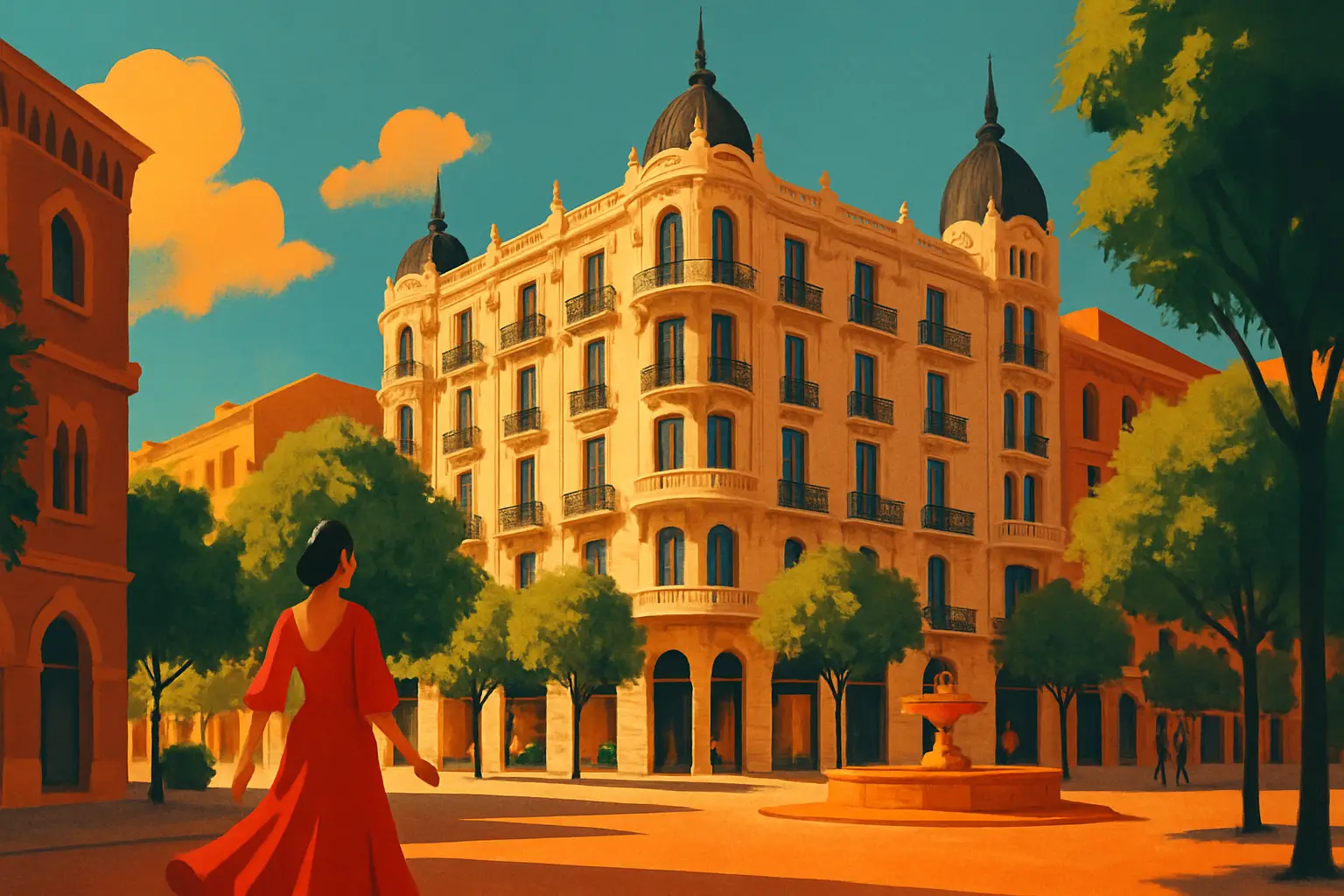
The most immediately obvious thing about walking through Barrio de Salamanca is the architecture. The buildings are 5–7 stories of ornate late 19th-century construction — Eclectic historicism with heavy French influence, elaborate cornices, ironwork balconies, sculptural decorative programs above windows and doorways, and a consistent material palette of stone and brick that gives the neighborhood its characteristic warm grey-gold color.
Barrio de Salamanca and Barcelona's Eixample were both built in the same two decades, both as planned urban extensions for wealthy residents, and both following a grid plan. The comparison stops there. The Eixample's plan was ideologically democratic — a uniform block size and street width that treated every address equally. Salamanca's plan was explicitly hierarchical: the principal arteries (Calle de Serrano, Calle de Velazquez, and the Paseo de la Castellana) are noticeably wider and grander than the connecting streets between them, and the corner buildings are more elaborately decorated than mid-block facades. The neighborhood was designed to have an A-side and a B-side, and it still does.
The most distinctive streets to walk are Calle de Velazquez (4-5 story Belle Epoque blocks in near-original condition, with relatively few ground-floor shop conversions) and Calle de Jorge Juan (where independent restaurants and a handful of luxury boutiques have colonized ground floors without disrupting the residential character above). The blocks around Calle de Lagasca hold some of the best-preserved early facades in the neighborhood.
3. Calle de Serrano and the Golden Mile: what the luxury shopping actually is
Calle de Serrano runs 2.3 kilometers from the Puerta de Alcala at Plaza de la Independencia to Plaza de la Republica Argentina at its northern end, bisecting the neighborhood from south to north. It is Madrid's principal luxury shopping street — the Spanish equivalent of London's Bond Street or Milan's Via della Spiga — and it has been marketed under the nickname La Milla de Oro (The Golden Mile) since at least the 1980s.
The reality on the ground is more layered than the marketing suggests. The southern end of Serrano, between Puerta de Alcala and Calle de Goya, is genuinely high-end: Loewe at number 26 (the oldest luxury leather goods brand in Spain, founded in Madrid in 1846) occupies a building that functions almost as a flagship museum of the brand's history. El Corte Ingles's premium department store at number 47 anchors the middle stretch. The northern end, above Calle de Juan Bravo, becomes more residential and is where the market street character that predates the luxury economy is still partially visible.
The street that the neighborhood's most serious residents actually treat as the luxury corridor is Calle de Ortega y Gasset, one block east of Serrano between Velazquez and Castellana. This is where Balenciaga, Manolo Blahnik, and the most expensive jewelry houses have their Madrid stores. There is almost no tourist foot traffic on Ortega y Gasset — it functions as a street for people who already know what they're looking for.
4. Mercado de la Paz: the neighborhood's 140-year-old living room
Mercado de la Paz at Calle de Ayala 28 opened in 1882, the same decade the neighborhood was being built, and has been serving the barrio's residents ever since. It is not a tourist market — there are no prepared Iberian ham plates laid out for photography, no Wagyu beef slices for €25, no overpriced smoothie bars. It is a working covered market that happens to be located in one of the most expensive neighborhoods in Spain, which means the quality of what's on offer is extraordinary and the clientele is largely Spanish.
The ground floor runs conventional market lines: a fish counter supplied daily from the Mercamadrid wholesale market, butchers offering everything from premium Iberian cuts to offal, produce vendors, and a delicatessen section with Spanish charcuterie and cheese. The upper level holds a bar and a handful of prepared food stalls where you can eat lunch for €8–12 seated.
The bar's breakfast service — from 8:30 a.m. on weekdays — is the market's best-kept open secret. Tostada con tomate y aceite (grilled bread rubbed with tomato and drizzled with olive oil) with cafe con leche costs under €3.50, the orange juice is squeezed to order, and the table facing the market floor gives you a direct view of the neighborhood doing its morning shop. This is how the residents of Salamanca have started their days for five generations. It is also completely unknown to anyone who comes to Madrid looking for 'authentic experiences' and goes to the Boqueria instead.
5. Museo Lazaro Galdiano: Madrid's best museum that nobody visits
At Calle de Serrano 122, set back from the street behind a garden, stands the Parque Florido — a neo-Renaissance mansion built in 1903 by Jose Lazaro Galdiano (1862–1947), a Navarrese publisher and collector who spent 50 years acquiring objects with the systematic intensity of someone who understood that accumulation was itself a form of knowledge.
Galdiano left his house and its entire contents to the Spanish state at his death in 1947. What the state received was 15,000 objects spread across 30 rooms, covering a span of 5,000 years. Medieval Limoges enamels. Flemish panel paintings. An extraordinary collection of clocks and scientific instruments. Five Goya paintings, including a small portrait of the Duke of Wellington that was stolen from the museum in 1961 and recovered in Venezuela 17 years later. Works attributed to Hieronymus Bosch and his school. Two paintings that may be by Leonardo da Vinci — their attribution is contested but the museum presents the case fairly.
The museum opened in 1951 and has never particularly tried to compete for visitors against the Prado, the Reina Sofia, or the Thyssen. Entry costs €7 (free Sundays until 3 p.m., free every afternoon after 4 p.m. Wednesday through Sunday). Typical weekday attendance is under 100 visitors. The rooms are almost entirely unmodified from Galdiano's original arrangement, which means you are seeing the collection more or less as he left it — an intimate and slightly overwhelming experience of one person's judgment applied to 50 years of acquisition. If you visit one museum in Salamanca that isn't on the standard Madrid itinerary, this is the one.
6. Museo Arqueologico Nacional: all of Spain's history in one building
Sharing a vast neoclassical building on Calle de Serrano 13 with the National Library — one of the most impressive institutional facades in Madrid — the Museo Arqueologico Nacional covers Spain's human history from the prehistoric cave cultures of the Cantabrian coast to the early medieval Christian kingdoms. Entry is €3, free on weekends and free every afternoon after 2 p.m.
The collection's most famous object is the Dama de Elche — a 5th-century BC limestone bust of an Iberian woman, discovered in 1897 at a site near Elche in the Valencia region. The sculpture is one of the most recognizable pre-Roman artifacts on the Iberian Peninsula: a formally composed portrait with elaborate headdress and jewelry that suggests both technical sophistication and cultural wealth. It was sold to France in 1897, displayed at the Louvre for 40 years, and returned to Spain in 1941 under an agreement between Franco and the Vichy government. The room in which it is displayed is designed around the sculpture and is worth visiting for the object alone.
Second in significance are the Visigoths' Guarrazar Treasure — gold votive crowns set with sapphires and pearls, found buried in a garden near Toledo in 1858, representing some of the finest examples of early medieval goldsmithing in Europe. The museum's Roman mosaic collection, much of it from excavations across Castile, is also exceptional and largely unknown outside specialist circles.
7. Getting to Salamanca, how long to plan, and what August looks like
Barrio de Salamanca is served almost entirely by Metro Line 4 (the brown line), with five stops crossing the neighborhood: Serrano, Velazquez, Goya, Lista, and Nunez de Balboa. The neighborhood's southern edge at Plaza de la Independencia is a short walk from Retiro station on Line 2 (red). From central Madrid (Sol or Gran Via), the journey takes about 10 minutes by metro.
The neighborhood is also directly adjacent to Parque del Retiro along its southern and western edges. The Puerta de Alcala — a 1778 neoclassical triumphal arch built by Charles III — marks the point where Calle de Serrano transitions into the park entrance. Walking from the Puerta de Alcala through Retiro to the Palacio de Cristal takes about 20 minutes.
August specifically: Barrio de Salamanca in August is calmer than at any other point in the year. Many of the neighborhood's permanent residents have relocated to their summer houses on the Cantabrian coast, in Galicia, or in San Sebastian for the month — a pattern that leaves Salamanca feeling somewhat emptied of its usual human texture. This is actually an advantage for visiting: the restaurants that remain open are doing local business rather than tourist business, the streets are walkable in the morning and evening without the density of October or May, and Mercado de la Paz has shorter queues. A half-day is enough to cover the main streets and one museum; a full day allows both the Lazaro Galdiano and the Museo Arqueologico Nacional plus a proper breakfast at the market and a walk into Retiro.
8. Common questions: safety, combining with other Madrid neighborhoods, and where to eat
Is Barrio de Salamanca safe? It is one of the safest neighborhoods in Madrid by every measure. Standard urban precautions apply on Calle de Serrano during peak shopping hours, but the streets around Velazquez and Lagasca are genuinely tranquil. There is essentially no street harassment, no late-night disturbance culture, and very little of the pickpocketing pressure that exists around Puerta del Sol and the Gran Via.
Where to eat? Taberna La Daniela at Calle del General Pardinas 21 is one of the most reliable places in Madrid to eat cocido madrileño — the chickpea and meat stew that is the city's defining winter dish (they serve it year-round, in three courses: first the broth, then the chickpeas and vegetables, then the meats). El Paraguas at Calle de Jorge Juan 16 has been serving Madrid's professional class since 1982; the croquetas de jamon are frequently cited as among the best in the city and the terrace is one of Salamanca's most pleasant places to have a long lunch. For a more casual midday meal, the Mercado de la Paz upper level does the job at a fraction of the price.
Can I combine Salamanca with [Malasana](/es/blog/madrid-malasana-neighborhood-guide)? You can, but the contrast is jarring enough to feel like visiting two different cities rather than two different neighborhoods. Salamanca to Malasana is a 25-minute walk or 15 minutes by metro (Serrano on L4 to Bilbao on L4, then one stop west) — the physical proximity makes the cultural distance between them more apparent. As a study in what Madrid's 19th-century urban expansion produced at opposite ends of the social spectrum, the comparison is interesting. As a single day's itinerary, it is ambitious. A morning in Salamanca and an evening in Malasana, with the afternoon somewhere else, works better than trying to do both in full.