1. Why Asturias feels like a different Spain — because historically it was
The Asturian coastline — 345 km of Atlantic cliff, estuary, and sand — sits at latitudes where summer heat is measured in the low 20s Celsius rather than the mid-30s. The Cantabrian Mountains, running parallel to the coast between 60 and 100 kilometres inland, block warm Mediterranean air in summer and create a microclimate closer to Ireland than to Andalusia. This is the green Spain that domestic tourists call España Verde, and in July and August it becomes the primary refuge for Madrileños, Sevillanos, and Valencians seeking relief from heat that makes their own cities difficult to inhabit.
The historical consequence of this geography is equally significant. The Cantabrian Mountains also stopped the Moorish invasion of 718 CE, which swept through most of the Iberian Peninsula and established Al-Andalus within a decade of entering at Gibraltar. A small Christian kingdom, the Kingdom of Asturias, survived in these mountains — first at Cangas de Onís, then at Oviedo. From Oviedo, Asturian monarchs launched what would eventually become the centuries-long Reconquista, the recovery of the peninsula from Moorish rule. Asturias is, in a precise historical sense, the origin point of modern Spain. Its residents carry this fact with the particular quiet pride of people sitting on something important that others keep overlooking.
2. Oviedo: Spain's oldest Christian architecture and the cider boulevard
Oviedo is a mid-sized city of around 225,000 people that has almost entirely avoided the international travel circuit. Its historic center — walkable in under an hour — contains pre-Romanesque buildings that predate the rest of standing Spain by centuries.
The three essential monuments are on or near Monte Naranco, a hill 3.5 km northwest of the old city (bus line 10 from Calle Uría, or a 40-minute walk). Santa María del Naranco was built in 848 CE as a royal hall for King Ramiro I — converted to a church in the 10th century — and its barrel-vaulted nave and open loggia galleries represent a building style that has no direct precedent in European architecture. It predates Romanesque by 200 years and is structurally unlike Visigothic or Roman work: a genuinely original thing, built at the edge of a besieged Christian world. San Miguel de Lillo, 200 metres further up the hill and built simultaneously, preserves Byzantine ivory carvings on its doorjambs that are the oldest figurative sculpture remaining in Spain. Combined admission to both: €6. Both close Mondays.
In the city center, the Catedral de San Salvador houses the Cámara Santa (Holy Chamber), a 9th-century pre-Romanesque chapel containing the Sudarium of Oviedo — a cloth held by Catholic tradition to have covered Christ's face at burial — and the Cruz de los Ángeles (805 CE), the oldest documented altar cross in medieval Spain. Admission €7.
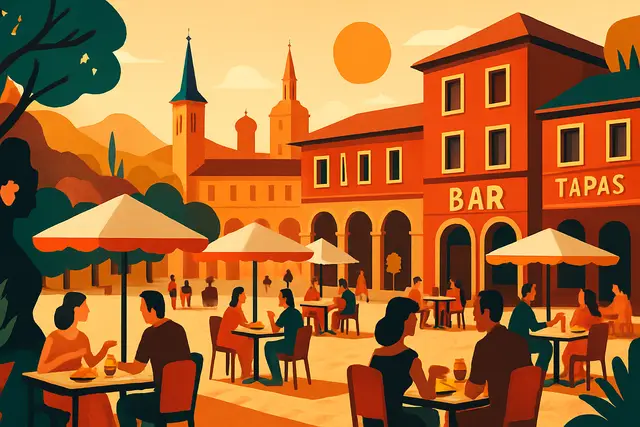
A 10-minute walk northwest from the cathedral reaches Calle Gascona, officially the *Bulevar de la Sidra* (Cider Boulevard): a single street lined end-to-end with sidrerías where the full experience — fabada, grilled meat, cider, conversation — plays out at long communal tables, typically from 1 p.m. for lunch and from 8 p.m. for dinner. This is where Oviedo's cider culture is most concentrated and most visible.
3. The escanciado ritual: why Asturian cider is UNESCO heritage
Asturian cider is not what most visitors picture when they hear the word. Sidra natural is unfiltered, lightly tart, made exclusively from Asturian apple varieties — Verdialona, Raxao, Ernestina, Xuanina among others — under a Protected Designation of Origin established in 2003. It has an ABV of 5–6%, a dry vinegary edge, and a flavor profile closer to aged farmhouse cider than anything sold in a can. UNESCO inscribed Asturian cider culture as Intangible Cultural Heritage in 2023, placing it alongside flamenco and Neapolitan pizza-making as a practice worth protecting.
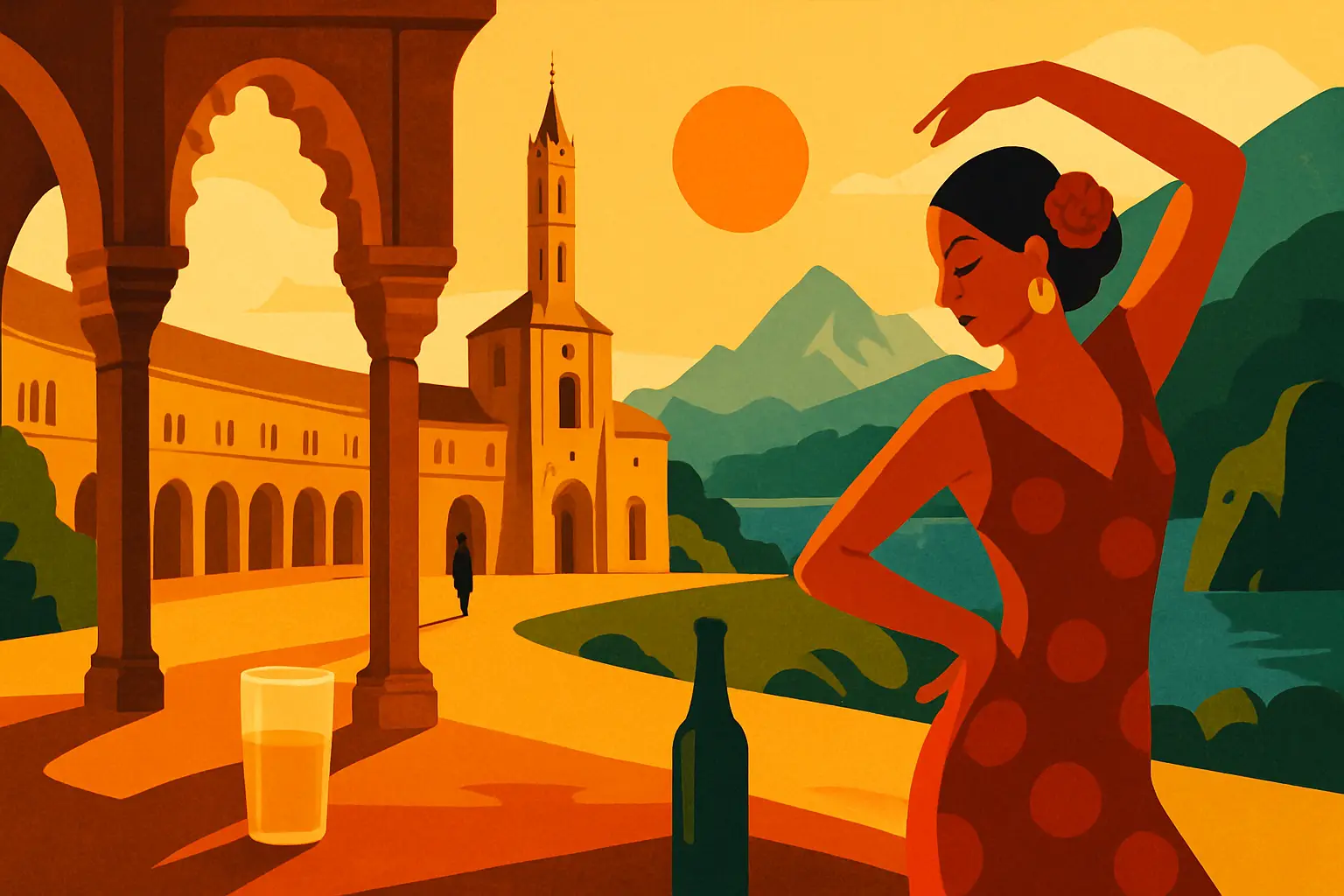
The ritual that earned that designation is the escanciado: pouring from a bottle held at full arm's length above the head, into a glass held at hip level, from a distance of 60–80 cm. The fall aerates the cider as it hits the glass, creating a brief natural carbonation that does not survive. The resulting pour — a culín of approximately 100–120 ml — must be consumed immediately. You are drinking the aeration itself, and it dissipates within 30 seconds. The drinking rhythm of an Asturian evening is therefore determined by the pour: conversation pauses, the culín is served, everyone drinks, conversation resumes. There is no sipping over time.
On Calle Gascona in Oviedo, the pour is performed either by a trained *escanciador* (waiter) or, in more casual sidrerías, by customers who request to do it themselves and are prepared to be assessed by the table next to them. A bottle of sidra costs €3–€4.50 and contains roughly 6–8 culines — a dinner for two typically involves two bottles alongside food. Asturias produces 80% of Spain's cider output and is the fourth-largest producer in Europe. It has been doing this since at least the 16th century, and the ritual has not fundamentally changed.
4. Picos de Europa: the Ruta del Cares and how to visit
Spain's first national park (designated 1918), the Picos de Europa rises from coastal Asturias to limestone peaks of 2,600 metres within 25 kilometres of the Atlantic — a vertical compression that has no equivalent elsewhere in Spain. From the coastal foothills, the Picos appear as a wall of grey-white limestone jutting from the horizon. From inside the park, the scale becomes personal.
The defining trail is the Ruta del Cares: a 12.5 km one-way path (25 km return) cut into the vertical walls of the Cares Gorge, running between Poncebos (Asturias) and Caín (Castile and León). The path follows the gorge at near-constant altitude, with the Cares river 200–300 metres directly below and limestone walls rising above. It is not technically difficult — no scrambles or exposed ridges — but the path is narrow, the exposure is real and continuous, and there is nothing to buy inside the gorge. Total time: 5–6 hours return at a moderate pace. Bring at least 2 litres of water per person.
For a shorter introduction to the park, the Fuente Dé cable car (in the Cantabrian section, approximately 1 hour 30 minutes from Poncebos by car) rises 800 metres in 4 minutes to a plateau at 1,823 metres with views across the central massif. It runs daily 10 a.m.–6 p.m.; tickets €12 one way, €18 return. Book online in August — walk-up queues regularly exceed 2 hours.
Public access from Oviedo: ALSA bus to Cangas de Onís (1 hour, approximately €7), then taxi or rental car to Poncebos (30 minutes, no direct public transport). A rental car from Oviedo or Gijón (€35–€55/day) is the most practical approach and allows combination with the coastal villages of eastern Asturias — Llanes, Lastres, Ribadesella — on the same trip.
5. Gijón: the port city that does not perform for tourists
Gijón is Asturias's largest city (approximately 270,000 people) and its de facto summer capital — the city where Asturian families from the interior come in August to sit on the beach, drink cider on the promenade, and eat grilled sardines at fish restaurants that have not adjusted their prices for a tourist audience. It does not market itself to international visitors, which makes it one of the most genuinely interesting places to spend two days in northern Spain.
Playa de San Lorenzo is a 1.5 km urban beach running along the eastern face of the Santa Catalina headland, separating the old fishing quarter from the newer city. In high summer, San Lorenzo operates at beach-resort intensity without the infrastructure having been optimized for it — the bars along the Paseo de Begoña are local establishments rather than international brands, and the crowd is overwhelmingly Spanish. This is what domestic beach culture looks like when it has not been overwritten by the international kind.
The old fishing quarter, Cimavilla, sits on the headland above the beach: a dense grid of narrow streets, sidrerías, and fish restaurants that has remained functionally unchanged while the rest of the city modernized around it. The best Asturian cooking in Gijón is consistently found here, along Calle San Bernardo and the cluster of grills around the small harbor at Calle Pescadores.
Five kilometres southeast of the center stands the Universidad Laboral (now Laboral Ciudad de la Cultura): a Francoist-era complex (1946–1956) designed by Luis Moya Blanco and the largest building constructed in Spain in the 20th century. Its neoclassical colonnades, interior courtyards, 130-metre bell tower, and opera house occupy a scale that makes the politics that built it impossible to ignore. Free to enter; guided tours available most mornings.
6. What to eat in Asturias: fabada, cachopo, Cabrales, and everything else
Asturian cuisine is dense, protein-driven, and built for cold months — which means that in summer, when the rest of Spain is eating gazpacho and fried fish, Asturias is still serving the same stews and slow-cooked meats it serves in February. The visitor who leans into this rather than looking for a lighter Mediterranean alternative eats extremely well.
•**Fabada asturiana** — The defining dish: white fava beans (fabes de la Granja, PDO) slow-cooked with blood sausage (morcilla asturiana), chorizo, and salted pork shoulder (lacón) until the beans have absorbed the fat of the meat and the broth has thickened to a dense, dark liquid. Served at every restaurant in Asturias; €12–€16. Do not eat it the night before a Picos de Europa hike.
•**Cachopo** — Two thin sheets of veal or beef enclosing jamón serrano and melted Asturian cheese, breaded together and deep-fried until the outer crust is crisp and the interior continuous. A full cachopo is typically 30–40 cm long. Restaurants note the size on the menu for a reason. Expect €18–€25; sharing is optional but advised on a first visit.
•**Cabrales** — Blue cheese aged in the limestone caves of the Picos de Europa, PDO, produced in and around **Arenas de Cabrales**. The Cueva del Queso Cabrales (€3 admission) lets you see ageing wheels in the actual cave. Sharper, wetter, and more mineral than Roquefort. A 200g wedge costs €6–€8 at cave-side shops; do not refrigerate it for more than 2 days after purchase.
•**Queso Gamonéu** — Semi-aged, lightly smoked mountain cheese from the Onís and Cangas de Onís municipalities. Less aggressive than Cabrales and a reliable entry point into Asturian cheese culture. Also excellent melted inside a cachopo.
•**Merluza a la sidra** — Hake poached in Asturian natural cider with clams, onion, and parsley. The cider contributes acidity and a faint tannin without overpowering the fish; no lemon required. A reliable main course at any sidrería with a kitchen, €14–€18.
•**Arroz con leche** — Rice pudding with a caramelized sugar crust: the Asturian dessert that every restaurant makes and no one abroad talks about. The cinnamon-to-cream ratio in the Asturian version is higher than in the Castilian, and the best versions have a faint citrus note from lemon zest worked into the rice. €4–€6.
7. When to visit Asturias, how to get there, and what to budget
Asturias rewards planning more than most Spanish destinations because the Picos de Europa requires a car or advance transport coordination that the south's beach infrastructure does not. The logistics are not complicated, but they need to be thought through before arrival.
•**Best months:** July and August for beaches and outdoor culture (18–24°C coast, long days, full festival calendar including the Festival de la Sidra Natural de Gijón in late August). September for Picos hiking — cooler air, significantly fewer people on the Ruta del Cares, and the trails in their best condition. October for the sidra harvest season.
•**Avoid:** November through February unless you are prepared for persistent Atlantic rain and short days. Asturian winters are genuinely wet.
•**Flying in:** Asturias Airport (OVD), 45 km from Oviedo and 30 km from Gijón, has direct connections to Madrid, Barcelona, London Stansted, and Dublin. Bus from OVD to Oviedo (ALSA): 45 minutes, approximately €8.
•**Train from Madrid:** Alvia from Madrid Chamartín to Oviedo, approximately 4 hours 40 minutes, €40–€70 depending on booking window. Reserve at least a week ahead in July and August — seats sell out.
•**Driving from Bilbao:** approximately 3 hours on the A-8 coastal motorway. The drive itself is excellent and passes through the coastal towns of Cantabria. From San Sebastián: approximately 3 hours 30 minutes.
•**Within Asturias:** Oviedo and Gijón connected by ALSA bus (30 min, €3) and Renfe (30 min, €3.35). For Picos access and coastal villages, rent a car (€35–€55/day from either city). The N-632 coastal road between Avilés and Llanes is one of the finest driving routes in northern Spain.
•**Daily budget:** €80–€120 covers mid-range accommodation (hotel or rural casa rural), two meals with cider, and transport. Budget travelers using the menú del día (€13–€15 for three courses with drink, Mon–Fri lunch) and staying in hostels can manage €50–€65.
•**Camino connection:** The **Camino Primitivo**, the oldest of all Camino routes, begins in Oviedo and follows the Asturian interior west toward Galicia. The **Camino del Norte** follows the coast. Both pass through or alongside Asturias. For pilgrimage planning, see our [Camino de Santiago guide](/es/blog/camino-de-santiago-frances-route-practical-guide).