The standard Madrid day trip shortlist runs to Toledo (90 minutes by bus or AVE, €10–15 each way), Segovia (27 minutes by AVE, €12 each way), and Cuenca (55 minutes by AVE, €15–20 each way). Alcalá de Henares does not make that list in most travel guides despite being closer, cheaper, and carrying a UNESCO designation that places it alongside the historic centers of Salamanca and Toledo.
The UNESCO inscription in 1998 was specific: "University and Historic Precinct of Alcalá de Henares." The citation named the city as the first and most complete example of a Renaissance university city — one conceived from the ground up as an institution of learning rather than a historic city that later acquired a university building. The distinction matters because what you see in Alcalá is not a cathedral that grew a college next door. The entire urban plan — its streets, colleges, convents, printing houses, and public squares — was built to support scholarship. No other city in Europe was designed this way first.
In late August and September, Alcalá enters one of its best periods for visitors: summer crowds ease, all museums remain on summer hours through August 31, and the university's return in October gives the streets an anticipatory energy as students begin arriving for the new academic year.
The University of Alcalá was founded in 1499 by Cardinal Francisco Jiménez de Cisneros — confessor to Queen Isabella I of Castile, twice regent of Spain, and one of the most powerful ecclesiastical figures of the early 16th century. Cisneros' model for Alcalá was deliberately different from the medieval universities at Salamanca or Oxford, which had grown organically through royal patronage and church sponsorship over centuries. Alcalá was to be a planned city of learning: built from scratch on a coherent grid, with 42 colleges and student residences arranged around the central Colegio Mayor de San Ildefonso on Plaza de San Diego.
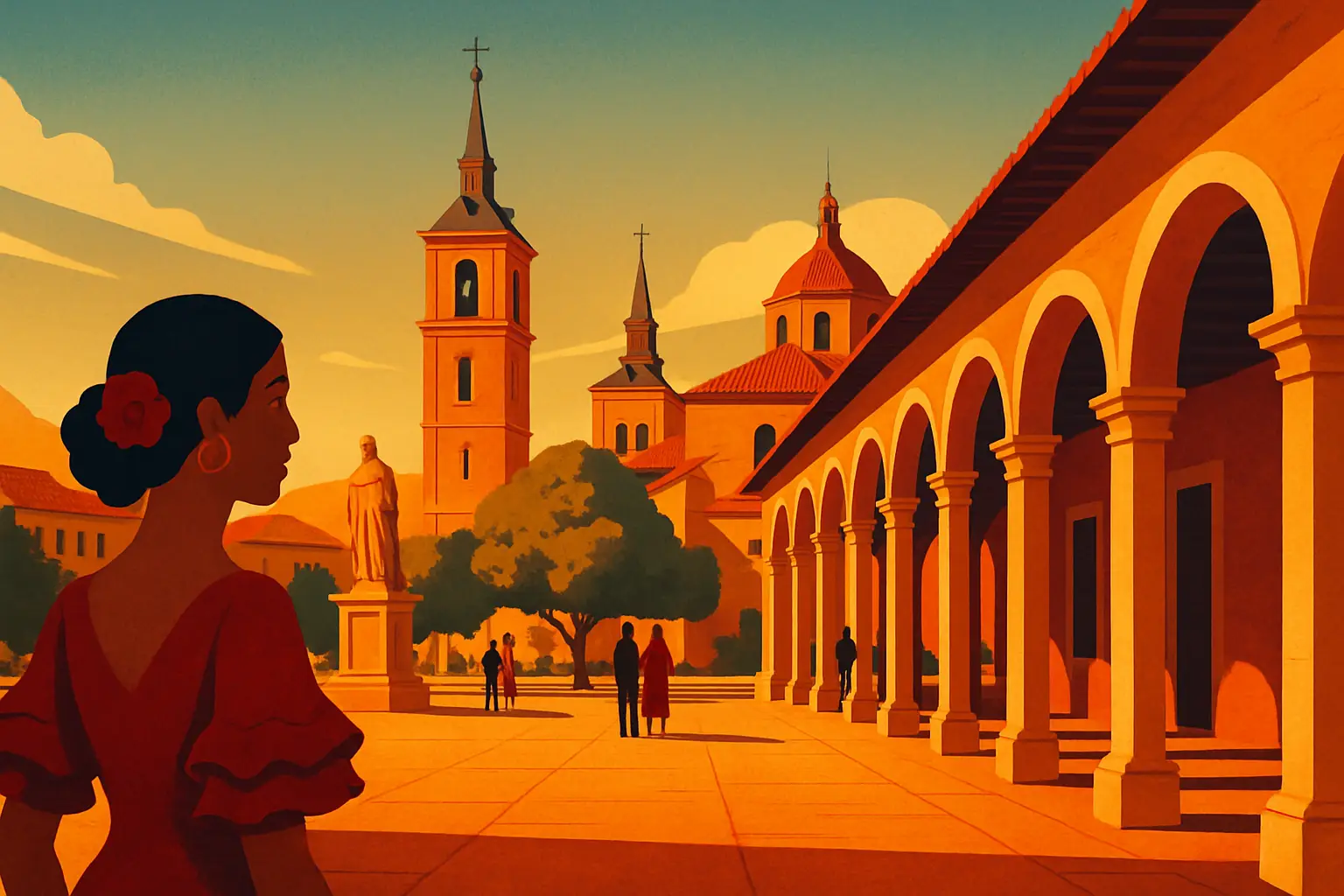
The Colegio Mayor de San Ildefonso is the visual centerpiece of the historic campus. Its plateresque stone facade, completed in 1553, is carved with the Cisneros heraldic shield, the Franciscan cord motif (Cisneros was a Franciscan friar before becoming a cardinal), and heraldic imagery that announced an institution of public purpose rather than private power. The facade faces onto Plaza de San Diego — a wide, austere square whose proportions were designed to put the university's ambition on display.
Cisneros' most consequential project was the Biblia Políglota Complutense — the Complutensian Polyglot Bible — commissioned around 1502 and printed between 1514 and 1517 at the Alcalá press of Arnao Guillén de Brocar. It was the first critical scholarly edition of the Bible: Hebrew, Aramaic, Greek, and Latin texts printed in parallel columns so scholars could compare sources directly. Six hundred copies were produced. The project required recruiting Greek and Hebrew scholars to establish the most accurate possible text in each language — a scholarly ambition that helped define what Renaissance humanism meant in practice, and that preceded Erasmus' New Testament by a year.
Get short, interactive stories that make each place easier to remember while you travel.
Inside the Colegio Mayor de San Ildefonso, the Paraninfo is the ceremonial Great Hall — a rectangular room with a carved artesonado ceiling and stone galleries on three sides that date to the 16th century. The room seats approximately 300 people on wooden benches that have occupied the same positions since the building was completed.
Since 1976, the Paraninfo has hosted the annual Premio Cervantes ceremony — Spain's highest literary award for Spanish-language fiction, poetry, and essay, presented by the King of Spain on April 23 each year, the date of Cervantes' death in 1616 (which, by a famous historical coincidence, is also the date William Shakespeare died). Recipients have included Jorge Luis Borges, Octavio Paz, Dulce María Loynaz, and Rafael Cadenas. The ceremony's choice of venue is not merely symbolic: the Paraninfo is a working lecture hall, not a museum showpiece, and placing the prize here anchors it to scholarship and teaching rather than statuary.
The guided tour passes through the Paraninfo, the Capilla de San Ildefonso (where Cardinal Cisneros' elaborate stone tomb stands — one of the finest Renaissance funerary monuments in Spain), and the Patio Trilingüe, the Cloister of the Three Languages, named for the Hebrew, Greek, and Latin curriculum Cisneros built the university around. The cloister is the most serene space on the tour — a two-story stone arcade built to monastic proportions, typically quiet even on summer afternoons.
Miguel de Cervantes was baptized on October 9, 1547, at the parish church of Santa María la Mayor in Alcalá de Henares. The baptismal record, preserved in church archives and extensively studied since the 19th century, establishes both the date and the city with certainty.
The Casa Natal de Cervantes at Calle Mayor 48 is a reconstruction: the original Cervantes family house was demolished at some point in the 18th century. The current 16th-century-style building, constructed in the early 20th century on the same plot, was designed to approximate the layout and furnishings of a middle-class Alcalá home from the 1540s. The Cervantes family was lower-middle-class — Rodrigo de Cervantes, Miguel's father, was a barber-surgeon who moved frequently to find work — so the reconstruction represents an aspirational rather than precise picture of their circumstances. What it communicates accurately is the physical scale of 16th-century domestic life: low ceilings, a central courtyard, small windows, and rooms whose multiple purposes (eating, sleeping, receiving patients) leave no space for modern categories of domestic organization.
The museum includes early editions of Don Quijote alongside panels explaining the novel's composition and context. Cervantes completed Don Quijote Part I in 1605 at the age of 57, after decades of financial difficulty — imprisonment for debts, work as a tax collector and naval victualing officer for the Armada. By the time he published what would eventually be called the first modern novel in the Western tradition, he had been working at the margins of Spanish literary culture for over thirty years.
The main pedestrian street of Alcalá's historic center is Calle Mayor, running approximately 750 meters from the train station side of the old town to the university buildings at Plaza de San Diego. Both sides of the street are lined with Renaissance-era stone and timber arcades — continuous covered walkways whose proportions were designed for a market street but now shelter cafés, bookshops, and pastry sellers.
At the western end of Calle Mayor, the Catedral Magistral de los Santos Niños Justo y Pastor holds a distinction found only in two churches worldwide. Its "Magistral" title — dating to the 13th century and still legally operative — means that only priests holding a doctorate may serve as canons of the chapter. The other Magistral church is in Leuven, Belgium. The present Gothic structure, begun in the 15th century, contains a carved Renaissance high altarpiece and a sacristy with Flemish choir stalls that predate the building's later modifications. Entry is free.
On Plaza de Cervantes — the city's main square and the social center of the historic town — the Corral de Comedias is one of the oldest surviving open-air theater courtyards in Spain. Built in the 17th century in the classic corral format (a rectangular courtyard with tiered wooden galleries on three sides and a raised stage), the theater still hosts performances; check the schedule at teatrocervantes.com.
Along Calle Santiago, the Palacio Arzobispal (Archbishop's Palace) marks the birthplace of Catherine of Aragon — born December 16, 1485 to Ferdinand and Isabella during their residence at the palace. Catherine would later become the first wife of Henry VIII of England, and her marriage's annulment would precipitate the English Reformation. The palace exterior is accessible from the street; the interior opens occasionally for cultural events.
Catedral Magistral: Plaza de los Santos Niños. Open Monday–Saturday 10:00 AM–1:30 PM and 5:00–7:30 PM, Sunday 11:00 AM–2:00 PM. Free.
Corral de Comedias: Plaza de Cervantes. Check teatrocervantes.com for the summer performance schedule — tickets typically €8–15.
Palacio Arzobispal: Calle Santiago 17. Exterior viewable at all hours; check with the Alcalá tourist office (Calle Santa Trinidad 1) about interior access.
Alcalá's food identity is shaped by its Castilian location and university population, which keeps prices consistently lower than tourist-heavy destinations like Toledo or Segovia.
**Almendras garrapiñadas** — sugar-glazed whole almonds sold from carts on Plaza de Cervantes and Calle Mayor. The tradition is tied to university fair days and has been a city specialty for at least three centuries. Around €2 per bag from street vendors.
**Menú del día** — restaurants on Calle Mayor and around Plaza de Cervantes serve three-course lunches with wine for €10–12, several euros cheaper than equivalent meals in Madrid. Mesón El Bodegón (Calle Mayor 23) and Restaurante Hostería del Estudiante (Calle Colegios 3, inside a historic university building) are established choices for Castilian standards: roast meats, legume stews, and vegetable dishes from the Henares valley.
**Rosquillas** — dry ring-shaped pastries flavored with anise, traditionally associated with the area's religious fairs. Pastelería El Estudiante on Calle Libreros makes a version that has been on their counter since the 1950s.
Getting there: Renfe Cercanías C-2 from Madrid Chamartín, Nuevos Ministerios, Recoletos, or Atocha to Alcalá de Henares station. Trains run every 10–15 minutes during the day; no advance booking required. Journey time approximately 40–50 minutes. Single ticket €3.60–€4.50. From the station, the historic center is a 15-minute walk west on Paseo de la Estación; buses also run to Plaza de Cervantes.
How long: A focused half-day (4–5 hours) covers the university tour, Casa Natal de Cervantes, and Calle Mayor. A full day (7–8 hours) adds the Catedral Magistral, the Corral de Comedias, a proper menú del día lunch, and time to walk the town without feeling rushed. Late August and September are particularly good: summer hours are still in effect, the worst of the heat has eased, and visitor numbers are lower than July.
Compared to Toledo and Segovia: Toledo is bigger, farther (€14–20 return by AVE), and significantly more crowded in summer — essential for the cathedral and El Greco, but exhausting in August. Segovia has the aqueduct, the Alcázar, and cooler temperatures at altitude — see our Segovia August day trip guide for how to make that trip work in the heat. Alcalá is the right choice if you want a UNESCO city with serious historical depth, minimal crowds, and the lowest budget of any day trip from Madrid. It lacks a single overwhelming landmark comparable to the aqueduct or the Alhambra, but the combination of university architecture, the Cervantes connection, the Paraninfo, and authentic Castilian street life produces a day that most visitors describe as the most human-scale experience on the entire Madrid day-trip circuit.
Is one day enough? The Casco Histórico and its main sites can be covered comfortably in 5–6 hours. Some visitors return specifically to attend a Corral de Comedias evening performance — a different experience from a daytime visit, and one that uses the building exactly as it was intended.