1. Why Cuenca is the day trip Madrid visitors keep overlooking
Most Madrid-based day trips follow the same short list: Toledo for the medieval city, Segovia for the aqueduct, El Escorial for the monastery. Cuenca appears on fewer itineraries because it requires a slight leap of faith — the marketing imagery of Spanish castles and sun-soaked plazas does not quite capture what makes it distinctive. What makes it distinctive is geology.
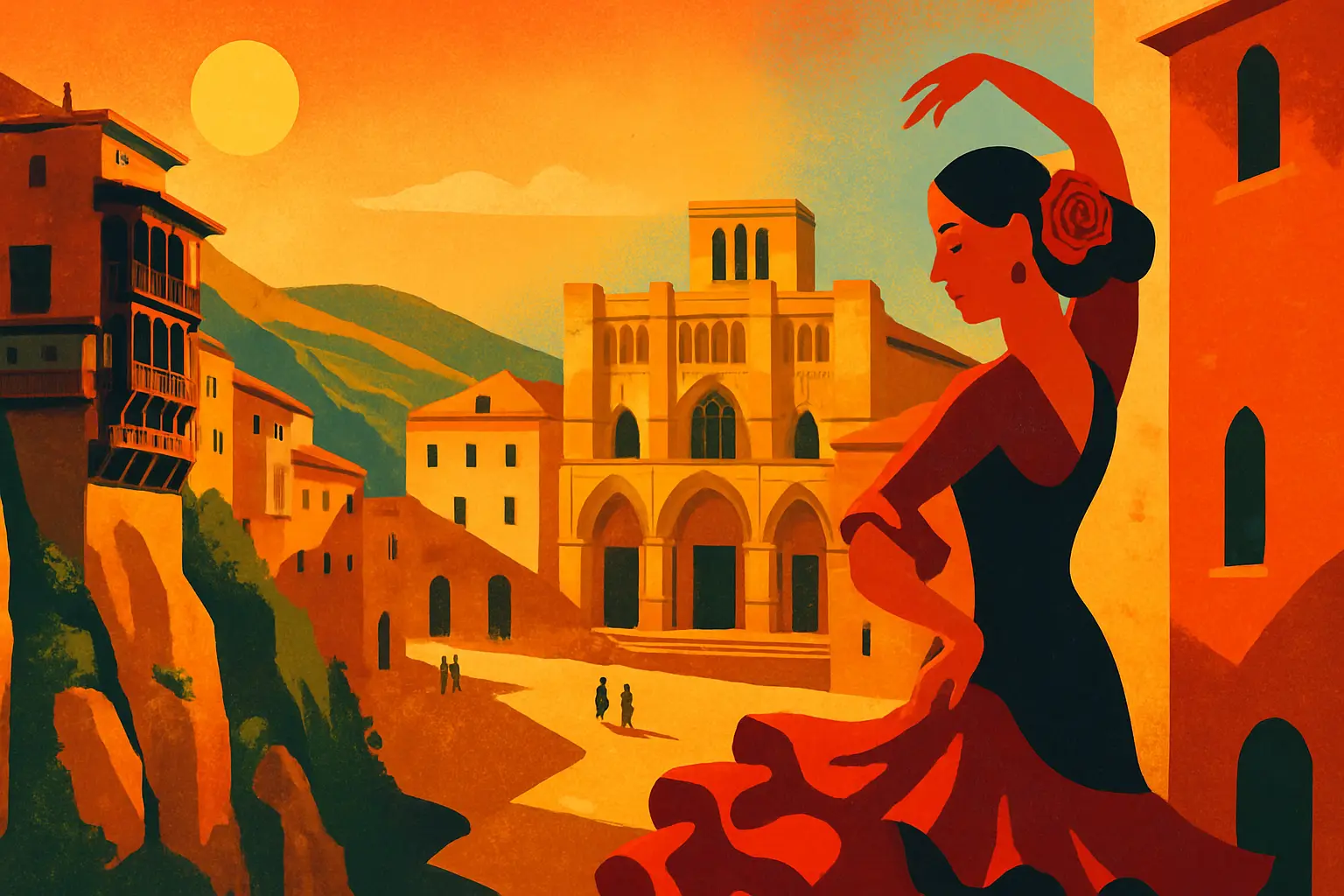
The old city occupies a narrow promontory of rock between the Huécar and Júcar river gorges. Medieval builders had no flat land to expand onto, so they built upward and outward — houses were constructed against the cliff edge, with wooden balconies and upper floors projecting over the void. On the Huécar side, where the gorge is deepest, this produced the Casas Colgadas (Hanging Houses), a cluster of 15th-century structures whose facades appear, from the bridge across the ravine, to float without visible support.
Cuenca has been a UNESCO World Heritage City since 1996. It has a Gothic cathedral begun in the 12th century, a remarkable modern art museum inside one of the Hanging Houses themselves, a castle promontory viewpoint, and a new-town approach that is entirely navigable by escalator. The high-speed AVE train from Madrid Puerta de Atocha to Cuenca Fernando Zóbel station takes approximately 55 minutes, and the station itself is named after the painter who spent three decades restoring the city's cultural reputation. None of this is obscure. The visitor numbers have simply not caught up to the reality.
2. The Casas Colgadas: what you are looking at and why medieval architects built homes over a cliff
The Casas Colgadas — literally 'hanging houses' — on the eastern edge of the Casco Antiguo are not a curiosity of architectural risk-taking. They are the logical outcome of building on a narrow promontory where land at the cliff edge was effectively free. In the 15th century, Cuenca's population was expanding within fixed geographic constraints: the Huécar gorge to the east, the Júcar to the west, and a steep descent in every direction. The only direction to go was out — over the gorge edge, supported by timber frames anchored into the rock.
Of the original cluster of hanging houses on the Huécar side, three main structures survive in restored condition. Their wooden balconies project approximately 40 meters above the river below. From Calle Canónigos in the old city, they look like standard medieval townhouses. From the Puente de San Pablo — the iron pedestrian bridge rebuilt in 1902 on the foundations of an earlier convent crossing — they look like something that should not be standing.
The bridge itself deserves a moment. It replaced a wooden bridge used by the adjacent Convento de San Pablo (now a four-star parador hotel) and offers the most photographed angle on the Casas Colgadas. In early morning, before tour groups arrive from Madrid, the view down the gorge from the bridge is unusually quiet for a UNESCO site. If you are in Cuenca only for one afternoon, the sequence of Puente de San Pablo → Casas Colgadas → the walk along Calle Canónigos back to Plaza Mayor covers the old city's visual highlights in under an hour on foot.
•The Casas Colgadas are located at Calle Canónigos, s/n — follow the signs east from Plaza Mayor for about 5 minutes on foot.
•The Puente de San Pablo footbridge is free and open at all hours. The adjacent Parador de Cuenca (converted from the 16th-century Convento de San Pablo) serves lunch and dinner; a meal there runs €35–€50 per person but includes a terrace view down the gorge.
•Entry to the Museo de Arte Abstracto Español inside the Casas Colgadas is €3 — among the cheapest museum admissions for the quality of the collection.
3. The Museo de Arte Abstracto Español: how one painter turned a crumbling medieval building into Spain's best argument for abstract art
In the late 1950s, the Spanish-Filipino painter Fernando Zóbel moved to Cuenca. The city was economically declining and its medieval buildings were deteriorating. What Zóbel saw was a place whose visual qualities — the dramatic light, the verticality of the gorge, the bleached stone — corresponded to something he wanted to understand in painting. By 1966, he had opened the Museo de Arte Abstracto Español inside two of the Casas Colgadas, donating his personal collection and collaborating with sculptors Gustavo Torner and Gerardo Rueda to adapt the medieval interiors.
The collection he assembled reads now as a concentrated record of Spanish abstract painting under and immediately after Franco's rule. The artists included — Antonio Tàpies, Manuel Millares, Luis Feito, Antoni Clavé, alongside Zóbel, Torner, and Rueda themselves — were working during years when Spanish visual culture was either state-approved academicism or underground experiment. Abstraction was not illegal, but it was politically legible: a refusal of figuration was also, in many cases, a refusal of the regime's preferred imagery of history and military triumph.
The building enhances the collection rather than competing with it. The narrow rooms, the views down through small windows to the gorge, and the exposed timber construction create an intimacy unusual in museum spaces. A painting by Tàpies mounted on a wall of rough plaster, with the gorge visible through the window beside it, operates differently than it would in a white-cube gallery. This is precisely what Zóbel intended.
The museum is managed by the Fundación Juan March, which also runs the Juan March Museum in Madrid. Opening hours: Tuesday to Friday 11 a.m.–2 p.m. and 4–6 p.m.; Saturday 11 a.m.–2 p.m. and 4–8 p.m.; Sunday 11 a.m.–2:30 p.m. Closed Mondays.
4. The Cathedral of Cuenca: Spain's first Gothic church and a controversial 20th-century reconstruction
Construction on the Cathedral of Cuenca began in the 12th century, shortly after King Alfonso VIII of Castile recaptured the city from the Moors in 1177. It is one of the earliest Gothic buildings in Spain, and its design reflects Anglo-Norman influences — unusual in a Castilian cathedral — typically attributed to Alfonso VIII's political ties to England through his marriage to Eleanor of England, daughter of Henry II and Eleanor of Aquitaine.
For most of its history the cathedral was distinguished but not exceptional. Then in 1902, the west facade partially collapsed — a structural failure that had been building for decades — and the building remained essentially ruined for the better part of a century. A full reconstruction of the interior was carried out in the 1990s by a team including Fernando Higueras, who introduced exposed metalwork and modern stained glass into a Gothic shell. The result is divisive: architectural historians argue about whether it respected or violated the original, and Cuenca's own residents hold strong opinions. What is not divisible is that the reconstruction preserved the building from further collapse and that the interior is visually striking on its own terms.
What to look for inside: the 16th-century Flemish tapestries in the sacristy, the iron grilles by Hernando de Arenas in the plateresque style, and the original 13th-century stone columns in the nave where they survive unreconstructed. Entry is €4.80 and includes access to the treasury.
•The Cathedral is on Plaza Mayor at the western end — open Monday to Saturday 10 a.m.–6 p.m. (July–August until 7 p.m.), Sunday 2:30–6 p.m.
•The Torre de Mangana, a 16th-century watchtower on the opposite end of Plaza Mayor from the Cathedral, was rebuilt in the 18th century and is a useful orientation landmark. It is not open to the public.
•The Cathedral treasury includes a Byzantine diptych and 16th-century processional crosses that predate the 1902 collapse and survived it — among the oldest objects in the building.
5. Walking the Casco Antiguo: a practical route through the old city
The Casco Antiguo (old city) of Cuenca is compact enough to cover entirely in three to four hours. The following route covers the major points of interest without backtracking.
Start at Plaza Mayor, the long arcaded square at the center of the old city with the Cathedral at its western end. The square functions as Cuenca's social core — the cafés under the arcades are useful for orientation, and the combined view of the Cathedral facade, the Renaissance-style Ayuntamiento (Town Hall), and the ochre-stone apartment buildings is the most complete picture of what the old city looks like assembled.
From Plaza Mayor, walk east along Calle Alfonso VIII, the main artery of the Casco Antiguo. It passes the Palacio Episcopal (Bishop's Palace, now the Museum of Cuenca, free entry) and several 16th-century palaces converted to public use. At the eastern end, Calle Alfonso VIII opens onto the Mirador Barrio del Castillo — the highest viewpoint in the city, overlooking both gorges simultaneously and the plains of Castilla-La Mancha stretching to the south. What the mirador makes clear is the geology that determined the city's entire layout: the old city is a narrow finger of rock, and there was genuinely nowhere else to build.
From the mirador, descend north along the cliff edge toward Calle Canónigos, which runs along the top of the Huécar gorge. The Casas Colgadas are at the far end of this street. Cross the Puente de San Pablo for the view back toward them, then return to Calle Canónigos and walk back west toward Plaza Mayor. The full circuit takes 30–40 minutes at a relaxed pace, not counting time inside the Museo de Arte Abstracto.
6. Ciudad Encantada: the limestone forest 25km outside Cuenca
If the Casco Antiguo covers the medieval city, the Ciudad Encantada (Enchanted City) covers Cuenca's other major attraction — a landscape 25km to the north in the Serranía de Cuenca, where 90 million years of limestone erosion by the Júcar river have produced approximately 130 hectares of formations resembling bridges, boats, mushrooms, and open sea.
The formations have been given names over the decades: El Puente Romano (The Roman Bridge) is an arc of rock spanning a small natural gully; El Mar de Piedra (The Stone Sea) is a plateau of eroded limestone that genuinely resembles frozen waves from the right angle; Los Barcos (The Boats) is a cluster of upright formations whose silhouettes, from below, suggest a harbor. A 3km marked walking circuit connects the main formations and takes 60–90 minutes at a comfortable pace.
Getting there requires either a car or a taxi from Cuenca — there is no regular public transport. A taxi from Cuenca city center costs approximately €25–30 each way, making a return trip around €55–60. Entry to the Ciudad Encantada is €6. In August, arrive before 11 a.m. to avoid both the midday heat and the tour buses that typically arrive from Cuenca around noon. The site is open daily 10 a.m.–8 p.m. in summer.
7. Getting there, budget, and best time to visit Cuenca
Getting to Cuenca from Madrid: The AVE high-speed train from Madrid Puerta de Atocha to Cuenca Fernando Zóbel station runs multiple times daily and takes approximately 55 minutes. Book through RENFE (renfe.com) at least two weeks in advance for tickets starting around €15 one-way. Last-minute or station tickets run €40–50. The slower Alvia regional service exists but takes 2 hours 30 minutes — it saves money but eliminates the main practical advantage of the trip.
The Cuenca Fernando Zóbel station is 3km from the city center. Taxis from the station to the old city cost €8–10. If you are on foot, city buses connect the station to the center, but a taxi is the clearest option for first-time visitors.
Budget: A full day in Cuenca for two people typically costs €80–110: AVE tickets (€30–40 per person return), museum entries (Museo de Arte Abstracto €3, Cathedral €4.80), a menú del día lunch (€10–13 per person at restaurants along Calle San Francisco or Calle Cervantes in the new town, noticeably cheaper than Madrid), and taxi from the station. If you add Ciudad Encantada, budget an additional €55–60 for the taxi and €12 for two entries.
Best time to visit: Spring (April–June) and early autumn (September–October) offer the most comfortable walking temperatures — 18–24°C. August is hot (35–38°C in the valley, slightly cooler in the old city's stone streets), and the Casas Colgadas are often overexposed in midday light. If visiting in summer, arrive before 11 a.m. and take a long lunch break in the shade between 2–5 p.m. — restaurants in the new town are air-conditioned. Tourist density in Cuenca even at peak season remains a fraction of what Toledo or Segovia experience.
Is one day enough? The Casco Antiguo and Museo de Arte Abstracto can be covered in 4–5 hours. Add Ciudad Encantada and you need a full 8-hour day. Some visitors return a second time specifically to see the Casas Colgadas at dawn — around 7 a.m. in summer — when the light is horizontal, the air is cool, and the old city is entirely empty.
•**Day trip or overnight?** Cuenca has several hotels in the Casco Antiguo for €70–120 per night. The Parador de Cuenca (the converted Convento de San Pablo) is the most famous, from around €120, and its terrace breakfast with gorge views is genuinely extraordinary.
•**Lunch:** The menú del día in Cuenca's new-town restaurants typically runs €10–13 for three courses with wine — €5–8 less than equivalent Madrid spots. Restaurante Figón del Huécar on Ronda de Julián Romero, 6, in the old city, specializes in Cuenca regional cooking: morteruelo (a rich pork liver and game pâté), zarajos (braised lamb intestines, not for everyone), and ajoarriero (salt cod with garlic and olive oil). These are Castilla-La Mancha dishes rarely found in Madrid — eating them in Cuenca is part of the point.
•**Language:** English is spoken at the Parador and the Museo de Arte Abstracto but less consistently in smaller cafés and new-town restaurants. Basic Spanish is useful; Cuencanos generally appreciate any attempt.