Before Spanish priests renamed it and rewrote the recipe, pozole was called tlacatlaolli — and Fray Bernardino de Sahagun documented exactly what went into it. In his Florentine Codex, a 16th-century record of Aztec life assembled from indigenous testimonies, he described the dish as a maize stew made alongside the flesh of sacrificial captives, consumed after the heart had been offered to the gods. The corn was cacahuazintle — a large-kerneled heirloom variety that, when treated with cal (lime water) in a process called nixtamalization, blooms open into the soft, chewy kernels we now call hominy. This was sacred corn: the Aztecs believed maize had been gifted by the gods and that human blood nourished it in return. Pozole completed the cycle. When the Spanish conquered Tenochtitlan in 1521 and outlawed cannibalism, cooks switched to pork. Colonial chroniclers wrote that the substitution made sense because pork tasted similar to human flesh — a claim that likely reflects 16th-century rhetoric more than anything else, but it stuck in the historical record. The dish survived the conquest almost structurally unchanged: same corn, same ceremonial logic, same role in celebration. What changed was the protein. Today pozole is served at birthdays, weddings, and on the eve of Mexican Independence Day — one of the few dishes that traveled from ritual sacrifice to national comfort food.
Modern pozole splits into three color families, each with a regional home and a different flavor logic. Pozole rojo is the most internationally recognized: dried guajillo and ancho chiles give the broth a deep red-orange color and a warm, earthy heat. It is Jalisco's signature style and the version most commonly exported to Mexican restaurants abroad. Pozole verde comes from Guerrero — the Pacific coastal state south of Mexico City — and is built on a completely different system: tomatillo, epazote, hoja santa, and roasted pepita (pumpkin seed) create a broth that is tangy, herbal, and almost grassy. The chile heat is present but comes from fresh or dried green chiles rather than the dried red varieties. Pozole blanco is the stripped-down version: white broth of pork, corn, onion, garlic, and bay leaf. It looks minimal but is not — it is designed to be finished at the table, where the garnish tray does all the seasoning. In Mexico City, blanco is the style you will encounter most often at neighborhood spots, because the garnish setup was always part of the local culture.
Rojo: dried guajillo and ancho chiles — Jalisco's style, the most widely exported
Verde: tomatillo, epazote, roasted pepita — Guerrero's herbal, tangy answer
Blanco: plain white broth — the garnish tray finishes the job
Get short, interactive stories that make each place easier to remember while you travel.
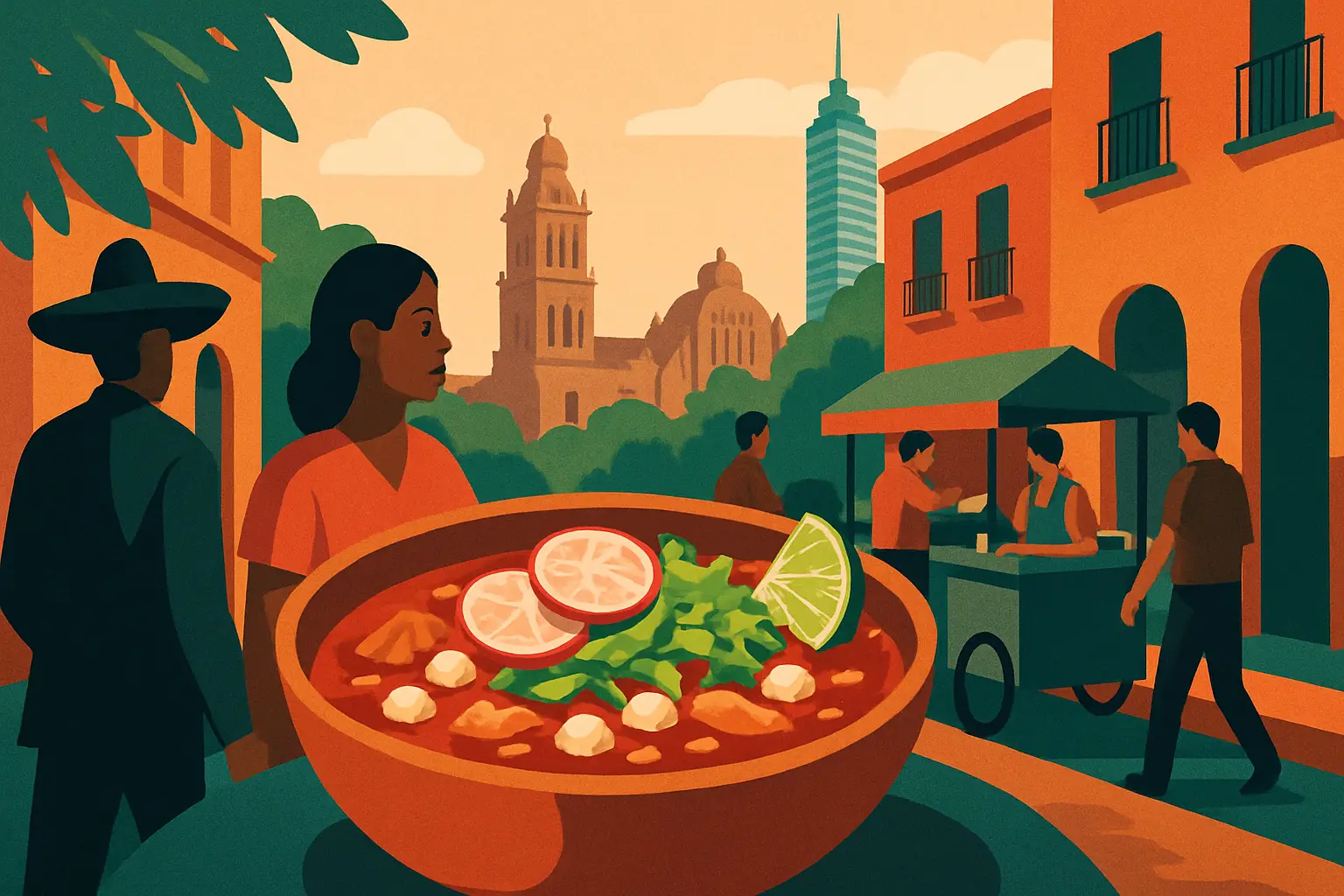
No bowl of pozole arrives complete. Every table gets a garnish tray, and building your bowl is as much the experience as eating it. The standard Mexico City set-up: finely shredded cabbage or iceberg lettuce (crunch and freshness), sliced radishes (sharp and peppery), dried oregano (crumble it between your fingers over the bowl so the oils release), lime wedges, minced white onion, dried chile flakes or ground chile powder, and a stack of tostadas. Better spots add sliced avocado, crumbled chicharron (pork crackling), and dried shrimp powder — standard in Guerrero-style versions. The method: taste the broth first on its own, then build. Oregano and lime go in early; chile powder goes last so you control the heat. The tostadas soften quickly if you dip them in the broth — some people eat them crunchy alongside the bowl, some let them absorb the liquid. There is no wrong approach; the garnish tray is personal.
Core garnishes: shredded cabbage, radishes, oregano, lime, onion, chile flakes, tostadas
Guerrero-style adds: avocado, chicharron, sometimes dried shrimp powder
Add lime and oregano first — chile flakes last, once you know the broth's base heat
The most specific instruction you will get for any restaurant in this guide: walk to Calle Moctezuma 12 in the Barrio Guerrero neighborhood — a short walk from Metro Garibaldi near the mariachi plaza — find what looks from the street like an apartment building, and ring the doorbell marked Pozole. That is the only sign on the outside. El Pozole de Moctezuma has operated from this location since 1947, when a woman named Balvina Valle from the state of Guerrero began cooking in her apartment kitchen and selling bowls to neighbors. Word spread, the dining room slowly took over, and now the fourth generation of the family runs the tables. The specialty is Guerrero-style pozole verde, but the tableside ritual is what separates it from every other bowl in the city: a server cracks a raw egg directly into your hot broth — it soft-poaches in the liquid in about ninety seconds — and adds a couple tablespoons of Guerrero mezcal. The egg enriches the broth; the mezcal cuts through the fat; the garnish tray arrives loaded with avocado, chicharron, diced onion, and oregano. It is still word-of-mouth, still run from an apartment, and still the most singular pozole experience in Mexico City. The kitchen closes when the pot runs out, which it does — go for lunch Tuesday through Sunday.
Calle Moctezuma 12, Barrio Guerrero — ring the doorbell marked Pozole, no other sign
In operation since 1947, currently fourth-generation family-run
Tableside: server cracks a raw egg into your hot broth and adds a splash of Guerrero mezcal
For something between a hidden gem and a full sit-down restaurant, Pozoleria Teoixtla at Zacatecas 59 in Roma Norte is the right address. It is a proper restaurant with a full menu — mole poblano, enchiladas, tostadas — but pozole verde is the reason people come back. The broth is smoky, built on roasted tomatillo and green chile, and arrives with chicharron and avocado chunks. There is usually a guitarist playing near the front door. Open daily from 11 a.m. to 9:30 p.m., Teoixtla is one of the few good pozole spots you can walk into for an early dinner in Roma Norte without a reservation and without arriving at midnight. On the opposite end of the spectrum: La Casa de Tono is a local chain with around a dozen locations across Mexico City, some of them open 24 hours. The Zona Rosa branch on Londres 144 and the Escandon location near Circuito Interior are both easy to reach. The pozole — rojo or blanco — costs around 90 pesos, arrives with the full garnish tray, and is ordered on a paper form you fill in at the table. It is not the most complex bowl in the city, but at 2 a.m. after a long night in a neighborhood you are still figuring out, La Casa de Tono is exactly the right answer.
Pozoleria Teoixtla: Zacatecas 59, Roma Norte — smoky verde, live music, open daily 11 a.m. to 9:30 p.m.
La Casa de Tono: ~12 locations across CDMX, some 24 hours — London 144 (Zona Rosa) is an easy one
La Casa de Tono orders via paper form; pozole rojo or blanco around 90 pesos
September 15 — the eve of Mexican Independence Day — is the single biggest pozole night in the country. Millions of households across Mexico eat pozole that evening, pozolerias stay open past midnight, and combining the Grito de Independencia ceremony at the Zocalo (where the president rings the bell at 11 p.m.) with a bowl of rojo and a cold beer is one of the most specifically Mexican evenings possible. Lines at every serious pozoleria in the city build after 8 p.m. — go before 7 or plan for a long wait. Beyond that night, pozole is a year-round dish in Mexico City. Unlike some regional stews that thin out in summer, you will find it daily at the restaurants in this guide. Friday has traditionally been a strong pozole day — a legacy of the Catholic no-meat-on-Friday custom that pushed cooks to perfect broth-based meals, and even though pozole with pork technically breaks that rule, the Friday pozole rhythm persisted. Late-night pozole at a 24-hour La Casa de Tono is also a distinct Mexico City experience worth doing once: the city is quieter, the bowl is the same, and the other people in the room are all going home from somewhere interesting.
A bowl of pozole is a full meal, not a starter — the combination of hominy (dense and starchy), braised pork, and a fully loaded garnish tray adds up faster than it looks. For a first bowl in Mexico City, start with pozole rojo if you want something familiar and deeply savory, or verde if you want to understand why Guerrero has a food culture distinct from the rest of Mexico. Blanco is the purist's choice — order it at a spot with a serious garnish setup, like El Pozole de Moctezuma, where the egg-and-mezcal tableside ritual turns a plain white broth into something memorable. Skip pozole at restaurants that do not specialize in it. It is one of those dishes where the broth takes several hours to build properly, and a kitchen that is not focused on it produces a flat, thin version that does not resemble what is described here. Ask the staff what style they specialize in. Any place that answers with 'we do all three equally well' is probably not a pozoleria — it is a restaurant that happens to serve pozole. That distinction matters more with this dish than almost any other in Mexico City's food history.
First bowl: rojo for familiarity, verde for the Guerrero revelation, blanco only at spots with a serious garnish setup
A large bowl is a full meal — skip the appetizers
Avoid pozole at restaurants without a dedicated focus — a rushed broth is immediately obvious