1. Vicente Martinez Ybor and the 1886 Founding
In the spring of 1885, a Cuban-born cigar manufacturer named Vicente Martinez Ybor stood on a stretch of scrubland four miles northeast of downtown Tampa and decided it was the right place to rebuild his industry. Ybor had arrived in the United States in the 1860s and established his factory in Key West, where Cuban cigar rolling had concentrated after the Ten Years' War displaced Havana's cigar workers. But yellow fever epidemics, labor unrest, and the logistical difficulty of shipping from a barrier island pushed him to look for a new location.
The Florida railroad boom of the early 1880s had connected Tampa to the national rail network. The land Ybor purchased was flat, cheap, and largely treeless — he paid roughly $9,000 for forty acres. His plan was not simply to build a factory but an entire company neighborhood: worker housing, a hotel, shops, and infrastructure for a manufacturing town in the European tradition. A second manufacturer, Ignacio Haya, opened an adjacent factory the same year.
The first factory — El Principe de Gales, later called the Vicente Martinez Ybor factory — opened on April 13, 1886, at Ninth Avenue and Fourteenth Street. The building still stands as part of the Ybor City State Museum complex. Within a decade, the neighborhood had absorbed Cuban, Spanish, Italian, and Sephardic Jewish immigrant communities, all working in the cigar trade and all living within walking distance of their factories. By 1920, Ybor City and nearby West Tampa produced more than 400 million handmade cigars per year — the largest cigar-manufacturing concentration in the world.
2. The Lectores: Readers Who Read All Day to Cigar Workers
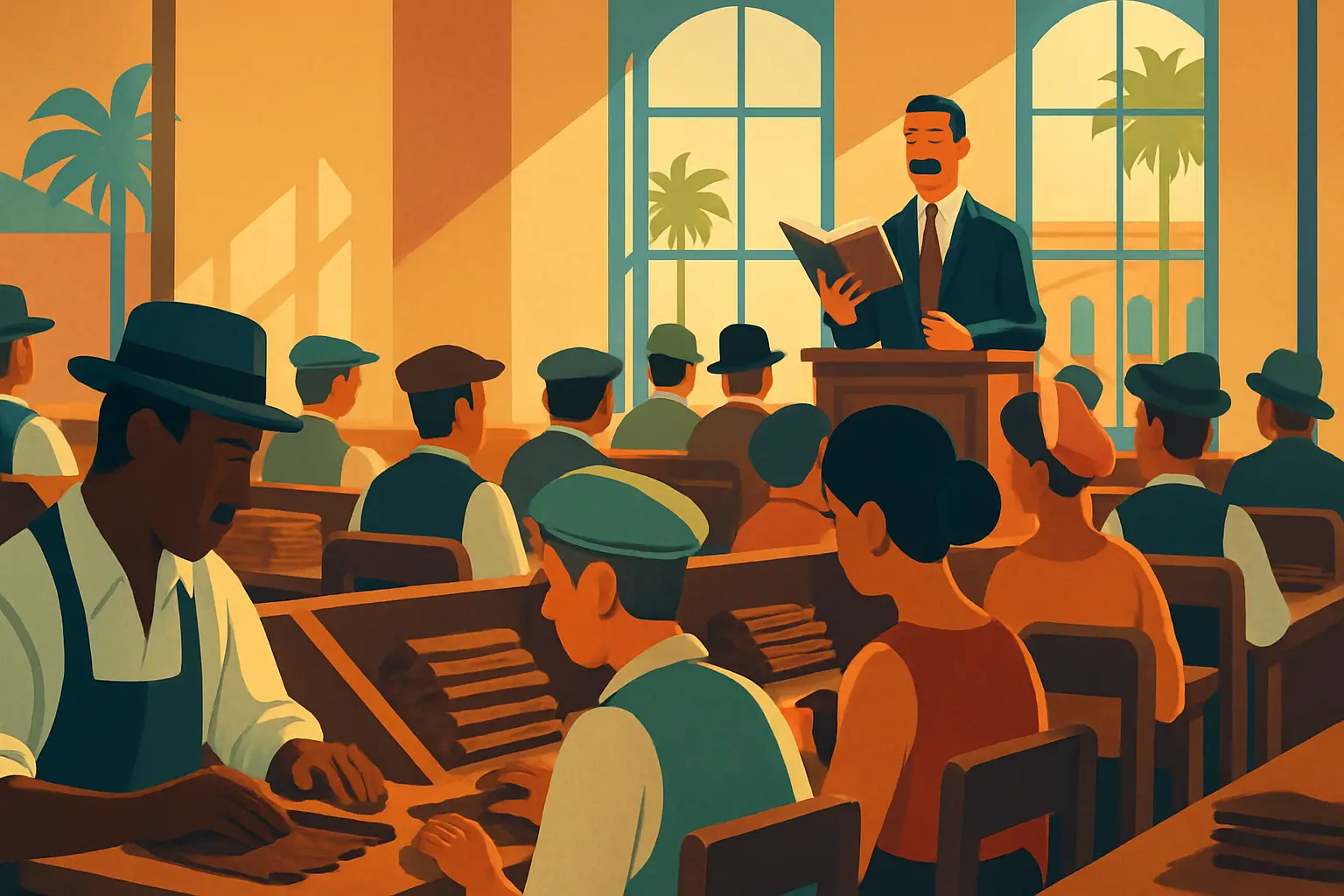
The most singular institution of Ybor City's working life was the *lector*: a trained reader, hired and paid collectively by the cigar rollers themselves, who sat in an elevated chair at the front of the factory floor and read aloud — continuously — while hundreds of workers rolled cigars at their benches.
The practice originated in Cuba and arrived in Tampa with the first factories. Each worker contributed a small weekly sum from their wages to cover the lector's salary. A typical day started with a newspaper in the morning — international and national news, coverage of Cuba's independence movement — and shifted to a novel or essay in the afternoon. The selection was determined by vote among the workers. Frequent requests included Don Quixote, Les Misérables, The Count of Monte Cristo, and the political writings of José Martí, the Cuban independence leader whose essays were read in Ybor City factories while he was still alive and organizing exile support from New York.
The institution was not just cultural: lectores read labor publications alongside literature, and several of Ybor City's most significant strikes in the early 20th century were organized partly through texts read on the factory floor. By the 1920s, factory owners began installing radio systems to replace the lectores — partly for cost, partly to remove the political dimension of the role. The last lector in Ybor City's factories stopped reading in 1931, when manufacturers completed the radio transition.
The Ybor City State Museum at 1818 Ninth Avenue has a dedicated exhibit on the lectores, including the elevated reader's chair from one of the original factories.
3. The Mutual Aid Societies That Built a Neighborhood
Because Ybor City's immigrant communities — Cuban, Spanish, Italian, Sephardic Jewish, and Afro-Cuban — arrived with distinct languages and cultural traditions but shared the same neighborhood and trade, they organized separately but in parallel. The result was a dense network of mutual aid clubs that provided medical care, life insurance, social facilities, and legal assistance to their members.
The largest were:
- Centro Español (Spanish, founded 1891) — the oldest, with a hospital and pharmacy at 1526 E. Seventh Avenue
- Círculo Cubano (Cuban, founded 1899) — at 2010 Avenida República de Cuba; its theater and tiled reading room are partially restored
- Centro Italiano (Italian, founded 1894) — later known as L'Unione Italiana
- Centro Asturiano (Asturian Spanish immigrants, founded 1902) — its 1914 building at Nebraska Avenue eventually became the original home of the Tampa Museum of Art
For a monthly dues payment, members had access to a doctor, a hospital bed, prescriptions, a library, a theater, and a social club. This infrastructure — built entirely by immigrant workers before any comparable public services existed in Tampa — was one of the most sophisticated mutual aid systems in American urban history.
Several of the original clubhouses survive and are part of the Ybor City Historic District, designated a National Historic Landmark in 1990.
4. The Columbia Restaurant: Florida's Oldest, Since 1905
The Columbia Restaurant at 2117 E. Seventh Avenue opened in 1905 when Cuban immigrant Casimiro Hernandez Sr. turned a small corner café — selling coffee and Cuban sandwiches to cigar workers — into a full dining room. The operation expanded under three subsequent generations of the Hernandez family across eleven rooms occupying an entire city block. The fourth generation runs it now.
The Columbia's signature dish is the 1905 Salad: romaine, olives, Swiss cheese, julienned ham, tomato, and a garlic-Worcestershire dressing, prepared tableside by your waiter in a wooden bowl. The ceremony was developed in the 1940s by Casimiro Jr. — the waiter cracks a whole head of garlic against the bowl, which has made dinner at the Columbia recognizable across four generations.
The restaurant presents a flamenco show Tuesday through Saturday during dinner service. It's theatrical enough to work for a tourist crowd and genuine enough not to embarrass itself. The chicken and yellow rice and the *ropa vieja* — shredded beef in tomato-wine sauce — are both excellent without the show.
The Columbia also makes a strong claim to the Tampa-style Cuban sandwich: pork, ham, salami, Swiss cheese, pickles, mustard, on Cuban bread. The salami distinguishes it from the Miami Cuban (which omits salami). The debate between Miami and Tampa over which city 'owns' the Cuban sandwich is real, unresolved, and mostly conducted in good humor.
5. The Collapse of the Cigar Industry and the Urban Renewal Threat
The industry that built Ybor City began collapsing in the 1930s. Mechanized production from Northern factories undercut handmade prices; cigarettes replaced cigars as America's mass tobacco product. The Great Depression accelerated the decline. By 1950, most of the major factories had closed or moved production out. The neighborhood's population fell by half between 1940 and 1960.
The second threat arrived in the form of urban renewal. Tampa's expansion plans in the 1960s included an expressway routing that would have demolished a significant portion of Ybor City's street grid, and separate proposals called for clearing historic blocks for parking and commercial development. Several original factory buildings were lost during this period. The neighborhood's survival was partly accidental — the expressway alignment was adjusted, and the density of immigrant-era brick construction generated enough local opposition to stop further clearing.
Ybor City's National Historic Landmark designation in 1990 and its listing on the National Register of Historic Places gave the remaining building stock formal protection. The rehabilitation of 7th Avenue as a commercial and nightlife district followed through the 1990s and 2000s. The cigar industry never returned at scale, but a handful of small hand-rolling shops still operate on or near 7th Avenue — the Gonzalez y Martinez shop at 2025 E. Seventh Avenue is the most frequently cited.
6. 7th Avenue Today: La Sétima, the Streetcar, and the Roosters
Seventh Avenue — La Sétima — runs east-west through the center of Ybor City and is its commercial spine. The current street life is primarily nightlife-oriented: bars, clubs, and restaurants in a concentrated stretch between 14th and 21st Streets. On weekend evenings the city closes the street to car traffic and it fills with pedestrians.
The TECO Line Streetcar connects Ybor City to downtown Tampa via a 2.7-mile route with eleven stops. The ride is free. On weekends it runs from approximately 10 a.m. to late night, roughly every 20 minutes. The Ybor City stop at Centennial Park drops you half a block from the beginning of 7th Avenue.
The street's most unexpected feature is also its most photographed. Wild roosters have roamed Ybor City since the neighborhood's early days — kept by immigrant residents for cockfighting, which was legal at the time, and for eggs. When cockfighting was outlawed, many birds were released into the neighborhood. A 1937 Tampa city ordinance specifically protected the Ybor City chickens from removal, and their descendants have occupied the streets ever since. City estimates put the current population at 50–100 birds. They cross 7th Avenue in front of bar crowds with complete indifference, roost in vacant lots, and approach pedestrians freely. Do not feed them — it concentrates them in ways that create problems — but do expect them at almost every corner.
•Ybor City State Museum: 1818 Ninth Ave, open Tue–Sat 10 a.m.–4 p.m., $4 admission; includes the original factory building and lector exhibit
•Columbia Restaurant: 2117 E. Seventh Ave, lunch daily 11 a.m.–3 p.m., dinner from 4 p.m.; flamenco show Tue–Sat at dinner, book in advance
•TECO Line Streetcar: free, departs downtown Tampa Convention Center stop, runs to Ybor City Centennial Park — about 15 minutes end-to-end
7. Is Ybor City Worth Visiting? (FAQ)
Is Ybor City safe? During the day and early evening, yes — it's well-trafficked and the museum cluster is active. Late Friday and Saturday nights, the bar-heavy stretch of 7th Avenue draws a large crowd. The street is car-free on weekend evenings, which makes it feel festive but occasionally loud after midnight. Standard urban awareness applies; the daytime and museum experience is straightforwardly comfortable.
How do I get to Ybor City from downtown Tampa? The TECO Line Streetcar (free) runs from the Tampa Convention Center stop to Ybor City Centennial Park in about 15 minutes. Driving takes 10 minutes from downtown; parking is available in surface lots off 7th Avenue but congested on weekend evenings. Uber and Lyft service the area without difficulty.
When is the best time to visit? For the museums and the Columbia Restaurant, any weekday is less crowded than weekends. For the nightlife and the full 7th Avenue experience, Friday or Saturday evening. February and March bring the most pleasant weather — Tampa in August (right now) is genuinely hot and humid, but the brick arcades along 7th Avenue and the Columbia's air conditioning make the midday hours manageable.
What else is worth pairing with an Ybor visit? The Tampa Riverwalk is a 2.6-mile pedestrian path along the Hillsborough River through downtown, a 15-minute streetcar ride from Ybor. Armature Works — a converted 1910 streetcar maintenance depot at 1910 N. Ola Ave — holds one of the better food halls in Florida and is a 10-minute drive from Ybor. Both are worth combining on the same day.
Is there anything about Ybor City in TourMe? Yes — explore Tampa's story through interactive cards about the lectores, the mutual aid societies, and the Columbia's century of Cuban sandwiches. Collect stories as you walk.