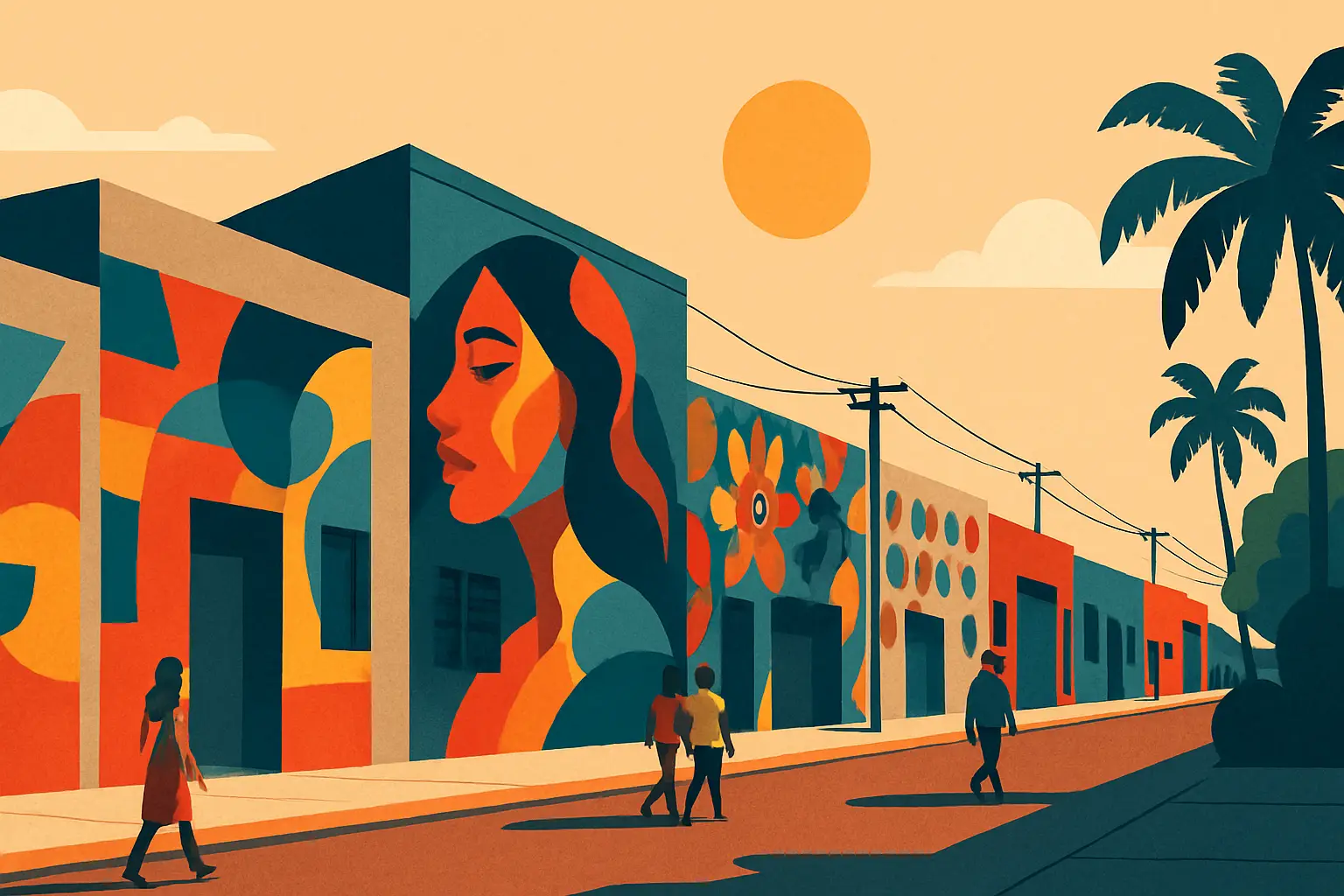
The land that is now Wynwood was developed in the 1950s and 1960s largely by a developer named Robert Wynn, whose name the neighborhood eventually took. The area attracted light industry — food distribution, garment production, small manufacturers — and the affordable housing around it drew Miami's Puerto Rican community in the postwar decades. By the 1970s, the stretch of NW 2nd Avenue between downtown and the Miami Design District was informally known as Little San Juan: a dense working-class neighborhood of bodegas, botanicas, and Puerto Rican social clubs.
Deindustrialization hollowed it out. As manufacturing left Miami through the 1980s, the warehouses went vacant. By the 1990s, NW 2nd Avenue was a strip of car repair shops, low-margin distributors, and empty concrete buildings with blank walls facing the street — the blank walls turned out to be the feature that mattered most.
Tony Goldman (1943–2012) had already done this once before: he bought cheap buildings in SoHo, New York in the 1970s when artists were moving into industrial lofts, and then helped transform Miami Beach's South Beach in the 1980s when it was a neglected collection of Art Deco buildings occupied mainly by retirees. He started buying Wynwood warehouses in 2004. His observation was simple: the windowless concrete warehouse walls were the largest blank canvases he had ever seen. In December 2009, during Miami Art Basel week — the annual convergence of the global art market that happens in the first week of December — he opened Wynwood Walls and invited 12 of the world's most prominent street artists to paint them. The project was funded by Goldman, produced on commission, and launched to an audience of 50,000 art-world attendees who happened to be in town that week. The neighborhood's trajectory changed overnight.
Wynwood Walls occupies a roughly two-acre compound centered on 2520 NW 2nd Avenue. The Welcome Center and ticketing entrance is at 2516 NW 2nd Ave. Inside, the complex holds over 40 large-scale murals, 12 outdoor sculptures, and three rotating fine-art galleries — all wrapped around a central outdoor courtyard and a smaller rear garden.
The walls are not static. Goldman's daughter Jessica Goldman Srebnick, who took over as CEO after her father died in September 2012, has continued the practice of regularly retiring murals and commissioning new ones. Artists are invited by the foundation — application is not open — and the selection spans international reputations and emerging voices. The roster over the years has included Os Gemeos (the Brazilian twin brothers Otavio and Gustavo Pandolfo, whose yellow-tinted figures appear on a corner that has become one of the most photographed spots in Miami), Shepard Fairey (the designer behind the Obama 'Hope' poster), Kenny Scharf (a New York Pop Art painter connected to the 1980s East Village scene), Futura (a New York subway-era graffiti artist who evolved into abstract spray painting), and Hebru Brantley, the Chicago-based artist whose characters appear throughout the compound in 2026.
The three fine-art galleries inside the compound — The Wynwood Walls Gallery, The Wynwood Doors, and a rotating third space — show smaller works by the same artists and others, with pieces for sale. These are among the few places in Wynwood where you can buy original artwork rather than prints.
Practical note: the admission includes both the outdoor murals and the gallery interiors. Spend at least 90 minutes to move through everything. Guided tours are available at an additional charge and are worth it if you want context on specific works; the audio guide available via the Wynwood Walls app covers the same ground for free after admission.
Address: 2516 NW 2nd Ave (Welcome Center entrance); hours daily 10:30 a.m.–6:30 p.m.
Admission: $12 adults, $5 ages 6–17, free under 5; book at thewynwoodwalls.com to skip the line
The Wynwood Walls app provides free audio guides to specific murals after ticket purchase
Photography is encouraged — this is one of the few ticketed cultural sites in Miami where tripods and professional cameras are permitted in the outdoor areas
Get short, interactive stories that make each place easier to remember while you travel.
Most of Wynwood's murals are not behind the admission gate. The streets for a dozen blocks in every direction are covered in work — on warehouse facades, utility boxes, parking garage walls, alleyway gates, and the sides of restaurants. You could spend four hours walking the neighborhood without paying a dollar.
NW 2nd Avenue between NW 22nd and NW 29th Streets is the densest corridor. The galleries, shops, and restaurants that fill the ground floors of the warehouses here back up to painted walls on every side. Walking north from NW 22nd Street, you pass commissioned murals that range from tight photorealist portraits to large abstract fields — some of them painted by internationally recognized artists, others by local Miami artists whose names are worth seeking out.
The side streets are worth following. NW 25th and 26th Streets, the blocks immediately behind the Walls compound, are heavily painted. NW 23rd Street between NW 2nd and 3rd Avenues runs through a cluster of studios and small galleries that participate in the monthly art walk. The alleyways off NW 2nd Ave, which the neighborhood calls the 'Wynwood Garage' blocks, contain some of the densest and most layered street art in the district — works painted over works painted over works, the way street art actually accumulates over time.
A practical approach: walk NW 2nd Ave in one direction, turn down the side streets to follow whatever catches your eye, and use the Walls compound as your anchor. The whole walkable area is roughly six blocks by six blocks, which is manageable even in Miami heat if you start in the late afternoon.
The restaurant density on NW 2nd Avenue rivals what you would find on any comparable creative district street in the country. A few specific addresses:
KYU (251 NW 25th St) is the best restaurant in Wynwood by most measures — a Japanese-influenced wood-fire kitchen by chef Michael Lewis that opened in 2016 and has held serious critical attention since. The broccoli with yuzu miso is ordered by nearly every table. The wood-grilled proteins rotate seasonally. Reservations are required on weekends; walk-ins at the bar on weeknights are possible but not guaranteed.
Panther Coffee (2390 NW 2nd Ave) opened in Wynwood in 2010, a year after the Walls launched, and preceded most of the restaurant and bar development on the street. It imports directly from farms in Central and South America and roasts on-site at a Wynwood facility. The espresso is reliably excellent. The original Wynwood location is the most interesting of the several Panther outposts in Miami — the building is an industrial space with high ceilings and a roasting smell that makes it worth visiting before the mural walk.
Coyo Taco (2300 NW 2nd Ave) is a large, loud taqueria with an underground mezcal bar called the 'underground' that stays open until 3 a.m. on weekends. The tacos are solid — the al pastor and the barbacoa are the orders — and the outdoor terrace is one of the more practical places to eat when the weather cooperates.
The Salty Donut (50 NW 23rd St) turned artisan-donut culture into one of Wynwood's persistent street-level draws. The seasonal flavors rotate weekly — guava and cheese, café con leche, brown butter and salt — and the line on weekend mornings reflects real demand, not hype. Arrive before 11 a.m. if you want the best selection.
Concrete Beach Brewery (325 NW 24th St) is the neighborhood's craft beer anchor — a large taproom in a converted warehouse with an indoor-outdoor format and regular live music. If you want to end a long afternoon of mural-walking with a cold beer and somewhere to sit, this is the most straightforward option.
KYU: 251 NW 25th St; dinner Mon–Sat, weekend brunch; reservations recommended (kyu-miami.com)
Panther Coffee: 2390 NW 2nd Ave; daily 7 a.m.–9 p.m.; best for morning before the mural walk
Coyo Taco: 2300 NW 2nd Ave; daily noon–3 a.m.; underground mezcal bar accessible via back stairs
The Salty Donut: 50 NW 23rd St; Wed–Sun 8 a.m.–3 p.m. or sold out; seasonal flavors worth checking online
Concrete Beach Brewery: 325 NW 24th St; Mon–Fri 4 p.m.–midnight, Sat–Sun noon–midnight
The Second Saturday Art Walk runs on the second Saturday of each month, from roughly 6 p.m. to 10 p.m. Galleries across the district stay open late, some host artist receptions, and the NW 2nd Avenue corridor fills with foot traffic that makes it feel like a street fair. Entry to participating galleries is free. The event began in the mid-2000s, before the Walls opened, as a mechanism to build an audience for the nascent Wynwood gallery scene — it predates the neighborhood's transformation and still functions as its primary recurring community event.
For the densest week of art activity, nothing in the calendar competes with Miami Art Week — the first week of December, centered on Art Basel Miami Beach (the American edition of the Swiss art fair that commands the largest prices and most global attention of any fair in the Western Hemisphere). Art Basel itself is held in the Miami Beach Convention Center, but the satellite events, pop-up exhibitions, hotel-lobby installations, and gallery openings spread across Wynwood, the Design District, and Midtown Miami for the full week.
During Art Basel week, Wynwood becomes unrecognizable in volume. Every gallery has an opening. The streets close for pop-up events. Artists who commission murals during other months often appear in person. If you are in Miami in early December, Wynwood during Art Basel week is a once-a-year version of the neighborhood — louder, more crowded, and more concentrated with serious art-world energy than at any other point in the calendar. If you prefer a calmer version, any other time of year is better.
August heat advisory: Miami's heat index in August regularly exceeds 105°F with high humidity. Outdoor time between 11 a.m. and 4 p.m. is genuinely uncomfortable. The most practical approach for a summer visit: arrive in Wynwood around 4 p.m., buy Wynwood Walls tickets for the last 90 minutes before the 6:30 p.m. close, then transition to dinner and the cooler evening on NW 2nd Ave. Panther Coffee is air-conditioned and opens at 7 a.m. — useful if you want to walk the streets in the morning before the heat builds.
The most comfortable months for an outdoor Wynwood visit are November through April, which is also Miami's high tourist season. December combines the best weather with Art Basel. February and March offer warm temperatures without summer humidity. These months also bring higher hotel prices across Miami — budget travelers often find that the value math improves significantly in late September and October, when the heat has dropped but the crowds remain thin.
What you can reasonably skip: The interior of the Wynwood Kitchen & Bar (inside the Walls complex) is a mediocre tourist-facing restaurant; the food is not worth the prices relative to the independent restaurants two blocks away on NW 2nd Ave. Skip it and go to KYU or Coyo Taco instead. Several of the 'gallery' spaces in Wynwood operate more as gift shops selling prints — they are not bad, but they are not the same experience as the serious galleries that participate in the Second Saturday Art Walk.
Is Wynwood safe for visitors? The NW 2nd Avenue commercial corridor and the several blocks surrounding Wynwood Walls see heavy visitor traffic consistently and are entirely comfortable during the day and into the evening hours. As with any urban neighborhood, the residential blocks that lie farther from the main commercial strip are quieter and less trafficked — sticking to the areas described in this guide covers all the significant attractions within the most active zone. The neighborhood has seen substantial development in safety and infrastructure over the past decade alongside its commercial transformation.
How does Wynwood connect to Little Havana and South Beach? Wynwood is roughly four miles from South Beach and about two miles from Little Havana's Calle Ocho. None of these neighborhoods are walkable to each other — use Uber or Lyft to move between them. If you are spending multiple days in Miami and want the neighborhood-by-neighborhood version of the city, a useful sequence is: morning in Little Havana for Domino Park and the ventanita culture (see our guide to Little Havana), late afternoon in Wynwood for the mural walk and dinner, and a separate morning or evening in South Beach for the Art Deco district.
Can you do Wynwood in half a day? Yes. Two to three hours covers the Wynwood Walls, a walk of NW 2nd Avenue between 22nd and 29th Streets, a stop at Panther Coffee, and a meal. Add another hour if you want to explore the side streets thoroughly or visit a specific gallery.
What about Wynwood for kids? The outdoor murals are entirely appropriate and genuinely engaging for children — the scale and color make an impression on almost everyone. The Wynwood Walls complex is accessible with strollers. The admission cost for under-5 visitors is free. The neighborhood's evening bar and restaurant crowd gets louder after 9 p.m. on weekends, making the late evening less well-suited for families, but daytime and early evening visits are straightforward.