1. How the Pearl District Got Its Name — and What It Replaced
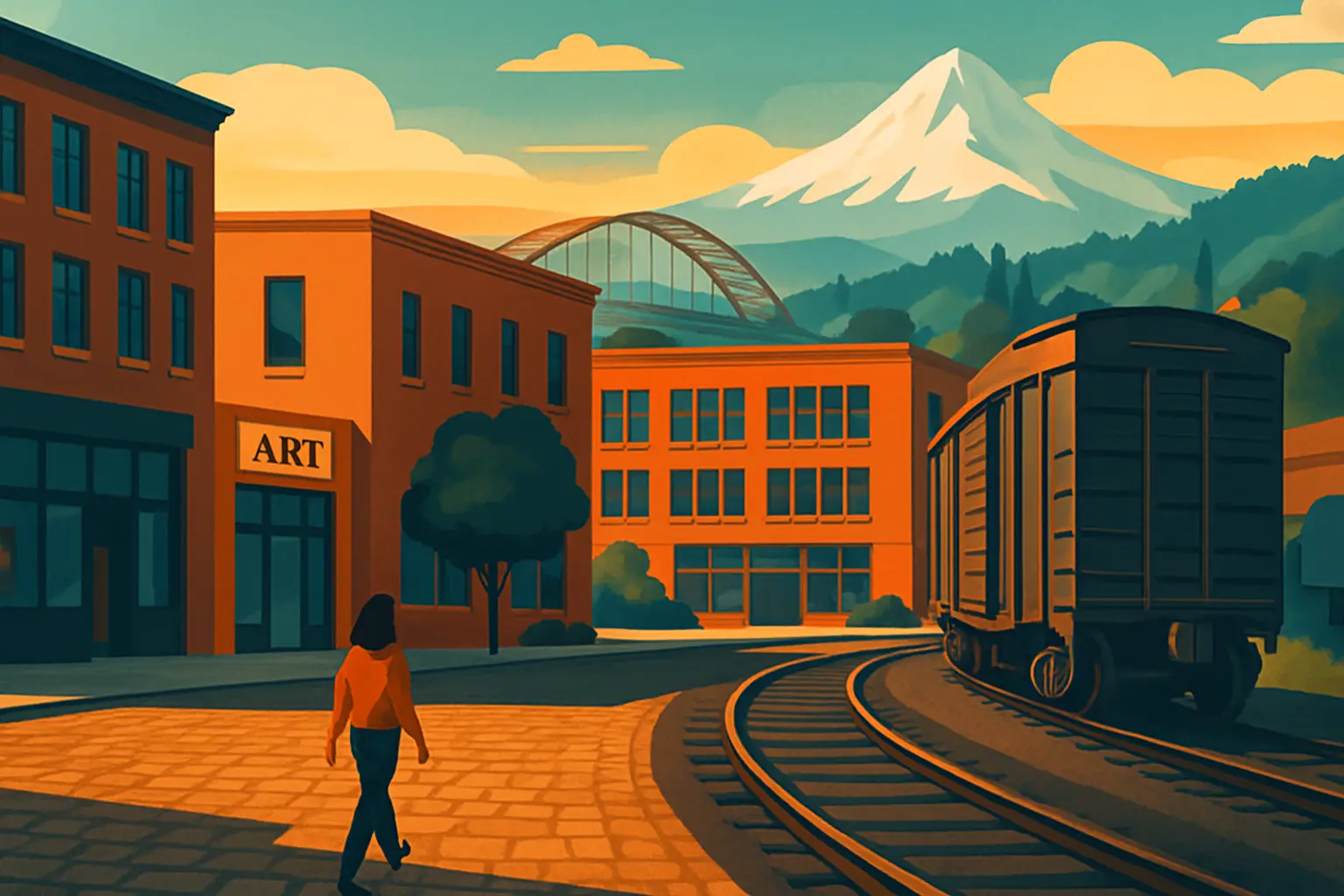
The name 'Pearl District' was coined around 1985 by a Portland gallery owner who described the raw industrial neighborhood as an oyster: gritty on the outside, containing pearls within. Those pearls were the artists who had been quietly occupying the cheap warehouse lofts for a decade, doing exactly what artists do in cheap industrial districts — making work, opening studios, and slowly making the neighborhood worth knowing about.
Before the artists came the railroads. For most of the 20th century, the blocks between W. Burnside Street and Union Station were one of Portland's most active industrial zones — freight yards, machine shops, brick warehouses with loading docks and high ceilings. The Southern Pacific and Union Pacific rail lines converged here. The neighborhood had almost no residential population.
When freight rail declined after World War II, the warehouses gradually emptied. By the early 1970s the blocks were cheap and mostly vacant. Artists and small manufacturers moved in. The transition was slow until the 1990s, when Portland designated the area the River District and began investing in streetcar infrastructure, parks, and residential development. The old warehouses were not torn down — they were converted. That decision is why the Pearl District looks the way it does: exposed brick, high ceilings, street-level ground floors that were once loading bays and are now gallery windows and restaurant entrances.
2. Powell's City of Books: The World's Largest Independent Bookstore
Powell's City of Books at 1005 W Burnside St occupies a full city block between NW 10th and 11th Avenues — a former car dealership expanded incrementally by Michael Powell through the 1980s and 1990s until the 1999 addition completed the block. Walter Powell founded the original store in Chicago in 1970 and moved to Portland in 1971; his son Michael turned it into the institution it is today.
The store contains over 500,000 books organized across nine color-coded rooms and more than 3,500 sections. New and used books are shelved together by subject. A newly published novel might sit next to a 1963 paperback edition of the same author's earlier work, priced at $3.50. The sorting logic rewards browsing in ways no algorithm can replicate.
Outside the Pearl District entrance on NW 10th Avenue stands the Pillar of Books — a Tenino sandstone carving by artist Kathleen McCracken depicting eight great books stacked on top of each other. The base inscription reads in Latin: 'Buy the book, read the book, enjoy the book, sell the book.' It is a precise description of the store's business model, which accepts used books back in trade.
Practical note: opens daily at 9 a.m., closes at 11 p.m. The Gold Room (literature) and Rose Room (children's) are the largest. The Coffee Room serves Stumptown and is at the back of the store. First-time visitors: pick up the color-coded room map at the entrance — without it the layout is disorienting.
3. Tanner Springs and Jamison Square: Two Parks Built on a Buried Creek
The two parks at the center of the Pearl District look like thoughtful modern greenery. They are actually a deliberate act of memory.
Tanner Creek once ran through this entire area. Named for the tannery built by pioneer Daniel Lownsdale in 1845, the creek flowed from the West Hills down through what is now the Pearl District into Couch Lake — a shallow marshy basin roughly where Tanner Springs Park stands today. As Portland grew in the late 19th century, the creek was routed underground through a system of pipes and the lake was filled to make way for warehouses and rail infrastructure. The creek and the lake disappeared beneath pavement and railroad ties.
Jamison Square (NW 11th Ave and NW Johnson St) opened in 2000 with a stepped fountain basin that fills and drains on a slow tidal cycle. In August, children wade in it from mid-morning through early evening. Tanner Springs Park (NW 10th Ave and NW Marshall St), completed in 2005, sits on the approximate footprint of former Couch Lake. It features restored wetland plantings, a stone walking path, and a rusted steel wall embedded with original rail spikes and artifacts recovered from the site during construction — a deliberate archaeological gesture from a neighborhood that has otherwise moved on entirely from its industrial past.
•Jamison Square: NW 11th Ave and NW Johnson St — fountain active daily in summer, free, no admission
•Tanner Springs Park: NW 10th Ave and NW Marshall St — quieter, better for sitting; the steel wall of rail artifacts is on the park's west edge
•Both parks are 4 blocks apart and connected by a pleasant walking route along NW Johnson St
4. Where to Eat and Drink in the Pearl District
Fuller's Coffee Shop (NW 9th Ave) has operated in the Pearl District since 1947. The neighborhood around it changed entirely; Fuller's did not. Counter seating, short menu, lunch plates in the $10–$15 range. Opens at 6:30 a.m. and closes mid-afternoon. The wait on weekend mornings is real.
Andina (1314 NW Glisan St) has been serving Peruvian food in the Pearl since 2003 — before Peruvian cuisine became a staple of every food-trend conversation. The ceviche is excellent. The pisco sours are stronger than they look. Reservations recommended for weekends.
Deschutes Brewery (210 NW 11th Ave) is the Portland outpost of the Bend, Oregon brewery behind Black Butte Porter and Mirror Pond Pale Ale. The pub opens at 11 a.m. and the outdoor patio is one of the neighborhood's best summer afternoon destinations, two blocks from Powell's.
Coava Coffee (NW 11th Ave) roasts its own beans and is among Portland's most respected independent roasters. The Pearl location occupies a converted warehouse space with high ceilings and long communal tables — the aesthetic is exactly what the neighborhood does well.
For seafood: Jake's Famous Crawfish (401 SW 12th Ave, on the Pearl's southern edge) has been serving Pacific Northwest seafood since 1892. Oregon king salmon and halibut are in peak season through August.
5. The Gallery Scene and First Thursday Art Walk
More than 25 galleries operate within the Pearl District's roughly 15 square blocks — the density that gave the neighborhood its name and still defines it today. Most are small, privately owned, and focused on contemporary Pacific Northwest artists.
Blackfish Gallery (420 NW 9th Ave), founded in 1979, is one of the oldest artist-run cooperative galleries in the United States. It predates the Pearl District's rebranding by six years — it was here when the neighborhood was still gritty industrial warehouses, and it is still here now. Monthly exhibitions rotate across painting, sculpture, and mixed media.
First Thursday is the neighborhood's signature free event: on the first Thursday of every month, galleries across the Pearl stay open from roughly 5 to 9 p.m. with opening receptions for new shows. Wine is typically free. There is no registration, no ticket, no wristband — walk in. It has run continuously since 1986 and draws a genuine cross-section of Portlanders, not just tourists. If your visit overlaps with a first Thursday, plan around it: it is the best evening the neighborhood has to offer.
6. August in the Pearl: Portland's Best-Kept Seasonal Secret
Portland's reputation for rain is accurate — for about eight months of the year. August is the city's driest month by a significant margin, averaging under half an inch of total rainfall. Temperatures run in the mid-70s Fahrenheit with low humidity. The city that brought you January drizzle becomes genuinely, reliably warm and clear in August.
In the Pearl District specifically, this means the Jamison Square fountain is running all day and parents bring children to wade in it from morning through evening. The Deschutes outdoor patio fills by noon. Powell's stays cool inside and open until 11 p.m. The gallery walks are pleasant without the overcast skies that characterize most of the year.
A 15-minute walk east and south from the Pearl gets you to the Portland Saturday Market at Tom McCall Waterfront Park (2 SW Naito Pkwy), which runs every Saturday and Sunday from March through Christmas Eve. Founded in 1974, it is the largest continuously operating open-air arts-and-crafts market in the United States — roughly 350 vendors, concentrated on handmade goods. August Saturdays are peak season, with the Willamette River and the Hawthorne Bridge as backdrop.
7. Getting There, Getting Around, and What Else Is Within Walking Distance
How do I get to the Pearl District? The Portland Streetcar NS Line runs through the heart of the neighborhood on NW 10th and 11th Avenues — convenient for reaching Powell's, the parks, and the gallery blocks. MAX Light Rail stops at Union Station (Yellow/Green/Orange lines, NW 6th Ave), about a 10-minute walk from the southern edge of the Pearl. From PDX airport, the MAX Red Line connects to downtown in approximately 40 minutes with no transfer.
Is the Pearl District safe? The Pearl is one of Portland's safest and most active neighborhoods, with a consistent resident and commercial population that keeps the blocks occupied day and night. The parts of Portland that received national attention for street-level issues from 2022 onward are primarily Old Town/Chinatown — the blocks between the Pearl and the Willamette waterfront; the Pearl District itself is a different situation.
What else is within walking distance? Northwest 23rd Avenue (Nob Hill) is a 10-minute walk west — Portland's most concentrated strip of independent restaurants and boutiques. Old Town/Chinatown is 10 minutes east, home to the Portland Saturday Market and Lan Su Chinese Garden (239 NW Everett St), a traditional Suzhou-style garden built by craftspeople from China that is consistently one of Portland's most undervisited attractions. For more Pacific Northwest urban exploration, see our guide to Pike Place Market in Seattle.