The word itself is the first signal that New Haven's pizza tradition runs deeper than marketing. 'Apizza' is an anglicized spelling of how Neapolitan-dialect speakers in southern Italy — specifically from Naples and the surrounding Campania region — said 'a pizza.' In Neapolitan dialect, the phrase 'a pizza' (meaning 'the pizza') contracted and softened so that it was pronounced more like 'ah-BEETS' or 'ah-BYEETS.' When southern Italian immigrants settled in New Haven's Wooster Square neighborhood in the early 1900s, they brought that pronunciation with them. The local spelling 'apizza' preserved the dialect marker in written form.
This is not an affectation or a branding decision made by a restaurant consultant. It is a phonetic survival from a specific regional Italian dialect, hardwired into the vocabulary of a specific immigrant community in a specific American city. New Haven's Neapolitan immigrants came primarily from the area around Naples during the great migration of 1880 to 1920. They settled in the blocks around Wooster Square, built churches, social clubs, and bakeries — and they made their pizza the way people in their home villages had made it: thin, blistered, coal-fired, and simple.
The word is also a quiet test. Ask a New Haven local how to pronounce it, and they will say 'ah-BEETS' without hesitation. Ask someone from outside the city, and they'll usually say 'ah-PEE-tsa.' Both are trying to honor the same word. Only one of them grew up hearing it.
Frank Pepe was born in Maiori, a small town on the Amalfi Coast south of Naples, and immigrated to New Haven around 1909 as a teenager. He worked in a bakery on Wooster Street, learned the trade, and in the years before he opened his own place, sold pizzas informally — carrying them through the Wooster Square market on a wooden board balanced on his head, calling out to customers.
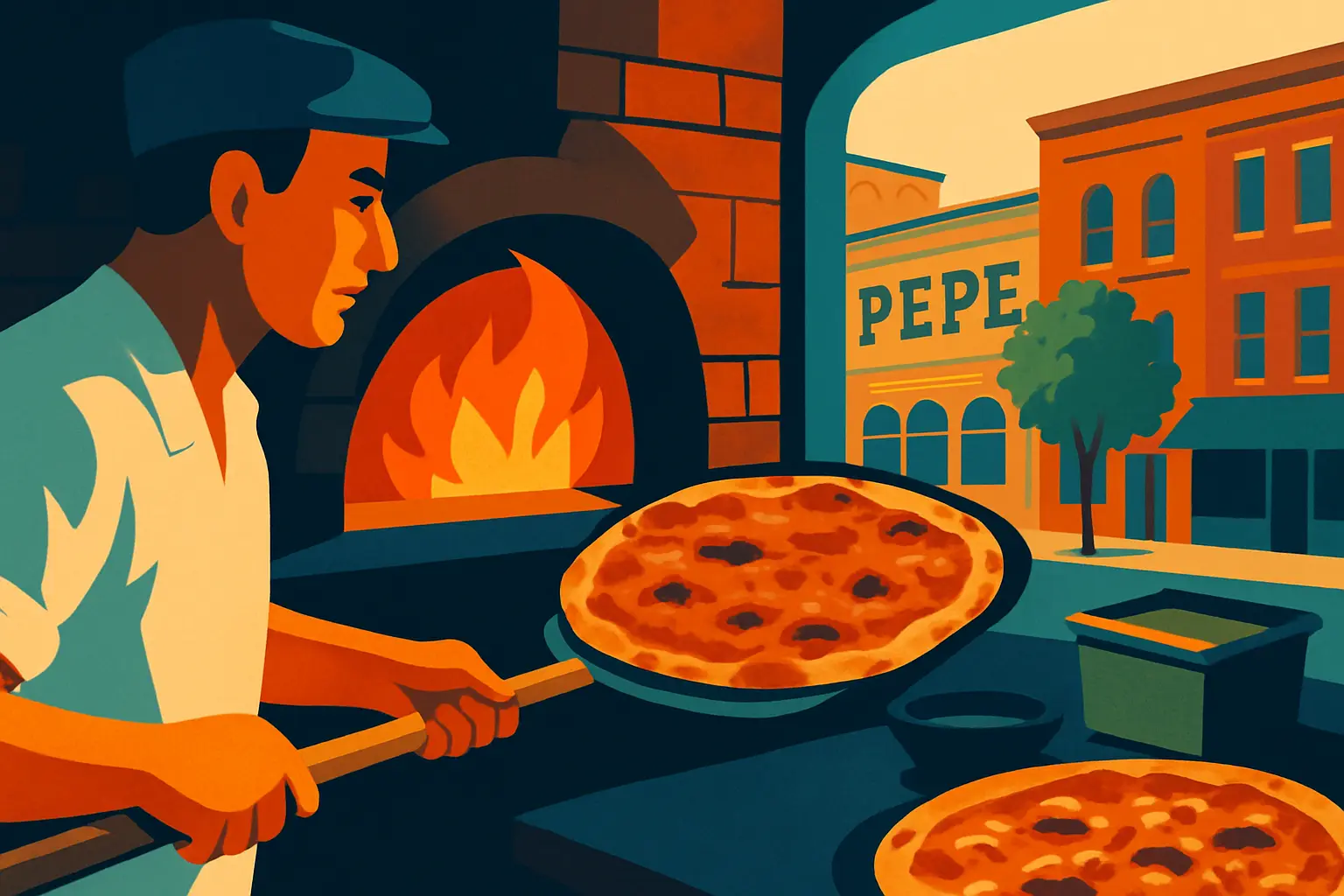
In June 1925, Pepe formalized the operation, taking over the bakery where he had worked and opening Frank Pepe Pizzeria Napoletana at 163 Wooster Street. In 1937 he moved next door to 157 Wooster Street, the address where the flagship location still operates today. The coal-fired brick oven he installed has been in continuous use since the 1920s. The building around it has changed; the oven's fundamental design has not.
Pepe's original product was simple: thin dough pressed by hand into whatever oblong shape it wanted to take, topped with crushed tomatoes and grated cheese, slid on a peel into a coal oven running between 550°F and 650°F, and pulled with a dark, blistered, charred crust that bore no resemblance to the pale, doughy crusts coming out of gas ovens across the country. He was not trying to differentiate his product from competitors. There were no competitors. He was making what he knew.
Get short, interactive stories that make each place easier to remember while you travel.
A coal-fired brick oven operates differently from a wood-fired oven and very differently from a gas oven. Coal burns hotter and more consistently than wood, achieving sustained temperatures that wood ovens reach in spikes but can't maintain as steadily. The radiant heat from the brick walls and the dome — not just the direct heat from the floor — cooks the pizza from all sides simultaneously. A New Haven apizza is in the oven for roughly 6 to 8 minutes. A gas-oven pizza of equivalent size might take 10 to 15 minutes.
The result is a crust that is simultaneously thin and structurally stiff, with a pocked, charred exterior and a slightly chewy, bread-like interior. The char is not incidental — it is the flavor. Maillard reaction products (the compounds created when proteins and sugars are heated rapidly to high temperatures) develop on the crust surface and contribute bitterness that balances the sweetness of the tomatoes and the salty, sharp Pecorino Romano. Gas ovens can produce good pizza; they cannot produce this specific result. The coal oven is not a heritage prop. It is the technology that defines the product.
All three of New Haven's classic pizzerias — Pepe's, Sally's, and Modern Apizza — use coal-fired ovens. Modern Apizza (874 State St), which opened in 1934 and is perhaps the least visited of the three by out-of-town tourists, operates on a slightly different part of the block and has a lower-key dining room that regulars often prefer for a quieter experience than Wooster Street delivers.
In 1938, Sal Consiglio — Frank Pepe's nephew — opened Sally's Apizza at 237 Wooster Street, fewer than two blocks from Pepe's. The family split, the rivalry began, and it has been feeding New Haven's ongoing pizza debate for nearly 90 years.
The two pizzerias share more than they differ: same coal oven technology, same basic dough technique, same stripped-down tomato-first approach. Where they diverge is in subtle specifics that partisans have been arguing about since the Eisenhower administration. Pepe's dough is typically described as slightly thinner and crispier at the edge. Sally's dough tends to have a bit more body and a different char pattern. Pepe's sauce runs bright and acidic; Sally's is slightly smoother. These are fine distinctions, not obvious contrasts, and which one you prefer usually tracks with which you tried first.
The more meaningful distinction is cultural. Pepe's expanded — the company now has 17 locations across seven states, all coal-fired, all following the original recipes. Sally's remained a single Wooster Street location for most of its history, which built a fiercely loyal local following that viewed the non-expansion as a mark of authenticity. (Sally's has since opened an additional location in Stamford.) The Wooster Street originals of both are the ones worth visiting if you're making a trip specifically for apizza — the branches are faithful reproductions, but the buildings and ovens on Wooster Street are the real objects.
The white clam pizza is not a gimmick. It was a practical answer to a specific local supply opportunity, and it became the single dish most associated with New Haven pizza internationally.
New Haven sits on Long Island Sound, and littleneck clams have been available cheaply and locally since the city existed. Sometime in the late 1950s or early 1960s — the exact date is disputed and the Pepe family has told different versions — someone at Pepe's combined fresh littleneck clams with the existing coal-fired crust and added garlic, olive oil, oregano, and grated Pecorino Romano. No tomato sauce. No mozzarella. Just crust, clams, garlic, and cheese.
The result is bracingly marine. The clam liquid steams during the oven's 6-to-8-minute cook time, soaking slightly into the charred crust while the clams tighten just enough to stay tender. The garlic caramelizes. The Pecorino provides sharp, salty contrast. If you've never had it, the description sounds strange. If you've had it once, it reorients your understanding of what pizza can be.
Food critic Ruth Reichl described the Pepe's white clam pie as 'the best pizza in America' in a widely circulated review. Craig Claiborne wrote about it for the New York Times. It has appeared on nearly every national best-pizza list for the past four decades. None of that is why it matters. What matters is that it was invented by accident, from available ingredients, in a coal oven on Wooster Street, and it has never needed to change.
Modern Apizza operates at 874 State Street, about a mile from the Wooster Street cluster. It opened in 1934, making it older than Sally's, and it attracts a quieter local crowd than the Wooster Street destinations. The dining room is no-frills: red-checked tablecloths, a menu board, a bar that pours without ceremony.
Modern's signature item — barely known outside New Haven — is the Italian Bomb: a white pie topped with sausage, mushrooms, peppers, onions, and fresh garlic. It is the opposite of the stripped-down Pepe's philosophy, piling toppings in a way that should be chaotic but works because the coal-fired crust is stiff enough to carry the weight without going soggy. The mashed potato and bacon pie is a second house specialty that sounds impossible and delivers.
Modern is the local's recommendation when visitors ask which pizzeria locals actually go to. It doesn't appear in travel magazine 'best of' lists with the frequency of Pepe's or Sally's. The trade-off is a consistently shorter wait and a room that fills with Yale students and lifelong New Haven residents rather than food tourists. For visitors willing to cab or walk a mile off Wooster Street, it's the most consistent recommendation you'll get from anyone who lives there.
Yes, with caveats. New Haven proper has more going for it than apizza — Yale University dominates the center of the city and its campus architecture, from the Gothic Old Campus quadrangle to the modernist Beinecke Rare Book Library (a building designed to let light pass through its marble walls), gives the city more architectural substance than most small cities its size. The Yale Art Gallery (1111 Chapel St) and the Peabody Museum of Natural History (170 Whitney Ave) are free and genuinely world-class collections. The city's Wooster Square Park blooms with Japanese cherry trees in April and is the photogenic heart of the Italian-American neighborhood.
New Haven is 90 minutes by train from New York Penn Station on Metro-North's New Haven Line. Round trips run all day and the train deposits you at Union Station on Union Avenue, from which a 15-minute walk or 5-minute cab gets you to Wooster Street. If you are already in New York and serious about pizza, one day-trip to New Haven is the most efficient way to understand why the 'New York pizza vs. everyone else' framework misses the bigger American pizza story. The comparison isn't between cities. It's between two different traditions, both descended from the same Neapolitan immigrants, who made different choices about ovens and toppings and definitions of what 'plain' means.
**Train from NYC**: Metro-North New Haven Line from Grand Central or Penn Station. Service runs every 30–60 minutes; the ride is approximately 90 minutes.
**Wooster Street cluster**: Pepe's (157 Wooster St) and Sally's (237 Wooster St) are within a 3-minute walk of each other. Arrive by 5 p.m. on weekdays for shortest waits.
**Modern Apizza**: 874 State St — about 1 mile from Wooster Street. Best reached by a short Uber or a 20-minute walk through downtown.
The question comes up in every online pizza discussion and usually generates more heat than light. Here are the practical differences.
Shape: New Haven apizza is oblong. Not precisely oval — whatever shape the hand-stretched dough takes. New York pizza is round by convention and cut into triangular slices. New Haven apizza is cut into uneven pieces from an irregular shape.
Crust thickness and texture: New York pizza has a thin center with a raised, pillowy cornicione (edge crust). New Haven apizza is thin across the entire surface, with a denser, cracker-like char at the edge that has almost no puff.
Default toppings: A New York 'plain' pie means mozzarella and tomato sauce. A New Haven 'plain' or 'tomato pie' means tomato sauce and Pecorino Romano — no mozzarella unless you add it. This surprises nearly everyone on the first visit.
Char level: New Haven pizza is significantly more charred than most New York pizza. Spots of black on the crust edge are not errors; they are the expected outcome of a 650°F coal oven. Some visitors unfamiliar with this interpret the char as burning. It is not.
Oven type: Most high-volume New York slice shops use gas-deck ovens. The oldest and most respected New Haven pizzerias use coal-fired brick ovens running at temperatures gas cannot reliably reach.
Neither tradition is better. They solve different problems: New York pizza scales to high-volume slice service across a massive city; New Haven apizza is a sit-down tradition tied to specific buildings, specific ovens, and a specific community. The history of New York pizza runs through similar immigrant roots and similarly specific neighborhoods — but the oven, the word, and the default topping all diverge at Wooster Street.