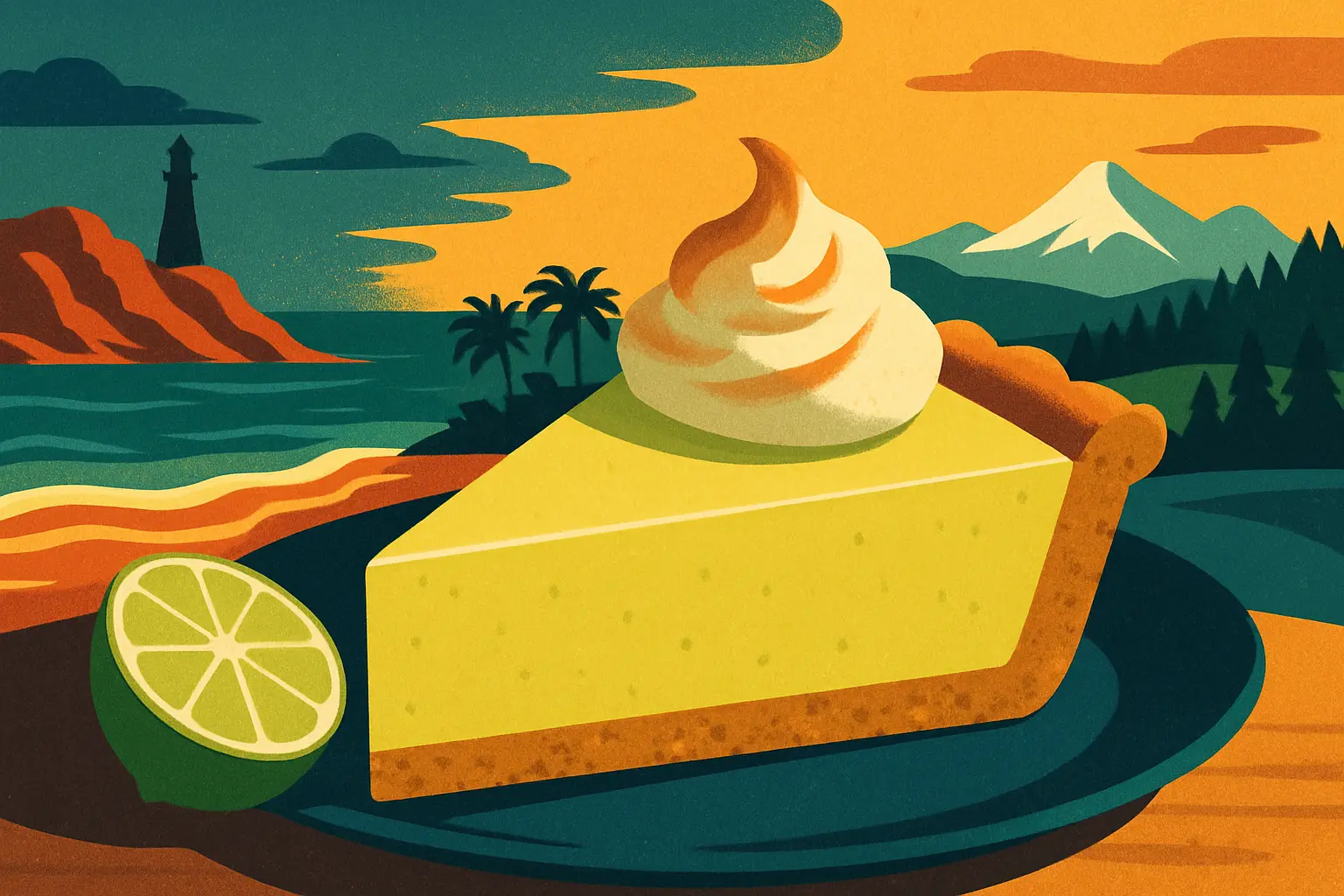
The real Key lime pie is modest in construction. The filling requires three things: Key lime juice, sweetened condensed milk, and egg yolks. The crust is graham cracker, pressed into a pan and pre-baked. The topping, where one exists at all, is whipped cream — a soft cloud, not a meringue crown. The pie is finished with a brief bake (around 15 minutes at 350 degrees Fahrenheit) to pasteurize the eggs and set the custard to a firm, trembling consistency.
The filling color is the easiest tell. Ripe Key limes are yellow, not green — smaller and rounder than the Persian limes sold in every supermarket, with a thinner skin and a more complex, floral tartness. Their juice is pale straw-colored. A filling that comes out any shade of green has been colored artificially. This is not a matter of taste preference; it is a flag that whoever made the pie did not use the correct ingredient or did not know the fruit.
Authentic Key lime pie is also not cloyingly sweet. The sweetened condensed milk provides the sugar and body, but a generous amount of lime juice — typically about 3/4 cup for a standard 9-inch pie — brings enough acidity to balance the sweetness into something tangy and rich rather than cloying. Pies that taste like lime-flavored candy have been made with too little juice or too much sugar.
The origin of Key lime pie is genuinely contested, and the two competing accounts tell different stories about whether the dish emerged from necessity in a Keys kitchen or from a corporate test kitchen.
The Keys origin story places the pie in the late 19th century, when the Florida Keys were accessible only by boat and fresh milk spoiled rapidly in subtropical heat. Sweetened condensed milk — patented by Gail Borden in 1856 — was a pantry staple precisely because it did not require refrigeration. The local lore credits a Key West cook nicknamed Aunt Sally, who worked for wealthy sponge merchant William Curry, with perfecting the recipe in the late 1800s. Local newspaper articles from 1926 described Key lime pie as an established Keys tradition, which Key West advocates cite as evidence the recipe predates the next competing claim.
The Borden's test kitchen theory points to a recipe called 'Magic Lemon Cream Pie' published in a Borden's promotional brochure in 1931. Food historian Stella Parks, in her book *BraveTart*, argues that the no-bake method — which relies on the chemical interaction between lime juice acidity and condensed milk proteins to set the filling — was more likely the work of a food scientist than a home cook. Borden had strong commercial reasons to develop exactly this kind of recipe that showcased sweetened condensed milk.
The most honest reading of the evidence is that a version of the pie existed in the Keys before 1931, that Borden's recipe standardized and nationalized it, and that neither account can be fully verified. What is documented: an 'icebox lime pie' appeared in print as a Florida Keys specialty in 1935, and the pie became Florida's official state pie in 2006, which resolved the legal question of ownership without settling the historical one.
Get short, interactive stories that make each place easier to remember while you travel.
The science behind Key lime pie is more interesting than the recipe suggests. Sweetened condensed milk has a pH around 6.3 — nearly neutral. Key lime juice has a pH of roughly 1.8 to 2.0, which is highly acidic. When the two combine, the acid from the lime juice begins to denature the milk proteins, cross-linking them into a semi-solid gel. This is the same process that makes ceviche: raw fish 'cooked' by the acidity of citrus juice rather than heat.
The original Keys recipe may have been made entirely without an oven — just the lime juice's acidity setting the filling in the refrigerator. The catch is that uncooked egg yolks carry a Salmonella risk. Most recipes since the mid-20th century call for a brief bake — around 15 minutes at 325 to 350 degrees Fahrenheit — to pasteurize the eggs while keeping the filling from over-setting and cracking.
The 30% acidity threshold is why the recipe works and why substitutions fall short. Persian lime juice is less acidic than Key lime juice and slightly more bitter; a pie made with Persian limes will taste different and may not set as cleanly without adjustment. Lemon juice sets but tastes wrong. Bottled Key lime juice — Nellie and Joe's is the most widely available brand — works well and is an accepted substitute at most Keys restaurants when fresh Key limes are scarce, which is most of the year.
The topping question divides Key lime pie makers more reliably than almost any other detail.
Whipped cream is the most common topping at Key West restaurants and the version most closely associated with Keys tradition. It is usually plain or lightly sweetened, piped or spread over the cold pie in a soft layer.
Meringue — the stiff, toasted egg-white topping associated with lemon meringue pie — is considered by most Keys purists to be a mainland misunderstanding. It works structurally but changes the character of the dessert, covering the pale custard with an opaque white layer and adding sweetness where the original recipe relies on contrast between the sour filling and the neutral, slightly salty crust.
No topping is the choice of purists who argue that the graham crust, the custard, and the lime are a complete three-part dessert. This is the version you are most likely to encounter at a small Keys diner or a bakery making the pie for locals rather than tourists.
The chocolate-dipped on a stick version — the filling poured into a graham cracker mold, frozen, and coated in dark chocolate — was popularized in Key West and has become one of the island's most photographed tourist items. It is genuinely delicious and unapologetically commercial. Kermit's Key Lime Pie Shop on Elizabeth Street is the best-known source, and the concept horrifies traditionalists in exactly the way that delights most visitors.
Key West has no shortage of places claiming the best Key lime pie on the island. A few stand above the rest on consistency and provenance.
Kermit's Key Lime Pie Shop (200 Elizabeth St., Historic Seaport area) is the island's most dedicated Key lime operation — started 30 years ago as a smoothie stand and evolved into a full pie shop. The chocolate-dipped-on-a-stick version is their signature, but the sliced pie is equally serious: a dense, properly sour custard on a dark graham crust. Open roughly 10 a.m. to 9:30 p.m. daily, hours vary by season. Kermit's also ships nationally for anyone who wants to bring the flavor home.
Blue Heaven (729 Thomas St., Bahama Village) ranks consistently among the island's best — an ABC News taste test rated it 9 out of 10 in their Key West pie comparison. The outdoor courtyard setting, with roosters wandering freely among the picnic tables under tropical trees, makes eating here an experience in itself. Open for breakfast and lunch from 8 a.m. to 2:30 p.m. daily, with happy hour at 3:30 p.m. and dinner from 5 to 10 p.m.
Key West Key Lime Pie Company (Duval Street) specializes in the frozen-on-a-stick format. Their chocolate-dipped version scored 7 out of 10 in the same ABC News taste test. Good for a quick Duval Street purchase; the format is more walk-and-eat than sit-down.
Pepe's Cafe (806 Caroline St.) is Key West's oldest operating restaurant, open since 1909. Their Key lime pie is straightforward and honest — not a showpiece, but made correctly. The low-key diner setting is a relief after the more theatrical options on Duval.
Details checked October 2026; hours and prices change, so confirm before you go.
Kermit's Key Lime Pie Shop — 200 Elizabeth St., Historic Seaport; ~10 a.m. to 9:30 p.m. daily; ships nationally
Blue Heaven — 729 Thomas St., Bahama Village; breakfast and lunch 8 a.m. to 2:30 p.m.; dinner 5 to 10 p.m.
Key West Key Lime Pie Company — Duval Street; walk-in, no reservations; frozen-on-a-stick format
Pepe's Cafe — 806 Caroline St.; oldest restaurant on the island (1909); unpretentious local atmosphere
Is unbaked Key lime pie safe to eat? The original recipe, made without baking, carries a Salmonella risk from raw egg yolks. Nearly all restaurant versions today are baked briefly to pasteurize the eggs. If you make the pie at home and want to skip the oven, use pasteurized egg yolks, sold at most major grocery stores. Pregnant and immunocompromised individuals should stick to the baked version.
Where can I buy Key limes outside of Florida? Fresh Key limes are available at well-stocked grocery stores (look for the small, round, thin-skinned variety), Latin grocery stores, and specialty markets. Bottled Nellie and Joe's Famous Key Lime Juice is the most widely used substitute — it is sold nationally at grocery chains and works well because the juice is already extracted at the correct acidity.
Can I use regular limes? You can, and the pie will still be good, but it will taste different — less floral, slightly more bitter, and less intensely tart. If substituting Persian limes, increase the juice by about 25 percent to compensate for the lower acidity and sharper flavor.
When is the best time to visit Key West? The Key West visitor guide covers the full picture, but October through April is the reliable window — temperatures in the high 70s, lower humidity, and no hurricane risk. October is particularly good: the island is quieter before the snowbird season begins, and Fantasy Fest runs the third and fourth week of the month.
What about Key lime pie outside of Key West? The pie travels well and the recipe is forgiving, so good versions exist across Florida and beyond. Cuban bakeries in Miami's Little Havana often make a serious version. Outside Florida, the quality drops quickly — most restaurant 'Key lime pies' in other states use Persian lime juice and green food coloring. When in doubt, ask if the filling is yellow.