The three amusement parks that made Coney Island famous opened within seven years of each other at the turn of the 20th century — and two burned to the ground within a decade.
Steeplechase Park arrived first, in 1897. George Tilyou built it between West 16th and West 19th Streets on land his family had worked for decades. The signature ride was a mechanical horse race on a track that sent riders side by side around the park's perimeter — the first amusement where strangers were placed in physical proximity and expected to enjoy it. Steeplechase survived a 1907 fire and was rebuilt. It operated until 1964, the longest run of the three.
Luna Park opened in 1903. Its founders, Frederic Thompson and Elmer Dundy, had just made a fortune at the 1901 Pan-American Exposition and poured the profits into elaborate electric light towers, elephant rides, and a gondola-style journey called 'A Trip to the Moon.' At its peak, Luna Park had over 1,200 towers carrying 250,000 electric bulbs — at a time when most American cities had only recently wired their streetlights. The park burned in 1944.
Dreamland went up in 1904, built by state senator William Reynolds with more capital and grander ambitions than either competitor. It lasted seven years. In May 1911, a vat of boiling tar used in construction caught fire at 1 a.m. The blaze killed the animals in Bostock's menagerie and burned through the week. Reynolds never rebuilt.
What survived the fire era isn't the parks themselves — it's the individual things that outlasted them. A roller coaster, a hot dog stand, a Ferris wheel. Those three objects tell you more about what Americans actually want from leisure than any park master plan ever did.
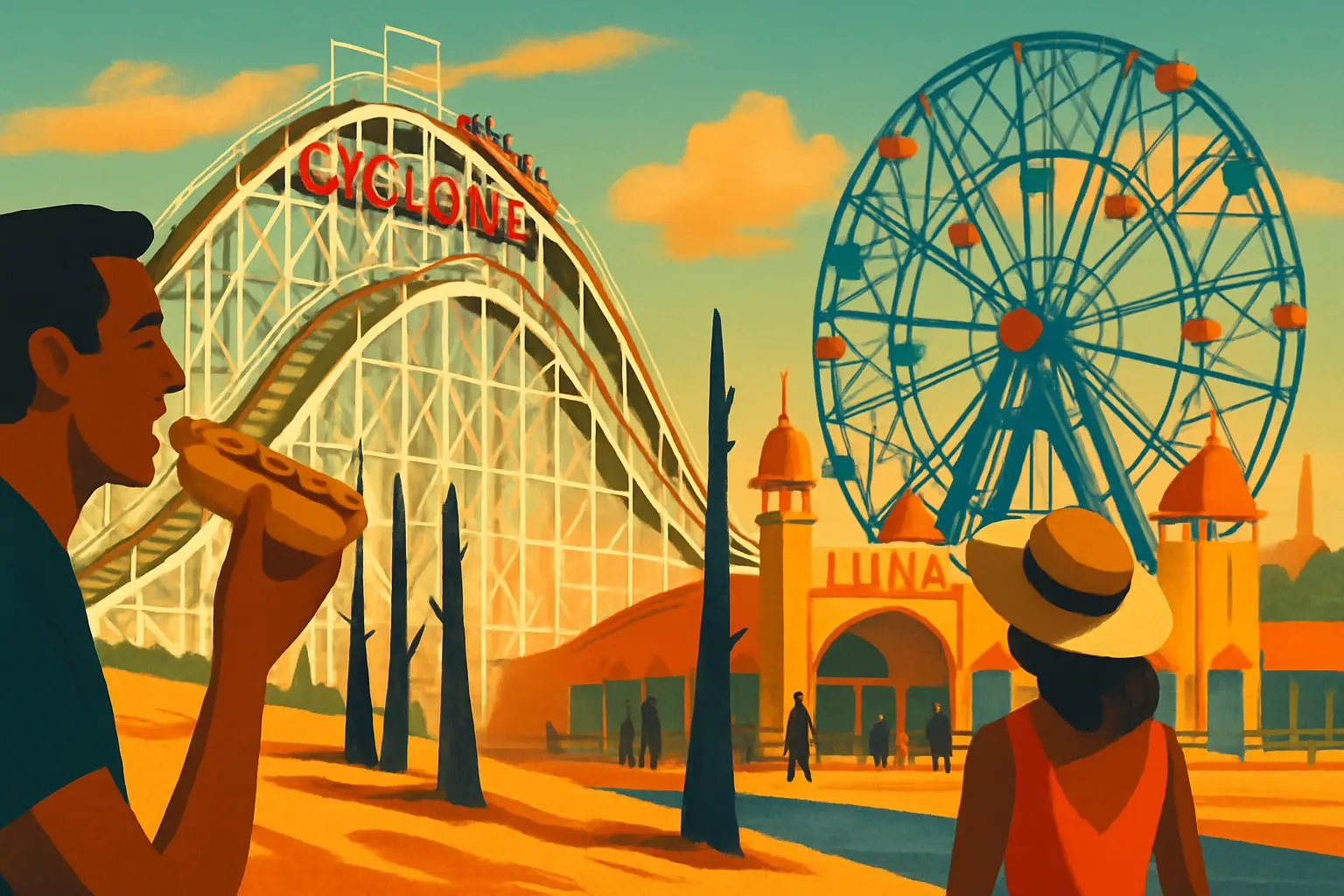
The Cyclone opened in June 1927, designed by Vernon Keenan and built by Jack and Irving Rosenthal — two Russian immigrant brothers who ran concessions at the island and hired the country's leading coaster engineer to beat the Thunderbolt and the Tornado, two competing wooden rides already operating on the same stretch of beach.
The Cyclone runs 2,640 feet of track at a top speed of 60 miles per hour. The first drop — 85 feet, at an angle that would concern a modern safety engineer — is followed by nine dips that throw riders sideways into each other with lateral G-forces that steel coasters eliminated decades ago. That lateral force is the ride's signature: you're not being pushed into your seat, you're being thrown into the person next to you. The experience hasn't changed since it was designed.
In 1988, New York City declared the Cyclone a landmark alongside the Brooklyn Bridge and the Statue of Liberty. In 1991 it joined the National Register of Historic Places. It remains one of the last operational wooden coasters from what historians call the Golden Age of the American roller coaster.
One documented detail: Charles Lindbergh rode the Cyclone in 1927, shortly after returning from the first solo transatlantic flight, and reportedly said it was more thrilling than flying across the Atlantic. Whether that's genuine testimony or amusement park marketing depends on your view of a man who spent 33 hours alone over the ocean. Either way, the ride still charges $10 and runs every summer day the weather permits.
Cyclone: 834 Surf Ave, adjacent to Luna Park — ticket price ~$10, no Luna Park admission required
Operating season: April through October; daily in peak summer, weekends in shoulder season
The ride lasts 110 seconds — the same duration it has always been
Get short, interactive stories that make each place easier to remember while you travel.
Nathan Handwerker opened Nathan's Famous in 1916 at the corner of Surf Avenue and Stillwell Avenue — directly across from the subway exit, in the most trafficked square foot of the island. The price: five cents, half what competitors charged at the time. The recipe: a blend his wife Ida developed, with a natural casing that splits under direct heat.
The early problem was the price cut. Customers assumed cheap hot dogs meant something was wrong with them. Handwerker's reported solution: he hired men in white coats — either doctors or actors dressed as doctors, depending on who's telling the story — to eat publicly at the counter. It worked. By 1920, Nathan's was the most crowded stand on the island.
The story that made Nathan's famous nationally: in 1939, President Franklin D. Roosevelt served Nathan's hot dogs at a White House luncheon for King George VI and Queen Elizabeth during the British royal family's first visit to the United States. It was a deliberate act of Americana — Roosevelt chose the food specifically to show the King something quintessentially American. The Associated Press photograph of the King holding a hot dog ran on front pages across the country.
Today the original Nathan's stands at the same corner it always has. The July 4th hot dog eating contest — broadcast nationally since 1972, now sanctioned by Major League Eating — has produced competitors who have consumed more than 70 hot dogs in 10 minutes. The counter still sells the original recipe. A dog with mustard and sauerkraut costs around $6.
The Wonder Wheel opened in 1920, built by the Eccentric Ferris Wheel Company using Bethlehem steel poured and worked directly on the Coney Island beach. It has 24 cars: 16 'swinging' cars that slide along a curved internal track as the wheel rotates, throwing riders outward over the 150-foot height; and 8 stationary cars for those who want the view without the lateral motion. The sliding mechanism was designed by engineer Charles Hermann specifically to give riders a second, unexpected sensation at the peak — what he called 'the surprise.'
The Wonder Wheel was declared a New York City landmark in 1989. The Vourderis family, who bought it in 1983, operates it as part of Deno's Wonder Wheel Amusement Park. Over 35 million rides have been given since 1920.
The Boardwalk runs 2.7 miles from Coney Island east to Brighton Beach, with the Atlantic on one side and a wall of concessions, arcades, and beach access on the other. The beach is free and public. Peak summer weekends in August bring hundreds of thousands of visitors from across the five boroughs — arrive before 10 a.m. for a workable spot near the water.
MCU Park (formerly KeySpan Park), home of the Brooklyn Cyclones minor league baseball team, sits at 1904 Surf Ave with a left-field wall that opens directly to the boardwalk and the ocean beyond it. A Cyclones game in August — tickets start around $15 — is one of the better-value experiences in New York.
Wonder Wheel: Deno's Wonder Wheel Park, W 12th St and Boardwalk — open May through October
Brooklyn Cyclones games: MCU Park, 1904 Surf Ave — season runs June through September, tickets from $15
Boardwalk access: free at any of the 30+ entry points from Surf Ave
Walk the boardwalk two miles east from the Wonder Wheel and the amusement parks fall away. You're in Brighton Beach — a neighborhood so densely Russian and Ukrainian that street signage runs in Cyrillic, fish markets sell caviar by the jar, and the banya (bathhouse) scene is serious enough that regulars discuss it the way Brooklyn wine bars discuss natural wine.
The neighborhood is called 'Little Odessa' and the name is specific: the largest wave of Soviet Jewish emigration in the 1970s and 1980s landed in Brooklyn, and a substantial portion of those families settled here, establishing grocery stores, restaurants, bakeries, and social clubs along Brighton Beach Avenue under the elevated B and Q tracks.
Tatiana Restaurant (3152 Brighton 6th St) occupies a beachside cabaret dining room that seats 500, serves Georgian natural wine, and runs live music on weekend nights. It's one of the most unusual dining environments in New York City — the decor reads Las Vegas casino, the wine list reads Tbilisi, and the room is genuinely full every summer Saturday.
For provisions: any of the food markets along Brighton Beach Avenue sell house-cured fish, black bread, smoked meats, and $8 Georgian wine. The combination of Coney Island in the morning and Brighton Beach for lunch or dinner is unusually good value — one subway fare, one long walk, two completely different worlds.
How do I get to Coney Island from Manhattan? The F or Q train to Coney Island-Stillwell Avenue is the standard answer — direct from Midtown, 45 minutes from 34th Street-Herald Square. The Q also stops at Brighton Beach (one stop before Stillwell), making it the train to take if you plan to do both in the same visit. Driving is possible but parking is expensive and fills by 10 a.m. on summer weekends.
When is the best time to go? Weekday mornings in August — full services running, beach accessible, boardwalk uncrowded before noon. Friday evenings add the free fireworks (9:30 p.m., late June through Labor Day). Avoid Saturday afternoons between July 4th and Labor Day: the beach is genuinely dangerous to navigate in peak hours and the subway home is brutal.
What should I skip? The carnival games along the boardwalk are high-margin and unrewarding — spend that $20 on lunch instead. The New York Aquarium (602 Surf Ave) is worthwhile for families with young children but doesn't combine naturally with a beach and boardwalk day; treat it as a separate trip.
Is Coney Island safe? The boardwalk, beach, and Luna Park area are busy and well-staffed during daylight hours throughout the summer. The residential blocks inland from Surf Avenue have a different character — stay on the beach corridor and you will have no issue. Brighton Beach, two miles east, is a residential neighborhood with nothing to be concerned about at any hour.