The bronze statue of John Harvard at the center of Harvard Yard is one of the most photographed objects in Massachusetts. Guides call it 'the Statue of Three Lies,' and the nickname is accurate on all three counts.
Lie one: it's not John Harvard. When sculptor Daniel Chester French (later famous for the Lincoln Memorial) was commissioned in 1884, no verified portrait of John Harvard existed. He used a student named Sherman Hoar as his model.
Lie two: the inscription says 'Founder.' John Harvard was not the founder of the college. Massachusetts Bay Colony founded the institution in 1636. John Harvard was a benefactor — a young Puritan minister who died of tuberculosis in 1638 and left half his estate and 400 books to the fledgling school. The General Court named it in his honor. Generous, yes. Founder, no.
Lie three: the date says 1638. Harvard was founded in 1636. The inscription records the year of John Harvard's gift, not the institution's founding.
None of this makes the statue less worth seeing — knowing the story makes it better. Harvard Yard itself opened in 1638 and is now enclosed by 27 historic buildings. The Johnston Gate, on Massachusetts Avenue, is the ceremonial main entrance, designed by McKim, Mead & White in 1889. Walking through it remains one of the better entrances in American higher education.
Brattle Street runs west from Harvard Square and is one of the oldest intact residential streets in America. It earned its colonial-era nickname — Tory Row — because nine of its most prominent houses were owned by British loyalists who fled to Halifax or London when the Revolution began. The Continental Army used several as headquarters and officer quarters.
Longfellow House at 105 Brattle Street is the block's anchor. George Washington used it as his headquarters from July 1775 to April 1776, the period when the Continental Army besieged Boston from Cambridge. Henry Wadsworth Longfellow lived there from 1837 until his death in 1882, writing *Paul Revere's Ride* and *Evangeline* in the second-floor study. It's a National Historic Site; guided tours run Thursday through Sunday in summer.
The street also contains the American Repertory Theater at the Loeb Drama Center (64 Brattle St), founded in 1980 and one of the most influential regional theaters in the country. Productions that originated here — including *Hair* and *The Glass Menagerie* revivals — have gone on to major Broadway runs.
For coffee on this stretch: Tatte Bakery (70 Brattle St) opened its first location in Cambridge and remains the best reason to start a Brattle Street walk before noon. The sesame babka and labneh toast are the order.
Get short, interactive stories that make each place easier to remember while you travel.
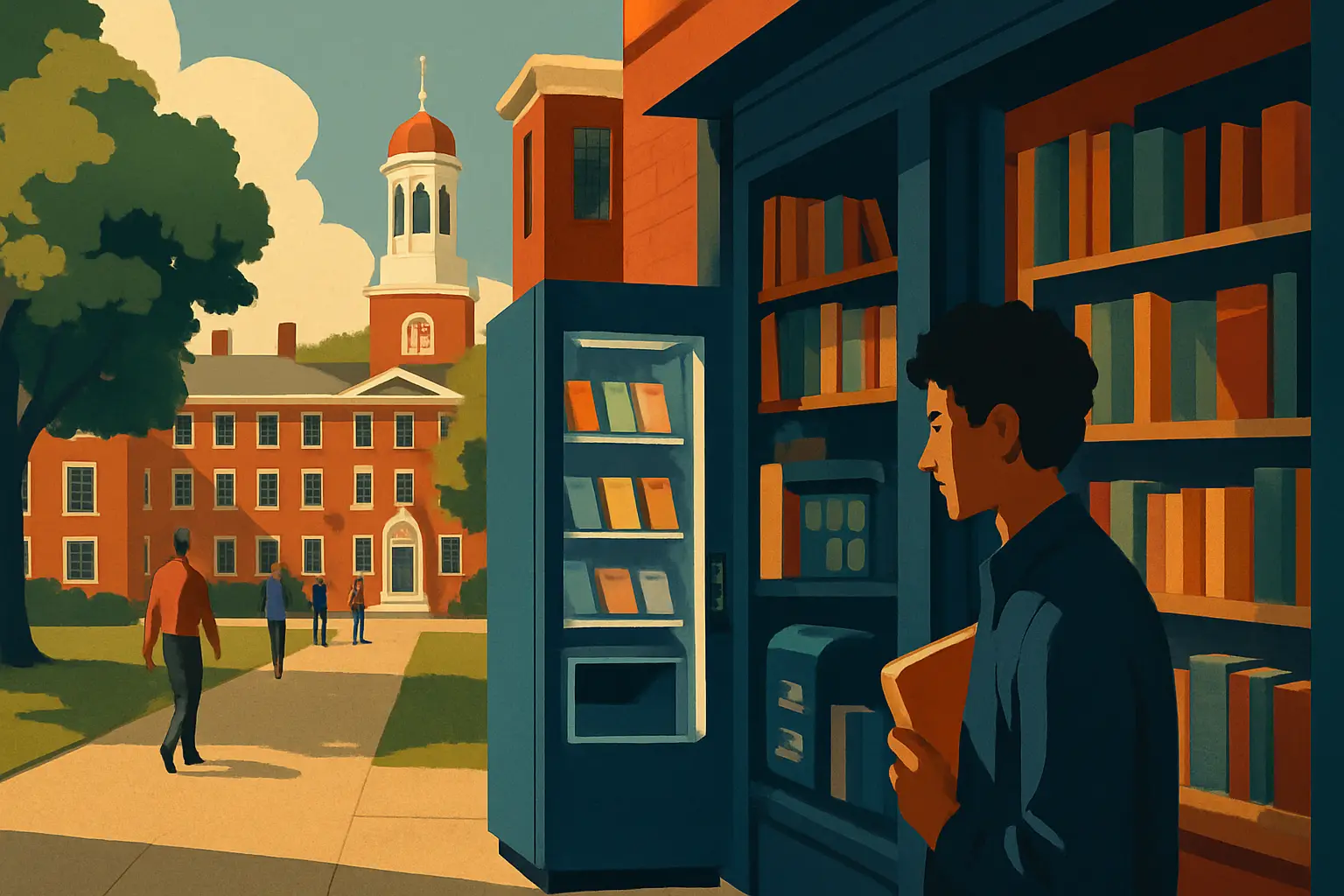
Harvard Book Store at 1256 Massachusetts Avenue opened in 1932 and is now one of the last genuinely great independent bookstores in New England. Three things distinguish it from chain alternatives: the used-book basement (dense, deeply organized, worth 30 minutes on its own), the staff picks selection on the ground floor which reliably surfaces titles months before they reach mainstream attention, and the Biblio-Mat — a vending machine installed in 2013 that dispenses a random used book in a paper sleeve for $3. You do not choose the book. This is the point.
The store runs a substantial author events program, mostly free, with a mailing list covering visiting writers for the Harvard academic year — novelists, historians in town for lectures, and the occasional Nobel laureate promoting a translated edition.
Raven Used Books (23 Church St, one block off the square) is quieter and smaller, with a tighter selection focused on literature, philosophy, and history. It's where Harvard Book Store staff sends customers who want something more obscure.
Harvard Book Store: 1256 Massachusetts Ave — open daily, used-book basement closes an hour before the store
Biblio-Mat: $3 random book vending machine, ground floor near the entrance
Author events: free most nights; sign up at harvard.com/events for the semester calendar
Central Square is one stop southeast of Harvard on the Red Line, and it is a different universe. Where Harvard Square is curated and expensive, Central has the energy of a neighborhood that has been sorting itself out productively for four decades.
The anchor is The Middle East at 472–480 Massachusetts Avenue — a restaurant and music complex that opened in 1970 as a Lebanese restaurant and added music in the 1980s. The club now operates four rooms of varying capacity under the same roof and has launched a significant fraction of the region's indie and alternative artists. The downstairs room fits 575 people; the Zuzu bar books smaller acts. Lebanese food is served throughout, and it's genuinely good — the kibbe and hummus plates outlast the show.
For food, Central Square has the highest concentration of Ethiopian restaurants in the Boston area. Asmara (739 Massachusetts Ave) serves injera and combination platters at the graduate-student price points the neighborhood was built around — a filling dinner for two under $40.
Life Alive (765 Massachusetts Ave) is the other Central Square institution: an organic cafe that's been feeding the neighborhood since 2007 with grain bowls, soups, and juice blends that predate the current wellness restaurant wave by a decade.
Inman Square is a 15-minute walk northeast of Harvard along Cambridge Street — less visited, less famous, and better for dinner.
Trina's Starlite Lounge (3 Beacon St at Cambridge St) is the neighborhood's most reliable anchor: an American bar and kitchen doing chicken and dumplings, burgers, and excellent cocktails in a booth-heavy room that hasn't changed its formula since opening in 2008. It's the kind of place where the regulars know the bartenders' names and four menu items have been there from day one.
Tupelo (1193 Cambridge St) serves Southern food — Nashville hot chicken, pork belly biscuits, shrimp and grits — in a space that fills early on weekends. No reservations, and the Saturday night wait can run 45 minutes. Worth it.
1369 Coffee House (1369 Cambridge St) has been a neighborhood fixture since 1990 and is the working coffee shop where the other Cambridge — the one that isn't Harvard — actually works. The atmosphere is lived-in in the best sense: mismatched chairs, regulars with laptops, no line of tourists.
Trina's Starlite Lounge: 3 Beacon St — dinner Mon–Sat, brunch weekends, no reservations
Tupelo: 1193 Cambridge St — arrive by 5:30 p.m. on weekends to avoid the wait
1369 Coffee House: opens 7 a.m. daily — the best work-from-cafe option in Cambridge
The Charles River runs along the southern edge of Cambridge, and Memorial Drive follows it from the BU Bridge east toward the Eliot Bridge — one of the best riverside walks in New England, with the MIT campus on one side and the Boston skyline on the other.
MIT begins at Kendall/MIT on the Red Line. The campus is free and open to the public. Two things are worth finding:
The Stata Center (32 Vassar St) was designed by Frank Gehry and opened in 2004 as MIT's Computer Science and Artificial Intelligence Laboratory. The building is a deliberate visual shock — tilted walls, clashing angles, surfaces that don't meet at right angles — and it generated immediate controversy when it opened. It's now a landmark. Walk inside: the interior is just as unsettling and interesting as the exterior.
Killian Court, on the river-facing side of the main campus, is MIT's version of Harvard Yard — a formal grass rectangle flanked by neoclassical buildings with the Rogers Building Dome (1866) at the center, facing the Charles River directly.
The walk from Kendall/MIT station along the Charles River back to Harvard Square takes about 35 minutes and is the best way to experience both campuses in sequence. In late September and October, the tree canopy along Memorial Drive turns a vivid combination of orange and red that rivals anything in rural New England.
When is the best time to visit Cambridge? September through early November is the strongest window: fall foliage along the Charles River begins in late September, the academic year brings the full roster of author events and theater productions, and the temperatures are comfortable for walking between neighborhoods.
Early September — move-in week at Harvard and MIT — is a particular sub-season. Families from dozens of countries arrive simultaneously, the square is the most internationally diverse it ever gets, and the bookstores and coffee shops are full of people starting something new.
Do I need to book a Harvard tour? The Harvard Information Center (Holyoke Center, 1350 Massachusetts Ave) offers free guided tours of Harvard Yard on weekdays, run by current students. They book out days ahead in September and October. Self-guided walking works just as well — the Yard is publicly accessible, and the Statue of Three Lies does not require a guide to appreciate.
How do I get between Harvard Square and Central or Inman Square? The Red Line connects Harvard and Central in about 3 minutes. Inman Square is a 15-minute walk northeast along Cambridge Street — no direct T stop, but the grid is flat and the walk passes interesting blocks. Cambridge pairs naturally with Boston's Beacon Hill and North End on the same day trip from the Red Line.
Harvard tours: free, book at harvard.edu at least 3–5 days ahead during fall semester
Best fall foliage: last week of September through second week of October along Memorial Drive
Red Line from Harvard to Park Street (downtown Boston): about 20 minutes, no car needed