The Back Bay we walk through today did not exist before 1857. The original Boston was a pear-shaped peninsula barely a mile across, surrounded by water on three sides. To its west sat a tidal flat — shallow, foul-smelling, and flooding twice daily. The city tried to improve it in the 1820s with a milldam, but the dam trapped sewage rather than draining it, and the Back Bay became one of the most polluted water bodies in New England.
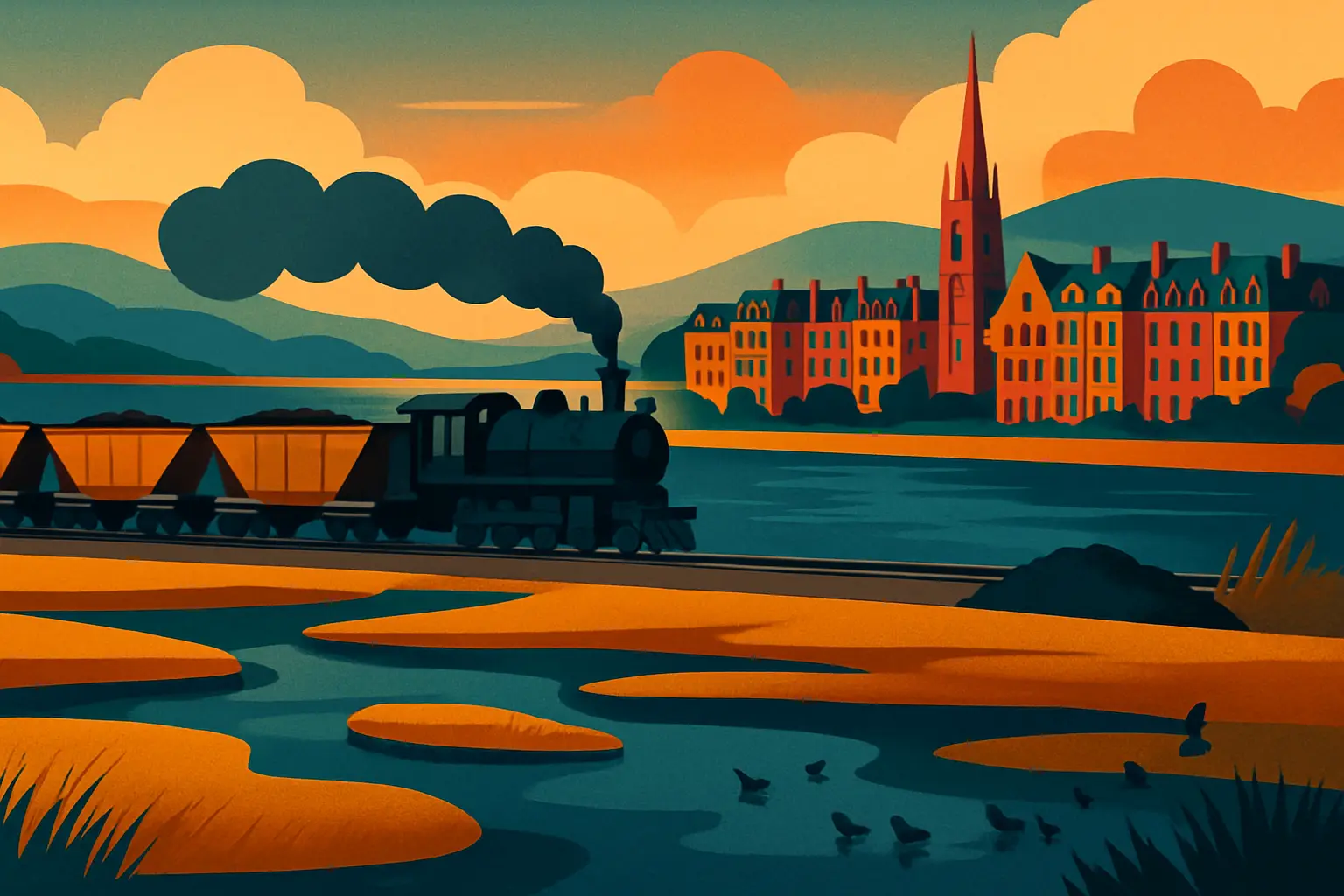
The solution was to fill it. Starting in 1857, a continuous chain of gravel trains — up to 35 cars per day — ran from gravel pits in Needham, 10 miles away, into the fill zone at the rate of two car-loads per minute. The fill operation ran every day for 25 years, eventually creating 580 acres of new land and pushing the shoreline of the Charles River half a mile to the north. Streets were laid out as the fill advanced westward, which is why the alphabetical grid begins at Arlington (nearest to the original city) and marches in order to Hereford, where the fill project ended.
The engineer who designed the grid had been to Paris. Commonwealth Avenue was laid out at 200 feet wide with a 100-foot central tree-lined promenade — a deliberate echo of the boulevards Haussmann was redesigning in Paris at the same moment. The brownstone houses that line the side streets were built quickly enough that their architectural style tracks the decades of construction: Italianate in the 1860s, French Second Empire in the 1870s, Queen Anne in the 1880s, Romanesque Revival in the 1890s. Walking from east to west on Commonwealth is walking through an architectural timeline of Victorian America.
The central promenade of Commonwealth Avenue — the Commonwealth Avenue Mall — runs for 1.5 miles from Arlington Street at the Public Garden's west edge to Charlesgate at the Fens. It is a 100-foot-wide corridor of American elms, park benches, and bronze statues, maintained as a city park through its entire length.
Thirty-six statues stand along the mall, representing figures from across American and world history in a concentration unusual for any city. Alexander Hamilton stands near Arlington Street — a standard portrait. More interesting are the statues that reflect the neighborhood's later progressive consciousness: Domingo Faustino Sarmiento, the 7th President of Argentina and founder of Argentina's public school system, stands at Dartmouth Street — a gift from the Argentine government in 1973, installed because Sarmiento spent time in Boston studying its schools. Phillis Wheatley, the first African American and first enslaved person to publish a book of poetry in America, was added at Dartmouth Street in 2023, making it one of the very few major American street monuments to honor an enslaved person. William Lloyd Garrison — the abolitionist and editor of *The Liberator*, who organized founding meetings of the Anti-Slavery Society in the North End's African Meeting House — stands near Dartmouth as well.
The mall in late August and early September, with the elms fully leafed and the afternoon light at low angles, is the best time to walk it. Free seating is everywhere.
Get short, interactive stories that make each place easier to remember while you travel.
Copley Square sits at Dartmouth Street, where Boylston and St. James Avenue intersect in an open public plaza. It holds two buildings that almost never appear on the same city block — Trinity Church and the Boston Public Library — and the visual tension between them across the square is one of the great urban compositions in the United States.
Trinity Church (206 Clarendon Street) was completed in 1877. Its architect, Henry Hobson Richardson, designed the building in a style now called Richardson Romanesque — a personal interpretation of 11th-century French and Spanish Romanesque characterized by heavy masonry, rounded arches, short massive columns, and a deep integration of sculpture into the structure itself. Trinity was the first fully realized example of this style, and it influenced American architecture so comprehensively that the generation of buildings it spawned is named after Richardson alone. The American Institute of Architects has ranked it among the top ten greatest buildings in American architectural history. Guided tours run weekdays; admission is $12 for adults, $6 for students. The interior — with murals by John La Farge covering nearly every surface, and stained glass windows designed by Edward Burne-Jones for Morris & Co. — is the part most visitors don't know to expect.
Boston Public Library (700 Boylston Street, McKim Building) was completed in 1895, designed by the firm McKim, Mead & White in Italian Renaissance style — a deliberate counterstatement to Trinity's medieval weight directly across the square. The BPL was the first large free public library in the United States open to all adults regardless of status or education. The exterior is pink Milford granite; the phrase 'Free to All' is carved above the Dartmouth Street entrance. Inside, a vaulted entry hall leads to a courtyard modeled on the Palazzo della Cancelleria in Rome — open air, arcaded on all four sides, with a fountain at its center. Bates Hall on the second floor is the main reading room: 218 feet long, barrel-vaulted, with ornate oak reading tables that have been here since 1895. John Singer Sargent's mural cycle 'Triumph of Religion' occupies the north staircase — Sargent worked on it for 28 years, and the final panels, depicting the synagogue, provoked immediate controversy on installation in 1919 that has never fully resolved. The library is open to the public, free of charge, Monday through Thursday 9 a.m. to 9 p.m., Friday and Saturday until 5 p.m.
Trinity Church — 206 Clarendon St; tours weekdays and Sundays; $12 adults, $6 students; free to visit the plaza and exterior anytime
Boston Public Library (McKim Building) — 700 Boylston St; free entry; Mon–Thu 9 a.m.–9 p.m., Fri–Sat 9 a.m.–5 p.m., Sun 1–5 p.m.
Free BPL guided tours: weekdays at 2:30 p.m., Saturday at 11 a.m., Sunday at 2 p.m.; depart from the Dartmouth Street entrance lobby
Newbury Street runs for eight blocks parallel to Commonwealth Avenue, one block south. It is among the most visited retail streets in New England and rewards walking its full length rather than stopping at whichever block a hotel drops you nearest.
Blocks 1–4 (Arlington to Dartmouth): High-end boutiques — Louis Vuitton, Chanel, Cartier — occupy the ground floors of 19th-century brownstones. The upper floors of these buildings typically hold medical offices, apartments, or salons, maintaining the residential scale even as the street life below it is purely commercial. Clio at 370 Commonwealth (just off Newbury at Arlington) is the fine-dining anchor — New American tasting menu, one of the city's most consistent kitchens since 1997. Trident Booksellers & Cafe at 338 Newbury is the independent bookstore and cafe that belongs to every neighborhood but almost no neighborhood has anymore — open until midnight on weekends, full coffee service, decent food.
Blocks 5–8 (Dartmouth to Massachusetts Avenue): The character shifts visibly around Exeter and Fairfield Streets. Boutiques give way to vintage clothing stores, independent music shops, galleries, and restaurants that don't need white tablecloths to be serious. Pavement Coffeehouse at 736 Commonwealth (just past Mass Ave) is the best coffee in the neighborhood. The Pour House at 907 Boylston is the dive bar Back Bay residents treat as their own. The west end of Newbury is the part of Back Bay where people who live there actually spend their afternoons.
The Charles River Esplanade runs for 3 miles along the north side of Back Bay between the Museum of Science and the Longfellow Bridge, separated from Storrow Drive by a sound barrier berm. It is the most heavily used recreational waterfront in Boston — joggers, cyclists, kayakers, and families fill it on any warm day — and it contains one landmark most visitors from outside Boston know mainly from television.
The Hatch Memorial Shell at 47 David G. Mugar Way is an open-air concert stage that has hosted the Boston Pops Fourth of July concert since 1929. The shell's distinctive reinforced-concrete form, built in 1940, projects music across the lawn without amplification — a rare surviving example of pre-electronic concert design that still works for the purpose. The Pops plays a full season of free outdoor concerts here in June and July; the schedule for late summer 2026 is available at bso.org.
Community Boating at 21 David G. Mugar Way operates the oldest public sailing program in the United States, founded in 1936. Single-day membership for the sailing program starts at around $20 for visitors; kayak and paddleboard rentals are available without membership. The lagoon between the Esplanade and the Charlesgate is sheltered enough for novice sailors. Access to the Esplanade is easiest from the Charles/MGH T stop on the Red Line, then across the footbridge over Storrow Drive.
Back Bay is a genuine grid — unusual in Boston, whose original streets follow colonial footpaths — which means getting lost is almost impossible once you understand the system. The alphabetical cross streets run north-south; Boylston and Commonwealth run east-west and are the two main routes through the neighborhood.
The Green Line's Copley stop puts you directly at Copley Square, equidistant between Trinity Church and the BPL. The Arlington stop deposits you at the Public Garden entrance and the beginning of both Commonwealth Avenue Mall and Newbury Street. For the Esplanade, Charles/MGH on the Red Line is faster and closer than any Green Line option.
Back Bay connects cleanly to Boston's other major historical neighborhoods. Beacon Hill is immediately east — cross Arlington Street toward the Public Garden's east side and you're on Charles Street within two minutes. The North End requires walking through Government Center but is doable in 25 minutes on foot. The Beacon Hill guide covers that neighborhood in full if you're combining both in a single day. From Back Bay's west edge, the Back Bay Fens — Frederick Law Olmsted's park anchoring the Emerald Necklace, and the approach to Fenway Park — begins at Charlesgate, just past Hereford Street.
Is Back Bay walkable? Very. The alphabetical grid means the navigation is intuitive, and every destination in the neighborhood is within a 10-minute walk of every other. The sidewalks are wide, level brick — not the narrow cobblestone of Beacon Hill — which makes Back Bay considerably more accessible for strollers and wheelchairs.
How long should I spend? Newbury Street and the BPL interior take two to three hours. Add Trinity Church (45 minutes for the self-guided tour), a walk down the Commonwealth Avenue Mall, and a stop at the Esplanade, and you have a full day.
What's the best time to visit? Late August through October is the best period. The elms on the Commonwealth Avenue Mall are fully leafed through September, crowds thin slightly after Labor Day weekend, and the afternoon light on Copley Square's stonework is noticeably warmer than in summer. The Skywalk Observatory at the Prudential Tower (800 Boylston St, $26 adults) offers the clearest views of the Charles River on crisp fall days.
Is it safe? Back Bay is one of Boston's safest and most heavily trafficked neighborhoods. The area around Boylston and Newbury Streets stays active with foot traffic until at least 10 p.m. on weekends.
What's the best restaurant in Back Bay? It depends on what you're after. For a serious dinner, Davio's at 75 Arlington (Northern Italian steakhouse) and Abe & Louie's at 793 Boylston (classic American steakhouse) are the neighborhood's long-running formal options. For a quick, specific meal: Flour Bakery at 131 Clarendon for breakfast or lunch — their egg sandwich and sticky bun are both worth seeking out.