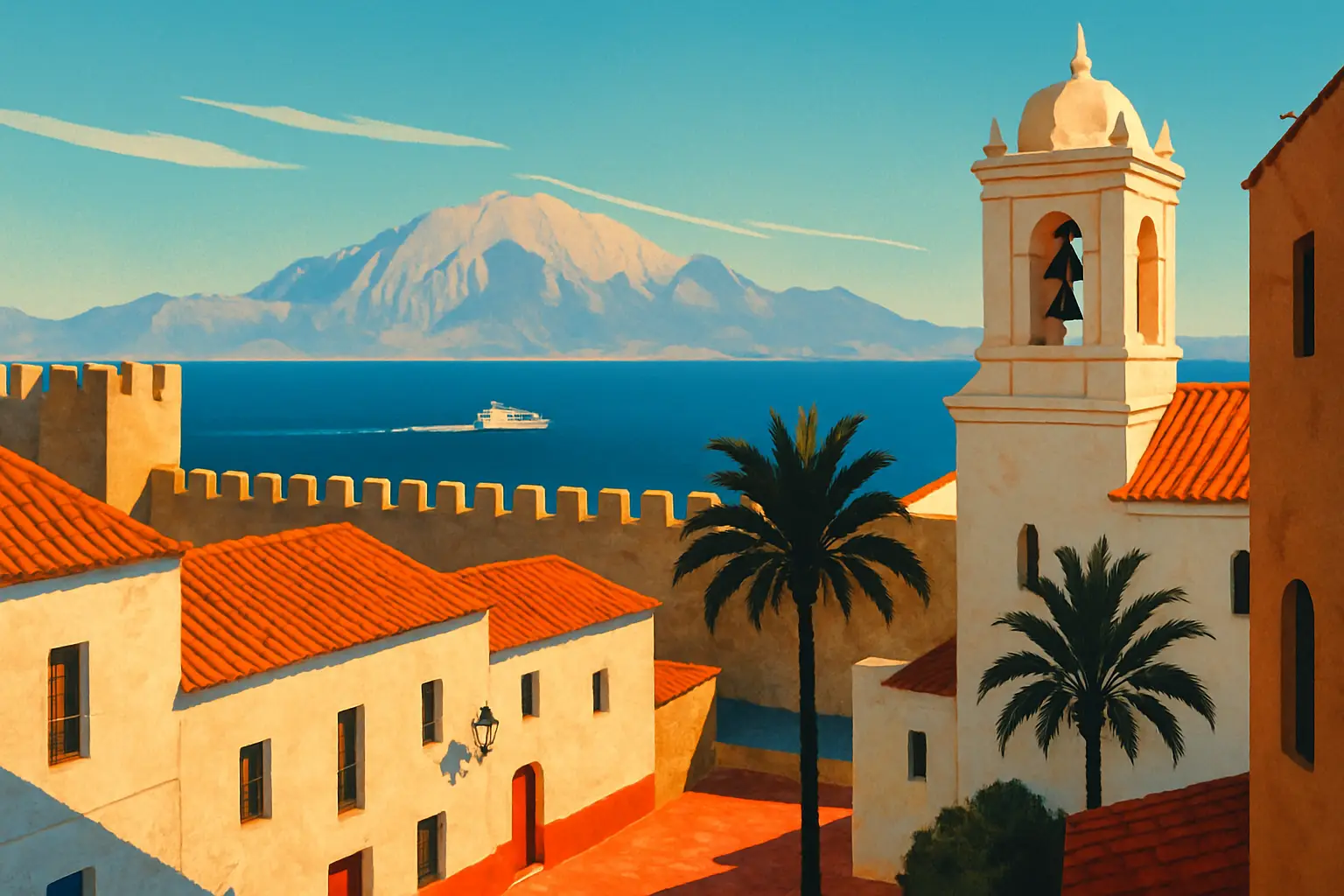
Tarifa occupies the southernmost municipality of mainland Spain and the nearest point in Europe to Africa. The small rocky island just offshore — the Isla de las Palomas (Island of Doves), now housing a lighthouse and a military installation — is connected to the town by a causeway and its tip, Punta Marroqui, sits at the narrowest crossing of the Strait of Gibraltar. Morocco is 14 kilometers away.
That proximity explains why the town has been fought over for a thousand years. The Romans called this crossing point Fretum Herculeum — the Strait of Hercules — and built the city of Baelo Claudia 20 kilometers north specifically to exploit the tuna fishery of the Strait. The Moors held Tarifa from 710 AD, just one year before the full Islamic conquest of the Iberian Peninsula — the Arab general Tariq ibn Ziyad crossed from Morocco to the Rock of Gibraltar in 711, and Tarifa was the point where the invasion fleet first came ashore, giving the town its name (Arabic: *Tarifa*, a transliteration of Tariq's name). Centuries of Reconquista fighting followed, producing the castle that still dominates the old town.
Modern Tarifa sits between two identities: a historic Andalusian town of roughly 18,000 residents with whitewashed walls and a tight medieval street grid, and the wind sports capital of Europe, where the same geographic funnel that made this crossing strategically vital now channels Atlantic and Mediterranean winds into conditions that attract kitesurfers and windsurfers from across the continent. These two identities coexist more peaceably than you'd expect — the wind culture settles on the beaches north of town, and the old town goes about its Andalusian business largely undisturbed.
The Castillo de Guzmán el Bueno was built in 960 AD by order of the Umayyad Caliph Abd al-Rahman III, who had it constructed to defend against Fatimid raids from North Africa. The walls are original 10th-century construction in large sections, and the tower at the castle's southeast corner — from which you can see both the Strait and the Mediterranean coast toward Algeciras — gives the most instructive view of why this location mattered so much to so many empires.
The castle's name comes from a story from 1294. Alonso Pérez de Guzmán, the Castilian military governor, was commanding the garrison when a Marinid force from Morocco — allied with the renegade Castilian prince Juan — besieged the castle. The Marinids had captured Guzmán's young son and threatened to execute him unless the castle was surrendered. Guzmán refused. When his son was brought to the walls and the threat repeated, Guzmán reportedly threw his own dagger over the battlements, saying they should use it if they intended to carry out the killing. His son was executed. The castle held. Guzmán was awarded the epithet 'el Bueno' (the Good) — not for the execution of his son, but for his absolute refusal to betray his king.
The story has been contested by historians as legend, but it became one of the foundational texts of Spanish honor culture and is still taught in Spanish schools today. The castle itself is entirely worth visiting: €2 entry, the walls are walkable, and the tower views are the best in the old town.
Get short, interactive stories that make each place easier to remember while you travel.
Tarifa's walled old town is compact — roughly 600 meters by 400 meters — and entered through the Puerta de Jerez, a 15th-century stone arch at the eastern edge of the walls. Inside, the street grid is unmistakably Moorish: tight, angular, designed to baffle an invader who didn't know the layout. Calle Sancho IV el Bravo is the main artery, lined with whitewashed walls, independent cafes, and surf gear shops that make no apology for the town's contemporary identity.
The Iglesia de San Mateo on the main square is the largest church in the old town, built in the 15th century on the site of a former mosque. The Baroque portal on the north facade is 17th-century and disproportionately grand for the modest building behind it — a common pattern in Andalusian church building, where the entrance was meant to project power more than the structure warranted. Inside, a Gothic nave and 16th-century chapels make for a quiet 15-minute visit.
The small square in front of San Mateo — the Plaza de Santa Maria — is where Tarifa's social life centers in the evening: families in plastic chairs, older men in cafes, and the sound of the wind through the castle walls. In September, this square is active until midnight on warm evenings. There are no tourist-facing restaurants here; the places fronting the square serve €10 menus del dia at lunch and tapas in the evening at genuinely local prices — a half-portion of papas aliñas (potato salad with tuna and vinegar, an Andalusian classic) runs €3.50.
Tarifa's main beach, Playa de los Lances, begins at the edge of the old town and stretches 9 kilometers northwest — a long, wide band of pale sand backed by juniper pines and dunes. It is one of the longest undeveloped beach stretches in Andalusia; the dune system is a protected natural area, and there are no beach clubs or built structures along most of its length. In calm conditions, the swimming is excellent and the views of Morocco are constant.
When the Levante blows — and in summer it blows for days at a stretch — Playa de los Lances becomes difficult to enjoy on foot. The sand moves horizontally, fills drinks and eyes, and the surface chop makes swimming uncomfortable. This is when Tarifa's second identity takes over: the beach becomes a spectacle of color as dozens of kites fill the air above the water.
Playa de Valdevaqueros, 6 kilometers from town, is the principal kitesurfing and windsurfing beach. The combination of consistent strong wind, flat water behind the Punta Paloma sandbar, and a wave break in front of it creates conditions that support both flat-water freestyle and wave riding in the same location. Schools line the beach access road — Kiteboarding School Tarifa (Carretera Nacional 340, km 76) and Kite Spirit are among the longest-established. A first-time 3-hour taster lesson runs approximately €100-120. If you don't kite, Valdevaqueros in full Levante is still worth seeing — 40 kites in the air simultaneously is a specific kind of visual spectacle.
For swimming when the Levante blows, the sheltered coves around Bolonia (see below) on the Atlantic side of the cape are calmer. The Poniente wind, which funnels in from the west, creates its own rough conditions on the northern beaches but leaves the coves on the strait side of the peninsula gentler.
Twenty-two kilometers north of Tarifa on the CN-340 toward Cadiz, the small village of Bolonia sits above a curved bay with one of the cleanest beaches on the Andalusian coast and a Roman city that has been excavating itself from the sand since the 1970s.
Baelo Claudia was a Roman municipality founded in the 2nd century BC and elevated to the status of municipium by the Emperor Claudius in the 1st century AD — hence the name. Its location on the Atlantic coast opposite Morocco made it a center for the salted fish trade: the site contains the best-preserved cetariae (fish-salting vats) in the Roman world, a row of stone tanks where tuna caught in the Strait were processed into garum, the fermented fish sauce that was one of the most traded food products in the Roman Empire. The forum, basilica, three temples (dedicated to Juno, Minerva, and Jupiter), and a theater are all substantially intact.
Entry to the site is free for EU citizens with ID; €1.50 for others. The interpretive museum at the entrance is better than average for provincial Roman sites, with reconstructed cetariae equipment and a good explanation of the garum trade. The walk from the Bolonia parking area to the site entrance takes 15 minutes through dune vegetation.
Behind the site, the Bolonia dune (Duna de Bolonia) is one of the largest mobile dunes in Europe — a 30-meter-high sand ridge about 200 meters wide that has been advancing slowly into the archaeological site for decades. It is visually striking and geologically significant: the dune moves with the Poniente wind and has already buried portions of the Roman residential district. Swimming at Bolonia beach is consistently calmer than Tarifa's main beaches, and the village has a handful of chiringuitos (beach bars) serving fresh fish from the strait.
The FRS ferry from Tarifa's port to Tangier-Ville takes 35 minutes and runs five or more round trips daily depending on season. The port entrance is at the end of Calle Amador de los Rios, three minutes' walk from the old town's Puerta de Jerez. Book online at frs.es; adult tickets run approximately €35-45 each way.
A Tangier day trip from Tarifa is one of the more unusual things you can do from a Spanish city and genuinely worthwhile if approached with realistic expectations. Tangier is not the chaotic medina city of 1970s guidebook legend — the city has been substantially rebuilt since the early 2000s and the waterfront area near the ferry terminal is modern, orderly, and oriented toward European visitors. The medina (old city) is a 15-minute walk from the port: a real Moroccan market city with narrow streets, a functioning souk, and the Kasbah (fortified palace complex) overlooking the strait. The Kasbah museum houses a reasonable collection of Moroccan decorative arts and provides roof terrace views back toward Spain.
Practical notes for the day trip: bring your EU identity card or passport; Moroccan visa is not required for EU and US citizens for stays under 90 days. The Moroccan dirham is not convertible, so exchange what you'll spend at the port or in the medina. A working knowledge that taxi fares in Tangier are negotiable and that the standard rate from the port to the medina is around 30-40 dirham (approximately €3) will save you the first-timer's overcharge. The ferry is the crossing — the city itself requires a few hours minimum to move through at a reasonable pace. A full day (first morning crossing, last evening return) is adequate; overnight requires a hotel and passport.
Ferry operator: FRS Iberia | frs.es | Tarifa port, Calle Amador de los Rios
Journey time: 35 minutes | Multiple daily departures from ~8 AM
Ticket price: approx €35-45 each way per adult | Book 24h+ ahead in season
Documents: EU ID card or passport required | No visa for EU/US citizens
Moroccan dirham: not convertible outside Morocco | Exchange at port or medina
The Strait of Gibraltar is one of the most productive cetacean corridors in the world. Mediterranean whales and dolphins use the Strait as a seasonal highway, and the depth differential between the Atlantic and Mediterranean — water flows east near the surface and west at depth in a permanent two-layer current — concentrates fish and squid in ways that sustain year-round dolphin populations and seasonal whale migrations.
Common dolphins (*Delphinus delphis*) and bottlenose dolphins (*Tursiops truncatus*) are present in the Strait throughout the year and visible on most whale-watching departures. Pilot whales (*Globicephala melas*) are reliably sighted between April and November. Fin whales and sperm whales appear in summer and into September. Orcas (*Orcinus orca*) — the Strait's most famous cetacean — have a documented summer population that comes to feed on bluefin tuna during their July-August migration; sightings drop off significantly in September but are not impossible.
FIRMM (Foundation for Information and Research on Marine Mammals), based at Calle Pedro Cortés 4 in Tarifa's old town, runs the most scientifically grounded whale-watching operation in the Strait. Their tours last 2-4 hours, use small vessels, and are led by researchers who have been documenting Strait cetaceans since 1999. FIRMM's priority is research; whale watching is how they fund it — which means their briefings are substantive and their identification accuracy is high. Tours run €30-36 per person. In September, sighting rates for at least one cetacean species are above 90%.
FIRMM — Calle Pedro Cortes 4, Tarifa | firmm.org | €30-36 per person | 2-4 hour tours
Best months for orcas: July-August (tuna migration) — September sightings possible but less frequent
Year-round species: common dolphins and bottlenose dolphins, most tours
Seasonal: pilot whales April-November; fin whales and sperm whales through September
September is the best single month to visit Tarifa, for reasons that compound each other: the Levante wind that dominates July and August moderated but not gone (still enough for kitesurfing lessons, no longer a multi-day ordeal for anyone not on the water), Atlantic sea temperature at its annual peak around 22-23°C, air temperature around 25-28°C without August's heat, and the beach crowds of high summer cleared. October is also excellent and noticeably quieter. April and May offer similar conditions without sea temperatures quite as high.
July and August are spectacular for the kite culture but genuinely difficult for anyone who came for the beach or the old town — the Levante can blow at 35+ knots for a week at a stretch. November through February is mild by northern European standards (14-18°C), and the town is genuinely quiet — hotels run at a fraction of summer prices but some restaurants reduce hours.
Getting to Tarifa:
From Seville: ALSA bus | 3 hours | ~€15 | Multiple daily departures from Seville Plaza de Armas
From Malaga: ALSA bus | 2.5 hours | ~€12 | Change at Algeciras or direct express services
From Algeciras: local bus or taxi | 20 minutes | Algeciras is the main regional transport hub
By car from Seville: A-381 and A-7 motorway | 2h 15m | Free tolls on this route
No train: Tarifa has no rail connection — Algeciras (25km north) is the nearest train station
Accommodation: €80-140/night in September for mid-range guesthouse; prices drop 40% vs August