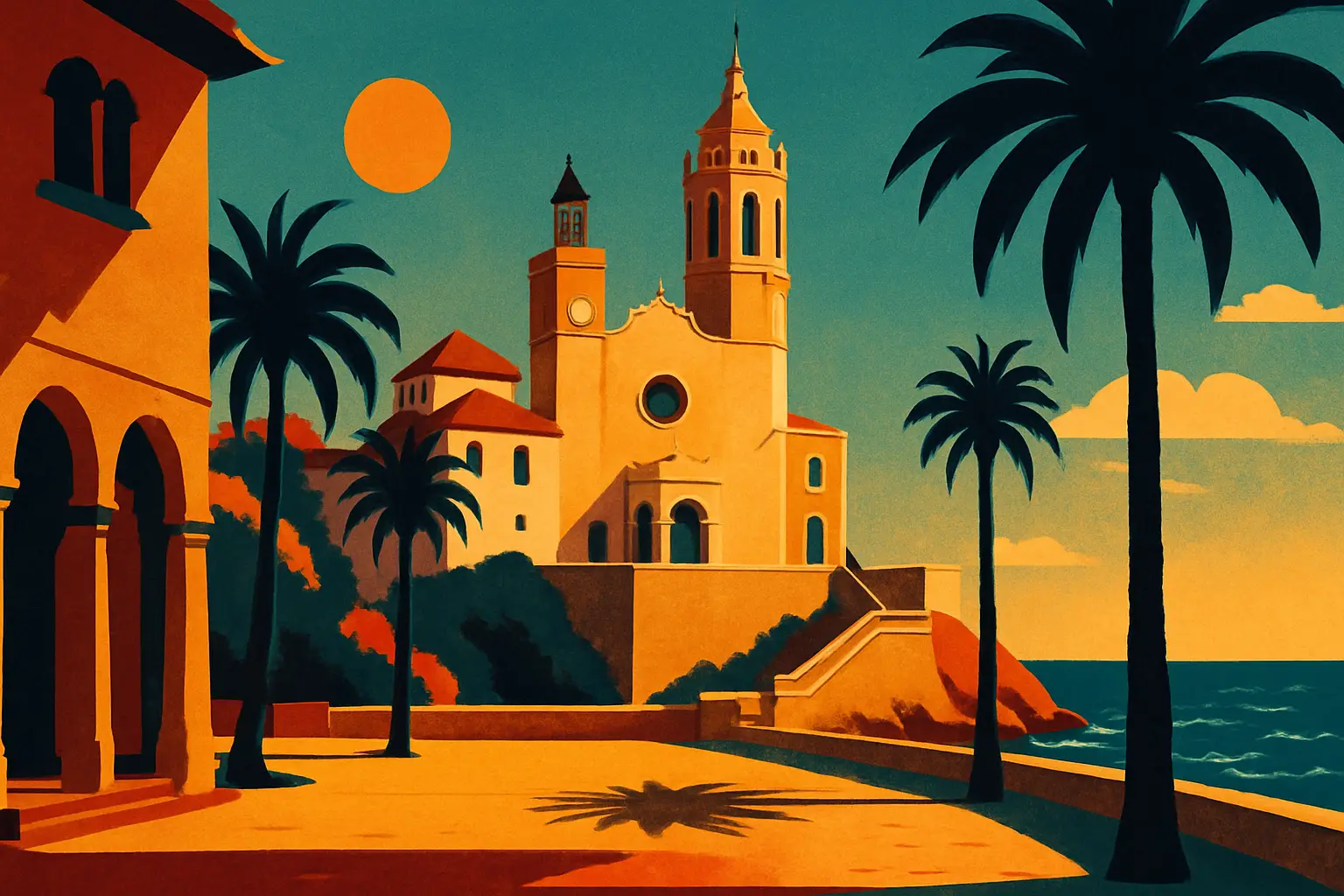
Sitges has three distinct identities layered on top of each other, and understanding how they coexist is the key to understanding what makes the town unusual.
The first identity is the medieval fishing village and wine port. Before tourism, Sitges exported the local malvasia wine — a sweet, amber-coloured fortified wine that was popular in northern Europe from the 15th century onward. The town grew wealthy on this trade, which is why the old buildings near the waterfront are disproportionately grand for a settlement this size. The wine trade collapsed in the late 19th century with a phylloxera epidemic that destroyed the Catalan vineyards, but the infrastructure — the merchant houses, the warehouses along Carrer Major, the old harbour — remains.
The second identity is the Modernisme colony. In the 1890s, the painter Santiago Rusinyol began spending summers in Sitges and bought a pair of fishermen's houses on the cliff above the sea to use as a studio. He filled it with paintings, ironwork, ceramics, medieval crosses, and two canvases by El Greco — turning it into one of the most extraordinary private collections of the era. He invited the Catalan modernista circle — Picasso visited as a young man, as did the composer Isaac Albeniz and the poet Joan Maragall — and the town became a counterculture gathering point that shaped the Catalan Modernisme movement. Rusinyol's house is now the Museu Cau Ferrat.
The third identity emerged from the Franco era and its aftermath. Sitges, with its beach culture and relative distance from Barcelona, became a discreet refuge for LGBTQ+ communities during the dictatorship years when visibility elsewhere was actively dangerous. That tolerance became embedded in the town's character. After Franco's death in 1975, Sitges developed openly as one of Spain's most welcoming destinations, a reputation it has maintained. The combination of the art history, the Carnival (held in February and considered one of Europe's most spectacular), and the inclusive beach culture makes Sitges a genuinely unusual place — a medieval Catalan fishing town that became, by accident, a refuge for modernist artists, queer communities, and serious film lovers.
The Museu Cau Ferrat at Carrer de Fonollar, s/n is the reason Sitges has an art history that matters, and it is dramatically undervisited by day-trippers who go straight to the beach.
Rusinyol bought the two adjacent fishermen's houses in 1891 and spent the next decade converting them into a combined studio, residence, and collection space. The name he gave it — Cau Ferrat, meaning roughly 'den of iron' in Catalan — referred to his obsessive collection of medieval wrought ironwork: door knockers, hinges, keys, crosses, and decorative pieces that now line the entire walls of several rooms. The ironwork alone is the most significant private collection of its kind in Catalonia.
But the collection extends far beyond the iron. Rusinyol acquired two paintings by El Greco — *The Penitent Magdalene* and *Saint Peter* — which he transported to Sitges in 1894 in a ceremony now celebrated annually in the town. He also collected works by his contemporaries, including paintings by Ramon Casas (who painted some of the most important documents of the 1890s Barcelona bohemian circle) and Joaquim Mir. His own paintings fill several rooms: symbolist seascapes, garden scenes, and studio interiors that document both his technical range and the specific quality of Sitges light.
The house itself is the exhibit. The living quarters were designed to blur the line between domestic space and gallery: ceramics on shelves, paintings floor to ceiling, iron candlesticks on every ledge. The upper floor has a terrace directly above the sea. Looking out from that terrace — over the baroque church on one side, the Mediterranean on the other, the old town below — you see exactly what Rusinyol and his circle were responding to when they made Sitges their base. The light is extraordinary: flat, white, and intense in summer, with none of the haze that blurs the Barcelona waterfront.
Get short, interactive stories that make each place easier to remember while you travel.
The Iglesia de Sant Bartomeu i Santa Tecla is the building that dominates every photograph of Sitges — a 17th-century baroque parish church built on the cliff edge at the end of the promontory, so that its apse projects directly above the sea. The original chapel on this site dates to the 13th century; the current structure was built between 1672 and 1705. The interior is relatively plain by Spanish baroque standards, but the exterior and its position are unmatched: standing on the Balcó del Mediterrani (the terrace at Carrer de Fonollar) directly below the church walls, you are at sea level looking straight up at a building that appears to grow out of the cliff.
The old town below the church, built around Carrer Major and Carrer de les Parellades, is compact and walkable in 30 minutes. Several specific things are worth looking for:
- The Palau Maricel at Carrer de Fonollar — a neo-Gothic building assembled in 1910 by the American millionaire Charles Deering from fragments of medieval buildings across Catalonia. The public rooms contain murals by Josep Maria Sert. Now part of the Museu Maricel (admission included with the combined Cau Ferrat ticket).
- Casa Bacardi at Carrer del Pecat, 13 — the family home of Facundo Bacardi Masso, who was born in Sitges in 1814 and emigrated to Cuba, where he founded the Bacardi rum company in 1862. The house is now a cultural centre and rum-tasting space, open during summer months.
- Carrer de les Parellades — the main pedestrian street through the old town, lined with 19th-century merchant houses. The facades are notably wide for a small town, a legacy of the malvasia wine trade prosperity.
Allow 30–40 minutes to walk through the old town before or after the museum, depending on the heat.
In October — typically the first or second week of the month — Sitges becomes the headquarters of the Festival Internacional de Cinema Fantàstic de Catalunya, better known internationally as the Sitges Film Festival. It is the oldest and most prestigious genre film festival in the world: founded in 1968, it has screened early or world-premiere versions of films including *RoboCop* (1987), *Bram Stoker's Dracula* (1992), and *Pan's Labyrinth* (2006), and has a programming scope broad enough to cover horror, science fiction, animation, and arthouse cinema that defies easy genre classification.
For day-trippers visiting in summer, the festival is relevant for two reasons. First, the town's cafe culture — particularly along Passeig de la Ribera and in the bars around Plaça de la Cap de la Vila — is directly shaped by the festival's history. Sitges has attracted a specific creative and film-literate crowd for 50 years, and that history is present in the quality of independent bookshops, the cinema posters in bar windows, and the conversations you overhear at outdoor tables. Second, if your dates are flexible, the first week of October combines festival access (many screenings are publicly ticketed) with post-summer temperatures that are ideal for both beach and old town walking — roughly 22–25°C, clear, and significantly less crowded than August.
Festival tickets and programming: sitgesfilmfestival.com. The town's population roughly doubles during festival week; book accommodation months in advance if you plan to attend.
Sitges has a restaurant culture that genuinely exceeds what you would expect from a day-trip beach town — partly because it has attracted a year-round resident creative class, partly because the Catalan food tradition around fresh seafood and local produce is strong along this stretch of coast.
**El Vivero** — Passeig de la Balmins, 3. A terrace restaurant at the edge of the Balmins naturist beach, with grilled fish and rice dishes at honest prices for the location. The arros negre (squid-ink rice) is the house order. Cash preferred; book ahead on weekends in August.
**La Nansa** — Carrer de la Carreta, 24. A family-run restaurant operating from a narrow old-town space since the 1980s. Catalan fish stew (suquet de peix), salt cod in samfaina (Catalan ratatouille), and romesco sauce with fresh vegetables. Lunch menus on weekdays around €18. Closed Tuesdays.
**Maricel** — Carrer de Fonollar, 6. The most architecturally notable restaurant setting in Sitges — inside a room adjacent to the Palau Maricel, with sea views through the arched windows. The menu runs to fresh pasta, grilled fish, and local rice dishes. Dinner €35–€50 per person.
**Bodega El Cabo** — Carrer del Pecat, 5. A small wine bar in the old town focusing on Catalan wines — particularly Penedes whites (grown just inland from Sitges), cava from Sant Sadurni d'Anoia, and occasional bottles from smaller Priorat producers. Excellent accompaniment: jambon, cheese, tinned conserves.
**Bar Voramar** — Passeig de la Ribera, 62. The classic old-town bar directly on the beachfront promenade. Draught beer, vermut, and simple tapas — not the most refined option, but consistently the best spot to watch the beach from a shaded seat. Open from 8 a.m.
Sitges sits at the southern edge of the Parc del Garraf, a protected limestone massif that runs north from the town toward Castelldefels and Barcelona. The landscape — white rock, Mediterranean scrub, steep coastal cliffs — is dramatically different from the flat beach strip of the Maresme coast north of Barcelona, and it gives the Sitges coastline a more rugged character even in summer.
If you have a car or are willing to walk, two coastal spots beyond Sitges town repay the effort:
Garraf village — 5 kilometres north of Sitges along the coast road (or one train stop north on the R2 Sud toward Barcelona), Garraf is a tiny hamlet at the foot of the limestone cliffs where the Garraf river valley meets the sea. It has a small beach, a handful of seafood restaurants, and an almost complete absence of summer crowds compared to Sitges. The train from Sitges arrives directly at the beach. The Celler de Garraf — a wine cellar-turned-wine-bar built by Antoni Gaudi's collaborator Francesc Berenguer in 1895 — is 200 metres from the beach and is one of the least-visited Modernisme buildings in Catalonia.
The coastal path — a marked trail (GR-92) runs along the clifftops between Sitges and Garraf, covering roughly 5 kilometres of limestone headlands with sea views in both directions. The walk takes 90 minutes and requires solid shoes — the path is rocky and exposed. In August, walk it before 9 a.m. or after 6 p.m. to avoid the worst heat.
Both Garraf and the coastal walk are genuinely off the day-trip circuit for visitors arriving by tourist bus — they require the train or your own navigation.
August is the most crowded month on the Spanish coast, and Sitges in August is genuinely busy — the beaches fill early, the old town restaurants require reservations, and the train from Barcelona runs packed on weekend afternoons. That said, Sitges handles the crowd better than most Catalan beach towns for a specific reason: the old town, the Cau Ferrat, and the Garraf coast absorb visitors who are there for more than the beach, distributing the load across multiple sites rather than concentrating everything on a single strip of sand.
The honest assessment: if you go in August, go on a weekday, arrive on the first or second morning train (departing Passeig de Gracia around 8–9 a.m.), visit the Cau Ferrat when it opens, eat lunch before 1:30 p.m. to beat the peak, and spend the afternoon at one of the less-central beaches. The experience is materially better than arriving at noon on a Saturday and fighting for restaurant space.
For Barcelona expats and longer-stay visitors with flexible timing: September is the best month for Sitges. The sea remains warm (typically 23–24°C), the crowds drop by roughly 40% after Spanish school terms start in early September, and the Modernisme assets — the museum, the church, the Palau Maricel — are accessible without the August scrum. The San Sebastian comparisons people make (old town culture, beach access, sophisticated food scene scaled for a small town) are most accurate in September.
By train (recommended): The Rodalies R2 Sud / C2 service from Passeig de Gracia (also stopping at Barcelona Sants) runs to Sitges in 38–42 minutes. Trains run roughly every 20–30 minutes on weekdays, every 30 minutes on weekends. Single €4.60; return €9.20. Use the Renfe app or the ticket machines at Passeig de Gracia — do not use the T-Casual or integrated transport cards, which do not cover this route beyond the Barcelona metropolitan zone. The Sitges train station is a 5-minute walk from the beach and a 10-minute walk from the old town.
By car: 40 kilometres south of Barcelona via the C-32 toll motorway (tunnel and coastal route; around €4.50 toll one-way) or the free but slower C-31 coastal road through Castelldefels. Parking in Sitges town centre in August is essentially unavailable — use the Parc d'Aparcaments on the outskirts and walk 10 minutes, or use the park-and-ride at the edge of town. The train is significantly easier.
Duration: A comfortable day trip is 6–7 hours in town — enough for the Cau Ferrat (1.5 hours), the old town (45 minutes), lunch (1.5 hours), and 2–3 hours on the beach. Last trains back to Barcelona run until midnight, so there is no reason to rush the return unless you are driving.