The date matters, and the story behind it is one of the most consequential episodes in Iberian history. The War of Spanish Succession (1701–1714) began when the childless King Carlos II of Spain died in 1700, leaving his throne — and the entire Spanish Empire, stretching from Peru to the Philippines — to the French Bourbon candidate Philip V. The rival claimant, Archduke Charles of Austria, represented the Habsburg line that had ruled Spain for two centuries.
Catalonia backed the Habsburg side. The reasons were pragmatic as much as ideological: the Habsburgs had historically respected Catalan privileges, local law (the Constitucions de Catalunya), and the Principality's substantial degree of self-governance. The Bourbons, as demonstrated by Louis XIV's France, represented centralized absolutism that had little patience for regional autonomy.
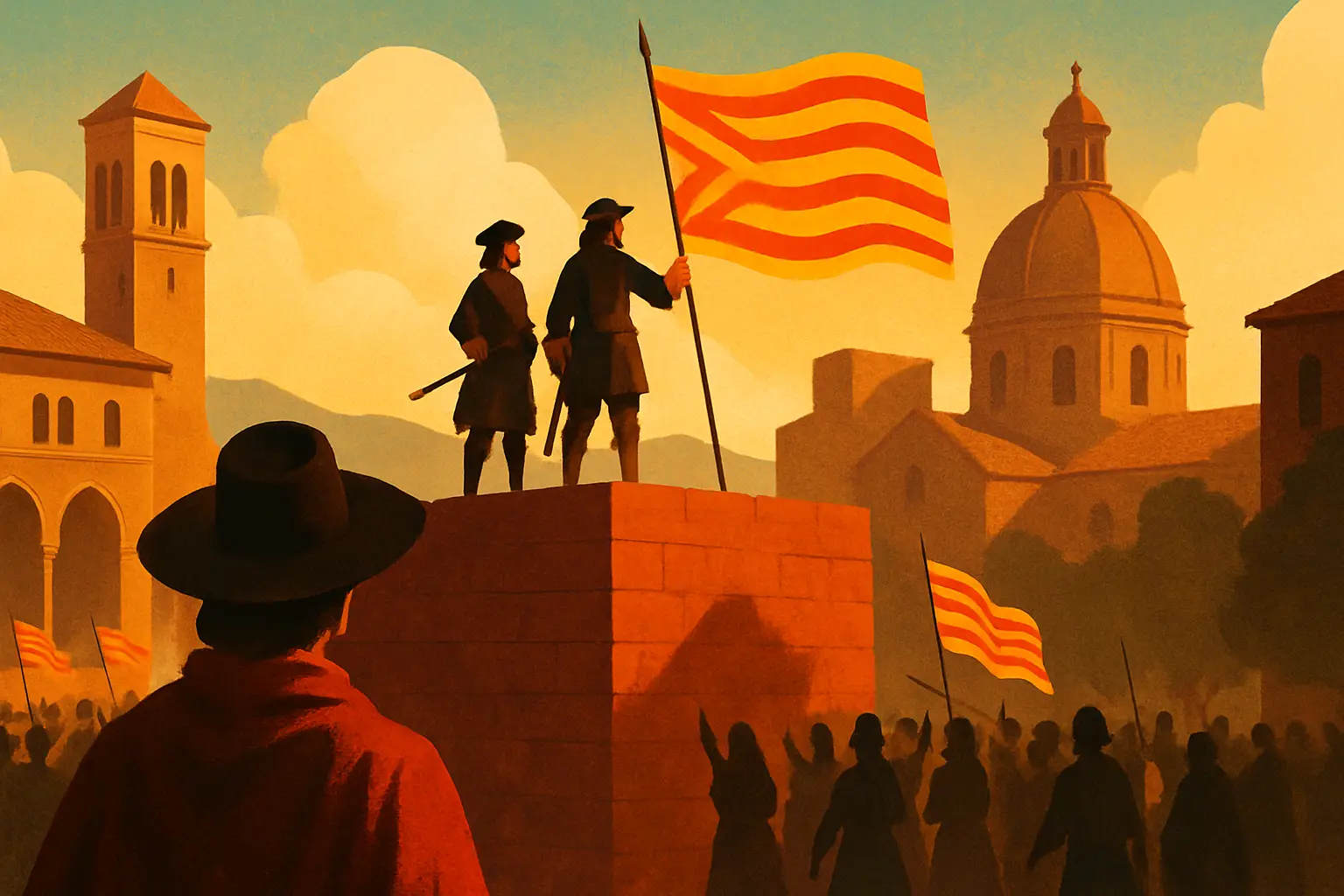
The war went badly for the Habsburg alliance. By 1713, most of Europe had switched sides or made peace. Catalonia found itself isolated, and by the summer of 1713, Barcelona was under siege by combined Bourbon and French forces. The city's defenders — outnumbered, undersupplied, and formally abandoned by the allies who had encouraged their resistance — held out for fourteen months. On September 11, 1714, Bourbon troops breached the walls of the Ribera district, and the commander of the defense, Rafael Casanova, was wounded fighting in the streets near the current location of the Arc de Triomf. The city fell by evening.
The fall was not merely a military defeat. For Catalonia, it was the end of a political system that had existed for centuries.
Philip V's response to Catalan resistance was methodical and comprehensive. The Decret de Nova Planta of 1716 abolished the Constitucions de Catalunya, eliminated the Generalitat (the Catalan government), dissolved the Corts Catalanes (the parliament), banned the use of Catalan in official and legal contexts, and replaced Catalan administrative law with Castilian law. It was a systematic dismantling of a distinct legal and political culture that had been developing since the 11th century.
The physical consequences are still visible in Barcelona. The Bourbon forces demolished an entire neighborhood — the Ribera district — to build a military citadel to control the city from within. Thousands of residents were displaced. The site of that citadel is now the Parc de la Ciutadella (the park's name means 'citadel'), and in El Born, workers doing a renovation in 2001 broke through the floor of the old iron market and found the buried ruins of the destroyed medieval neighborhood — streets, doorways, ceramic fragments — preserved exactly where they fell in 1714. That excavation is now the Born Cultural Centre, one of the most affecting historical sites in the city.
The Decrets did not, in the end, erase Catalan culture. The language survived in private speech, in literature, and in church. Economic growth throughout the 18th and 19th centuries gave Catalonia a bourgeoisie wealthy enough to fund a Catalan cultural revival — the Renaixença of the 19th century — that produced modern Catalan literature, the architectural movement of Catalan Modernisme, and eventually a renewed claim on political autonomy. The siege of 1714 had not ended the argument. It had deferred it by three centuries.
Get short, interactive stories that make each place easier to remember while you travel.
September 11 was first officially commemorated as a Catalan national day in 1886, during a period of cultural revival under the Bourbon restoration monarchy. The day was suppressed under Franco's dictatorship (1939–1975), when public expressions of Catalan identity were banned and the language was stripped from schools and public life. Catalan-language books were burned. Catalan-language broadcasts were forbidden. The name 'La Diada' itself was dangerous to say aloud in certain contexts.
After Franco's death and Spain's transition to democracy, La Diada was officially recognized as a Catalan public holiday in 1980, following Catalonia's restoration of the Generalitat in 1977. For decades it was a cultural commemoration — a day for Catalan identity, ceremony, and reflection — without being specifically a rally for independence. That changed in 2012.
On September 11, 2012, an estimated 1.5 million people marched through Barcelona's Passeig de Gràcia under the slogan 'Catalunya, nou estat d'Europa' (Catalonia, new state of Europe). It was the largest demonstration in Catalan history, triggered by the Spanish government's rejection of a new fiscal arrangement that Catalonia had been negotiating for years. The 2012 march began the sequence that led to the 2017 independence referendum — held on October 1, declared illegal by Madrid, met with police intervention on voting stations, and ending with the declaration of independence by the Catalan parliament on October 27, 2017, followed by the immediate application of Article 155 suspending Catalan autonomy and the imprisonment of independence movement leaders.
Since 2017, the political situation has remained unresolved. Catalonia has its autonomy restored and the Generalitat functions, but the underlying question of independence versus continued integration within Spain has not been answered by any agreed political process. La Diada remains the day when that unresolved question is most visibly present in the streets.
For visitors, the texture of September 11 in Barcelona is the first thing that needs describing. It does not look like a national holiday in the conventional sense — no fireworks, no military parade, no royal ceremony. It looks like a city that has organized itself into a political demonstration on a very large scale, with the festive warmth of a neighborhood event.
The Assemblea Nacional Catalana (ANC), the main organizing body for the independence movement, announces the demonstration format and route in late August each year. Some years it has taken the form of a march down the Passeig de Gràcia and Passeig de Sant Joan. In 2013 and 2014, it organized the Via Catalana — a human chain stretching the length of Catalonia, more than 480 kilometers — in which hundreds of thousands of people joined hands at 17:14 (the symbolic hour). The format changes annually, but the core features persist.
What you will see: Estelades (the starred independence flag, blue triangle and red-and-gold stripes) hanging from balconies throughout the Eixample, Gràcia, and El Born. Yellow ribbons everywhere. Families in the streets from mid-afternoon. Food stalls and street music near the assembly points. The demonstration itself tends to be remarkably orderly — children, grandparents, and dogs are all present. The atmosphere is more festival than protest.
What you will hear: Catalan spoken everywhere, which is normal in Barcelona but is audibly more concentrated on this day. Drums. The Catalan national anthem, Els Segadors ('The Reapers'), sung at gatherings — a 17th-century harvest song that became an anthem of resistance during the 1640 revolt against Castile and was formally adopted as Catalonia's anthem in 1931.
By evening, the organized demonstration disperses and the city settles into the rhythms of a holiday — restaurants and bar terraces fill, and the political energy gives way to something more simply celebratory.
If you want to understand what September 11 commemorates before joining the crowds in the street, the single best place to go is the Born Cultural Centre at Plaça Comercial 12 in El Born. Open Tuesday through Sunday from 10 a.m. to 8 p.m. (check hours on La Diada specifically, as the holiday may affect times), the center is built around the archaeological excavation of the Ribera neighborhood destroyed by Bourbon forces after 1714.
The experience is unusual. You walk along elevated walkways above the preserved ruins — street cobblestones, building foundations, ceramic fragments, a water cistern — of the actual neighborhood that was demolished to build the military citadel. Interpretive panels explain not just the archaeology but the political context: what the Nova Planta decrees meant, how the demolition was carried out, which families lived in which streets. The ruins cover roughly the area of three city blocks and are partially covered by the restored iron-and-glass market building (built 1876), creating a layered visual of the medieval below and the 19th-century industrial above.
Admission to the excavation is free. A permanent exhibition on the 1714 siege and its consequences occupies the upper levels and charges €6 for adults. Entry to the temporary exhibition space is separate. It is one of the more intellectually honest historical museums in Spain precisely because it deals with a defeat from Barcelona's perspective — which is rare in a country whose national narrative tends to emphasize unity.
For broader context on the neighborhood above the ruins, see the full guide to El Born, which covers the medieval church of Santa Maria del Mar, the Picasso Museum, and the cava bars that have made the barrio one of the most visited in the city.
La Diada is an official public holiday in Catalonia, which means the city runs differently than on a normal Thursday or Friday. Banks and government offices are closed. Public transport operates on a reduced (Sunday-equivalent) schedule for bus and metro lines — expect longer waits and more crowded carriages in the hours around the main demonstration (typically 5 p.m. to 8 p.m.).
Most tourist sites — the Sagrada Família, the Picasso Museum, Casa Batlló, La Pedrera, Park Güell — remain open but book ahead; reduced staff and higher visitor concentration (the demonstration ends and people fan out across the city) can create longer queues than usual in the late afternoon. The Mercat de Santa Caterina in El Born and the Mercat de la Boqueria on Las Ramblas are typically closed on public holidays.
For the demonstration itself: there is no ticket, no registration, no designated section for visitors versus residents. The area around the Arc de Triomf, Passeig de Sant Joan, and the Eixample grid tends to be where the organized march assembles and moves. Standing on a side street perpendicular to the march route gives you a clear view without being embedded in the crowd.
Walking distance note: The distances involved in La Diada are real. The main assembly zones are typically in the Eixample, which is a 20–30 minute walk from the Gothic Quarter or El Born. Wear comfortable shoes, carry water, and remember that September in Barcelona is still summer — the afternoon temperature commonly reaches 28–32°C.
Metro: Lines L1, L2, L4, and L5 all have stops near common demonstration zones. Arc de Triomf is on L1 (red line). Passeig de Gràcia is served by L2, L3, and L4.
Transport apps: Citymapper and TMB's official app show real-time service disruptions on La Diada. Download before you go.
Restaurants: Lunch in the Eixample or El Born books up on September 11. The Gràcia neighborhood typically has more walk-in availability. Dinner service returns to near-normal from 9 p.m. onward.
Photography: The demonstration is public and press is present. Photographing crowds, flags, and the street atmosphere is entirely normal. Photographing individuals at close range — always ask.
Is La Diada a public holiday throughout Spain? No. It is a public holiday only in Catalonia, specifically in the Comunitat Autònoma de Catalunya. September 11 is a normal working day in Madrid, Valencia, the Basque Country, and the rest of Spain. This reflects the day's character: it is specifically Catalan, not a pan-Spanish celebration.
Is the demonstration safe for visitors? Yes, with standard crowd awareness. La Diada demonstrations are among the most heavily attended and consistently peaceful mass gatherings in Europe. The ANC has a strong track record of coordinating large events without incident. Police presence is visible but not confrontational in normal circumstances. The practical risks are the standard ones for any large crowd: pickpocketing in dense areas (particularly near Las Ramblas before and after), heat exhaustion in September if you are not used to Mediterranean summers, and the general unpredictability of being in a compressed space with hundreds of thousands of people.
What is the current political situation with Catalan independence? As of 2026, Catalonia remains part of Spain as an autonomous community. The 2017 independence declaration was legally voided, the leaders who organized it received pardons in 2021, and a series of political negotiations between the Catalan government and Madrid has produced incremental changes in fiscal arrangements but no agreed mechanism for a binding independence referendum. The movement is internally divided between those who want to continue pressing for independence through institutional channels, those who favor unilateral action, and those who have concluded that independence is not achievable in the near term. La Diada remains the day when these differences are temporarily set aside in favor of a shared commemoration.
Can I attend without speaking Catalan? Absolutely. Barcelona is a bilingual city and English is widely spoken in tourist-facing contexts. At the demonstration itself, public addresses are in Catalan, but no one will question your right to be present regardless of language.